
"Nothing Is Cast in Stone" — and Suddenly the Flats in Clementi Are a Question Again
HDB wants 15 of Maju Forest's 23 hectares for public housing. Parliament debates it today, an MP has said the plans can still change, and that one sentence turns a nature story into a supply story.
On 10 July 2026, HDB released conceptual plans and accompanying environmental and heritage reports for two sites. About 15ha of the 23ha Maju Forest along Sunset Way in Clementi is proposed for public housing, with the remainder retained as wildlife refuges and ecological corridors. Gillman Barracks, a former military site with heritage buildings, is proposed as a mixed-use residential neighbourhood with public and private housing. The plans drew petitions, resident dialogues and an open letter, and at least 18 questions were filed for the 4 August 2026 parliamentary sitting. Jurong East-Bukit Batok GRC MP David Hoe told a public talk on 1 August that "nothing is cast in stone." No official unit count has been published for either site. For context on why the location matters: Clementi's median 4-room resale flat is $800k against a national median of $630k — the sixth-dearest of 25 towns.
The Straits Times reported this week that at least 18 parliamentary questions have been filed on the planned redevelopment of Maju Forest and Gillman Barracks, with Parliament sitting on 4 August to take them. MPs from both sides of the House are asking how housing needs are being weighed against environmental preservation — and whether the plans are open for discussion at all.
That last part is the bit worth slowing down on. Most housing news tells you what will be built. This one has quietly become a story about whether anyone knows yet.
Eighty people, a Friday evening, and a forest most Singaporeans have never walked in
Petitions, resident dialogues, an open letter and a newly formed group called Saving Maju Forest — the response to HDB's July plans has been unusually organised.
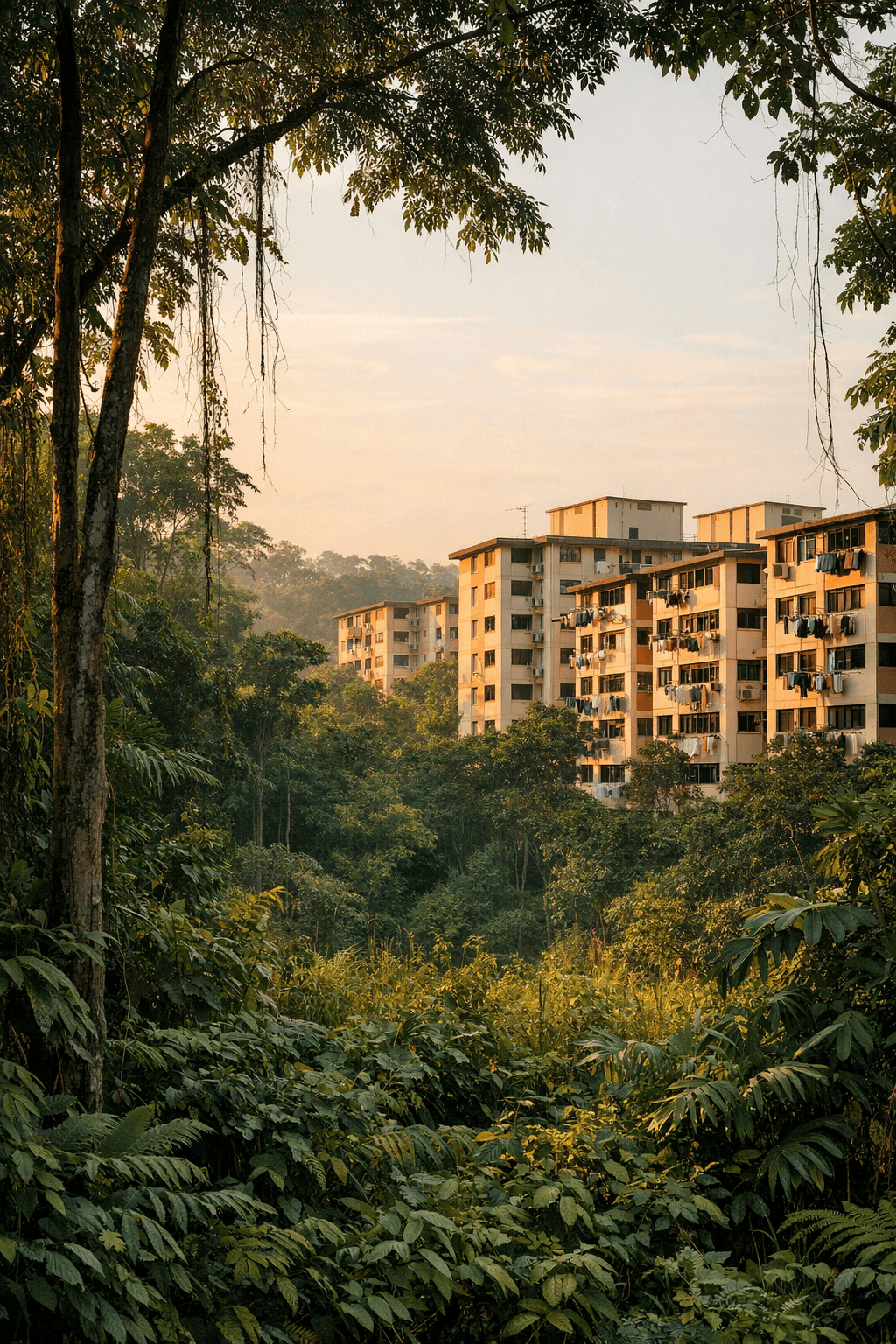
Maju Forest is 23 hectares of secondary growth behind the Sunset Way estate in Clementi. It is not a nature reserve. It has no visitor centre and no boardwalk, and for most of Singapore it has been, until about a month ago, an unnamed green patch on the way to somewhere else.
Then on 10 July, HDB released conceptual plans for it, together with environmental and heritage reports. What followed was not the usual grumble. As The Straits Times reported, there have been petitions, separate dialogue sessions organised by different MPs, and on 31 July an open letter from Sunset Way residents to their MP, Christopher de Souza. A new group has formed under the name Saving Maju Forest.
On 1 August, about 80 people spent an evening at a talk on the trade-offs between nature and development, hosted by Young PAP advisers David Hoe and Lee Hui Ying. According to the reporting, what attendees pressed on was not really the trees. It was the process: the transparency of the housing demand figures behind the plans, the brevity of the feedback window, and whether the social value of these places had been studied at all.
One attendee, an NTU student, said she was struck by how much of the contention was about the transparency of the decision-making rather than the decision itself. That is a telling thing for a room full of people to be arguing about.
What HDB actually put on the table
About 15 of Maju Forest's 23 hectares for public housing, with the rest kept as wildlife refuge; Gillman Barracks as a mixed-use neighbourhood of public and private homes.
The proposals, as reported, are specific in area and vague in everything else.
At Maju Forest, some 15ha of the 23ha along Sunset Way are proposed for public housing. The remaining area would be retained as wildlife refuges and ecological corridors. That is roughly two-thirds of the forest cleared, one-third kept — which is why the shorthand in the coverage has been "nearly two-thirds."
At Gillman Barracks, a former military site with heritage buildings, the proposal is a mixed-use residential neighbourhood carrying both public and private housing.
What has not been published is the number that would actually let a buyer plan: how many homes. There is no official unit count for either site. When the plans came out we wrote about what new flats in Clementi and Sunset Way would mean and noted the estimates analysts were putting on it — but an analyst's estimate off a conceptual plan is a guess with a suit on, and it is worth being honest that it is not the same thing as a launch.
The sentence that turned a nature story into a housing-supply story
An MP told the room the plans could still change. Eighteen parliamentary questions and a Workers' Party query about which parameters are still open suggest he was not being merely polite.
At the 1 August talk, David Hoe — whose Clementi ward sits near Maju Forest — told participants that a parliamentarian's job here is to act as a middleman for a community's competing views. Then he said this: "I say that because nothing is cast in stone, there is still time for change, and we believe that with more information, things can happen."
He also relayed, from an earlier 30 July dialogue organised by MP Rachel Ong, that one of the "elephants in the room" was whether public feedback would genuinely be taken seriously.
Read alongside what MPs have actually filed, that sentence stops sounding like reassurance and starts sounding like a live question. Rachel Ong, who oversees the Telok Blangah division where Gillman Barracks sits, is asking whether alternative sites for housing were evaluated. Christopher de Souza is asking whether nature groups' recommendations on preserving greenery and wildlife can be adopted. And Workers' Party NCMP Andre Low has noted that HDB announced the plans on the same day the consultation opened — asking which parameters, such as the development footprint and the areas retained, remain open to change.
Those are three different ways of asking the same thing: is the shape of this still movable? Hoe was careful to add that the eventual outcome will require trade-offs that will not satisfy everyone.
Why is HDB looking at Clementi in the first place?
Because Clementi is one of the dearer places in Singapore to buy a flat — the sixth-dearest of 25 towns, at $800k for a 4-room against a $630k national median.
Nobody proposes clearing a forest for housing in a town nobody wants to live in. So it is worth putting our own numbers next to the debate, because they explain the pressure that produced these plans.
Here is where Clementi sits among Singapore's HDB towns on the like-for-like measure — the median 4-room resale price, 2026 H1:
| Town | Median 4 Room price | Resales (n) |
|---|---|---|
| Central Area | $1.17M | 44 |
| Queenstown | $1.02M | 143 |
| Toa Payoh | $1.00M | 192 |
| Bukit Merah | $938k | 196 |
| Kallang/Whampoa | $920k | 144 |
| Clementi | $800k | 105 |
| Bishan | $790k | 99 |
| Tampines | $668k | 428 |
| Bukit Batok | $650k | 290 |
| Jurong East | $551k | 67 |
| Jurong West | $534k | 302 |
Clementi is the sixth-dearest of the 25 towns with enough 4-room resales to rank. At $800k, a 4-room flat there costs about $170k more than the $630k national median — and roughly $250k more than a 4-room in Jurong East, the next MRT stop down the line.
That gap is the entire argument for building there. It is also, uncomfortably, the reason the people who already live there have the most to protect.
What does the price gap actually tell you about west-side supply?
That the west is not uniformly expensive — Clementi is, and its cheaper neighbours are a long way behind, which is what a location-specific shortage looks like.
A useful thing about the table above is what sits below Clementi. Bukit Batok is at $650k, Jurong East at $551k, Jurong West at $534k. These are all western towns. They are not expensive.
So the west as a region is not short of affordable flats. Clementi specifically is dear — the schools, the one-stop ride to the city, the proximity to the university and the science park, the maturity of the estate. That is a location premium, not a regional one, and location premiums are the hardest kind to fix with supply somewhere else. Building 3,000 flats in Tengah does very little for a family that needs to be in Clementi.
Which is precisely why this particular forest is on the table, and precisely why "build on brownfield sites instead" — the alternative CNA's commentary examined this week — is a harder trade than it sounds. Brownfield land exists. Brownfield land in Clementi, at this scale, is the thing in short supply.
One honest caveat on that Clementi figure: it rests on 105 resales in the half-year. That is not a thin sample, but it is a mixed one — Clementi's older blocks and its much newer ones sell at very different prices, so the median moves with whichever happened to sell, more than a number built from Tampines' 428 sales does. Treat the ranking as approximate, too: sixth place is just $10k ahead of Bishan.
What does this mean if you're waiting for a flat in Clementi?
Treat it as a debate, not a pipeline. Nothing here has a unit count, a launch date or a settled footprint.
There is a particular kind of buyer this story is aimed at without ever addressing them: the person who saw the July headlines, thought flats are coming to Clementi, and quietly moved their plans back a couple of years.
Here is the state of what they would be waiting for. There is a conceptual plan. There is a consultation. There are 18 parliamentary questions, an open letter, several petitions and a public dialogue circuit. There is an MP saying the footprint may change and a Workers' Party MP asking which parts are even negotiable. There is no unit count, no flat-type mix, no launch date, and no confirmation that the 15ha figure survives the process intact.
That is not a pipeline. That is a proposal with an argument on top of it.
The honest read is that this cuts both ways, and which way depends on something nobody can yet tell you. If the plans proceed roughly as drawn, Clementi eventually gets a meaningful amount of new public housing, and that is genuine relief in one of the dearer towns in the country. If the footprint shrinks — because the environmental case lands, or because alternative sites are found — then the relief shrinks with it, and today's $800k median stops looking like a peak.
The honest catch: even the best case is years away, and it was never going to rescue today's buyer
BTO flats on a site still under consultation are the better part of a decade from keys. Anyone shopping in Clementi now is shopping in today's market, whatever Parliament decides.
It would be easy to write this as contested supply means prices stay high, and leave it there. That is too neat.
The timeline is the thing that deflates it. A site that was released as a conceptual plan in July 2026, is still in consultation, and is being actively questioned in Parliament, does not become a BTO launch next year. Add the build period after that. Even on the smoothest possible path, a family collecting keys at Maju Forest is collecting them well into the 2030s.
So whichever way this debate lands, it does almost nothing for the person viewing a resale flat in Clementi this month. Their competition is the other people at that viewing, and the other listings on the market — not a forest.
What the debate genuinely changes is the story people tell themselves about the future, and stories move markets at the margin. A neighbourhood widely believed to have 15 hectares of new housing coming feels different to price than one where that is in doubt. We cannot measure that, and we are not going to pretend we can. Our numbers here describe what flats have sold for, not what a parliamentary sitting will do to sentiment.
And one more thing worth saying plainly: this is a real trade-off, not a villain story. Housing that people can afford and mature secondary forest are both scarce, both valuable, and in this instance they want the same 15 hectares. Anyone selling you a clean answer to that is selling something.
Will the Maju Forest and Gillman Barracks plans actually change?
Nobody has said they will. An MP has said they can, and MPs across both sides have filed questions specifically about what remains open.
The honest answer is that this is undecided, and that the undecidedness is itself the news.
What is on the record: David Hoe told a public session on 1 August that "nothing is cast in stone, there is still time for change." He is one MP speaking at a community talk, not the ministry announcing a revision — and he also cautioned that the outcome will require trade-offs that will not satisfy everyone.
What is also on the record: at least 18 parliamentary questions were filed on these two sites, including Rachel Ong asking whether alternative housing sites were evaluated, Christopher de Souza asking whether nature groups' preservation recommendations can be adopted, and Andre Low asking which parameters — footprint, retained areas — remain open to change.
The 2021 Dover Forest episode is the nearest precedent, and it is worth remembering that public feedback there did change what was eventually built. That is a reason to take this process seriously in both directions: it is neither theatre nor a guarantee.
Should I wait for new flats in Clementi instead of buying now?
Not on the strength of this. There is no unit count, no launch date and no settled footprint — and even the best case is years from keys.
We would not build a housing plan around a conceptual plan that is currently being debated in Parliament, and we would be wary of anyone who tells you to.
There are three separate unknowns stacked here, and you need all three to resolve favourably for waiting to pay off. First, whether the development proceeds at the proposed footprint. Second, how many flats it actually yields — a figure nobody has published. Third, whether you would be eligible for and successful in balloting for them when they eventually launch, which on a site at this stage is years away.
The alternative is not glamorous but it is knowable: Clementi resale flats exist today at an $800k median for a 4-room, and neighbouring western towns are materially cheaper — Bukit Batok at $650k, Jurong West at $534k. Those are decisions you can actually make with information in hand.
If your reason for wanting Clementi is a school or a commute, that reason does not wait well. If it is simply the town's desirability, the price gap to its neighbours is worth staring at honestly before you sit out several years for a maybe.
How we sourced this
Corrected 15 September 2026: three sample counts came from an incomplete half-year and now match the table. The plans, the parliamentary questions and the quotes come from the reporting; the resale price figures are ours.
⚠️ Corrected 15 September 2026. Two passages on this page still carried sample counts from the first weeks of 2026 H2, a half-year that was still lodging. The table and summary moved to the complete 2026 H1 on 20 August, but these were missed: Clementi's median rests on 105 resales, not 15; Tampines' on 428, not 77; and the ranking covers 25 towns, not 23. At 105 resales the sample is no longer thin, so the caveat now describes what does apply — a mixed sample, and a sixth place only $10k ahead of Bishan. We have also added Kallang/Whampoa ($920k) to the table, where leaving it out made Clementi look fifth, and corrected Jurong East to the next MRT stop from Clementi, not two stops away. The medians and the argument are unchanged.
The account of what was proposed — the 10 July release of conceptual plans with environmental and heritage reports, the 15ha-of-23ha figure for Maju Forest, the mixed-use proposal for Gillman Barracks, the 18 parliamentary questions, the named MPs and their specific questions, the 1 August talk and David Hoe's quote, the 31 July open letter and the Saving Maju Forest group — comes from the reporting linked below. Those are the reporters' facts, attributed rather than claimed as ours.
The price figures are ours. The median 4-room HDB resale price by town for 2026 H1 is PropKaki's own matched median over HDB resale transactions, using one flat type so towns compare like-for-like rather than reflecting each town's mix of flat sizes.
Three caveats matter. Clementi's median rests on 105 resales in the half-year — not a thin sample but a mixed one, since its older and newer blocks sell at very different prices, so the median moves with the mix that sold and sixth place, $10k ahead of Bishan, is not a firm rank. Towns with fewer than 10 4-room resales are omitted entirely, so the 25-town ranking is not every town in Singapore. And prices are gross of any resale levy, commission or fees, and a particular flat varies with its storey, remaining lease and exact location within the town.
We have deliberately not published a unit count for either site, because no official one exists.
Sources
The reporting behind the plans and the debate, and the data behind our price figures.
The news:
- The Straits Times — Parliament to discuss Maju Forest redevelopment and GovTech retrenchments on Aug 4, 4 August 2026.
- The Straits Times — 'Nothing is cast in stone': MPs pledge to raise concerns on Maju Forest, Gillman Barracks, 2 August 2026.
- CNA — Commentary: Forests vs flats? Singapore's land development debate needs to move beyond that, 3 August 2026.
The data:
- PropKaki median 4-room HDB resale price by town, 2026 H1, over HDB resale transactions.
Related reading on PropKaki:
About this commentary
Opinion and analysis from the PropKaki Editorial Desk — not financial or property advice.
This is commentary written by the PropKaki Editorial Desk on reporting by The Straits Times and CNA. The account of what was proposed and what MPs have asked belongs to those newsrooms; the price analysis, the framing and the opinions are ours.
It is opinion and general information, not financial, legal or property advice, and it is not a recommendation to buy, sell or wait. This is also a live process: Parliament sits on the matter on 4 August 2026, the consultation is ongoing, and the plans described here are conceptual. Details may have moved by the time you read this, so check HDB's and URA's own published materials before acting on anything.
We hold no position on whether Maju Forest should be developed. We think readers are better served by an honest account of what is unsettled than by a confident answer nobody is entitled to yet.
Published 4 August 2026. Corrected 15 September 2026 — see How we sourced this.
Got a question this raised? Ask PropKaki.
Take any point from this analysis and apply it to your own project, budget or decision.
 PropKaki
For most buyers this year, staying well within budget beats trying to time the market.