

The 15-Month Wait Is Gone — and the Cooling Measure Just Became a Weather Report
Singapore has scrapped the 15-month wait-out period for private property owners buying a resale flat. The rule was never really about them — it was about how fast HDB prices were climbing. Here's what our numbers say about why it went now, and who actually gains.
Singapore removed the 15-month wait-out period on 28 July 2026, with immediate effect. Private property owners and former private property owners can now buy a non-subsidised HDB resale flat of any size, at any age, without waiting — provided they take no HDB housing loan, and they must still dispose of their private property (in Singapore or overseas) within six months of completing the purchase. Previously only citizens aged 55 and above buying a 4-room or smaller flat were exempt. The rule was introduced in September 2022 to cool demand from private downgraders. Our own read of HDB's official index supports the timing: the HDB Resale Price Index fell to 202.8 in 2026Q2, down 0.3% quarter-on-quarter and roughly flat year-on-year — a second consecutive quarterly fall (203.6 → 203.4 → 202.8). The national median 4-room resale flat is $630k, essentially unchanged year-on-year.
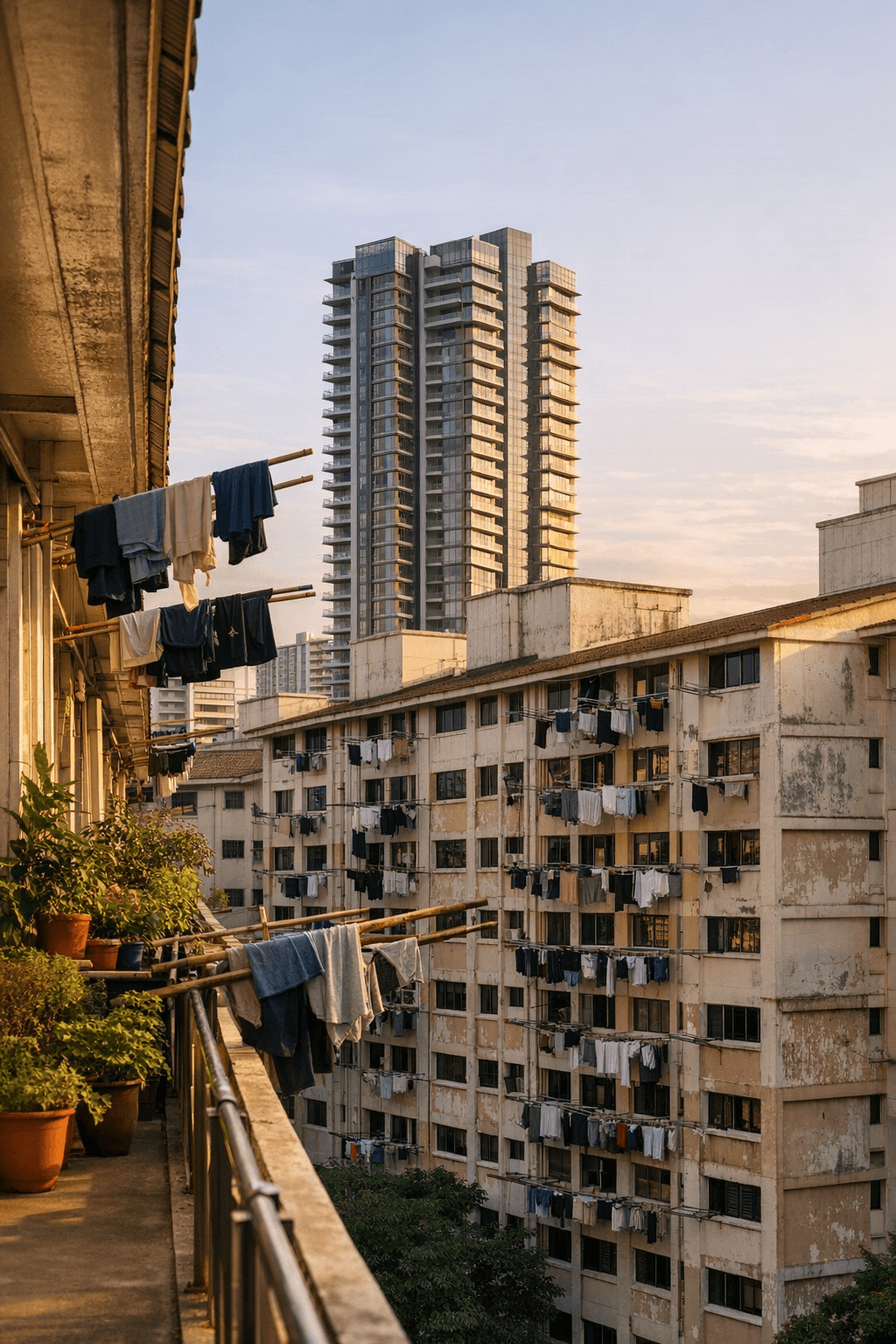
CNA reported this week that private property owners will no longer have to wait 15 months after selling up before they can buy a non-subsidised HDB resale flat. National Development Minister Chee Hong Tat said resale price growth has eased significantly since the pandemic years, and the measure had served its purpose.
It is the kind of announcement that sounds technical and lands personally. Somewhere in Singapore there is a couple who sold a condo in March and had pencilled a date in late next year — the first day they would be allowed to buy the flat they actually wanted. That date just disappeared. So did the reason they were waiting.
The fifteen months nobody could shorten
Since September 2022, selling a private home meant sitting out 15 months before you could buy a resale flat — long enough to change a family's plans entirely.
Fifteen months is an awkward length of time. Too long to hold your life still, too short to build another one. It is a rented flat for five quarters, a school year that begins somewhere you did not plan to be, a set of boxes you decide not to unpack because what would be the point.
That was the arithmetic facing anyone who owned private property in Singapore and wanted to move into a resale HDB flat. From September 2022, they had to wait 15 months after disposing of their private home before they could buy a non-subsidised resale flat. The rule caught the retiree cashing out of a condo, the family whose finances had changed, the couple who had decided a flat in a familiar town beat a mortgage in a shinier one.
There was one door open. Citizens aged 55 and above could skip the wait — but only for a 4-room flat or smaller. If you were 54, or the flat you wanted had five rooms because your parents were moving in, the door was shut. You waited.
Why the rule existed in the first place
It was a cooling measure, aimed at cash-rich downgraders bidding up resale flats in the hottest HDB market in a decade.
The wait-out period was never a judgement about downgraders. It was a brake, applied at a moment when the resale market was running hot enough to worry people.
In 2022, HDB resale prices were climbing at a pace Singapore had not seen in years, and a particular kind of buyer was in the mix: someone who had just sold a private property, arrived at a flat viewing with a great deal of cash and no mortgage constraint, and could out-bid a young family working to a bank's valuation. Cash-over-valuation was the language of the day. The 15-month wait was introduced in a package of cooling measures to take that buyer out of the queue for a while.
That is worth remembering now, because it tells you exactly what would have to change for the rule to go: not fairness, not lobbying, but the price line itself. Cooling measures are removed when the thing they were cooling has cooled.
The line on the chart that let the brake off
HDB's own index has now fallen two quarters running — the clearest signal in years that resale prices are no longer the problem.
Minister Chee's stated reason was that resale price growth had eased significantly since the pandemic. That is the sort of claim worth checking against the numbers rather than nodding along to — so we went to HDB's own official Resale Price Index, the same series the ministry watches.
It tells the story cleanly. The index peaked at 203.7 in 2025Q3, held flat at 203.6 through the end of that year, slipped to 203.4 in 2026Q1, and fell again to 202.8 in 2026Q2. That is a decline of 0.3% quarter-on-quarter, and it is the second consecutive quarterly fall. Year-on-year, the index is now essentially unchanged — a flat -0.0%.
For a market that spent the early 2020s climbing without pause, a flat year is a genuinely different weather system. The brake came off because the hill stopped.
What has the HDB resale market actually been doing?
The official index has drifted down for two straight quarters, while median prices are level or slightly up on a year ago.
Here is the full recent run of HDB's official Resale Price Index (2009Q1 = 100), which is HDB's own series and separate from URA's private index:
| Quarter | HDB Resale Price Index |
|---|---|
| 2024Q3 | 192.9 |
| 2024Q4 | 197.9 |
| 2025Q1 | 201.0 |
| 2025Q2 | 202.9 |
| 2025Q3 | 203.7 |
| 2025Q4 | 203.6 |
| 2026Q1 | 203.4 |
| 2026Q2 | 202.8 |
The shape is unmistakable: a steep climb through 2024, a plateau across 2025, and a gentle turn down in 2026. Nothing here is a crash — the index is still far above where it sat two years ago. But the momentum that justified a cooling measure is not in this chart any more.
The median prices tell the same story in dollars. Across all towns in 2026 H1, the national median 4-room resale flat is $630k, essentially unchanged year-on-year. Across the other flat types the picture is mixed rather than uniformly soft.
What does a resale flat cost today, by flat type?
From $375k for a 2-room to $910k for an executive flat — with the smallest and the largest types up on a year ago.
Because the wait-out period no longer caps the size of flat a former private owner can buy without waiting, the bigger flats matter more than they used to. This is the national picture:
| Flat type | Median resale price | YoY | Resales (n) |
|---|---|---|---|
| 2 Room | $375k | +3.4% | 384 |
| 3 Room | $443k | +0.0% | 2,934 |
| 4 Room | $630k | +0.0% | 5,387 |
| 5 Room | $740k | +1.4% | 2,799 |
| Executive | $910k | +1.1% | 742 |
Two things stand out. First, the market is flat rather than falling — 2-room, 5-room and executive medians are all up on a year ago, while 3-room and 4-room are unchanged. Second, look at the top of the table: executive flats at a $910k median, 5-room at $740k. These are exactly the flats that were previously off-limits without a wait to anyone under 55 coming out of private property, and they are the ones the change opens up.
These are medians across every town, so a specific flat in a mature estate with a long lease can sit well above them — and they are gross of the resale levy, agent commission and legal fees.
Who actually gains from this change?
Right-sizers under 55, anyone who needs a flat bigger than four rooms, and families whose plans were paused mid-move.
The headline says private property owners, which sounds like a story about the wealthy. The people it frees are more ordinary than that.
First, the under-55 right-sizer — someone at 48 or 52 whose children have left, whose condo maintenance fee has crept up, and who would rather own a flat outright than carry a mortgage into their sixties. Same logic as a 56-year-old, none of the exemption.
Second, anyone who needed more than four rooms. The old carve-out stopped at a 4-room flat, quietly excluding the multi-generational household, the family moving parents in, the household that needs a study. On our numbers those are $740k and $910k decisions, and they were unavailable without a 15-month pause.
Third, the ones caught mid-move — people who sold during the wait-out era and were counting down. Their clock has simply been switched off.
What this is not is an invitation to arbitrage. You still cannot use an HDB housing loan, and you must dispose of your private property within six months of completing the purchase. This is a rule for people moving house, not people adding one.
The honest catch: removing a brake is not the same as pressing the accelerator
Demand that was delayed can arrive at once, and it lands on the larger flats in mature towns — the segment least able to absorb it.
It would be dishonest to present this purely as good news for buyers, because the people it helps and the people it competes with are not the same people.
A wait-out period does not remove demand. It stores it. Nearly four years of private owners who wanted a resale flat and were told to wait have been accumulating, and those who did not give up are now free at the same moment. That release is concentrated: right-sizers overwhelmingly want mature towns, near where their lives already are — and now, on the strength of the exemption that just widened, 5-room and executive flats.
Our data cannot size that pool. Nobody's can; it is a count of intentions, not transactions. What our data does say is that this lands on a market softening at the margin, not collapsing — the index is down 0.3% in a quarter, not 3%. A market drifting gently down has very little slack in it. If the released demand is meaningful, it would show first exactly where it showed in 2022: the bigger flats in the popular towns.
And a plain warning for anyone reading the direction of travel as permanent. This measure was introduced when prices ran hot and removed when they cooled. That relationship runs both ways.
Do I still have to sell my private property to buy an HDB resale flat?
Yes. The wait is gone, but the disposal requirement is not — you have six months after completing the flat purchase.
Yes. This change removed the waiting period, not the ownership rule.
If you buy a non-subsidised HDB resale flat as a private property owner, you must dispose of your private residential property — whether it is in Singapore or overseas — within six months of completing the flat purchase. You also cannot take an HDB housing loan for the purchase; it has to be financed privately.
So the sequencing has changed, not the destination. Previously you sold, then waited 15 months, then bought. Now you can buy first and sell within six months, which removes the interim-housing problem that made the old rule so disruptive. You still end up owning one home, not two.
Does this mean HDB resale prices are about to rise again?
Not necessarily — but it removes one of the reasons they were not rising, and the pressure would land on larger flats in mature towns first.
Nobody can tell you this honestly, and be wary of anyone who does. What can be said is which way the forces point.
On the upward side: a pool of buyers who were legally sidelined can now bid, they are typically well-capitalised, and the change opens flat types that were previously closed to them. On the downward side: the index has fallen two quarters running and national medians are only level to slightly up on a year ago, which suggests supply and affordability limits are doing real work — and the ministry only removed the measure because those forces looked durable.
The most likely shape is not a market-wide jump but a segment-level one. If you are shopping for a 5-room or executive flat in a mature town, you should expect more competition than you would have faced last quarter. If you are buying a 3-room in a non-mature estate, this change has very little to do with you. And if prices do run again, the honest historical lesson is that the measure that was just removed can be reintroduced.
How we sourced this
Corrected 15 September 2026: two sentences said every flat type was cheaper than a year ago; on the complete half-year none is. The policy details come from the reporting and official announcements; the price figures are HDB's own official statistics, read directly.
⚠️ Corrected 15 September 2026. Two sentences on this page — one in the overview of what the resale market has been doing, one in the answer on whether prices will rise again — said median resale prices were lower than a year ago across every flat type. That came from figures for the first weeks of 2026 H2, a half-year that was still lodging. The flat-type table and the rest of the text moved to the complete 2026 H1 on 20 August, but these two sentences were missed. On the complete half-year no flat type is cheaper than a year ago: 3-room and 4-room medians are level, and 2-room (+3.4%), 5-room (+1.4%) and executive (+1.1%) are up. The index figures and the argument are unchanged.
The policy details — the removal of the wait-out period, the 28 July 2026 effective date, the previous age-55-and-4-room-or-smaller exemption, the six-month disposal requirement and the no-HDB-loan condition — come from the reporting of Minister Chee Hong Tat's announcement, linked below. Those are the reporters' facts, attributed rather than claimed as ours.
The price figures are ours. The HDB Resale Price Index (2009Q1 = 100) is HDB's own official quarterly series, which we read directly rather than re-derive. The median resale prices by flat type are our matched medians across HDB resale transactions for 2026 H1, national across all towns.
Three caveats matter. The HDB index is a separate series from URA's private index — compare them on direction, never level. The medians are a dated half-year snapshot across every town, so a specific block, storey or remaining lease can differ substantially. And the current half-year is excluded until enough resales lodge, because a partial window under-counts and would distort the figure.
Sources
The announcement as reported, and the official index behind our figures.
The news:
- CNA — Government scraps 15-month wait for HDB resale buyers, 29 July 2026, including comment from Eugene Lim of ERA Singapore and the Singapore Institute of Estate Agents.
- Mothership — No more 15-month wait-out period for private property owners who buy HDB flats: Chee Hong Tat, 28 July 2026.
The data:
- HDB Resale Price Index (2009Q1 = 100), HDB's official quarterly series, latest reading 2026Q2.
- PropKaki median HDB resale prices by flat type, 2026 H1, national across all towns.
About this commentary
Opinion and analysis from the PropKaki Editorial Desk — not financial or property advice.
This is commentary written by the PropKaki Editorial Desk on reporting by CNA and Mothership. The account of what was announced belongs to those newsrooms; the price analysis, the framing and the opinions are ours.
It is opinion and general information, not financial, legal or property advice, and it is not a recommendation to buy or sell anything. Housing decisions turn on details we cannot see from an index — your income, your loan eligibility, the specific flat, the specific lease. Policy details can also be refined after an announcement, so check HDB's own published rules before acting on anything here.
Published 29 July 2026. Corrected 15 September 2026 — see How we sourced this.
Got a question this raised? Ask PropKaki.
Take any point from this analysis and apply it to your own project, budget or decision.
 PropKaki
For most buyers this year, staying well within budget beats trying to time the market.