

Is Singapore's Property Boom Over? No — It's Splitting in Two
The same quarter's figures told two stories: HDB resale prices slipped for a second straight quarter while private home prices edged higher. It isn't the boom ending — it's the market splitting into two speeds.
Singapore's property market is cooling unevenly — a two-speed split, not a broad downturn. HDB resale prices fell 0.3% quarter-on-quarter in 2026 Q2, a second straight quarterly decline that leaves the HDB Resale Price Index roughly flat over the year (~0.0% YoY), with the national median 4-room resale around $630k. Private home prices moved the other way, edging up 0.5% on the quarter and 2.9% over the year, led by mass-market (OCR +3.9% YoY) and landed homes (+7.0% YoY); private rents rose 0.7%. So the boom isn't over so much as splitting — HDB easing while private keeps grinding higher. Caveat: the HDB and private indices are separate measures, some Q2 figures are provisional, and these are index and median snapshots, not dollar valuations of any one home.
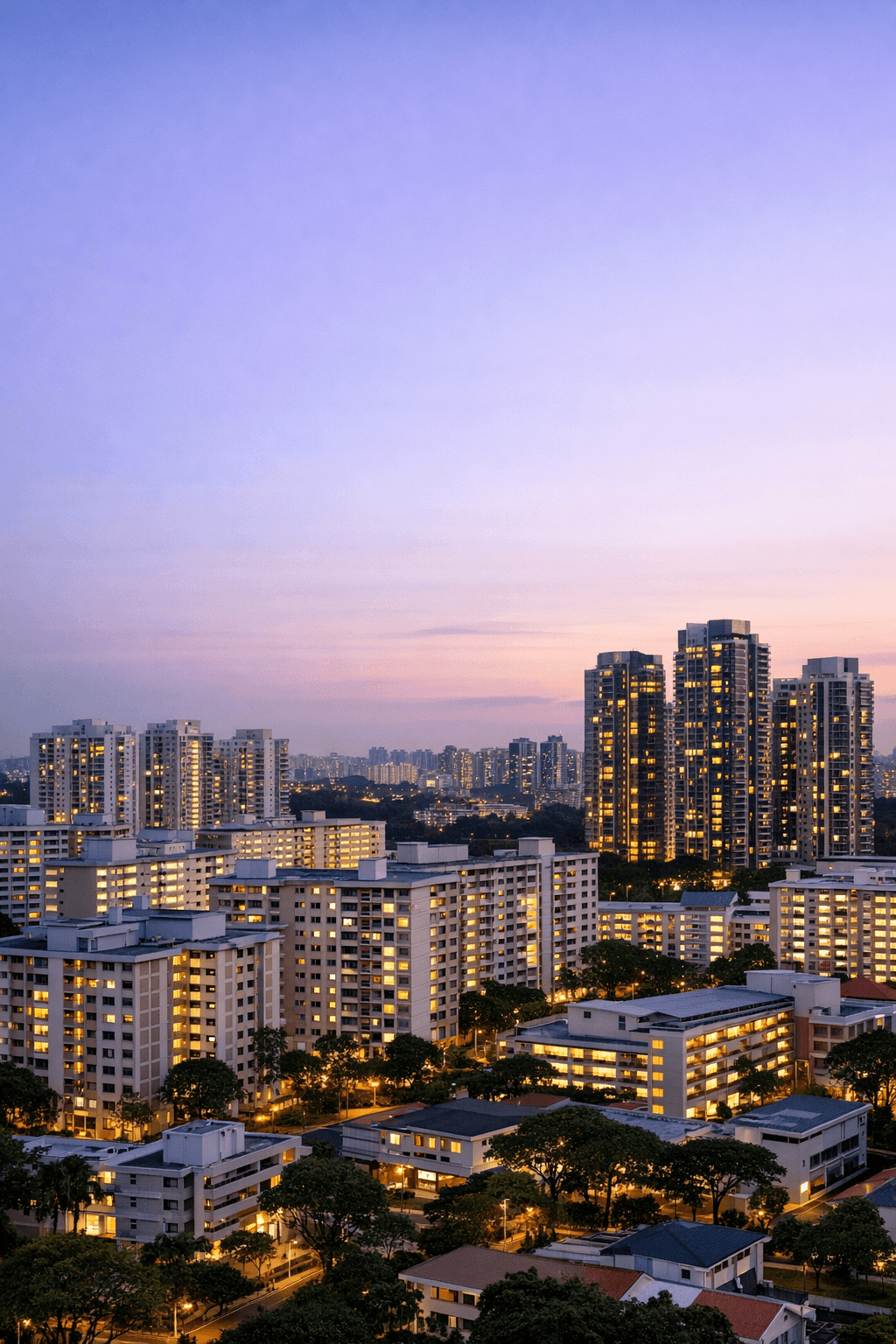
Every few months, the same question makes the rounds — at the kopitiam, in the family group chat, across the desk from a nervous first-time buyer: is the property boom finally over? This quarter, the official figures answered in two directions at once.
The Straits Times just reported that private home prices edged up again last quarter, even as — in the same quarter's data — Mothership reported that HDB resale prices fell for a second straight quarter. Same three months, opposite directions. So it's worth untangling slowly.
The question that comes back every few months
Every quarter, someone asks whether Singapore's property boom is finally over. This time, the answer wasn't a simple yes or no.
Every few months, the same question makes the rounds — at the kopitiam, in the family group chat, across the desk from a nervous first-time buyer: is the property boom finally over?
It's a fair thing to wonder. Prices have climbed for years, affordability keeps making headlines, and every cooling measure arrives with a promise that things will settle. So each new set of quarterly figures gets read like a weather forecast — is the storm passing, or just gathering?
This quarter, the forecast came back genuinely split. Not clearly sunny, not clearly stormy. Two different skies at once.
Two reports, pointing opposite ways
One report said private home prices rose again; another said HDB resale prices fell for a second straight quarter — both in the same quarter.
The Straits Times just reported that private home prices edged up again in the second quarter — rising 0.5%, with private rents up 0.7% alongside them. The private market, in other words, was still climbing.
But read the same quarter's public-housing figures and the story flips. As Mothership reported, HDB resale prices slipped 0.3% — a second straight quarterly fall. The market where most Singaporeans actually live was cooling.
Same three months. Same island. Two opposite directions. No wonder the answer to 'is the boom over?' felt slippery.
The boom isn't ending — it's splitting
The cleanest read isn't 'up' or 'down' — it's that the market has split into two speeds, with HDB easing while private keeps rising.
Put the two reports side by side and a clearer picture appears. This isn't a market topping out or rolling over. It's a market splitting into two speeds.
On one track, HDB resale — the great mass of ordinary flats — has quietly downshifted, giving buyers a little breathing room for the first time in a while. On the other, private property — condos and landed homes — is still grinding higher, especially at its mass-market and landed ends.
That's the story worth telling: not 'the boom is over,' but 'the boom has divided.' And the numbers, once you line them up, show exactly where the fault line runs.
Is Singapore's property market cooling in 2026?
Partly. HDB resale prices fell 0.3% in 2026 Q2 (a second straight quarterly drop) while private prices rose 0.5% — a two-speed market, not a broad decline.
The honest answer is: half of it is. Here is the split, side by side:
| Measure | Quarter-on-quarter | Year-on-year |
|---|---|---|
| HDB Resale Price Index | -0.3% | ~0.0% |
| Private Property Price Index | +0.5% | +2.9% |
HDB resale prices fell 0.3% on the quarter — a second straight quarterly decline — leaving them essentially flat over the past year. Private home prices did the opposite, edging up 0.5% on the quarter and 2.9% over the year.
The two are separate official indices — HDB's Resale Price Index and URA's private Property Price Index — so compare them on direction, not level. But the direction is the point: 'is the market cooling?' has two answers at once. The larger, more familiar HDB market is easing; the private market is not.
Why are HDB resale prices falling?
After years of strong gains, HDB resale has downshifted — the index slipped for a second straight quarter and is now roughly flat year-on-year, with the median 4-room around $630k.
For most of the last few years, HDB resale ran in one direction: up. That's what makes this quarter notable — the second straight quarter of small declines, something the market hasn't seen in a long while.
The move is gentle, not a lurch. The Resale Price Index is down 0.3% on the quarter and sits roughly flat over the year (about 0.0% year-on-year). In dollar terms, the national median 4-room resale flat is around $630k, essentially unchanged on a year ago — a plateau, not a slide.
What's behind it is less drama than supply. More flats reaching the end of their five-year Minimum Occupation Period, plus a steady pipeline of new BTO flats, gives buyers more to choose from and less reason to chase prices — the read most analysts have offered for the easing. After years of buyers competing for scarce resale flats, a little more choice goes a long way.
Which parts of the private market are still rising?
Mass-market and landed homes led — OCR up 3.9% and landed up 7.0% year-on-year — while the priciest core-central homes rose just 0.5%. Rents ticked up too.
The private market isn't rising evenly either. The gains are concentrated where everyday upgraders buy, and at the top end of landed housing — not in the priciest core-central condos. Here is the year-on-year picture by segment:
| Private segment | Price change (YoY) |
|---|---|
| Landed homes | +7.0% |
| Mass-market · Outside Central Region (OCR) | +3.9% |
| City fringe · Rest of Central Region (RCR) | +0.6% |
| Core Central Region (CCR) | +0.5% |
The mass-market — the Outside Central Region, where most new condos launch — rose 3.9% over the year, and landed homes climbed 7.0%. The core central region, home to the island's priciest addresses, barely moved at 0.5%. Renters felt it too: private rents rose 0.7% on the quarter and 1.7% over the year.
Zoom out and the private index is still on an upward grind — from about 213.2 in 2025 Q2 to 219.4 in 2026 Q2. The engine of the private market has simply shifted to its more affordable, mass-market end.
The caveat the two headlines hide
The HDB and private figures come from two separate indices, some quarterly numbers are provisional, and these are index and median snapshots — not the value of any one home.
Before anyone declares a winner, a few honest caveats — because the neat 'HDB down, private up' headline hides some fine print.
- They're two different rulers. The HDB Resale Price Index and URA's private Property Price Index are separate official measures. Compare them on direction, not level — one is not 'ahead of' the other.
- Some Q2 figures are provisional. Quarterly estimates can be revised as more transactions lodge, so treat a single quarter's small move as a signal, not gospel.
- These are indices and medians, not valuations. A 0.3% index dip or a $630k median says nothing precise about your block, your storey or your lease — your own flat can move differently from the average.
- Prices are gross. Median resale figures are before any resale levy, agent commission or legal fees.
None of this changes the shape of the story. It just keeps it honest: a modest two-speed split, not a boom and not a bust.
What does a two-speed market mean if you're buying or selling?
It depends which market you're in: HDB resale buyers have a little more room to negotiate, while private sellers in the mass-market and landed segments still hold the stronger hand.
This is opinion, not advice — but the two-speed split changes the mood on each side of the table.
- Buying an HDB resale flat: the pressure has eased a touch. Prices are flat-to-softening and more MOP and BTO supply is coming, so there's less need to overbid out of fear. Patience is worth a bit more than it was a year ago.
- Selling an HDB flat: the record-high momentum has cooled, so price to the recent comparables in your own town, not to last year's headlines.
- In the private market: the strength is real but uneven — mass-market and landed are doing the heavy lifting while core-central is quiet. Which segment you're in matters more than 'the market' as a whole.
The useful move, wherever you sit, is to stop reading 'the market' as one number and start reading the lane you're actually in.
Is this the start of a property crash?
There's no sign of it — HDB is easing gently while private prices are still rising. It reads as a normalisation, not a downturn.
On the evidence here, no. A crash looks like broad, steep falls across the whole market. What the data shows is a 0.3% dip in one index while the other is still rising — the private index has kept climbing to fresh highs.
The more accurate word is normalisation. After years of unusually strong HDB gains, a small step back toward balance — helped along by more supply — is closer to healthy than alarming. And a private market up 2.9% over the year is not a market in retreat.
Could the HDB softening deepen from here? Possibly — a second straight fall is worth watching, and we'll keep tracking it. But 'two-speed and cooling gently' is a very different thing from 'the boom is bursting.'
How we track this
We read HDB's official Resale Price Index and national median resale prices alongside URA's private figures, refreshing them as new data lodges.
PropKaki tracks HDB's own official Resale Price Index and the national median resale price by flat type, drawn from HDB's transaction records, and reads them next to URA's private price and rental indices. That lets us line the two markets up on the same timeline and see where they diverge.
Two caveats we carry rather than bury: the HDB and private indices are separate measures (compare direction, not level), and the most recent quarter's figures can be provisional until more transactions lodge. Prices are gross of levy, commission and fees. Want the resale trend or median for your own town and flat type? You can ask PropKaki for it.
Sources
- HDB Resale Price Index and national median resale prices (HDB transaction records), analysed by PropKaki.
- URA private residential Property Price Index and rental figures, 2026 Q2.
- The Straits Times - private residential rents rise 0.7% in Q2 as home prices inch up 0.5%: URA (original reporting).
- Mothership - HDB resale prices fall for a second straight quarter (original reporting).
About this commentary
This is editorial analysis by the PropKaki Editorial Desk, written for general information only — it is opinion and context, not a valuation, financial advice or a recommendation. The quarterly figures are drawn from published reporting and official HDB and URA statistics. Always verify prices and policy against official sources (HDB, URA, CPF) before acting.
Got a question this raised? Ask PropKaki.
Take any point from this analysis and apply it to your own project, budget or decision.
 PropKaki
For most buyers this year, staying well within budget beats trying to time the market.