

Jurong Is Becoming Singapore's Second Downtown — and Still One of the Cheaper Places to Buy
URA has just launched the first big Jurong Lake District site tender — the clearest sign yet that a second CBD is rising in the west. Here's what Jurong property costs today, and an honest read on what the plan could (and couldn't) do to it.
Jurong Lake District (JLD) is being built into what's widely called Singapore's second CBD — a major mixed-use business hub in the west. This month URA launched the tender for a large white site at Town Hall Link (up to 1,200 homes and at least 40,000 sqm of offices; tender closes 17 November 2026), moving the project onto the Confirmed List so it proceeds on the state's own timeline. Yet Jurong (postal district D22) is still one of the more affordable places to buy: private homes there transacted at a median $1.68M, or $1,672 psf, over the past ~12 months (465 sales) — just over half the psf of the island's priciest district (D09, $2,999) and only about a third higher than the cheapest (D25, $1,239). An HDB 4-room in Jurong East (~$530k) is the most affordable in Singapore. A funded, well-connected catalyst like JLD can support nearby home values over time — but the build-out runs for years, some optimism may already be priced in, and these are transacted, not asking, prices.
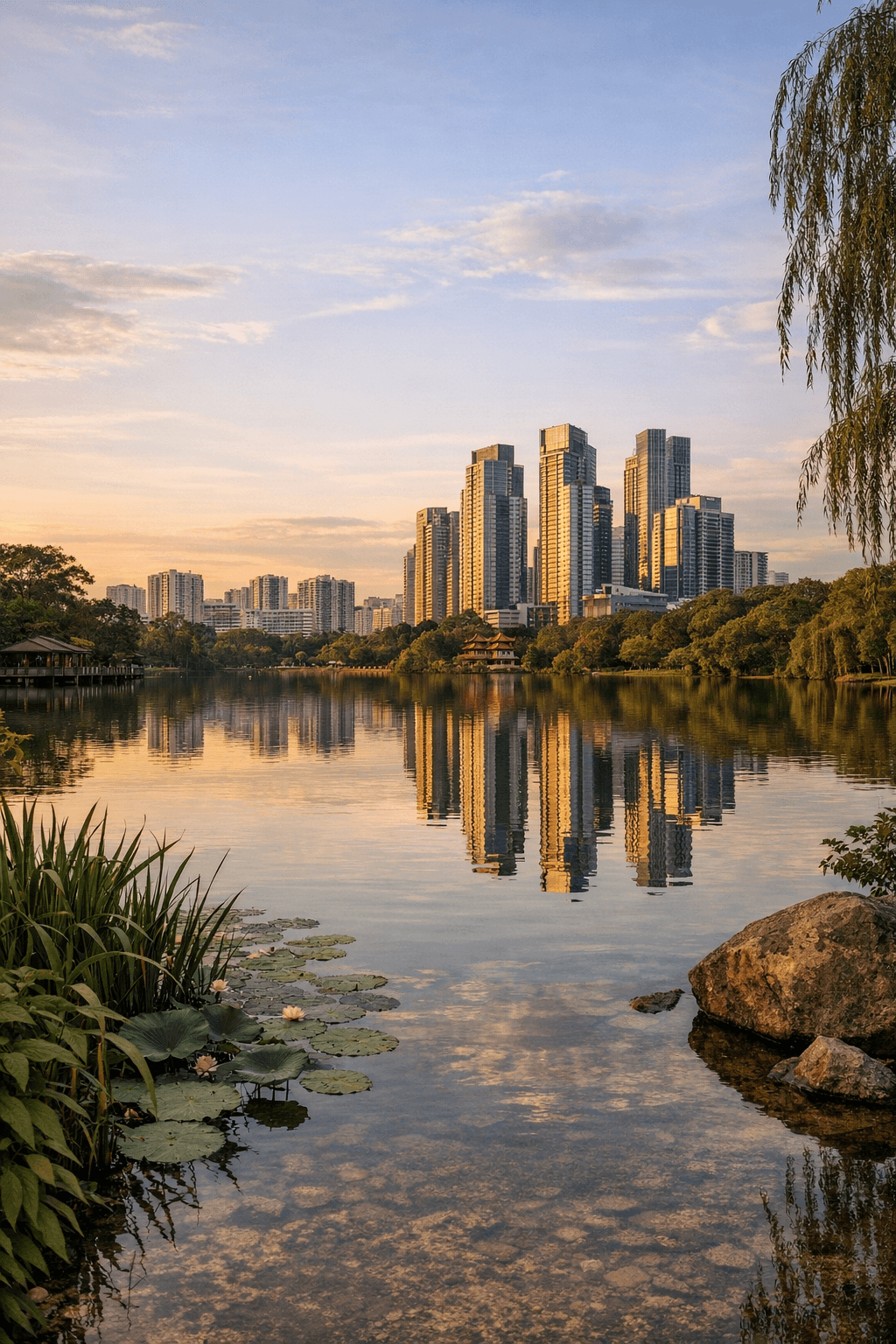
This month, Singapore's Urban Redevelopment Authority put a large white site in the heart of Jurong Lake District up for tender — a plot at Town Hall Link, beside the conserved old Jurong Town Hall, that could hold up to 1,200 homes and a small skyline of offices. On its own it's one parcel of land. But it's the clearest signal yet that a plan Singaporeans have heard about for years — a whole second downtown in the west — is finally being built rather than just drawn.
For a corner of the island people once joked was too far to visit, that's a remarkable turn. And it raises the question most homeowners actually care about: what does a second CBD do to the price of living in Jurong?
The far end of the map
For decades Jurong was Singapore's industrial west — the lake, the gardens, the heartland flats, and a running joke about being too far from town.
For most of its life, Jurong has been the place other Singaporeans teased you for living in. Too far. Too industrial. The end of the line, where the west goes to make things.
But it was always more than that. There is the lake, and the gardens beside it — the pagodas, the willows, the families feeding fish on a Sunday. There are the heartland flats, some of the most affordable on the island, and the science centre and the old bird park that every schoolchild was once bussed to. Jurong was never glamorous. It was where ordinary life happened, cheaply, with a little room to breathe.
That reputation — far, functional, affordable — is exactly what's about to be tested.
The month the plan got a deadline
URA has launched the tender for a major Jurong Lake District site — up to 1,200 homes and a cluster of offices — putting real dates on a long-promised second downtown.
This month, Singapore's Urban Redevelopment Authority put a large white site in the heart of Jurong Lake District up for tender — a plot at Town Hall Link, beside the conserved old Jurong Town Hall. On its own it is one parcel of land. On paper it is a small city block: up to 1,200 private homes, at least 40,000 square metres of offices, and another 44,000 sq m of shops, hotels and community space, with a tender that closes on 17 November 2026.
The detail that matters is where it now sits. URA moved the site onto the Confirmed List of its land-sales programme — which, in plain terms, means the state is putting it out on its own schedule instead of waiting for a developer to trigger it. The plan is no longer a masterplan poster; it has a deadline.
URA describes the goal as shaping Jurong Lake District into "the largest mixed-use business node outside Singapore's city centre." Most people know it by a shorter name: the country's second CBD. And the new site sits on what will become one of the best-connected spots on the island — wired into the Jurong East MRT interchange and a future Cross Island Line station by covered, multi-level walkways.
A downtown in the west, and one quiet question
If Singapore builds a second city centre here, what happens to Jurong property — still one of the more affordable corners of the island?
Here is what makes this more than a planning story. Singapore has done this before: it grew a whole financial district at Marina Bay out of reclaimed land, and the homes around it are now some of the priciest anywhere. The promise of Jurong Lake District is that the west gets its own version — offices, jobs, a skyline, a lakefront — a short train ride from where hundreds of thousands of people already live.
Which lands on the question every Jurong homeowner, and every buyer eyeing the west, is quietly asking: if a second downtown rises here, what does it do to the cost of living in it? So we pulled the numbers on what Jurong property actually costs today — the baseline against which all of this will be measured.
What does private property in Jurong cost today?
Over the past year, private homes in Jurong (district D22) transacted at a median of $1.68M, or $1,672 per square foot, across 465 sales — affordable by Singapore standards.
Jurong sits in postal district D22, which covers Jurong, Boon Lay and Lakeside. Over the last roughly twelve months, private homes there changed hands at a median price of $1.68M, or $1,672 per square foot, across 465 recorded sales.
| Jurong (D22) private homes | Last ~12 months |
|---|---|
| Median price | $1.68M |
| Median PSF | $1,672 |
| Recorded sales | 465 |
Those are transacted prices — what buyers actually paid, lodged with URA — not hopeful asking prices. And by the standards of a city where a central-district condo routinely clears $3,000 psf, $1,672 is squarely mass-market territory. This is still a place where an ordinary household can plausibly buy.
How affordable is Jurong compared with the rest of Singapore?
Jurong's $1,672 psf is just over half the island's priciest district and only about a third higher than its cheapest — and Jurong East has the most affordable HDB 4-room flats in Singapore.
Put Jurong on the national ladder and it sits comfortably toward the affordable end.
| District | Median PSF (private) |
|---|---|
| D09 — the island's priciest (Orchard / River Valley) | $2,999 |
| D22 — Jurong | $1,672 |
| D25 — the island's most affordable (Woodlands) | $1,239 |
At $1,672 psf, Jurong transacts at just over half the level of the priciest district (D09, $2,999) and only about a third higher than the cheapest (D25, $1,239). It's a mid-affordable, mass-market district — not bargain-basement, but a long way from the top.
The HDB picture says the same thing even louder. A 4-room resale flat in Jurong East has a median price of around $530k — currently the most affordable of any town in Singapore for that flat type. This is, right now, one of the cheaper places in the country to put down roots. That is the baseline a second CBD is being dropped on top of.
What could a second CBD actually do to Jurong prices?
A funded, well-connected employment hub can lift nearby home values over time — but the effect is slow, uneven, and partly priced in already.
The honest answer: probably support them, gradually, with a lot of caveats.
The case for a lift is real. Jobs move people. When tens of thousands of well-paid roles land somewhere with several MRT lines converging on it, some of those workers want to live nearby, and demand for homes within a short commute tends to firm up. Add offices, malls, hotels and a lakefront, and you change what the area is — Marina Bay is the local proof that a built-from-scratch business district can pull home values up with it.
But temper it with three things. First, time: the tender for this one site only closes in November 2026, and towers take years to build and fill — the payoff, if it comes, is measured in a decade, not a quarter. Second, it may be partly in the price already: the Jurong Lake District vision has been public for over a decade, so some of tomorrow's optimism likely sits inside today's $1,672 psf. Third, plans change — the Kuala Lumpur–Singapore high-speed rail terminus was once slated for Jurong, and it was shelved. A catalyst is a reason for optimism, not a guarantee of it.
Should I buy in Jurong now because of the plan?
Buy on the fundamentals that matter to you — budget, the specific unit, the lease, your timeline — and treat the second-CBD upside as a possible bonus, not the reason.
This is opinion, not advice, so take it as a frame rather than a nudge. The second-CBD story is a genuine, funded, dated catalyst — which makes it a good reason to look at Jurong, and a poor reason to overpay there.
The useful question isn't "will Jurong boom?" It's "does this specific home make sense for me at today's price, if the plan delivers nothing extra?" If the answer is yes — the unit fits your life, the lease suits your horizon, the sums work on your income — then the Jurong Lake District upside is a bonus you're not paying full freight for. If you can only make the numbers work by assuming the boom, you're buying the brochure, not the flat. The catalyst should widen your shortlist, not blow your budget.
The reality check: a tender is not a skyline
The gap between an announcement and its impact is long, and our figures are a trailing snapshot of transacted prices — read them as a baseline, not a forecast.
A few honest limits before anyone extrapolates a boom:
- A tender is not a building. The site's tender only closes in November 2026; the offices, homes and shops behind the headline take years to rise and fill. The distance between "launched" and "lived-in" is long.
- Some optimism is already priced in. Jurong Lake District has been on the map for years; today's $1,672 psf is not a pre-plan number.
- These are transacted, trailing prices. Our figures are what actually sold over the past ~12 months, lodged with URA — not asking prices, and not a prediction. A district median also shifts with the mix of units that happened to sell.
- Big plans can still change. The region has lost a marquee project before. Treat the second-CBD upside as plausible, not promised.
How we sourced this
The Jurong Lake District details are from URA's own launch; the prices are PropKaki's read of transacted URA private-sale and HDB resale records.
⚠️ Corrected 15 September 2026. The version of this page published on 28 July overstated District 22's sales. URA amends some caveat details after first publishing them, and our records had been keeping the original and the amended caveat as two separate sales — almost all of them new-launch sales. Corrected as at 28 July 2026, the date of the original analysis: D22 recorded 465 sales, not 490, at a median $1.68M and $1,672 per square foot rather than $1.70M and $1,703. D09's median is $2,999 psf rather than $3,025, and D25's $1,239 rather than $1,241. Jurong is still just over half the priciest district's PSF and about a third above the cheapest.
The plan and the site details — the white site, the yields, the tender date, the second-CBD ambition — come from URA's own announcement, linked below. We haven't invented any of the development figures.
The price figures are ours: PropKaki tracks Singapore's transacted private-sale caveats and HDB resale records, so we can read the current median price and PSF for any postal district (here, D22) and the resale median for any HDB town and flat type (here, a Jurong East 4-room). Two caveats we carry rather than bury: private figures are transacted, not asking prices over a trailing ~12-month window, and a district median reflects the mix of unit sizes that sold — the PSF is the more like-for-like gauge. Want the read for your own district, town or block? You can ask PropKaki.
Sources
- URA — Launch of White site to advance development of Jurong Lake District (the site launch, yields and tender date; primary source).
- Private-sale transaction records (URA caveats) and HDB resale records, analysed by PropKaki (district D22 medians; Jurong East 4-room resale median).
- "Second CBD" is the widely used shorthand for what URA calls "the largest mixed-use business node outside Singapore's city centre."
About this commentary
This is editorial analysis by the PropKaki Editorial Desk, written for general information only — it is opinion and context, not a valuation, financial advice or a recommendation. The development plans are drawn from URA's published announcement; the price figures are from transacted private-sale and HDB resale records. Always verify plans, prices and timelines against official sources (URA, HDB) before acting.
Got a question this raised? Ask PropKaki.
Take any point from this analysis and apply it to your own project, budget or decision.
 PropKaki
For most buyers this year, staying well within budget beats trying to time the market.