

The Government Just Gave Big En-Bloc Sites an Extra Year — and Quietly Changed Who Can Bid
From 29 July, developers buying large and mega en-bloc sites get six to seven years to build and sell instead of five and a half. It reads like a tax technicality. For owners of big ageing estates, it is the difference between a sale and no sale.
From 29 July 2026, developers buying large residential en-bloc sites get longer to qualify for the 35% remittable portion of ABSD. Large sites — those yielding at least 700 but fewer than 1,400 residential units — move to a 6-year completion-and-sale timeline, from 5½ years. Mega sites — at least 1,400 units — move to 7 years. Mega-site developers must sell at least half the units by the end of year six or face full clawback of the remittable portion, and full clawback if all units are unsold after seven years. Projects meeting additional criteria (complex technical or infrastructural requirements, the Strategic Development Incentive scheme, or higher productivity targets) get a further 6 months — 6½ years for large, 7½ for mega — and may start construction up to 3 years after purchase. Developers still pay 40% ABSD on residential land, of which 5% is never remittable. They will be selling into a private market that our reading of URA's index puts at +2.9% year-on-year and +0.5% quarter-on-quarter in 2026Q2.
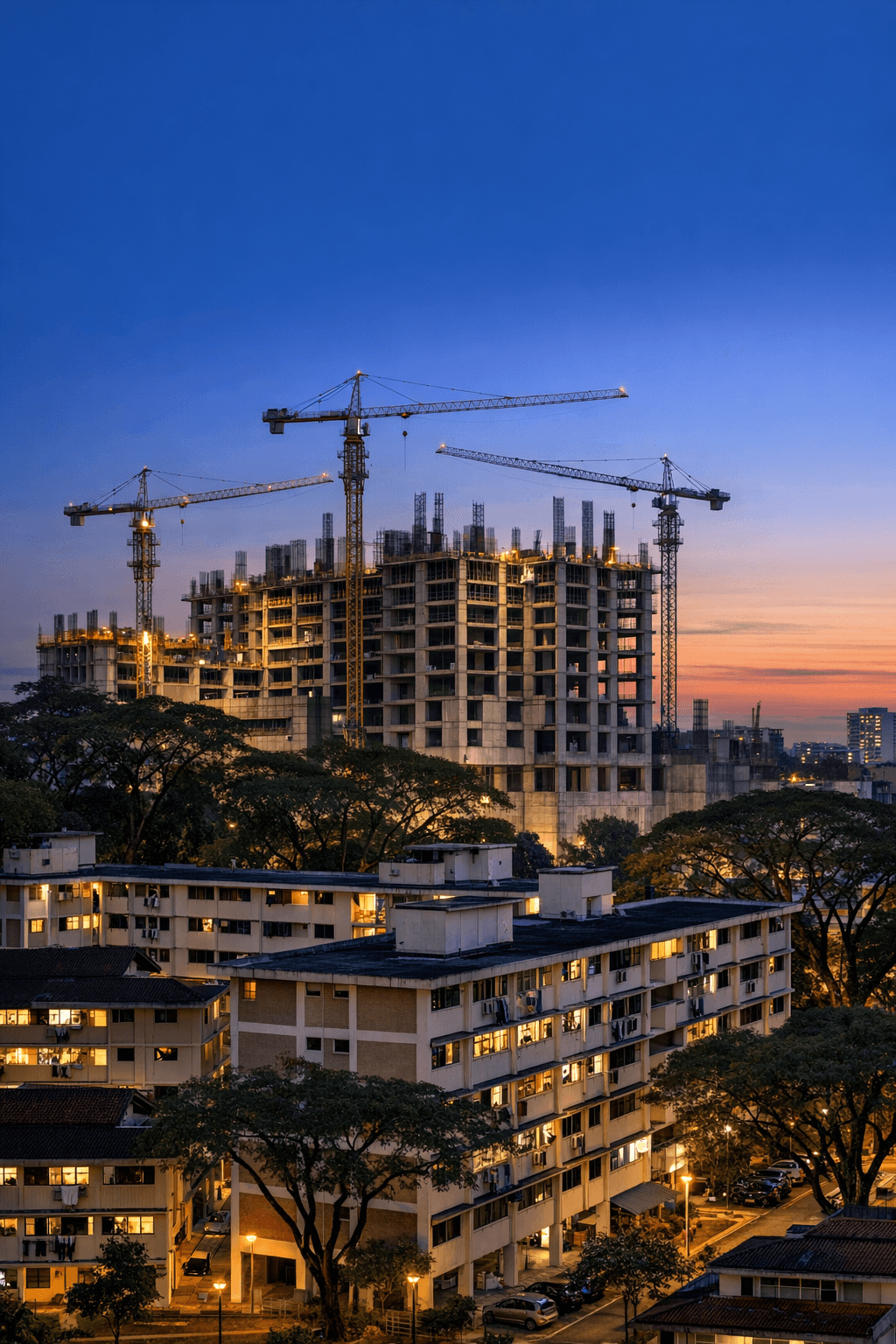
The Straits Times reported this week that from 29 July, developers buying large residential en-bloc sites will get materially more time to build and sell before the Additional Buyer's Stamp Duty claws back on them. National Development Minister Chee Hong Tat, announcing it at the Singapore Economic Review Conference, said Singapore risked a "lose-lose outcome" if developers were discouraged from redeveloping large estates altogether.
If you own a unit in a big, ageing development that has tried and failed to go en bloc, this is not a technicality. It is the most consequential thing anyone has said about your flat in a while — and to see why, you have to understand what a developer is actually afraid of when they look at your estate.
The estate that keeps almost selling
Big ageing developments are the ones most in need of redevelopment — and the ones developers are most reluctant to touch.
There is a particular kind of Singapore development everyone can picture. Built in the 1980s, generous in a way nothing new is generous — wide corridors, real balconies, trees that have had forty years to grow. Also: a leaky roof deck, a lift rebuilt twice, and a sinking fund conversation at every annual general meeting that leaves the room quieter than it was.
Several hundred families live there, and many have been trying to sell collectively for years. They form committees, appoint marketing agents, gather consent signatures door to door, set a reserve price. And then, more often than not, the tender closes without a bid — or with one, well below.
The owners' explanation is usually about price: we asked too much, the market is soft. Sometimes that is true. But for the biggest estates something else has been going on, and it has very little to do with what the land is worth.
What a developer is really buying when they buy your estate
Not just land — a five-and-a-half-year countdown with a 35% tax penalty at the end of it.
When a housing developer buys residential land in Singapore, they pay 40% Additional Buyer's Stamp Duty. Five percentage points of that can never be recovered. The other 35% can be remitted — but only if the developer meets a set of conditions: start construction within two years of buying the site, and complete the project and sell every single unit within the deadline.
Read that last clause again, because it is the whole story. Not most units. Every unit. Miss it, and the 35% falls due on a land price that, for a large site, runs into the hundreds of millions.
Now put yourself in the developer's chair looking at a 1,500-unit redevelopment. You must demolish an occupied estate, obtain approvals, build something enormous, and then sell fifteen hundred homes — all inside the same window that applies to a boutique 80-unit project on a small plot. The construction alone eats years of it. Everything after that is a race against a tax.
So the developer does the rational thing. They bid conservatively, or they do not bid at all, and they go looking for a smaller site instead. Which leaves the estate that most needs rebuilding as the one nobody wants.
The change, and the phrase the minister used
Six years for large sites, seven for mega sites — because the alternative was big estates simply not being rebuilt.
That is the problem the government has just addressed. From 29 July 2026, for sites purchased on or after that date, the timeline scales with the size of the job.
A large site — one that will yield at least 700 but fewer than 1,400 homes — now has six years to complete construction and sell out, up from five and a half. A mega site, yielding 1,400 homes or more, gets seven years.
There is a second tier for the genuinely hard jobs. Projects with complex technical or infrastructural requirements, projects approved under the Strategic Development Incentive scheme, or projects committing to higher productivity targets such as newer construction technologies, get a further six months — taking large sites to six and a half years and mega sites to seven and a half. Those projects may also begin construction up to three years after buying the site, rather than two.
Minister Chee's framing was blunt. The changes are "intended to set the right incentives for developers to rejuvenate larger estates", he said, warning that Singapore could end up with a "lose-lose outcome" if developers were put off redeveloping big sites at all. That is an unusually direct admission that a rule was producing an outcome nobody wanted.
What are the new ABSD timelines for en-bloc sites?
6 years for 700-1,399 units, 7 years for 1,400+, with a further 6 months for projects meeting additional criteria.
The new structure, as announced, for sites bought from 29 July 2026:
| Site type | Units on redevelopment | Complete + sell by | With additional criteria |
|---|---|---|---|
| Large | 700 to 1,399 | 6 years (was 5½) | 6½ years |
| Mega | 1,400 or more | 7 years (was 5½) | 7½ years |
The extra six months applies to projects with complex technical or infrastructural requirements, projects approved under the Strategic Development Incentive scheme, or those adopting higher productivity targets such as nascent construction technologies. Those projects also get up to three years, rather than two, to commence construction.
This sits on top of an earlier round of relief. In March 2025, the government granted six- to twelve-month extensions — an en-bloc project yielding at least 700 units, where the redevelopment yield was at least 1½ times the original development, received a six-month extension, with a further six months for technically complex projects. The 5½-year figure the new rules improve on already reflects that.
Unchanged underneath all of it: 40% ABSD on residential land, of which 5% is never remittable, and the requirement to start construction within two years of purchase for projects without the additional-criteria concession.
The catch the headline skipped: a checkpoint at year six
Mega-site developers must have sold half their units by year six, or the full remittable ABSD is clawed back.
The extra time is not unconditional, and this is the part most coverage moved past quickly.
A mega-site developer must sell at least half of the residential units by the end of year six. Miss that, and the full 35% remittable portion is clawed back — not a portion of it, not a penalty scaled to how close they came. And if any units remain unsold at the end of year seven, the full clawback applies as well.
That is a well-designed piece of pressure. The old rule's problem was that it punished scale — a big project could be perfectly well run and still miss a deadline built for a small one. The new rule keeps the discipline but moves it to something the developer controls: are you actually selling, at a pace that suggests this project will clear?
For buyers, it has a quiet implication worth holding onto. A developer sitting on a mega project in year five, facing a 50%-sold checkpoint, has a strong reason to move units — and pricing is how units move.
What market will these projects actually be selling into?
A private market rising steadily — up 2.9% year-on-year — but with the growth concentrated in the suburbs rather than the centre.
A seven-year runway is only generous if the market at the end of it can absorb 1,400 homes. So it is worth looking at what the private market is doing now, using URA's own Property Price Index, which we read directly rather than re-derive.
As at 2026Q2 the index sits at 219.4 — up 0.5% on the quarter and 2.9% on the year. Steady growth, not a boom, and the backdrop against which a developer is modelling a project that will not launch for years.
Where that growth is happening matters more here, because large en-bloc sites are rarely in the prime core:
| Region | Index (2026Q2) | QoQ | YoY |
|---|---|---|---|
| CCR (Core Central Region) | 161.5 | +1.8% | +0.5% |
| RCR (Rest of Central Region) | 226.2 | -1.2% | +0.6% |
| OCR (Outside Central Region) | 271.1 | -0.1% | +3.9% |
The suburbs are where the year-on-year growth is — OCR +3.9%, against +0.5% in the core central region. Landed, reported islandwide, is up 7.0%. That helps exactly the sites this policy targets: estates with the land area to yield 700 or 1,400 homes are mostly outside the centre, and that is where demand has been strongest.
These are indices, not dollar prices, so a specific project can move very differently — and the latest quarter can be a flash estimate URA later revises, so read 2026Q2 as provisional.
The honest reality-check: this helps big sites, not en-bloc hopes generally
If your estate won't yield 700 units, nothing changed for you — and a longer runway doesn't make an over-priced reserve worth bidding on.
It would be easy to read this as "en bloc is getting easier", and for most owners that would be wrong in a costly way.
The thresholds are the point. The concession begins at 700 units on redevelopment — not 700 existing units, but what the site could yield once rebuilt at its permitted intensity. Most collective-sale hopefuls are nowhere near that. A 120-unit walk-up on a modest plot is exactly as attractive to a developer today as it was last week.
And for estates that do clear the bar, more time is not more money. The binding constraint on most failed collective sales has been the reserve price, not the tax clock — sellers asking a number that leaves no margin after land, ABSD, construction and financing. A seventh year does not fix a first-year price problem. It widens the set of sites a developer will consider; it does not raise what they will pay.
There is also a timing trap: the rules apply to sites purchased from 29 July 2026, so a tender that closed earlier does not retroactively get the longer runway.
Finally, on our own numbers — the URA index tells you what the market has done, not what it will do seven years from now, when a mega project bought today would be completing. Nobody's data reaches that far, and a longer runway is also a longer exposure: seven years is more time to build into a downturn as well as a boom.
Does the longer ABSD deadline make my estate more likely to go en bloc?
Only if redevelopment would yield 700 or more units. Below that threshold, nothing has changed.
It depends entirely on scale, and the test is the redevelopment yield rather than the current unit count.
If your site could produce 700 or more homes once rebuilt to its permitted intensity, then yes — the pool of developers willing to look at it has genuinely widened, because the deadline that made large projects risky has been relaxed. If it would produce 1,400 or more, the change is substantial: seven years instead of five and a half, potentially seven and a half.
If your redevelopment would yield fewer than 700 homes — which covers the majority of Singapore's collective-sale attempts — this announcement does not apply to your site at all. The older March 2025 concessions, and the standard timelines, still govern.
Either way, the reserve price remains the thing most likely to decide whether your tender attracts a bid. Time helps a developer say yes to a fair number. It does not help them say yes to an unfair one.
Will this make new launches from big en-bloc sites cheaper?
Not directly — but the 50%-sold checkpoint at year six gives developers of mega projects a real reason to price to move.
There is no mechanism here that lowers a launch price. If anything, a developer who can bid more confidently for land may pay more for it, and land cost flows into launch pricing.
The more interesting effect is on pacing. Under the old rule, a developer racing an all-units-sold deadline had an incentive to discount hard near the end. Under the new one, a mega-site developer faces an explicit checkpoint — half the units sold by the end of year six, or the entire remittable ABSD is clawed back. That is a large, discrete cliff, and cliffs shape behaviour well before you reach them.
So the realistic expectation for buyers is not a cheaper launch, but a developer with a clear structural reason to keep sales moving steadily through the middle years of a very large project — and who is unlikely to sit on unsold stock waiting for a better market. Whether that shows up as price or as incentives is a project-by-project question, and not one an index can answer.
How we sourced this
The policy details come from the reporting of the announcement; the market figures are URA's own index, read directly.
Every detail of the policy change — the 29 July 2026 start, the 700-unit and 1,400-unit thresholds, the six- and seven-year timelines, the additional-criteria extensions, the 50%-sold checkpoint for mega sites, the 40%/35%/5% ABSD structure and the March 2025 concessions — comes from The Straits Times' report of Minister Chee Hong Tat's announcement, linked below. Those are the reporters' facts, attributed rather than claimed as ours.
The market figures are ours: the URA Property Price Index and its regional breakdown, from URA's official quarterly private residential statistics, which we read directly rather than re-derive.
The caveats: these are indices (2009Q1 = 100), not dollar prices or PSF, so a specific project can behave very differently. They cover private residential only, including ECs — HDB is not in this index. The CCR/RCR/OCR figures are non-landed only, while landed is reported islandwide. And the latest quarter can be a flash estimate URA revises, so read 2026Q2 as provisional.
Sources
The announcement as reported, and the official index behind our market figures.
The news:
- The Straits Times — ABSD regime tweaked from July 29 to facilitate the redevelopment of large en bloc sites, reporting Minister Chee Hong Tat's 28 July 2026 announcement at the Singapore Economic Review Conference.
The data:
- URA Property Price Index and regional non-landed price index, official quarterly private residential statistics, 2026Q2.
About this commentary
Opinion and analysis from the PropKaki Editorial Desk — not financial, legal or property advice.
This is commentary by the PropKaki Editorial Desk on reporting by The Straits Times. The account of what was announced belongs to that newsroom; the market analysis, the framing and the opinions are ours.
It is opinion and general information, not financial, legal, tax or property advice. Stamp duty rules are detailed and consequential, and the summary here is a commentary reading of a news report — anyone making a decision that turns on ABSD remission should work from IRAS and URA's own published rules and take professional advice. Policy details are also sometimes refined after an initial announcement.
Published 29 July 2026.
Got a question this raised? Ask PropKaki.
Take any point from this analysis and apply it to your own project, budget or decision.
 PropKaki
For most buyers this year, staying well within budget beats trying to time the market.