

The Million-Dollar HDB Flat They Can't Sell — Yet
A young family's bind is quietly becoming a national story: HDB values have climbed so far that a four-room can fetch seven figures — but a five-year rule still decides when you can cash in.
The million-dollar HDB flat is increasingly common but still the exception. 6.4% of HDB resales crossed $1m in 2025 (1,593 flats), up from just 1.8% in 2023 — and 2,510 have done so since January 2026. They cluster in mature, central towns (Toa Payoh, Bukit Merah, Queenstown) and in larger 4- and 5-room and Executive flats. But most flats still sell for far less, and a five-year Minimum Occupation Period (MOP) means owners can't sell to realise the gain until they've lived there five years.
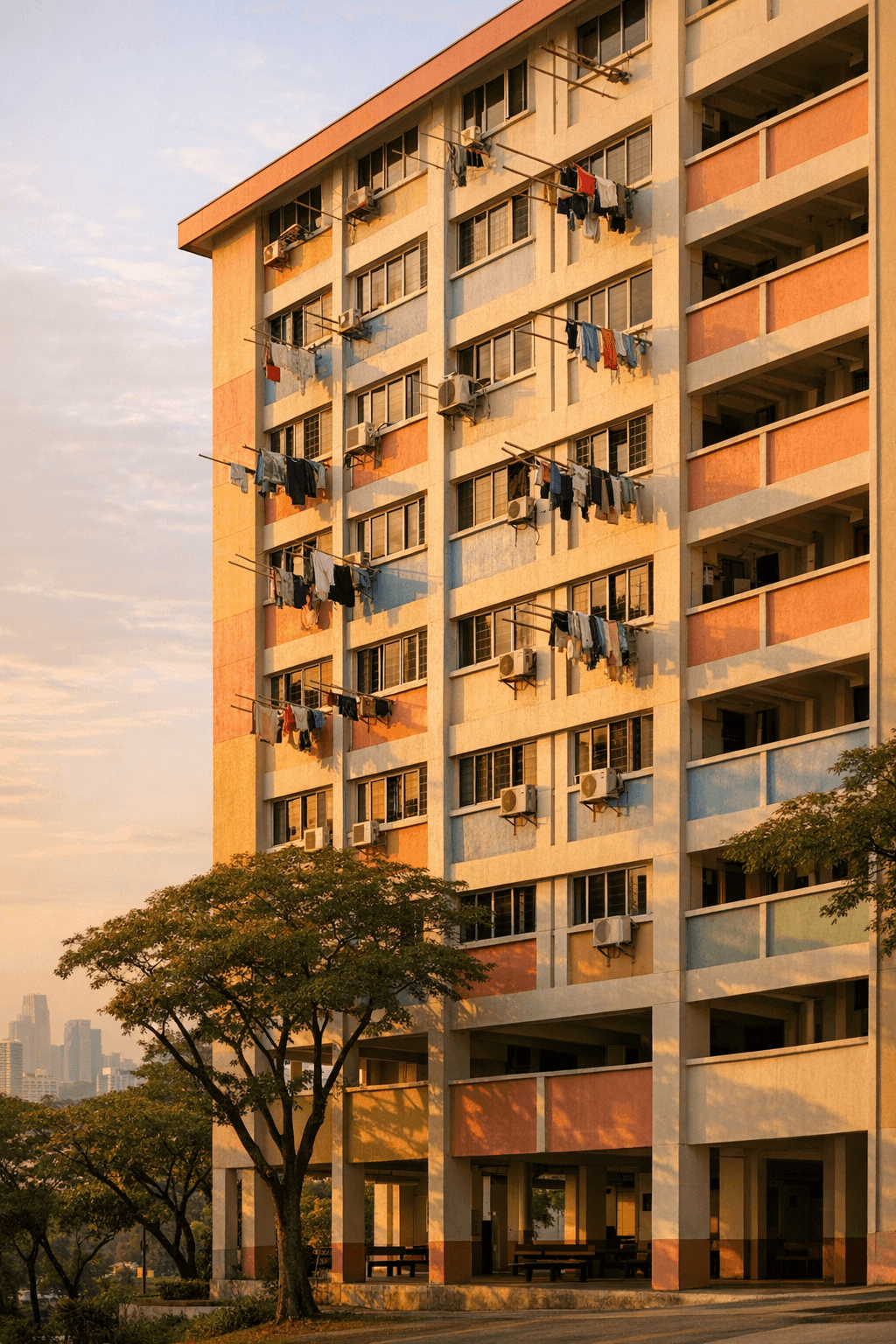
Mothership just reported a small, sharp story: a young couple, a third child on the way, and a four-room flat that had quietly become worth a small fortune — who then found they weren't allowed to sell it and move.
It's one household's bind. But the part where an ordinary HDB flat is suddenly worth a fortune is fast becoming everyone's — so it's worth telling slowly.
A young family who did everything right
A couple expecting their third child wanted to move somewhere bigger — and their appreciating flat seemed to make it easy.
The couple had done the sensible, expected thing years ago: bought a four-room HDB flat, settled in, started a family. Over time the flat did what flats have quietly done lately — it climbed in value, until it was worth comfortably more than they paid.
Then a third child arrived on the way, and the four-room began to feel snug. The plan more or less wrote itself: sell the flat, now worth a healthy sum, and move somewhere with an extra room — the same move families here have made for generations.
On paper, they had done everything right. The home had grown into a real asset, exactly as the dream promises. All that was left was to act on it.
The wall they hit
They hadn't lived in the flat for five years — the Minimum Occupation Period — so they couldn't sell. Their appeal for a waiver was turned down.
When they went to make the move, they couldn't.
The obstacle was the Minimum Occupation Period — the five years an owner must physically live in an HDB flat before selling it on the open market or buying private property. They hadn't reached it.
So they did the reasonable thing and appealed to HDB for a waiver, explaining the growing family and the need for space. According to Mothership's report, HDB declined — as it generally does: the rule exists to keep the system fair for everyone, and an exception for one household chips away at it for the rest. They were pointed toward other options to tide them over.
It reads, on its face, as a small administrative 'no'. But it's worth sitting with for a moment.
Rich on paper, stuck in real life
It's the peculiar bind of the moment — a flat can be worth more than ever and still be a door you can't open when you need to.
Here is a family whose home is worth more than they ever imagined — and whose wealth is, for now, entirely out of reach. They can't spend it, can't move it, can't turn it into the bigger home their life suddenly needs. The figure on the valuation is real; the timing belongs to the rulebook.
It's a very Singaporean kind of problem, and it would be easy to file it away as one unlucky household. It isn't. The 'worth a fortune' half of their story is quietly becoming everyone's — so we went and counted exactly how far it has spread.
How common is the million-dollar HDB flat now?
6.4% of HDB resales crossed $1m in 2025 — more than triple the 1.8% share in 2023 — and 2,510 flats have done so since January 2026.
We counted every HDB resale that transacted at $1,000,000 or more. The share has climbed steadily:
| Year | $1m+ resales | All resales | Share |
|---|---|---|---|
| 2023 | 469 | 25,754 | 1.8% |
| 2024 | 1,035 | 27,832 | 3.7% |
| 2025 | 1,593 | 25,086 | 6.4% |
| 2026 (YTD, partial) | 917 | 12,369 | 7.4% |
In two full years the share more than tripled — from about 1 in 56 resales to about 1 in 16. Since the start of 2026, 2,510 flats have crossed the million-dollar line, and the priciest was a five-room in Bukit Merah (Henderson Road) that sold for $1.73m in April 2026.
One honest caveat: 2026 is a partial, still-lodging year, so treat its 7.4% as a running total, not a full-year figure — under-lodged windows tend to over-state the tail.
Where are Singapore's million-dollar HDB flats?
They cluster in mature, central towns — Toa Payoh, Bukit Merah and Queenstown lead — and in larger 4- and 5-room and Executive flats.
The million-dollar flat is a geography as much as a price. Since January 2026, the top towns are:
| Town | $1m+ resales |
|---|---|
| Toa Payoh | 443 |
| Bukit Merah | 337 |
| Queenstown | 295 |
| Kallang/Whampoa | 222 |
| Ang Mo Kio | 160 |
And by flat type, it is overwhelmingly the bigger layouts: 4-room (1,070) and 5-room (887) flats dominate, followed by Executive (544). A million-dollar three-room is almost unheard of (just 4). The pattern is consistent — central location, larger size, and often a newer or recently-MOP block with plenty of lease left.
The catch, in plain terms: the five-year MOP
Owners must live in the flat for five years before they can sell on the open market — so a rising valuation is a gain you can't realise on your own timeline.
Back to the couple, because their catch is everyone's catch. HDB's Minimum Occupation Period requires owners to physically occupy the flat for five years before they can sell it on the resale market or buy private property.
So even as a flat's market value climbs, the owner can't convert that value into a bigger home until the clock runs out. The wealth is real; the timing isn't theirs. For a growing family that needs space now, that — not the price — is the binding constraint.
What does this mean if you're planning to upgrade?
Plan the move around the MOP, not against it: the five-year clock, not the sale price, usually decides your timeline.
Three practical reads:
- Count from key collection, not purchase. The five years run from when you take possession and physically move in; time spent renting it out doesn't count.
- The appreciation is a tailwind, not a lever you can pull early. A flat worth more on paper doesn't help fund an upgrade until you can actually sell it.
- Sequence the finances. Selling an appreciated flat resets your next purchase's loan-to-value, stamp duty and CPF position — worth modelling before, not after, the MOP date.
If you're weighing a move, the useful question isn't "is my flat worth a million?" — it's "when does my MOP end, and what will the sums look like then?"
Is my HDB flat likely to be worth $1 million?
Probably not — million-dollar flats are the tail, not the market. Most resales sell for far less.
It's worth stating plainly, because the headlines can distort: even at 6.4%, roughly 19 in 20 HDB resales in 2025 sold for under a million dollars. The million-dollar flats concentrate in a handful of central, mature towns and in larger, newer or recently-MOP units.
So the direction of travel is clear — the share is rising — but a typical flat in a typical town is nowhere near it. Treat the million-dollar flat as a signal of how far HDB values have moved, not as a benchmark for your own.
How we counted this
We tally every HDB resale lodged with HDB — about 25,000 a year — and flag those at $1m or more, by year, town and flat type.
PropKaki tracks the full HDB resale record — every caveat lodged with HDB, not a sample — so we can cut the million-dollar trend by year, town and flat type, and refresh it as new resales lodge. The figures here count resale transactions at $1,000,000 or more since January 2026.
Two caveats we carry, not bury: prices are gross transacted resale prices (before any resale levy, agent commission or legal fees), and the current year is a partial, under-lodged window whose share is a running total. A flat crossing $1m reflects its town, size, storey and remaining lease — it is not a valuation of any other flat.
Want the number for your own block or flat type? You can ask PropKaki for the million-dollar trend — and the wider resale picture — for any town.
Sources
- HDB resale transaction records (caveats lodged with HDB), analysed by PropKaki.
- HDB — Minimum Occupation Period (MOP)
- Mothership — the upgrader who can't sell before MOP (original reporting).
About this commentary
This is editorial analysis by the PropKaki Editorial Desk, written for general information only — it is opinion and context, not a valuation, financial advice or a recommendation. The household's situation is drawn from published reporting; the figures are from HDB resale records. Always verify policy and figures against official sources (HDB, CPF, IRAS) before acting.
Got a question this raised? Ask PropKaki.
Take any point from this analysis and apply it to your own project, budget or decision.
 PropKaki
For most buyers this year, staying well within budget beats trying to time the market.