

The En-Bloc Dream Is Back — With a Reality Check
Collective sales are stirring again — Tan Boon Liat's $950m deal, People's Park Centre's third try, a $2.13b bid in the east — but the sites that actually sell are the ones where owners price for the market, not the peak.
Singapore's collective-sale (en bloc) market is reviving — but on the market's terms, with deals closing where owners price realistically. The Straits Times reported that Tan Boon Liat Building sold en bloc to Kingsford Group for about $950 million at a lower reserve; People's Park Centre is attempting a third collective sale at a $1.48 billion guide; and a Frasers Property-led consortium bid $2.13 billion for the Bayshore Drive site. The backdrop, on PropKaki's read of URA data: the private Property Price Index rose 2.9% year-on-year but just 0.5% quarter-on-quarter in 2026Q2 — still climbing, but slowly. Near the deals, District 3 (where Tan Boon Liat sits) private homes transact at a $2.22M median ($2,829 psf) and District 1 (People's Park) at $2.13M ($2,809 psf). Note: the PPI is an index, not dollar prices, and the latest quarter is provisional; the deal figures are from the reporting.
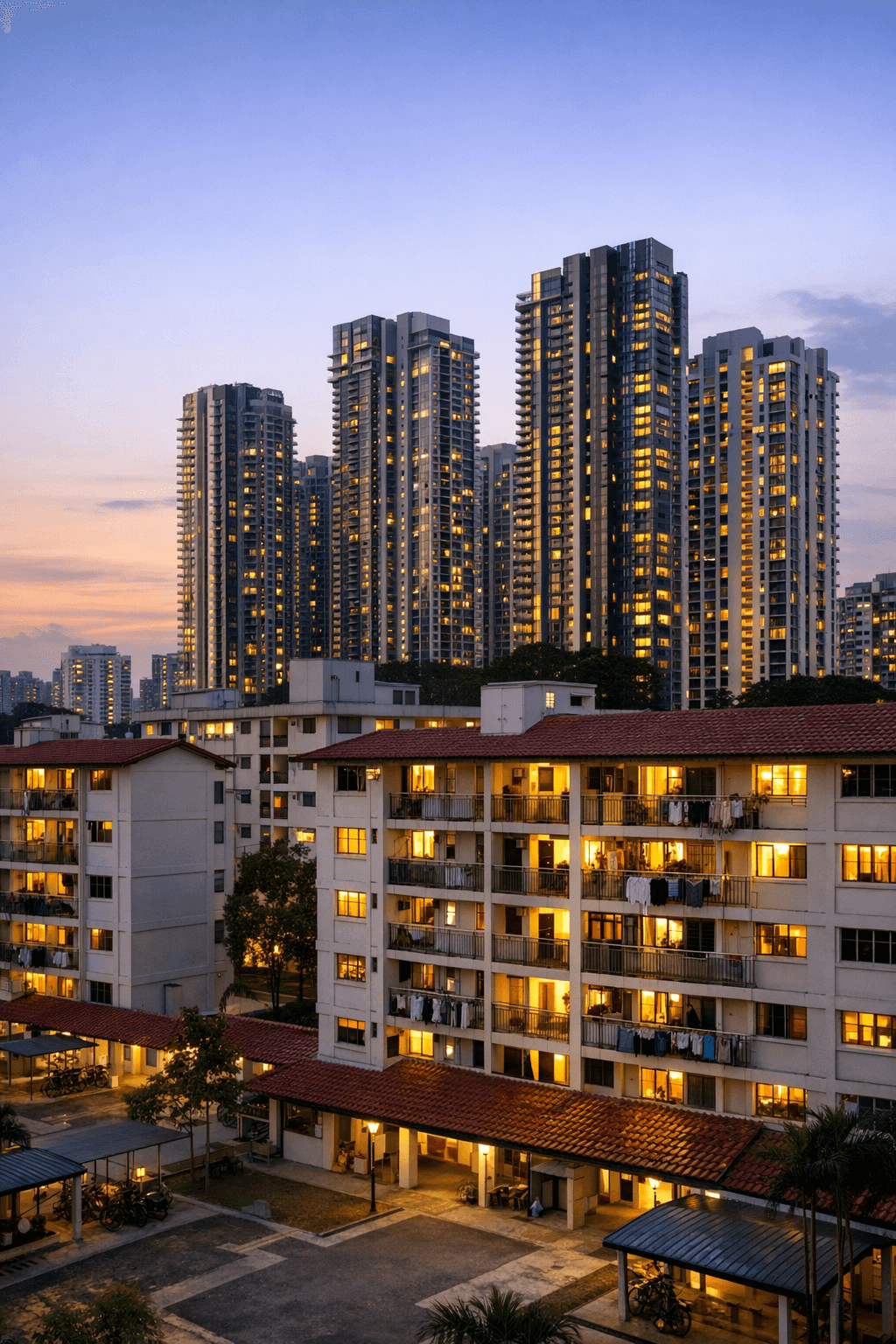
The Straits Times just reported that one of Singapore's most familiar old buildings has finally been sold whole — and that the deal marks a turn in the mood of the market: after a long quiet spell, collective sales are stirring again, but sellers are getting realistic about price.
The en-bloc dream — the hope that an ageing block gets bought entire and its owners walk away with a small fortune — is one of the most Singaporean property stories there is. It's back. What's new is the reality check that now comes attached.
The building that waited
Tan Boon Liat Building — a low-rise on Outram Road known for its furniture shops — is one of many ageing developments where the en-bloc hope has hovered for years.
Tan Boon Liat Building is one of those places Singaporeans know without quite noticing — a low-rise block on Outram Road, its floors filled for decades with furniture and home-furnishing shops, standing quietly as glassier, taller towers went up all around it.
For years, the words 'en bloc' have drifted through buildings like it: the possibility that a developer might one day buy the whole thing, tear it down, and build something new — handing every owner a cheque larger than they could get selling alone. For plenty of ageing developments, that possibility has hovered for a decade or more without ever landing.
So the owners waited, the way owners of old buildings here tend to — half-hoping, half-resigned.
The sale that finally came — at a price
It sold en bloc to Kingsford Group for about $950 million, per The Straits Times — but at a lower reserve than owners first held out for.
This month, the wait ended. The Straits Times reported that Tan Boon Liat Building was sold en bloc to Kingsford Group for about $950 million — but at a lower reserve price than the owners had first held out for.
That detail is the whole story in miniature. The deal didn't happen at the number the sellers once wanted. It happened when the number came down to something a developer was willing to pay. After all the years of waiting, the sale closed on the market's terms, not the owners' wish list.
And Tan Boon Liat, it turns out, isn't alone.
A revival with a reality check
People's Park Centre is on its third collective-sale try at a lower $1.48b guide, and a Frasers-led consortium bid $2.13b for the Bayshore Drive site — appetite is back, but only where prices are realistic.
Across the market, the collective-sale machine is warming up again. The Straits Times reported that People's Park Centre — the landmark complex in the old city core — is going for its third collective-sale attempt, this time at a lower $1.48 billion guide price. And developer appetite is plainly there: a Frasers Property-led consortium bid $2.13 billion for the Bayshore Drive site in the east, outbidding two rivals.
Put together, they sketch the shape of this revival: the buyers are ready, the sites are stirring — and the deals that actually close are the ones where the seller has accepted the market's price. The dream is back, with a reality check stapled to it. So we pulled our own data to show the backdrop the sellers are reading.
How is Singapore's private property market doing right now?
Still rising, but slowly — the private Property Price Index was up 2.9% year-on-year in 2026Q2, yet just 0.5% quarter-on-quarter.
On PropKaki's read of the official URA figures, the private market is still rising — just far more gently than it was.
| Private Property Price Index — 2026Q2 | Change |
|---|---|
| Quarter-on-quarter | +0.5% |
| Year-on-year | +2.9% |
Prices are higher than a year ago, but the last quarter barely moved — a +0.5% crawl. That combination matters here. A market grinding upward slowly, rather than galloping, is one where a developer can't count on tomorrow's selling prices to rescue a rich land bill today. When quarterly momentum cools, so does the price a developer will pay for a whole site — which is precisely the pressure nudging sellers to be realistic.
What are homes near these en-bloc deals actually worth?
Tan Boon Liat sits in District 3, where private homes transact at a $2.22M median ($2,829 psf); People's Park Centre is in District 1, at $2.13M ($2,809 psf).
It helps to see the ground these buildings sit on. Tan Boon Liat is in District 3 (the Bukit Merah / Tanjong Pagar belt); People's Park Centre sits in District 1, the old city core. Here's what private homes there actually transact at, on PropKaki's read of the sale records:
| District | Median private price | Median PSF |
|---|---|---|
| D03 — Bukit Merah / Tanjong Pagar | $2.22M | $2,829 |
| D01 — People's Park / city core | $2.13M | $2,809 |
These sit firmly among the pricier close-to-town districts — which is why a whole site here can command nine or ten figures. But it's also why the sums are so sensitive: at roughly $2,800 per square foot for finished homes, a developer only makes the maths work if the land goes for a realistic price. (These are transacted, not asking, prices over a trailing window; the median PSF is the more like-for-like gauge, since the median price shifts with whatever mix of unit sizes happened to sell.)
Why are sellers turning realistic on en-bloc prices?
A developer only bids what leaves room for land, build cost and margin at achievable selling prices — and with the index barely rising each quarter, peak-boom reserves no longer add up.
Because the arithmetic of a collective sale is unforgiving.
For a deal to happen, a single developer has to buy the entire site, and a developer will only bid what leaves room for three things: the land, the cost of building, and a margin — all measured against the prices the new homes can realistically fetch. In the boom years, when prices were climbing fast, owners set high reserves and developers stretched to meet them, betting the market would keep rising.
That bet is harder now. With the index inching up just 0.5% a quarter, the old peak reserves no longer pencil out. So the sites that sell are the ones whose owners meet the market: Tan Boon Liat closed at a lower reserve; People's Park Centre is back at a lower $1.48 billion guide. Realism, in other words, isn't the sellers giving up — it's the thing that finally gets the deal done.
The en-bloc reality check, in plain terms
An en-bloc payout is real, but it's gated by what a developer can profitably build — so the deals closing now are priced for today's market, not the last boom.
An en-bloc payout is real, and it can be life-changing. But it's gated by what a developer can profitably build on the site. A reserve price set for the last boom can leave a building sitting unsold for years — three tries, in People's Park Centre's case. The deals going through now are the ones priced for today's market, not the peak. The dream still pays out; it just pays at the market's number, not the owner's.
What does the en-bloc revival mean if you own in an older development?
The appetite is genuine but selective — it flows to well-located sites with redevelopment headroom, priced to a reserve a developer can actually build on.
If you own a unit in a development that dreams of a collective sale, three honest reads:
- The revival is real, but selective. Developer appetite is clearly back — a $2.13 billion bid for one site is not a shy market — but it flows to well-located sites priced sensibly, not to every ageing block that puts up a for-sale sign.
- Location and redevelopment headroom decide it, not age alone. A central, well-connected plot with room to build more is what draws a bid; a tired building in the wrong spot can wait indefinitely, however much its owners want out.
- The reserve has to meet the market. The buildings selling now are the ones whose owners accepted a number a developer could actually build on. A reserve anchored to the last boom is how a collective sale fails — often more than once.
None of this is advice on your own block — just the pattern the recent deals are drawing.
What does the revival mean for buyers?
Collective sales recycle ageing central sites into new homes — more new-launch supply in mature districts over the next few years, priced to recover large land bills.
Collective sales are, in the end, a recycling machine: they turn ageing, well-located sites into new homes. A wave of them means more new-launch supply landing in mature, close-to-town districts over the next few years — and, because the land bills are large, those launches tend to be priced to recover them.
The Bayshore Drive site is the clearest picture of what's coming: at a reported $2.13 billion, it isn't a single tower but the seed of a whole new estate in the east. For buyers, the en-bloc revival won't move this month's resale prices — but it is quietly redrawing the launch pipeline you'll be shopping from a few years from now.
How we sourced this
The market figures come from URA's private Property Price Index; the district medians from the full transacted private-sale record. The deal figures are from The Straits Times' reporting.
PropKaki reads two official records directly. The market figures come from URA's private residential Property Price Index (2009Q1 = 100), here for 2026Q2; the district medians come from the full transacted private-sale record, cut by postal district over roughly the last twelve months.
Two caveats we carry rather than bury. The PPI is an index — it tracks relative movement across the whole private market, not dollar prices, and the latest quarter can be a provisional flash estimate that URA later revises. The district figures are transacted prices (not asking prices) over a trailing window, with the median PSF the more like-for-like gauge. And the deal figures — the $950 million, the $1.48 billion, the $2.13 billion — are from The Straits Times' reporting, not PropKaki data; we've attributed each where it appears.
Sources
- PropKaki analysis of URA private residential Property Price Index and transacted private-sale records.
- The Straits Times — Tan Boon Liat's $950m sale adds to en bloc momentum as sellers turn realistic (original reporting).
- The Straits Times — Tan Boon Liat Building sold en bloc to Kingsford Group at $950 million.
- The Straits Times — People's Park Centre guns for a third collective sale at a $1.48 billion guide.
- The Straits Times — Frasers Property-led consortium's $2.13 billion Bayshore Drive bid.
About this commentary
This is editorial analysis by the PropKaki Editorial Desk, written for general information only — it is opinion and context, not a valuation, financial advice or a recommendation. The collective-sale deals are drawn from published reporting; the market and district figures are from URA and transacted-sale records analysed by PropKaki. Always verify prices, guides and scheme details against official sources (URA, and the relevant sale committee's marketing agent) before acting.
Got a question this raised? Ask PropKaki.
Take any point from this analysis and apply it to your own project, budget or decision.
 PropKaki
For most buyers this year, staying well within budget beats trying to time the market.