

A $2.13 Billion Bet Is Building a New Waterfront Town on Singapore's East Coast
A Frasers Property-led consortium has topped two rivals to win the Bayshore Drive site — up to 1,280 homes, a mall and a new MRT station on one of the last big open spaces by the sea. Here's what the east coast costs today, and an honest read on what the new town could (and couldn't) do to it.
A Frasers Property-led consortium has placed the top bid — about $2.13 billion — for the Bayshore Drive mixed-use site on Singapore's east coast, outbidding two rival groups, according to The Straits Times. The reporting says the government land-sales plot will hold up to 1,280 private homes, a retail town centre and links to the upcoming Bedok South MRT station on the Thomson-East Coast Line, with completion around 2030. It sits in postal district D16 (Bedok / Upper East Coast), where private homes have transacted at a median $1.88M, or $2,514 psf, across 1,528 sales over the past ~12 months — the sixth-priciest of Singapore's 27 districts by PSF, and the seventh-busiest by number of sales. A land bid, though, is not a launch price: it sets the developer's floor, not the eventual price list, and our figures are transacted, trailing prices, not a forecast.
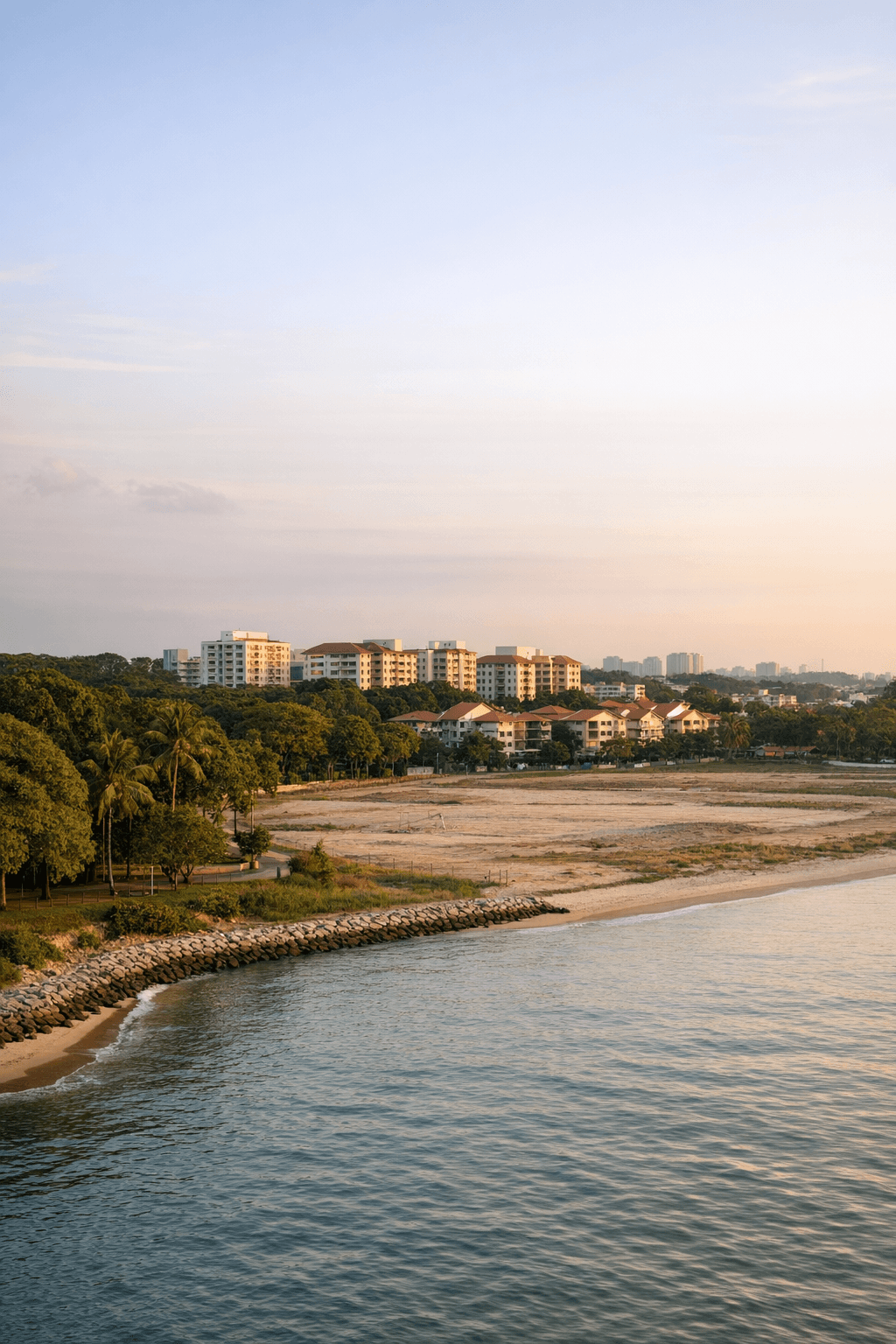
The Straits Times just reported that a Frasers Property-led consortium has placed the top bid — about $2.13 billion — for a large mixed-use plot on Bayshore Drive, on Singapore's east coast, edging out two rival groups. On paper it is a government land tender: one parcel, changing hands.
But it is also the moment a quiet, low-rise stretch of coastline was told what it will become — a brand-new waterfront town, with more than a thousand homes, a mall and its own MRT station, on one of the last big open spaces by the sea. For anyone who grew up cycling East Coast Park or queuing at the hawker stalls nearby, that lands somewhere between thrilling and unsettling. And it raises the question every east-coast owner, and every buyer eyeing the area, is quietly asking: what does a $2.13 billion bet do to the cost of living out here?
The coast we already love
For a long time the east coast has been one of the most lived-in corners of Singapore — the park, the sea breeze, the hawker food, and blocks that never grew too tall.
Ask people what they love about the east and you'll hear the same things. The long green ribbon of East Coast Park, bicycles and barbecue pits and the smell of the sea. Hawker centres people drive across the island for. Low-rise estates where the afternoon light still reaches the ground, and neighbours who have known each other for decades.
It has never been the flashiest part of Singapore, and that was rather the point. The east was where ordinary life happened well — close to the water, close to town, unhurried. That settled, low-rise familiarity is exactly what is about to change.
The last big space by the sea just got spoken for
A Frasers Property-led consortium has topped two rivals with a ~$2.13 billion bid for the Bayshore Drive GLS site — up to 1,280 homes, a retail centre and a new MRT link.
This month, a Frasers Property-led consortium placed the winning bid — about $2.13 billion — for the Bayshore Drive mixed-use site, outbidding two other groups, The Straits Times reported. It is one of the last large parcels of private-housing land in the area, released by the state through its Government Land Sales (GLS) programme.
What goes there is not a single condo. The reporting describes a small new town: up to 1,280 private homes and around 22,500 square metres of shops and a retail centre meant to anchor the wider Bayshore and Bedok catchment, wired directly into the upcoming Bedok South MRT station on the Thomson-East Coast Line and a new bus interchange, a short walk from East Coast Park. Completion is estimated around 2030.
The scale is the story. A single bid has just set the future shape of a piece of coastline that has looked much the same for a generation.
A new town, dropped on a settled one
When a whole new estate lands on an established, sought-after district, the first question owners ask is what it does to prices. So we pulled what the east coast costs today.
Here is why this is more than a property-page headline. Singapore has built brand-new districts before, and the homes around them have tended to do well — think of what Marina Bay did to the land beside it. The promise of Bayshore is a smaller, greener version of that: a walkable, transit-linked town on the water, dropped into a district people already want to live in.
Which lands on the question every east-coast homeowner, and every buyer eyeing the area, is quietly turning over: if a new town rises here, what happens to the cost of living in it? So we pulled the numbers on what private property on the east coast actually costs today — the baseline everything from here will be measured against.
What does private property on the east coast cost today?
Over the past year, private homes in district D16 (Bedok / Upper East Coast, where Bayshore sits) transacted at a median $1.88M, or $2,514 per square foot, across 1,528 sales.
Bayshore sits in postal district D16, which covers Bedok and the Upper East Coast. Over the last roughly twelve months, private homes there changed hands at a median price of $1.88M, or $2,514 per square foot, across 1,528 recorded sales.
| Bedok / Upper East Coast (D16) private homes | Last ~12 months |
|---|---|
| Median price | $1.88M |
| Median PSF | $2,514 |
| Recorded sales | 1,528 |
Those are transacted prices — what buyers actually paid, lodged with URA — not hopeful asking prices. And the volume matters as much as the level: at more than 1,500 sales in a year — the seventh-highest of 27 districts — D16 is one of the busier private-housing districts on the island. This is a deep, liquid, well-established market — not a quiet backwater waiting to be discovered.
How does the east coast sit on the island's price ladder?
At $2,514 psf, D16 is the sixth-priciest of Singapore's 27 districts — about 16% below the dearest and just over double the cheapest. It is an upper-tier district already.
Put D16 on the national ladder and it sits high — well into the upper tier, though short of the central core.
| District | Median PSF (private) |
|---|---|
| D09 — the island's priciest (Orchard / River Valley) | $2,999 |
| D16 — Bedok / Upper East Coast | $2,514 |
| D25 — the island's most affordable (Woodlands) | $1,239 |
At $2,514 psf, the east coast transacts only about 16% below the island's priciest district (D09, $2,999) and at just over double the most affordable (D25, $1,239) — the sixth-dearest of all 27 districts by PSF. This is not the cheap end of town. Buyers already pay a clear premium to be near the water and the park, which is precisely why a developer was willing to stake $2.13 billion on more of it. The baseline the new town is being built on is a high one. For all 27 districts ranked by PSF, see PropKaki's full district PSF league table. It is a separate snapshot of the twelve months to 7 July 2026, three weeks before this analysis, so its medians differ slightly from the ones here.
What does a $2.13 billion bet actually signal?
Developers don't stake $2.13 billion on a place they think is peaking — a new MRT, a town centre and a mall are long-term placemaking. But it is a bet on the district, not a promise for any one home.
A land bid this size is a considered, long-horizon wager, not a punt. A consortium's worth of capital does not chase a location it expects to fade — it chases one it expects more people to want. And the ingredients here are the ones planners lean on to lift an area over time: a new MRT station on the doorstep, a bus interchange, a retail centre with its own draw, and a walkable town built from scratch beside an existing park.
There is a useful number buried in the deal. The winning bid works out to roughly $1,323 per square foot of built space, according to the reporting — and that is just the land. Add construction, financing and the developer's margin, and the finished homes will be priced well above it. A land bid tells you the developer's floor and their conviction; it does not tell you the eventual price list. What it clearly signals is that a serious player expects the east coast to be worth more, to more people, than it is today.
What could it do to east-coast prices — and what might it not?
A funded, transit-linked new town can support nearby values over time — but the payoff is years away, some optimism is already in today's high prices, and 1,280 new homes are also fresh competition.
The honest answer: it can help, gradually, with real caveats on both sides.
The case up. New amenities and transport tend to firm up demand for homes within a short walk of them. A town centre, a mall, a station and a fresh stock of modern homes change what an area is, and settled districts with a new catalyst have historically held their value well. If you already own on the east coast, this is a tailwind.
The case for restraint. First, time — completion is estimated around 2030, so any effect plays out over years, not quarters. Second, it may be partly priced in already — D16 already trades at $2,514 psf, near the top of the island, so some of tomorrow's optimism likely sits inside today's number. Third, new supply cuts both ways — 1,280 brand-new homes are also 1,280 shiny competitors for anyone trying to sell an older unit nearby, and a large launch can cap resale prices as much as lift them. Nor is being near a station a profit guarantee: in PropKaki's matched-resale study of MRT proximity, homes near a station barely beat the wider market on the odds of a profitable resale. The likeliest outcome is support, not a windfall.
Should I buy on the east coast because of this?
Buy on the fundamentals that matter to you — budget, the specific unit, the lease, your timeline — and treat the Bayshore upside as a possible bonus, not the reason.
This is opinion, not advice, so take it as a frame rather than a nudge. The Bayshore project is a genuine, funded, dated catalyst — which makes it a good reason to look at the east, and a poor reason to overpay there.
The useful question isn't "will the east coast boom?" It's "does this specific home make sense for me at today's price, if the new town delivers nothing extra?" If the answer is yes — the unit fits your life, the lease suits your horizon, the sums work on your income — then any Bayshore upside is a bonus you're not paying full freight for. If you can only make the numbers work by assuming the boom, you're buying the render, not the home. And remember you can't buy into Bayshore itself yet: the site was only just awarded, and the homes are years and a launch price away.
The reality check: a land bid is not a launch price
The gap between a winning tender and a finished, priced home is long — and our figures are a trailing snapshot of transacted prices, not a forecast.
A few honest limits before anyone extrapolates a boom:
- A land bid is not a launch price. The ~$2.13 billion is what the land cost the developer; the eventual homes will be priced later, higher, and on the developer's terms. Nobody — including us — knows that number yet.
- The development figures are the reporting's, not ours. The bid, the 1,280 homes, the retail centre, the MRT link and the 2030 timeline come from The Straits Times' coverage of the tender, not from PropKaki data.
- Our prices are transacted and trailing. The D16 figures are what actually sold over the past ~12 months, lodged with URA — not asking prices, and not a prediction. A district median also shifts with the mix of units that happened to sell; the PSF is the more like-for-like gauge.
- Plans and timelines can move. A tender award is the start of a long build, and completion dates, unit counts and phasing can all change along the way.
Methodology: how we sourced this
Corrected 15 September 2026: an earlier version overstated D16's sales (2,044, now 1,528). The Bayshore deal details are from The Straits Times' reporting on the tender; the prices are PropKaki's read of transacted URA private-sale records for district D16.
⚠️ Corrected 15 September 2026. The version of this page published on 28 July overstated how many private homes sold in District 16. URA amends some caveat details after first publishing them, and our records had been keeping the original and the amended caveat as two separate sales — almost all of them new-launch sales. Corrected as at 28 July 2026, the date of the original analysis: D16 recorded 1,528 sales over the trailing twelve months, not 2,044, which makes it the seventh-busiest district rather than one with more than two thousand sales a year. Its median moves from $1.93M to $1.88M and from $2,541 to $2,514 per square foot, because the double-counted sales were new launches priced above the district's typical home. It is still the sixth-priciest district by PSF. D09's median is $2,999 psf rather than $3,025, and D25's $1,239 rather than $1,241; the comparisons drawn from them still hold.
The deal and the development details — the ~$2.13 billion bid, the Frasers Property-led consortium, the two rival bidders, the 1,280 homes, the retail centre, the Bedok South MRT link and the 2030 completion — come from The Straits Times' coverage, linked below. We haven't invented any of the development figures.
The price figures are ours: PropKaki tracks Singapore's transacted private-sale caveats, so we can read the current median price and PSF for any postal district — here, D16 (Bedok / Upper East Coast), across 1,528 sales in the trailing ~12 months, alongside the island's priciest (D09) and most affordable (D25) districts for context. Two caveats we carry rather than bury: these are transacted, not asking prices over a trailing window, and a district median reflects the mix of unit sizes that sold — the PSF is the more like-for-like level. Want the read for your own district, project or block? You can ask PropKaki.
Sources
- The Straits Times — Frasers Property-led consortium outbids two others with $2.13b offer for Bayshore Drive mixed-use site (the bid, consortium, home count, MRT link and timeline; primary source).
- Private-sale transaction records (URA caveats), analysed by PropKaki (district D16 median price, PSF and sales count; D09 and D25 for context).
- "Bayshore" refers to the coastal precinct in postal district D16 (Bedok / Upper East Coast) where the site sits.
About this commentary
This is editorial analysis by the PropKaki Editorial Desk, written for general information only — it is opinion and context, not a valuation, financial advice or a recommendation. The development details are drawn from published reporting; the price figures are from transacted private-sale records. A land bid is not a launch price, and past area trends are not a promise. Always verify plans, prices and timelines against official sources (URA, HDB) before acting.
Got a question this raised? Ask PropKaki.
Take any point from this analysis and apply it to your own project, budget or decision.
 PropKaki
For most buyers this year, staying well within budget beats trying to time the market.