
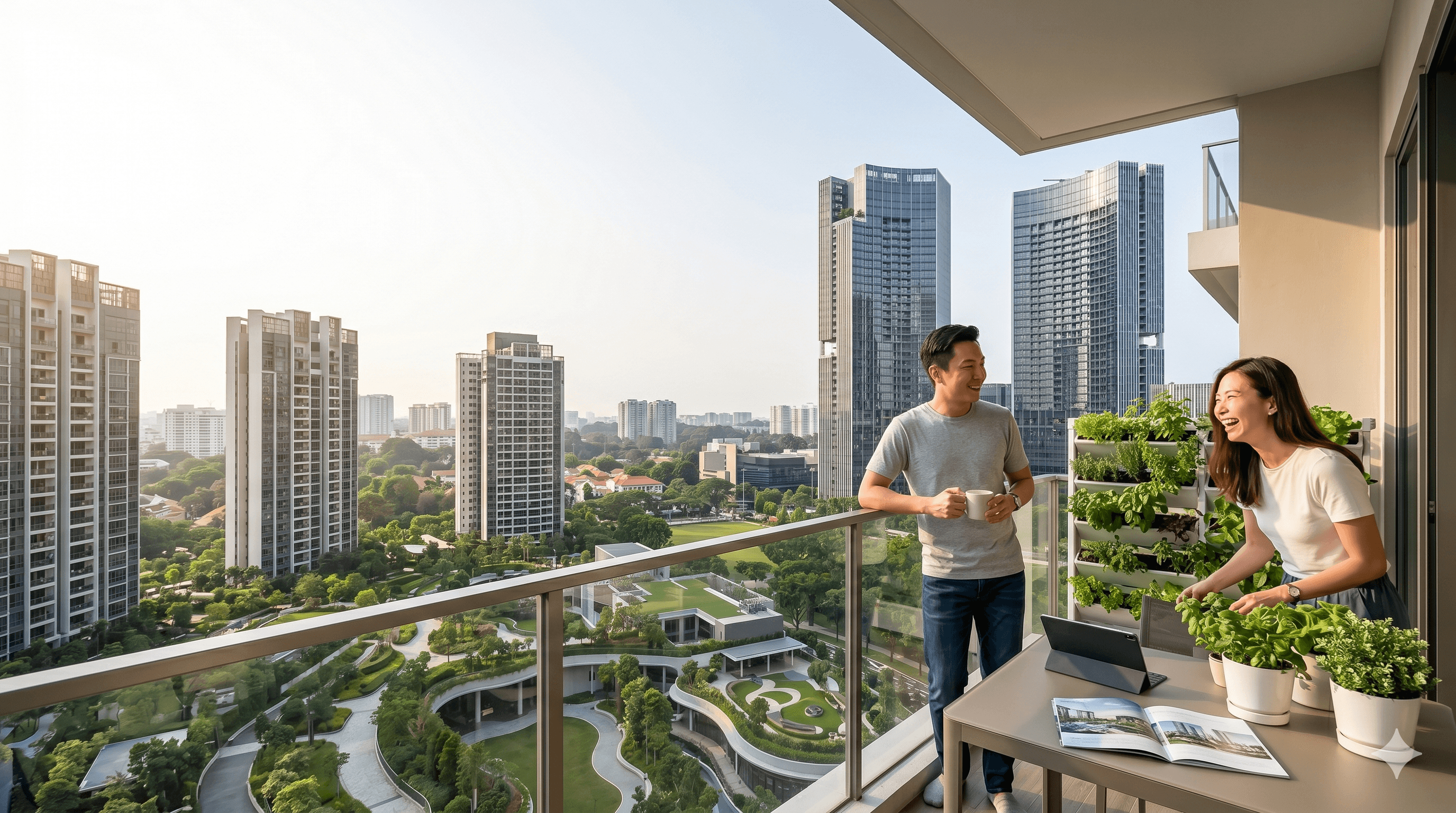
Shoebox and Micro Units in Singapore: How Small a Condo Can Be, What They Cost and Why New Ones Are Rarer
What counts as a shoebox unit, URA's 35 sqm minimum and its limits on small units, the smallest homes sold in the past year, and what small units sell and rent for.
A shoebox or micro unit is a very small private flat. There is no official size: URA's guides set a 35 sqm nett minimum for new private flats and condo units and, outside the Central Area, cap units of 50 sqm or less nett at 20% of a new development. PropKaki counts units of 50 sqm or less of strata area: 1,671 were sold from September 2025 to August 2026, 8.1% of condo and apartment units, at a median $918,000; the smallest was 30 sqm. Non-landed homes of up to 50 sqm let for a median $3,100 a month (August 2025 to July 2026).
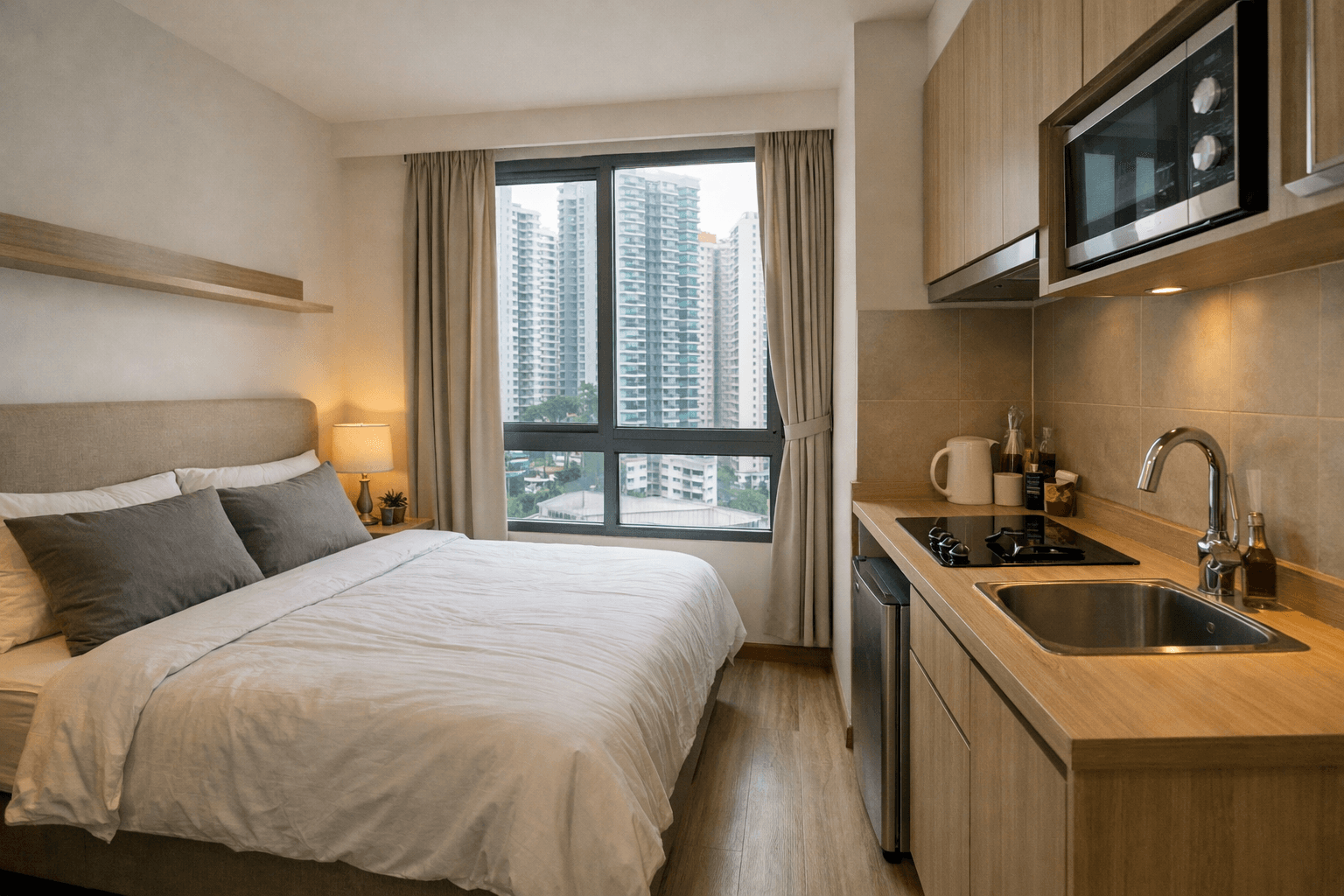
No rule says how big a shoebox unit is, yet URA has spent more than a decade limiting how many get built.
This guide sets out URA's rules on small homes, the smallest units sold in the past year, and what PropKaki's records show about how many small units sell and what they cost and rent for.
What are shoebox and micro units?
Very small private flats. Singapore has no official size for them: URA uses the word "shoebox" but sets rules by nett floor area instead. PropKaki counts units of 50 sqm or less of strata area (about 538 sq ft): 1,671 of the 20,556 condo and apartment units sold from September 2025 to August 2026, or 8.1%.
"Shoebox" and "micro unit" are market words for the smallest private flats. URA uses the first itself: in 2012 it limited the number of homes in new developments outside the Central Area "to moderate the excessive development of shoebox units" (URA). But no rule gives a shoebox a size. What URA does regulate is nett internal area, which excludes "voids, balconies, air-conditioner ledges and other external areas" (URA), and its rules mark two sizes:
- 35 sqm nett: the guide minimum for a self-contained home (next section).
- 50 sqm nett: outside the Central Area, a new development may have "A maximum of 20% of DUs with nett internal area of 50 sqm or less" (URA).
PropKaki uses URA's 50 sqm line for this guide: a small unit is one of 50 sqm or less of strata area (about 538 sq ft) in URA's records. From September 2025 to August 2026, 1,671 of the 20,556 single condo and apartment units sold were that small (8.1%), with a median size of 45 sqm.
A "studio" is a developer's layout name for a one-room unit, and HDB's current flat types include no studio or shoebox: our glossary explains, with rents for 1-bedroom homes. The glossary also defines the other terms used here (caveat, strata title, new sale, resale, psf).
"Shoebox" is a size people describe; nett floor area is the size URA regulates.
What is the smallest a condo unit can be in Singapore?
As a guide, 35 sqm of nett internal area for any new private flat or condo unit, under URA's dwelling-unit rules, which do not cover HDB flats or serviced apartments. Older units can be smaller: the smallest sold in the 12 months to August 2026 was 30 sqm of strata area, a resale. No new sale of a unit under 35 sqm of strata area has been recorded since September 2014.
URA's rule: "As a guide, all self-contained DUs island-wide shall be at least 35sqm nett in internal area", where nett means the "nett living space of a unit measured to the middle of the walls of the unit but excluding voids, balconies, air-conditioner ledges and other external areas" (URA). The rules on unit numbers and sizes "do not apply to HDB flats and Serviced Apartments" (same page).
What the records show, using the strata area URA's caveats carry:
- 1,662 sales of units under 35 sqm of strata area since 1995, new and resale (a unit sold twice counts twice).
- No new sale of one has been recorded since September 2014.
- The smallest sold in the past year was 30 sqm (next section).
Strata floor area and nett internal area are different measures: nett leaves out voids, balconies, air-conditioner ledges and other external areas, so ask how much of a unit's recorded size is outside its living space.
For a new private flat, 35 sqm nett is URA's guide minimum; for an older one, check the strata plan.
What is the smallest condo in Singapore?
By sales in the past year, units of 30 sqm: the smallest unit sold from September 2025 to August 2026 was a 30 sqm (323 sq ft) resale at Loft@Holland, for $810,000. The record shows units that sold, so a smaller unit that did not change hands would not appear.
The smallest single condo and apartment units sold from September 2025 to August 2026, by strata area (every sale of 31 sqm or less):
| Project | Strata area | Price | Month | Type of sale |
|---|---|---|---|---|
| Loft@Holland | 30 sqm (323 sq ft) | $810,000 | May 2026 | Resale |
| Suites @ Shrewsbury | 31 sqm (334 sq ft) | $705,888 | October 2025 | Resale |
| Attitude At Kim Yam | 31 sqm (334 sq ft) | $718,000 | November 2025 | Resale |
| Airstream | 31 sqm (334 sq ft) | $605,000 | June 2026 | Resale |
PropKaki analysis of URA caveats. Caveats are voluntary, so some sales never appear (URA).
Next came 5 sales at 32 sqm: Espada, Parc Somme, Suites @ Sims (3). All four were resales. Every unit's recorded sales are on PropKaki's condo directory and property transactions finder; URA's own transactions e-service covers the last 60 months.
The smallest homes sold in the past year were all resales, not new launches.
Why are new shoebox units rarer now?
Outside the Central Area, URA has capped how many homes a new development may have since 2012 and tightened the cap in 2018, and it says those rules have been "effective in achieving a good mix". Small units were 22.7% of new-sale units in 2019 and 9.9% in 2025; PropKaki's records show the fall, not its cause.
URA's rules, in order:
- 2012. URA limited the number of homes in a non-landed development outside the Central Area "to moderate the excessive development of shoebox units": the development's gross floor area divided by 70 sqm (URA).
- 2018. Having "observed smaller dwelling unit sizes in new private housing projects", URA raised the divisor to 85 sqm for development applications submitted from 17 January 2019 (URA), and asked for "at most 20% of the DUs with a nett internal area of less than 50sqm" (URA). In nine areas the divisor is 100 sqm (URA).
- 2022. Inside the Central Area there is still no cap on numbers, but for development applications submitted on or after 18 January 2023, new developments "will be required to provide a minimum of 20% of DUs with a nett internal area of at least 70sqm", after URA "observed a persistent trend in declining DU sizes" there (URA).
URA's own verdict on the 2018 rules: they "have been effective in achieving a good mix of both smaller and larger units in new private housing developments outside the Central Area" (same circular).
Units of 50 sqm or less of strata area, by year:
| Year | New-sale units | 50 sqm or less | Share | All units sold, 50 sqm or less | Share |
|---|---|---|---|---|---|
| 2005 | 6,964 | 70 | 1.0% | 92 | 0.7% |
| 2006 | 8,825 | 261 | 3.0% | 304 | 1.5% |
| 2007 | 11,924 | 429 | 3.6% | 611 | 1.9% |
| 2008 | 3,767 | 366 | 9.7% | 462 | 4.2% |
| 2009 | 12,730 | 971 | 7.6% | 1,220 | 4.3% |
| 2010 | 14,228 | 2,030 | 14.3% | 2,518 | 7.7% |
| 2011 | 14,923 | 2,928 | 19.6% | 3,438 | 11.9% |
| 2012 | 19,578 | 3,944 | 20.1% | 4,498 | 13.8% |
| 2013 | 14,705 | 2,784 | 18.9% | 3,115 | 14.6% |
| 2014 | 6,951 | 1,459 | 21.0% | 1,689 | 14.6% |
| 2015 | 7,176 | 1,238 | 17.3% | 1,536 | 12.0% |
| 2016 | 7,624 | 1,716 | 22.5% | 2,161 | 14.6% |
| 2017 | 9,712 | 1,471 | 15.1% | 2,420 | 11.1% |
| 2018 | 8,055 | 1,624 | 20.2% | 2,615 | 13.5% |
| 2019 | 8,827 | 2,006 | 22.7% | 2,638 | 15.9% |
| 2020 | 9,369 | 1,681 | 17.9% | 2,500 | 13.7% |
| 2021 | 12,533 | 1,928 | 15.4% | 3,624 | 12.3% |
| 2022 | 6,790 | 731 | 10.8% | 2,312 | 11.8% |
| 2023 | 6,240 | 731 | 11.7% | 2,278 | 12.9% |
| 2024 | 6,237 | 525 | 8.4% | 2,020 | 10.2% |
| 2025 | 10,661 | 1,054 | 9.9% | 2,609 | 10.8% |
PropKaki analysis of URA caveats: single condo and apartment units, by strata area. Rules apply to development applications, and projects reach the market years later, so a rule's effect cannot be read off one year.
New-sale small units peaked at 3,944 in 2012. Their share of new sales ranged from 15.1% to 22.7% between 2011 and 2021, and from 8.4% to 11.7% between 2022 and 2025. The share peaked in 2019, the year the 2018 revision began to apply to new applications, and was lower from 2022.
Small units have not disappeared; outside the Central Area they are now a capped share of each new project.
How many shoebox units are sold in Singapore, new and resale?
From September 2025 to August 2026, 1,671 units of 50 sqm or less were sold: 1,221 resales, 403 new sales and 47 sub sales. They were 10.4% of resales but 4.9% of new sales.
| Type of sale | All units sold | 50 sqm or less | Share | Median price, 50 sqm or less |
|---|---|---|---|---|
| New Sale | 8,181 | 403 | 4.9% | $1,487,000 |
| Sub Sale | 644 | 47 | 7.3% | $1,030,000 |
| Resale | 11,731 | 1,221 | 10.4% | $840,000 |
PropKaki analysis of URA caveats, September 2025 to August 2026: single condo and apartment units; ECs and landed homes left out.
Outside the Central Area, a new-launch buyer meets small units as a capped slice of each project (previous section). Compare any unit with recent sales in the same project on the property transactions finder, and new launch against resale in our new launch vs resale guide.
Most shoebox units sold in the past year were second-hand.
How much does a shoebox unit cost in Singapore?
From September 2025 to August 2026, units of 50 sqm or less sold for a median $918,000 ($1,935 per sq ft), against $1,952,200 for all condo and apartment units. New small units cost more: a median $1,487,000 for new sales against $840,000 for resales.
By size, September 2025 to August 2026:
| Strata area | Units sold | Median price | Median $ psf |
|---|---|---|---|
| Under 35 sqm | 30 | $707,944 | $1,962 |
| 35 to 39 sqm | 161 | $730,000 | $1,816 |
| 40 to 45 sqm | 763 | $888,000 | $1,921 |
| 46 to 50 sqm | 717 | $1,045,000 | $1,991 |
PropKaki analysis of URA caveats: single condo and apartment units of 50 sqm or less. Recorded prices, not valuations.
New or resale makes a big difference: new small units sold for a median $1,487,000, resales $840,000. The median price per square foot of small units, $1,935, sits below that of all units, $2,129, because of the mix: most small units sold were resales. Within each type, small units cost more per square foot: $2,986 against $2,663 for new sales, and $1,790 against $1,775 for resales. Why a low quantum can hide a high psf, and the reverse, is in quantum vs psf and price per square foot.
For a specific unit, compare it with sales of the same size in the same project on the property transactions finder, and test the loan and cash you need in the property financial planner.
A small unit is a smaller cheque but usually a dearer square foot: compare it with units of the same size.
How much rent does a shoebox unit get?
From August 2025 to July 2026, non-landed homes of up to 50 sqm let for a median $3,100 a month across 14,660 contracts: $2,900 for 30 to 40 sqm and $3,150 for 40 to 50 sqm, against $3,500 for 50 to 60 sqm. They were 16.9% of non-landed rental contracts.
| Floor area (URA band) | Contracts | Median monthly rent |
|---|---|---|
| 20 to 30 sqm | 51 | $2,200 |
| 30 to 40 sqm | 2,816 | $2,900 |
| 40 to 50 sqm | 11,793 | $3,150 |
| 50 to 60 sqm | 8,582 | $3,500 |
PropKaki analysis of URA rental contracts for non-landed private homes, August 2025 to July 2026, by URA's floor-area bands. A band's median is not the rent for any one unit.
Whether a small unit's rent justifies its price depends on that unit's own price and rent, not on these medians. How to work it out is in how to calculate rental yield. Rents for 1-bedroom homes, and what a "studio" usually is, are in our glossary.
Rent the size, not the label: URA's records are banded by floor area, and so should your comparison be.
The biggest mistake people make with shoebox units
Taking the recorded size as the space you live in. URA's sale records give strata floor area; URA's 35 sqm and 50 sqm rules use nett internal area, which leaves out voids, balconies, air-conditioner ledges and other external areas. Ask how much of a unit's recorded size is outside its living space.
URA defines nett internal area as the "nett living space of a unit measured to the middle of the walls of the unit but excluding voids, balconies, air-conditioner ledges and other external areas" (URA). The size in a caveat, and the one URA works out price per square foot on, is strata floor area (URA): a different measure.
Before you buy:
- Get the floor plan with areas, and see how much of the recorded size is balcony, ledge or void.
- Compare like with like: small units with small units in the same project, on price and on price per square foot.
- Check the MCST's by-laws if you plan to let the unit: they can govern how the home is used and let.
Buy the living space, not the strata area.
Official sources
The URA and HDB pages this guide quotes.
Methodology and sources
Where the figures come from, and what we have not claimed.
PropKaki figures. URA caveats as held by PropKaki, from 1995: single apartment and condominium units (ECs, landed homes and caveats covering several units left out), sized by the strata area URA records. A small unit is one of 50 sqm or less of strata area, PropKaki's line, taken from URA's 50 sqm rule. Past-year figures cover September 2025 to August 2026; yearly figures are exact counts by calendar year. Counts are sales, not distinct units: a unit sold twice counts twice. Rents are URA's rental contracts for non-landed homes, August 2025 to July 2026, by URA's 10 sqm floor-area bands. Caveats are voluntary, so some sales never appear, and URA notes "a time-lag of a few months" between buying from a developer and lodging the caveat, so the latest months' new sales are incomplete. How we work: PropKaki methodology.
Rules. URA's dwelling-unit guidelines and its 2018 and 2022 circulars, read on 26 September 2026; HDB's flat types through our glossary.
What we have not claimed: that URA's rules alone caused the fall in small new units (URA's own assessment is quoted); any unit's nett area; a rental yield (the prices and rents here come from different homes); or whether a small unit is a good buy. This is general information, not legal or financial advice.
Got a question this raised? Ask PropKaki.
Take any point from this analysis and apply it to your own project, budget or decision.
 PropKaki
For most buyers this year, staying well within budget beats trying to time the market.