
Dual-Key Units in Singapore: How They Work, the Rules for Letting One Side, and HDB's Old Multi-Gen Flats
What a dual-key home is (and isn't, legally), the occupancy, stay and tax rules that apply when you let one side, whether HDB allows dual-key flats, and what the 1980s multi-generation flats resell for.
A dual-key unit is a home laid out as two self-contained parts, usually a main unit and a studio with separate front doors off a shared foyer. No URA, HDB or IRAS rule we found defines it. Letting one side of a private home follows the rules for the whole property: tenants stay at least three consecutive months, and six unrelated occupants at most (eight for registered homes of 90 sqm or more). Owner-occupier property tax rates still apply if you live in the other side. HDB sells no dual-key flats; its 1980s multi-generation flats resold at a median $1,120,000 in 2024-09 to 2026-08.
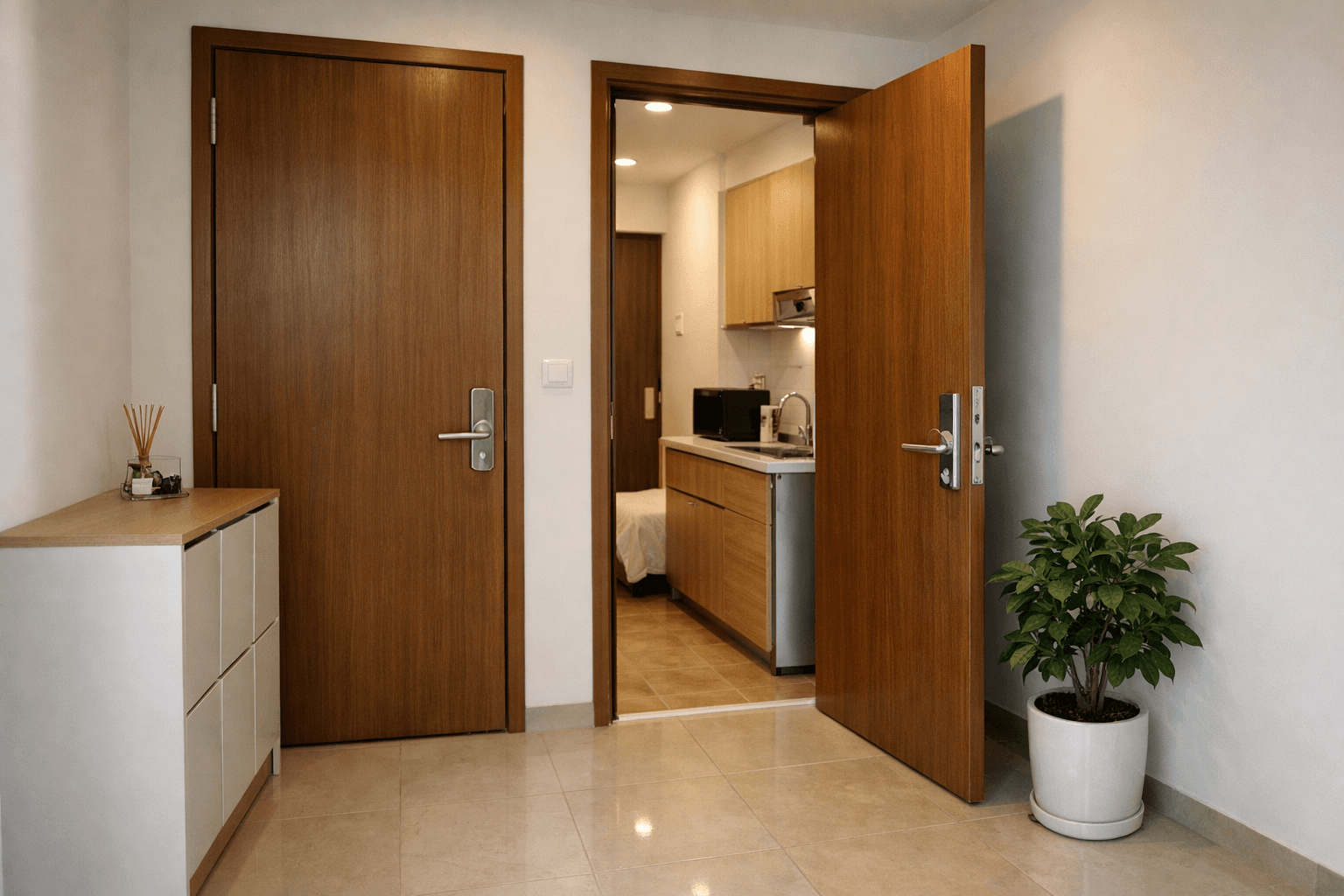
A dual-key unit splits one home into two self-contained parts, so a family can live in one and let or share the other. The term comes from developers and the market, not from any rule.
This guide sets out the rules that do apply when you let one side of a private home, whether HDB allows dual-key flats, and what HDB's own records show about its 367 multi-generation flats from the 1980s.
What is a dual-key unit?
A home laid out as two self-contained parts, usually a main unit and a studio, each with its own front door off a shared entrance foyer, so one household can live in one part and use or let the other. It is a developers' and market term: no URA, HDB or IRAS rule we found defines it, so the approved plans and the title decide what you are buying.
A dual-key unit is one home split into two living spaces that share an entrance foyer. A news description of one of HDB's 1980s multi-generation flats captures the idea: "a three-bedroom main unit and a separate 1-bedroom studio space, with each section having its own living facilities, including separate kitchens and living rooms", where the two "share an entrance foyer" but "have separate front doors" (Mothership, 9 July 2026).
"Dual-key" is not a legal category. URA's property-market glossary defines no unit layouts, dual-key included (URA), HDB's list of flat types has no dual-key flat (HDB), and no URA, HDB, MND or IRAS page PropKaki searched uses the term. So three records tell you what a particular unit really is:
- The approved plans: what URA approved the layout as. URA encourages owners who rent out a private home "to retain the approved internal layout" (URA).
- The title: what you would own, from a title search on SLA's INLIS.
- The MCST's by-laws, for a unit in a condominium: they can govern how the home is used and let.
The terms here (strata title, MCST, MOP) are in our Singapore property glossary.
"Dual-key" is a floor plan, not a legal status: the plans and the title are what you buy.
How does a dual-key unit work if you rent out one side?
In a private home, you live in one part and let the other within URA's rules for the whole home: every tenant stays at least three consecutive months, and the home is capped at six unrelated occupants (eight for homes of 90 sqm or more that register, until the end of 2028). Letting part of an HDB flat follows HDB's bedroom rules instead. Rent is taxable income.
Private homes. URA's rules for renting out a private home apply to the property, so both sides together, if the unit is one property on one title (URA):
- Minimum stay. "All occupants are to fulfil a minimum stay duration of three consecutive months." Short-term letting, "defined as stays of less than three consecutive months", is not allowed for any home (URA).
- Occupancy cap. "Private residential properties smaller than 90sqm are subject to an occupancy cap of six unrelated persons per property", and "Unrelated persons refer to anyone who is not part of the same family unit". From 22 Jan 2024 to 31 Dec 2028, homes of "at least 90sqm strata / lot area" can register, for a $20 fee, to allow "up to eight individuals".
- Subletting counts. "The occupancy cap also applies to tenants who sublet the property. As the property owner, you must ensure that your tenants follow the rules."
- Registration. For private homes, "it is not necessary to register the tenants (e.g., name of occupants) with URA", but "Owners should check with their respective MCSTs if there are specific by-laws requiring such registration".
Part of an HDB flat is let by the bedroom, with HDB's approval: a 3-room flat may let 1 bedroom and a 4-room or bigger flat 2, with at most 6 and 8 occupants as HDB's page stood in September 2026, where "Occupants include owners, authorised occupiers and tenants" (HDB), and "The minimum rental period for each tenant must be 6 months per application" (HDB). The full HDB rules are in our guide to renting out an HDB flat or room.
Tax. "The rental income from subletting is taxable" (IRAS); property tax is covered below.
Two doors, one home: the occupancy cap and the minimum stay apply to the property, not to each side.
Is dual-key HDB allowed?
HDB does not sell dual-key flats today: its flat types have none. The closest is the 3Gen flat, with 4 bedrooms, 2 of them with attached bathrooms, for families buying with their parents. HDB did build multi-generation flats in the 1980s: its block record counts 367 in 8 blocks in Yishun, Tampines and Bishan, and they still change hands on resale.
Today. HDB's current flat types run from the Community Care Apartment to the Executive flat and the 3Gen flat, with no dual-key option (HDB). The 3Gen flat is HDB's answer for extended families: "With 2 bedrooms with attached bathrooms, and 2 other bedrooms, a 3Gen flat supports the needs of extended families" (same page), and you buy it "with your fiancé/ fiancée or spouse and your parents" (HDB). Who can buy one, what they cost and what they resell for are in our 3Gen flats guide.
Renting part of an HDB flat is done by the bedroom, with HDB's approval: "Only bedrooms originally constructed by HDB can be rented out. All other parts of the flat (including partitioned rooms) cannot be used as bedrooms for tenants" (HDB). The owner of a new 3Gen flat "cannot rent out any bedrooms within the MOP" (HDB).
The 1980s exception. HDB's resale records still carry a "multi-generation" flat type, and HDB counts these flats with Executive flats in its count of resale applications ("Includes Multi-Generation flats", HDB). HDB's block record counts 367 of them in 8 blocks, all with leases starting in 1987 and 1988; the 554 resales since 1991 were in these blocks:
| Town | Block and street | Resales, 1991 to September 2026 |
|---|---|---|
| Yishun | 666 Yishun Ave 4 | 134 |
| Yishun | 633 Yishun St 61 | 98 |
| Tampines | 460 Tampines St 42 | 79 |
| Tampines | 454 Tampines St 42 | 71 |
| Bishan | 137 Bishan St 12 | 56 |
| Bishan | 148 Bishan St 11 | 43 |
| Yishun | 632 Yishun St 61 | 37 |
| Yishun | 605 Yishun St 61 | 36 |
PropKaki analysis of HDB resale records on data.gov.sg (flat type "multi-generation", both spellings) and HDB's block record.
HDB's multi-generation flats are a closed chapter: 1980s blocks you can buy on resale, not a flat type you can apply for.
What do HDB's multi-generation flats sell for?
More than a typical Executive flat, and they are bigger. From 2024-09 to 2026-08, 9 multi-generation flats were resold at a median $1,120,000, against $900,000 for the 3,068 Executive flats resold over the same months; their median floor area was 165 sqm, against 146 sqm.
| 2024-09 to 2026-08 | Multi-generation flats | Executive flats |
|---|---|---|
| Resales | 9 | 3,068 |
| Median resale price | $1,120,000 | $900,000 |
| Median floor area | 165 sqm | 146 sqm |
PropKaki analysis of HDB resale records, the same 24-month window as our 3Gen flats guide. HDB leaves out resales between relatives and part-share sales.
With so few sales, one deal moves these numbers, so treat the median as a range finder, not a price for a particular flat. Recorded prices for each block are on PropKaki's HDB directory and property transactions finder. All eight blocks' leases began in 1987 and 1988; how the remaining lease affects CPF use and loans is in our 99-year leasehold guide.
A rare flat type is priced one deal at a time: check the block's own recent sales.
Does renting out one side change your property tax and income tax?
Property tax: not if you still live in the home. IRAS says: "If you partially let out your home while still living in it, you are still eligible for the owner-occupier tax rates." Income tax: the rent is taxable, and expenses on the home are apportioned by the rooms you let, or you use IRAS's deemed 15% of gross rent.
- Property tax: "Scenario 3: Renting part of your home If you partially let out your home while still living in it, you are still eligible for the owner-occupier tax rates" (IRAS). Owner-occupier rates do not apply where "You have wholly rented out your property" (same page).
- Income tax: "The rental income from subletting is taxable", and "Property owners are required to apportion the allowable expenses incurred based on the number of rooms rented out"; alternatively, "an amount of deemed rental expenses calculated based on 15% of the gross rent will be pre-filled in the online tax form" (IRAS).
If you move out and let both sides, the home is wholly rented out and the non-owner-occupier rates apply. How those rates compare, with worked figures, is in our property investing guide.
Live in one side and the home keeps its owner-occupier rates; let both and it becomes an investment.
Is a dual-key unit a good investment?
The public records cannot tell you: URA's sale and rental records carry a unit's size (and, for rentals, its bedrooms), not whether it is dual-key, so dual-key homes cannot be separated from other homes of the same size, and PropKaki does not estimate a premium. What you can check is the rent comparable homes get in the same project, the MCST's by-laws, and the rules on occupancy and stays.
The case for a dual-key home rests on two incomes or two households under one roof; the case against, on a possible price premium for the layout and the limits on letting. Neither can be measured in the official records, which record size and bedrooms, not whether a unit is dual-key.
What you can check for a specific unit:
- Rents. Recorded rents for studios and for units the size of the main side in the same project, on PropKaki's property transactions finder, rather than an advertised rental potential.
- The rules. The occupancy cap and three-month minimum stay (above), and any MCST by-law on tenants.
- The costs. Stamp duty, loan limits and tax on a home you do not fully live in, worked through in our property investing guide and the property financial planner.
Price the layout from recorded rents, not from a brochure's rental potential.
The biggest mistake people make with dual-key homes
Treating the second key as a second, separate property. If the unit is one property on one title, a private home's rules apply to it as a whole: one occupancy cap for both sides and no stays under three months. In an HDB flat, no partitioned room may be let as a bedroom. A layout does not create rights the rules do not give.
The rules follow the property, not the doors. For a private home (URA):
- The occupancy cap is "per property", and it "also applies to tenants who sublet the property".
- No part of any home may be let for stays under three consecutive months (URA).
- URA encourages owners who let a private home "to retain the approved internal layout".
For an HDB flat, "Only bedrooms originally constructed by HDB can be rented out" (HDB), and each tenant must stay at least 6 months (HDB).
Check the title and the approved plans before you buy, so you know what the unit legally is.
Two keys open two doors, not two sets of rules.
Official sources
The URA, IRAS, HDB and data.gov.sg pages this guide quotes.
Methodology and sources
Where the figures come from, and what we have not claimed.
PropKaki figures. HDB's resale records on data.gov.sg, as held by PropKaki: every resale of the multi-generation flat type from 1991-04 to 2026-09 (554), and those in 2024-09 to 2026-08 compared with Executive flats resold over the same months, the same window as our 3Gen flats guide; the flat count is HDB's block record. HDB's dates are approval dates up to February 2012 and registration dates from March 2012, and HDB leaves out resales between relatives and part-share sales. PropKaki has no sound data on private dual-key homes: URA's caveats and rental contracts record size (and, for rentals, bedrooms), not whether a unit is dual-key. The one layout description quoted is from a news report and is attributed as such. How we work: PropKaki methodology.
Rules. URA, IRAS and HDB, read between 18 and 26 September 2026. Rules change: check the agency before you buy or let.
What we have not claimed: that no agency anywhere uses the term; how a particular dual-key home is titled or counted for stamp duty (check its title and ask IRAS); what a dual-key home earns in rent or gains in value. This is general information, not legal, tax or financial advice.
Got a question this raised? Ask PropKaki.
Take any point from this analysis and apply it to your own project, budget or decision.
 PropKaki
For most buyers this year, staying well within budget beats trying to time the market.