

New Launch vs Resale Condo Singapore: How to Compare Price, Timing and Liveability
A practical framework for comparing total quantum, unit size, wait time, renovation, move-in readiness, and resale clarity.
Resale condos usually suit buyers who need speed, inspectability, and clearer move-in planning. New launches usually suit buyers who can wait and prefer a brand-new home with lower near-term repair risk. The key comparison is not psf alone, but total quantum, fit-out cost, and timing together.
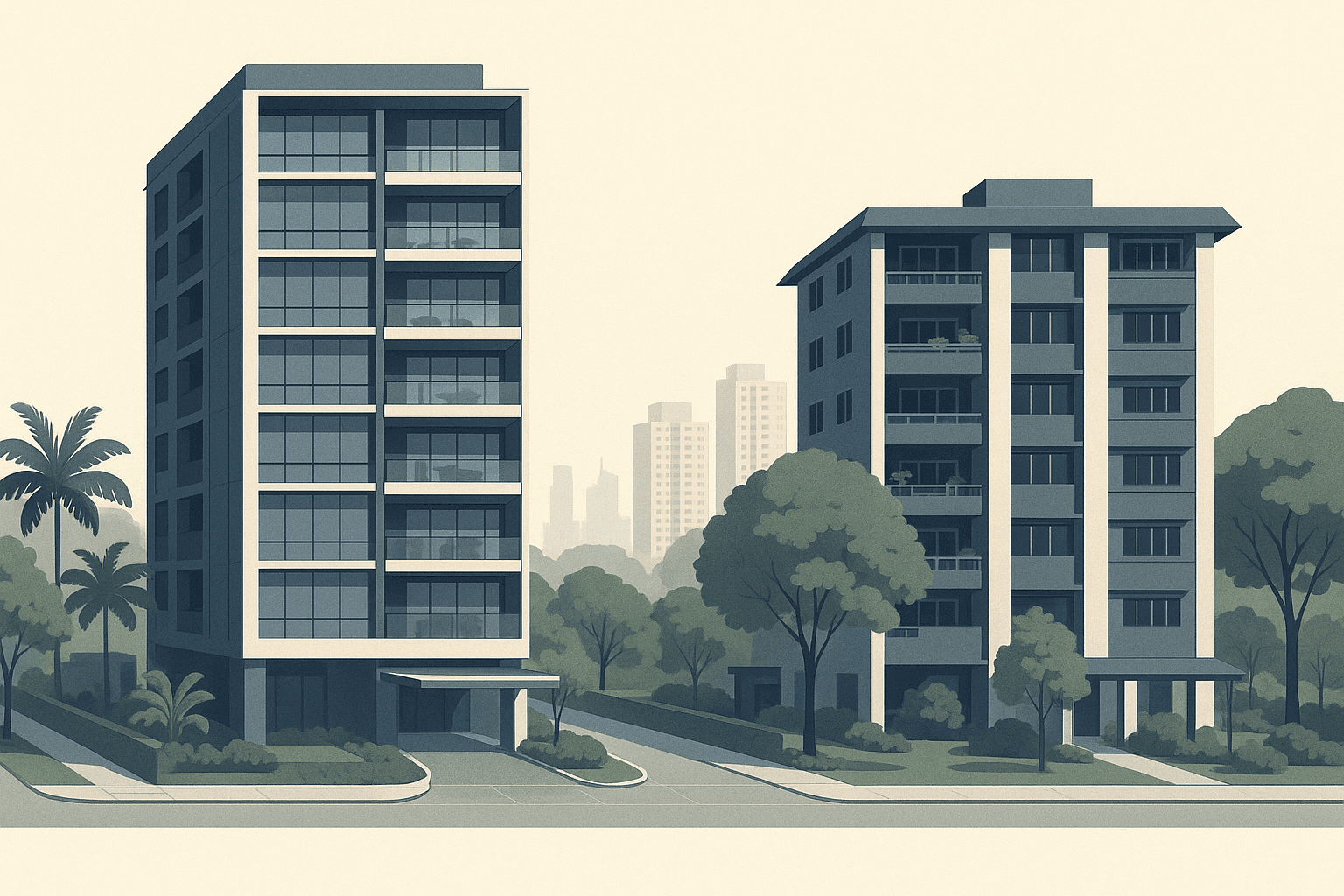
The right choice is usually clear once you filter for timeline, budget, and liveability. In Singapore, new launch and resale condos solve different buyer problems: one prioritises a brand-new future home, while the other prioritises visibility, speed, and a home you can assess today.
What is the real difference between a new launch condo and a resale condo in Singapore?
A new launch is usually bought before completion, while a resale condo is already built. In practice, buyers are choosing between a future home with more waiting and a completed home with more visibility.
The real trade-off is timing, certainty, and condition. A new launch asks the buyer to commit before the full finished product can be experienced, while a resale condo lets the buyer inspect the actual unit, estate, surroundings, and building condition before deciding.
| Factor | New launch | Resale |
|---|---|---|
| Condition at purchase | Under construction or newly launched | Completed and inspectable |
| Move-in timing | Later, after completion | Usually sooner |
| What the buyer can verify upfront | Floor plan, showflat, project materials, location context | Actual unit, actual estate, actual surroundings |
| Typical immediate works | Furnishing and fit-out after handover | Renovation, repair, or updating may be needed |
A simple way to put it: new launch buys freshness and planning time, while resale buys immediacy and visibility. For example, a couple planning two to three years ahead may accept the wait for a brand-new home, while an upgrader with a fixed housing timeline often values a completed unit more. For a consumer-facing overview, PropertyGuru's guide on new condo vs resale condo is a useful starting reference. For a broader overview, see Singapore Property Buying Decisions: How to Compare New Launch vs Resale, Freehold vs Leasehold and Other Key Tradeoffs.
Which option usually feels cheaper at entry, and why can psf alone be misleading?
Start with total quantum, not psf in isolation. A resale unit can look cheaper on psf but still cost more overall if it is larger, while a smaller new launch can look expensive on psf but still fit the buyer's budget better.
Psf is a comparison tool. Quantum is the real commitment. That is why buyers who focus only on psf often misunderstand what they can actually afford.
The gap at the psf line is large and consistent. In PropKaki's transaction data, the median new-launch unit priced about 41% above resale per sq ft islandwide as of June 2026 — so new launches cost roughly 41% more per square foot than resale right now. That is the premium a buyer is being asked to justify. It is a recent snapshot that moves with the market, and because psf is price divided by area, part of any single-window gap reflects which projects happened to sell, not tenure or condition alone.
A practical example: an older resale 3-bedder may show a lower psf than a new launch 3-bedder, but if the resale unit is meaningfully larger, the purchase price can still be higher. The reverse can also happen: a smaller new launch may look expensive per square foot, yet the overall cheque is lower because the floor area is tighter.
The clearest comparison sheet puts four lines side by side:
- Total purchase price
- Estimated upfront cash needed
- Post-purchase fit-out or renovation spend
- Likely move-in timing
Buyers pay quantum, not psf. Payment timing can also feel different because new launches typically spread the financial burden over the construction period, while resale purchases feel more immediate. If you want to go deeper, pair this with Quantum vs PSF When Buying a Condo in Singapore and PropertyGuru's breakdown of upfront condo purchase costs.
How do new launch and resale condos compare on unit size, layout, and liveability?
Resale condos are often larger on paper, while newer launches may use space more efficiently. The better home is the one that works for the household's daily routine, not the one that simply sounds newer.
This is usually a space-versus-finish trade-off. In many Singapore comparisons, older resale units offer more generous room sizes and easier furniture placement, while newer launches try to recover some of that loss through tighter, more efficient layouts.
The better test is to move past brochure language to real living questions:
- Can the living room fit the sofa and dining set the family already owns?
- Do the bedrooms still work after placing a proper bed and wardrobe?
- Is there usable storage, or will you need more carpentry later?
- Can the kitchen support how the household actually cooks?
A bigger older 3-bedder may feel easier for family living, especially for buyers with children, helpers, or work-from-home needs. A smaller new 3-bedder may still work for buyers who prefer a fresh finish and are comfortable with tighter room proportions.
Useful rule of thumb: efficient layout helps, but it does not magically replace missing space. If the buyer is choosing between roominess and freshness, link this discussion to Older Bigger Condo vs Smaller Newer Condo in Singapore. For background on why newer launches can feel smaller, StackedHomes' discussion on shrinking new-launch sizes and layout efficiency adds helpful context.
What should buyers consider about wait time versus move-in readiness?
If the buyer has a hard move-in deadline, timeline should come before brochure appeal. Resale usually suits urgent housing needs, while new launch suits buyers who can wait for completion.
Timeline is often the fastest way to narrow the decision. A buyer who must move because of lease expiry, marriage plans, school timing, childcare needs, or the sale of an existing home usually cannot treat waiting as a minor detail.
A simple way to decide is:
- If the move-in date is fixed or close, start with resale.
- If the buyer can wait several years depending on the project stage, new launch becomes a real option.
- If the buyer is unsure, work backwards from the housing deadline before comparing projects.
Resale is usually much faster to complete and occupy once the transaction is in motion. New launches involve a waiting period before handover, and the practical issue is not just patience but whether the buyer can manage the gap in between. That may include interim housing, temporary rental, storage, or staggered family plans.
A good home that arrives too late is still the wrong home. For a buyer-facing sense of resale transaction pacing, Ohmyhome's resale condo buying timeline guide can help frame expectations. For a broader overview, see Is a New Launch Worth the Premium Over a Resale Condo in Singapore?.
How do renovation, furnishing, and repair costs change the comparison?
Treat renovation, furnishing, and repair work as part of the real entry cost. Resale may need more immediate rectification, while new launch still needs practical fit-out before it feels fully livable.
This is where many buyers under-budget. The purchase price is only the first line item. The better question is what spending is still required before the home works properly.
For resale, common spending categories include repainting, replacement of worn fittings, flooring or bathroom updates, kitchen works, and repairs to older fixtures. For new launch, the repair burden may be lower at the start, but buyers still commonly need lighting, window coverings, loose furniture, storage solutions, and sometimes carpentry to make the unit functional.
The important distinction is timing, not whether spending exists at all:
- Resale often needs more condition-related spending earlier.
- New launch often shifts more spending to furnishing and customisation after handover.
A practical step is to budget in two buckets: your purchase budget and your post-key-collection budget. That instantly reduces the risk of a buyer stretching for the property and then underestimating what it takes to live in it properly. For a broader consumer comparison of costs, Ohmyhome's guide to new launch vs resale condo costs is a helpful reference. For a broader overview, see How to Compare Two Condo Projects in Singapore: A Practical Buyer Scorecard.
When is a resale condo the better choice for a buyer?
Resale is usually the better fit when the buyer needs speed, wants to inspect the actual unit and estate, or values size and certainty over a brand-new finish.
Resale tends to be the practical answer when the buyer's real problem is timing or certainty. Typical cases include upgraders coordinating a sale, families with school deadlines, buyers who need a larger layout now, and anyone who wants to assess the actual environment before committing.
Resale also helps when you want clearer answers to questions that brochures cannot fully settle, such as:
- Is the stack noisy at night?
- How strong is the afternoon sun?
- Does the estate feel well maintained?
- What is the immediate surrounding environment really like?
That makes resale reassuring if you are cautious, because you can inspect exactly what you are paying for. The conversation becomes more evidence-based and less projection-based.
If the housing timeline is fixed, resale usually solves the timing problem first. For side-by-side decision work, this section pairs well with How to Compare Two Condo Projects in Singapore.
When does a new launch make more sense?
New launch makes more sense when the buyer can wait, prefers a fresh unit and newer facilities, and is comfortable planning ahead with less certainty about the finished environment.
New launch is usually a fit decision, not an automatic value decision. It tends to suit buyers who are not under immediate housing pressure and who place real value on a brand-new unit, newer common facilities, and lower near-term wear-and-tear risk.
Typical profiles include a young couple planning ahead, an owner-occupier still living comfortably elsewhere, or a buyer who wants a fresh start and is willing to structure life around a later handover. In these cases, the buyer is effectively paying for freshness, a future move-in, and a lower chance of immediate repair works.
The key caution is not to treat a new launch as a guaranteed better-investment outcome. Some buyers will prefer it for lifestyle and planning reasons, but that is different from it being the best value in every case.
New launch works best for buyers with time, not buyers with deadlines. If you are debating whether the freshness premium is worth it, see Is a New Launch Worth the Premium Over a Resale Condo in Singapore?.
How do exit clarity and resale confidence compare?
Explain exit in terms of evidence, not promises. Resale usually has clearer comparables and project history, while new launch buyers are relying more on future positioning and eventual market reception.
The safer framing is relative clarity, not guaranteed performance. Established resale projects usually come with visible transaction history, neighbouring comparables, known building age, and a clearer sense of how buyers have already responded to the project. That gives you more concrete evidence when weighing eventual resale confidence.
With a new launch, the buyer may still like the story, concept, or location, but at the point of purchase there is less real-world resale history to rely on. A new-launch buyer is therefore working with more project-specific assumptions about future appeal, competing supply, and eventual demand.
A practical way to explain this is: resale is usually easier to anchor because the market has already seen it; new launch requires more belief about how the future will play out.
Checks that help keep this grounded:
- Review recent transaction evidence for nearby completed projects.
- Compare the project's likely competition when the unit eventually resells.
- Separate lifestyle preference from resale confidence.
For a reality check on common sales narratives, StackedHomes' piece on new launch versus resale sales pitches is worth reading.
What common mistakes do Singapore buyers make when choosing between new launch and resale?
The biggest mistakes are comparing only psf, underestimating post-purchase spending, and treating timeline as a minor detail. A buyer can choose the right price bracket and still choose the wrong home.
Three mistakes show up repeatedly:
- Cheap psf can still mean a bigger total quantum.
- Brand new does not mean fully move-in ready without more spending.
- A suitable home on paper can still fail if the move-in timing is wrong.
Before recommending either option, check four basics: the buyer's move-in deadline, true all-in budget, renovation or furnishing appetite, and minimum acceptable liveability. Keep the conversation anchored to the buyer's calendar and cash flow, not just the sales story.
Official sources
Go straight to the authorities for the current rules and figures.
Methodology and sources
Where every figure comes from — and what we deliberately did not claim.
Proprietary figures. Price figures come from PropKaki's transaction data — URA private caveats and HDB resale — with medians over the trailing 90 days (as of June 2026). Region PSF uses resale caveats only; new-launch pricing is reported separately, because which projects sell in a window would otherwise distort the region signal. PSF = recorded price ÷ area and can be skewed by unit mix.
What we have not claimed: that these medians are fixed or predictive — they are a recent snapshot that moves with the market; the price of any specific project or unit (always check live comparables); or a valuation of an individual property.
Got a question this raised? Ask PropKaki.
Take any point from this analysis and apply it to your own project, budget or decision.
 PropKaki
For most buyers this year, staying well within budget beats trying to time the market.