

BTO Defects Inspection: How HDB's Defect Check Works, What to Check and What Happens After Year One
The 1-month reporting window, how the Building Service Centre handles your list, what to inspect area by area, whether a defect checker changes anything, and the warranties that outlast the defects liability period.
Every new HDB flat has a 1-year defects liability period (DLP) from key collection, during which HDB arranges for its building contractor to repair reported defects. HDB asks you to report them within 1 month of key collection and before renovation begins, online through the QR code in your Welcome Kit or at the temporary Building Service Centre near your block. The centre arranges a joint inspection, assigns the repair and holds a closing inspection; repairs usually take less than 2 weeks. After the DLP, flats launched from 2005 keep a 5-year warranty for ceiling leaks and external wall seepage and a 10-year warranty for spalling concrete.
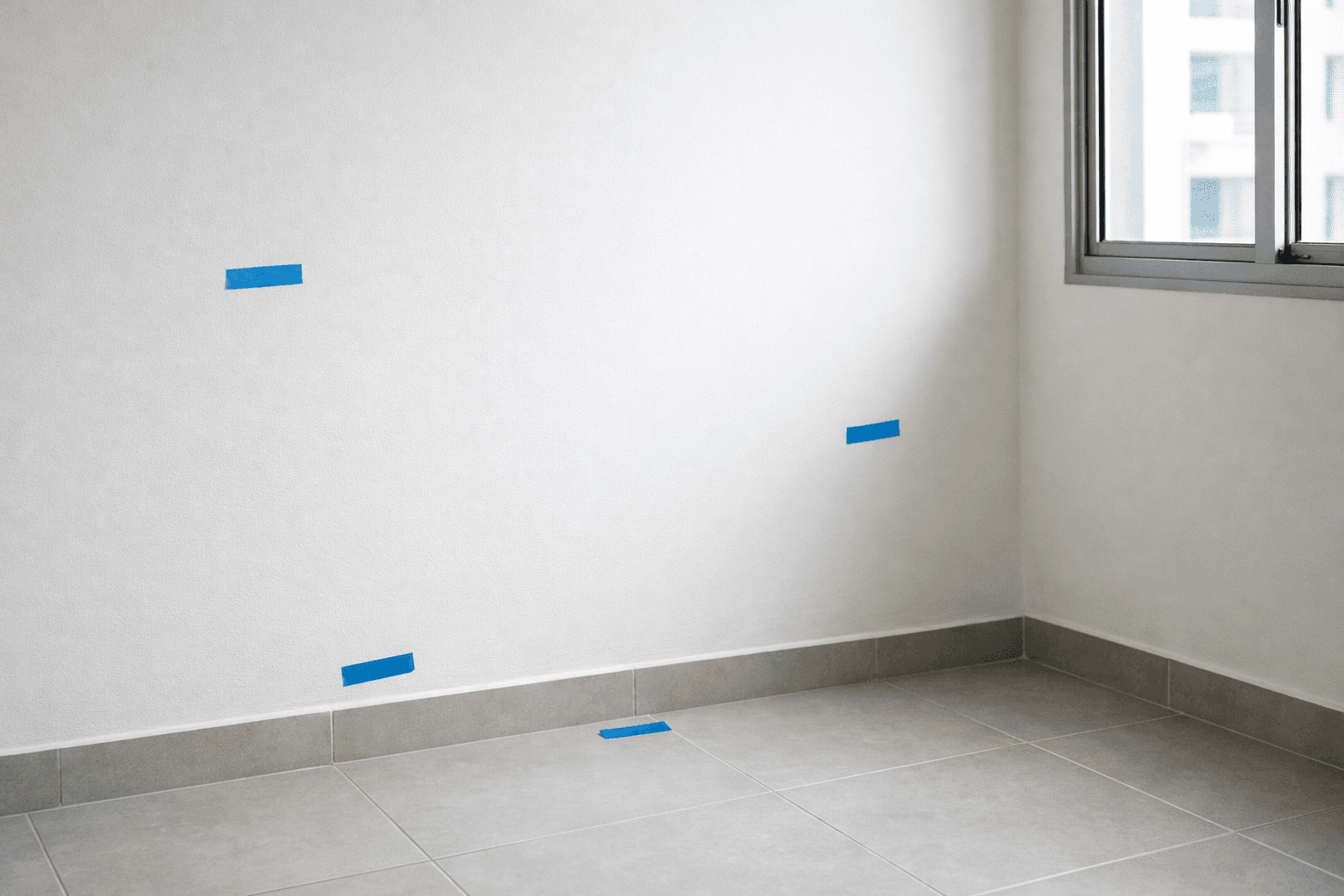
A new BTO flat comes with a 1-year defects liability period, and a shorter window inside it that is easy to miss: HDB asks you to report defects within 1 month of key collection, before any renovation starts.
This guide covers how HDB's defect process works, from the QR code in your Welcome Kit to the closing inspection; what to check, built from what HDB's brochures say every flat comes with; whether a private defect checker changes the process; and the warranties that run past the first year. Rules are HDB's and MND's, read on 25 September 2026.
How does a BTO defect check work?
HDB covers every new flat with a 1-year defects liability period from key collection. You list the defects and report them, ideally within the first month and before renovation, through the QR code in your Welcome Kit or at the temporary Building Service Centre near your block. The centre arranges a joint inspection, assigns a contractor and holds a closing inspection when the repair is done.
HDB: "In line with industry practice, all newly completed HDB flats are covered by a 1-year Defects Liability Period (DLP) effective from the date of key collection. During this time, we will follow up on items in the flat that require rectification" (HDB).
The process, in HDB's order:
- Report. "You can submit a rectification request online or at the Building Service Centre located in your precinct." Online is the "QR code in your Welcome Kit or on the notice pasted on your kitchen wall"; the temporary Building Service Centre (BSC) is "within walking distance of your home", with details in the Welcome Kit.
- Joint inspection. The BSC will "Arrange a joint inspection to verify the item(s) reported" and "Assign contractor(s) to carry out the rectification".
- Repair. "We usually take less than 2 weeks to complete the repair." HDB advises against handing your keys to the contractor: "Please bring a lock to secure your flat."
- Closing inspection. "Upon the completion of the rectification work, the BSC will arrange a closing inspection with you."
The DLP lasts a year, but the list that matters most is the one you file in the first month.
How long do you have to report BTO defects?
The defects liability period runs for 1 year from key collection, and HDB repairs what you report within it. HDB asks for your first list within 1 month of key collection and before renovation begins, so nobody has to work out whether a defect was built in or caused by your contractor.
Two clocks run from the day you collect your keys:
| Clock | Length | What it means |
|---|---|---|
| Defects liability period | 1 year from key collection | "we will follow up on items in the flat that require rectification" |
| HDB's reporting window | 1 month from key collection, and before renovation | "This will save the need to investigate whether the defects were inherent from HDB's construction or caused by renovation works" |
Source: HDB, rectification of defects in new flats, page updated 6 May 2026.
Keep reporting through the year: MND says "most defects would emerge within the first year" (MND, 6 February 2024). What surfaces later is covered below, under the warranties.
File early, and file again: the one-month list protects you, the one-year period catches the rest.
How common are defects in new HDB flats?
Mostly minor, by MND's account. It says most reported defects are imperfections such as scratches or cracks on timber surfaces, walls or tiles, and that more than 90% of reported defects were fixed within 14 working days. HDB's projects averaged a CONQUAS quality score of 95 over FY2020 to FY2022, up from 92 over FY2017 to FY2019.
MND's written answer of 21 April 2023 (MND) gives the official picture:
- What gets reported: "Most of the reported defects were minor imperfections such as scratches or cracks on timber surfaces, walls, or tiles."
- How fast it is fixed: "More than 90% of all defects reported were successfully rectified within 14 working days."
- Before and after COVID-19: "the proportion of flat owners who submitted feedback on defects within this period remained the same."
- Build quality: "HDB has consistently achieved high CONQUAS scores, with an average score of 95 over FY2020-2022, comparable to the scores achieved by private residential developments over the same period. It is also higher than HDB's average CONQUAS scores of 92 over FY2017-2019."
Defects also count against the contractor: contractors "are assessed every six months under HDB's Contractors Performance Assessment (CPA) framework", and "Poor performance, including a high incidence of defects, whether at the construction or the DLP stages, will result in lower CPA scores, and impact the contractor's ability to secure future HDB projects" (MND, 3 November 2020).
BCA's public CONQUAS banding covers private residential projects, not individual HDB flats (BCA).
Expect a list, not a disaster: most of it will be scratches and cracks, and more than 90% of reported defects are fixed within 14 working days.
What should you check in a BTO defect inspection?
Everything HDB says your flat comes with: the windows, doors and gate, tiles and flooring, bathroom fittings, the service-yard door and drying rack, electrical and data points, and the ceilings. What a flat comes with depends on the project, so start from your sales brochure's finishes and specifications pages and check each item for damage and for whether it works.
HDB's defect process covers "items in the flat that require rectification", so the checklist is the list of items. Your sales brochure gives it: PropKaki's reading of 61 HDB brochures shows what HDB specifies for every flat in 64 recent projects, and what varies (see what a new BTO flat comes with).
| Area | What the brochure says the flat comes with | What to look for |
|---|---|---|
| Windows | Aluminium-framed windows with tinted glass (all 61 brochures) | Each window opens, closes and locks; glass and frames undamaged |
| Doors and gate | Entrance door and metal gate; household shelter metal door; bedroom and bathroom doors where finishes are built in or you opted in under the OCS (2-room Flexi: sliding bedroom partition and folding bathroom door) | Each door swings, shuts and locks; no dents, chips or scratches |
| Floors and walls | Tiles in the kitchen, bathrooms and household shelter; vinyl flooring where built in or opted in under the OCS | Cracks, chips or scratches on tiles, walls and timber surfaces |
| Bathrooms | WC in every flat; wash basin and shower set where built in or opted in under the OCS | Flush, taps and drainage work; fittings firm and undamaged |
| Service yard | Aluminium-framed glass door (60 of 61 brochures); clothes drying rack | Door and rack work and are undamaged |
| Electrical and services | Concealed wiring to lighting and power points, water heater and air-conditioner points, television and data points | Points and switches are present and undamaged; check power once your utilities account is open |
| Ceilings | Skim-coated or plastered, and painted | Stains or cracks that could point to a leak |
Items from HDB's sales brochures ("Finishes and Fittings" and "General Specifications"). The "What to look for" column is PropKaki's plain check for damage and function, not an HDB list; MND says the most reported defects are scratches or cracks on timber surfaces, walls or tiles. Brochures state what HDB specifies at launch, and specifications can change. Finishes were built in on 14 of the 61 brochures PropKaki read.
Three practical points that follow from HDB's rules:
- Photograph and list before anything else happens in the flat, because HDB's reason for the 1-month window is telling inherent defects from renovation damage.
- Do not tamper with the household shelter while checking it: HDB's brochures say its walls, ceiling, floor and door "shall not be hacked, drilled, altered or removed".
- Keep your keys. HDB does not recommend handing them to the rectification contractor.
Check the flat against its own spec sheet, not against the showflat you remember.
Should you hire a defect checker?
HDB's process does not require one. You report the items, and HDB's Building Service Centre holds a joint inspection to verify them and assigns the repair. A private inspection is your choice and your cost; PropKaki does not recommend inspectors or quote their fees. Whoever finds the defects, the report still goes to HDB within the same 1-month window.
What HDB's process already includes (HDB):
- A joint inspection by the Building Service Centre "to verify the item(s) reported".
- A contractor assigned by HDB to do the repair.
- A closing inspection with you when the repair is done.
What a private inspection does not change:
- Who decides and repairs. Reported items are verified by HDB's centre and repaired by HDB's contractor, however the list was made.
- The window. HDB's window is still 1 month from key collection and before renovation.
When people weigh it, the real questions are time and confidence: whether you can go through every room and item yourself within the month, before your renovation starts. There is no official rule either way.
A checker can help you write the list; only HDB's process gets it fixed.
How much does a BTO defect check cost?
Reporting to HDB and the repairs HDB's building contractor carries out in the defects liability period are part of HDB's process; HDB's page lists no fee for them. What costs money is a private inspection, if you choose one, and repairs after the first year, unless they fall under HDB's 5- or 10-year warranties or HDB assesses the issue as an inherent defect. PropKaki does not track private inspection fees.
Who pays for what, in the official record:
| Situation | Who repairs, and who pays |
|---|---|
| Defect reported within the 1-year DLP | "HDB will arrange for the building contractor to carry out the necessary repairs" (MND) |
| Defect that recurs after the DLP, found inherent | "HDB will recall the building contractor to rectify it at no cost to the flat owner" (MND) |
| Recurrence due to fair wear and tear or a lack of maintenance | "the cost of repair will be borne by the party responsible for maintenance" (MND) |
| Other issues reported after the DLP | "HDB will investigate the likely cause … If the issue is assessed to be due to an inherent defect or quality issue, HDB will engage the building contractor to rectify it" (MND, 3 November 2020) |
| Issues after the DLP generally | "You can engage a repair contractor to rectify issues after the 1-year DLP" (HDB) |
Checking before the renovation costs you time; a defect found after the DLP may cost you money.
How long does a BTO defect repair take?
HDB says it usually takes less than 2 weeks to complete a repair, and MND says more than 90% of reported defects were fixed within 14 working days. If your renovation can't wait, HDB can fix defects during the renovation, where they don't get in its way, or after it.
- HDB's typical repair time: "We usually take less than 2 weeks to complete the repair" (HDB).
- MND's record: "More than 90% of all defects reported were successfully rectified within 14 working days" (MND).
- If renovation is booked: "HDB can rectify the defects during the renovation (if it does not hinder your renovation) or after. Some minor defects can also be rectified after you have moved in (if living condition will not be affected)."
How long your own inspection takes is up to you and the size of the flat; HDB sets the window (1 month), not the duration.
Book the contractor's hacking dates after your defect list is in, not before.
What happens if defects appear after the first year?
Flats launched from 2005 keep a 5-year warranty for ceiling leaks and external wall seepage and a 10-year warranty for spalling concrete. If a defect repaired during the DLP comes back, HDB investigates: if it is inherent, HDB recalls the building contractor at no cost to you; if it is wear and tear or a lack of maintenance, the party responsible for maintenance pays.
MND's answer of 6 February 2024 (MND):
- Warranties: "HDB provides owners of all new flats launched from 2005 a 5-year warranty for ceiling leaks and external wall seepage, and a 10-year warranty for spalling concrete."
- Who maintains what: "Flat owners are responsible for the maintenance of their flats. Town Councils are responsible for the maintenance of the common properties, including external walls of HDB flats." And: "Nonetheless, if a maintenance issue within the flat is reported to HDB after the DLP, HDB will investigate the likely cause and advise flat owners on the follow-up action based on the specific circumstances of each case."
- Recurring defects: HDB "will carry out an investigation to determine the likely cause. If it is assessed to be due to an inherent defect or quality issue, HDB will recall the building contractor to rectify it at no cost to the flat owner. Should the flat owner raise any compensation claim, it will be assessed on a case-by-case basis."
Day to day, the Agreement for Lease puts the upkeep on you: "homeowners are responsible for keeping the fittings and fixtures in their flats in good condition" (HDB).
Keep the DLP paperwork: it is your evidence if the same defect comes back.
Can you renovate before HDB fixes the defects?
Yes, once the defects are reported. HDB can repair them during your renovation if that doesn't get in the way, or after it, and some minor ones after you move in. What you should not do is renovate before reporting, because then nobody can tell HDB's defects from your contractor's damage.
HDB's position has two halves (HDB):
- Report first: within 1 month of key collection "and before your renovation works begin".
- Then renovate: "In a situation where your renovation cannot wait, HDB can rectify the defects during the renovation (if it does not hinder your renovation) or after."
Your renovation permit has its own clock: on a newly completed block the approved works must be finished within 3 months of the permit (HDB). The permit, the hours and the rules are in BTO renovation: what HDB allows.
Report, then renovate: in that order, nobody has to work out whose defect it is.
What comes after the defect check?
The renovation permit, the renovation itself within HDB's hours, and moving in. Collect your keys within a month of HDB's notice, file the defect list, open your utilities account, then let a listed renovation contractor apply for the permit.
The first months, in order:
- Keys. "you must take possession of the flat within 1 month from the date of HDB's notice" (HDB). The key collection steps are in BTO construction progress and wait times.
- Defects. This page.
- Renovation. What needs a permit and what the flat already has: BTO renovation ideas that pass HDB's rules. Working hours and neighbours: HDB renovation and noise rules.
- Moving in, with pets inside HDB's limits: HDB pet rules.
PropKaki's property timeline planner maps a BTO purchase from booking to the keys.
Find and report the faults first; make changes after.
What is the biggest mistake with BTO defects?
Letting the renovation start before the defect list is in. HDB asks for defects within 1 month of key collection and before renovation precisely so it can tell its own defects from renovation damage; once tiles are hacked or carpentry is fitted, that line blurs, and so does who pays.
The common versions:
- Hacking in week one. HDB's reason for the 1-month window is to avoid investigating "whether the defects were inherent from HDB's construction or caused by renovation works".
- Carpentry over the evidence. A cabinet fitted over a cracked tile hides what needed reporting.
- Handing over the keys. HDB does not recommend giving your keys to the rectification contractor.
- Stopping at month one. The DLP runs a full year; keep reporting what surfaces.
Photograph, list, report, and only then renovate.
Official sources
Check HDB's rectification page and your Welcome Kit for your project's Building Service Centre.
Methodology and sources
Where every figure comes from, and what we deliberately did not claim.
Official rules and figures. The defects liability period, the 1-month reporting window, the Building Service Centre process and repair times are from HDB's rectification page (updated 6 May 2026); key collection from HDB's key collection page (21 August 2026); the warranties and recurrence rules from MND's written answer of 6 February 2024; the defect profile, repair record and CONQUAS scores from MND's answer of 21 April 2023; contractor assessment from its answer of 3 November 2020; the permit period from HDB's renovation page. All read on 25 September 2026.
Proprietary analysis. The checklist is built from PropKaki's reading of 61 HDB sales brochures: every BTO project launched from October 2024 to June 2026, and the 11 Prime Location brochures from November 2021 to June 2024 that HDB still hosts (eight 2022 Prime Location brochures are no longer online). It records what HDB specifies for every flat, and which items only finishes-included or OCS flats have. How we work: PropKaki methodology.
What we have not claimed: a share of owners who report defects, what any private inspector charges or finds, or how HDB will assess a particular defect. We do not recommend inspectors or contractors. This is a practical guide, not legal or financial advice.
Got a question this raised? Ask PropKaki.
Take any point from this analysis and apply it to your own project, budget or decision.
 PropKaki
For most buyers this year, staying well within budget beats trying to time the market.