
Shophouses in Singapore Explained: What They Are, Who Can Buy One and What They Sell For
The two- and three-storey row buildings of Singapore's old town: how URA defines and conserves them, whether a shophouse is residential or commercial, who may buy one, the taxes, and what they sell for.
A shophouse is a two- to three-storey terraced building from 1840 to 1960, built for a shop below and a home above, fronted by a five-foot way; they are the bulk of URA's conserved buildings. Whether one is residential or commercial depends on its zoning and approved use: bought whole, Commercial land is 100% non-residential, Residential with Commercial at first storey land all but the commercial minimum, and Commercial & Residential land 60% residential for stamp duty. Foreigners can buy a shophouse for commercial use without approval. From 2021 to 2025 a single land-titled shophouse sold for a median $5,550,000 ($4,427 psf of land).
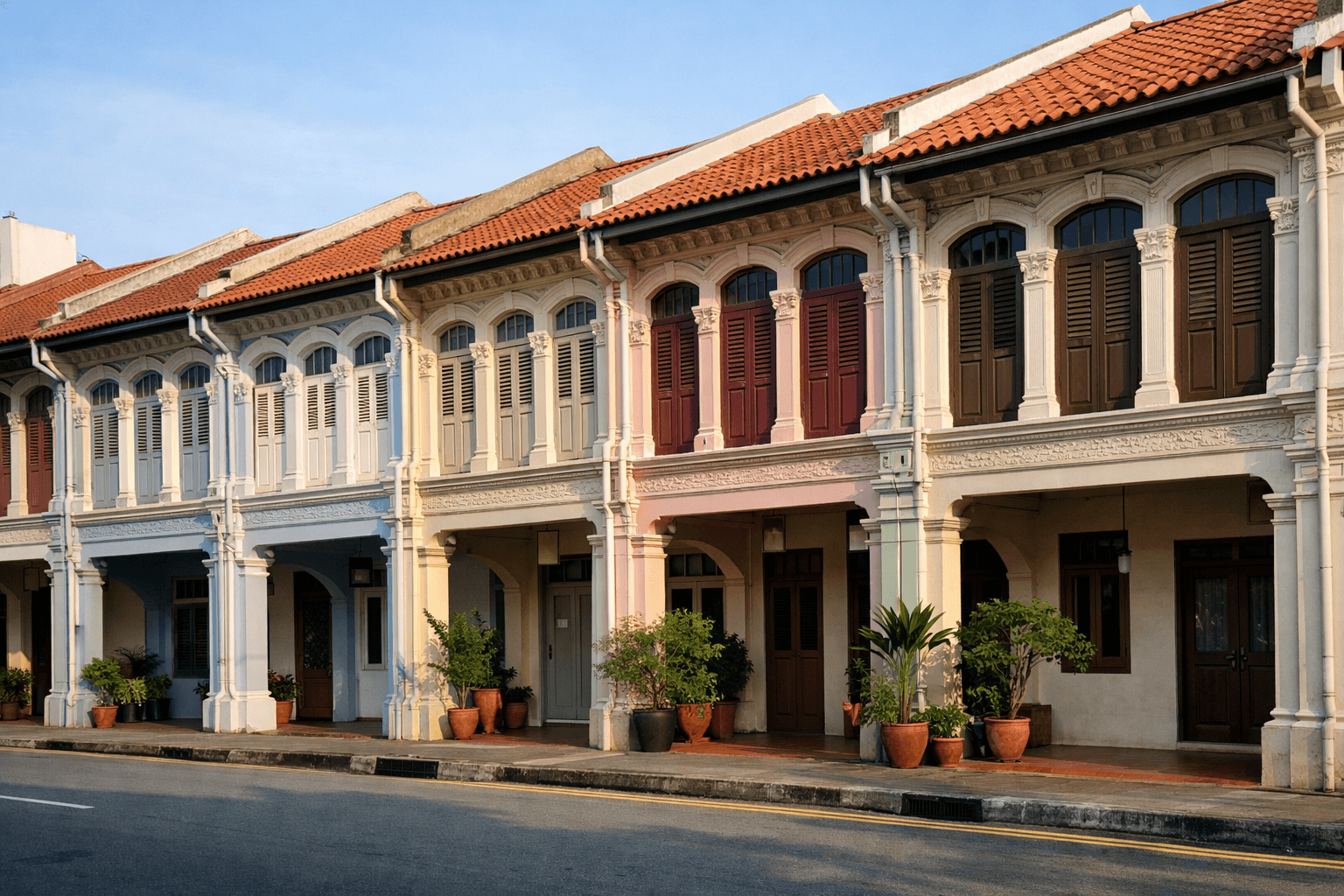
Shophouses are the terraced shop-and-home buildings of Singapore's historic streets, built between the 1840s and the 1960s; URA counts them as the bulk of its conserved buildings.
This guide explains what makes a shophouse, how to tell whether one is residential or commercial, who may buy it and what it is taxed at, and what 642 single shophouse sales from 2021 to 2025 say about price, tenure and location.
What is a shophouse in Singapore?
A two- to three-storey terraced building, built between the 1840s and the 1960s in a row with its neighbours, traditionally with a business on the ground floor and a home above, fronted by a covered five-foot way. URA calls shophouses "the bulk of our gazetted conservation buildings", and at least three in four single shophouse sales from 2021 to 2025 were of conserved buildings.
URA describes shophouses as buildings "Constructed between 1840 and 1960", "two- to three- storeys high, built in contiguous blocks with common party walls"; they "formed the majority of the pre-World War II urban fabric of the old city centre" (URA). Three features define one:
- Mixed use, by design. "Traditionally, shophouses are designed to provide for business premises on the ground floor and residential accommodation on the upper storeys" (same page).
- The five-foot way. The upper floor "projects over the five-footway to form a covered pedestrian arcade", a feature "mandated by Raffles since the first Town Plan for Singapore" (same page).
- Party walls. "Party walls are principal load-bearing walls which demarcate one shophouse from its neighbour" (same page), which is why shophouses come in rows.
URA sorts them into six styles by age: "The Early Shophouse", "The First Transitional Shophouse", "The Late Shophouse", "The Second Transitional Shophouse", "The Art Deco Shophouse" and "The Modern Shophouse" (same page). The land, title and zoning terms used below are in our Singapore property glossary.
A shophouse is a row house built for a shop below and a home above; its zoning, not its looks, decides how it is used today.
How many shophouses are there in Singapore?
URA does not publish a shophouse count, but they make up "the bulk" of its conserved buildings: over 7,000 buildings in almost 100 conservation areas. They trade rarely: URA's caveat records show 751 shophouse sales from 2021 to 2025, and 89 in 2025, against 526 in 2007.
URA: "Since 1989 ... conservation status has been conferred to almost 100 conservation areas involving over 7000 buildings throughout the island" (URA), and shophouses "form the bulk of our gazetted conservation buildings" (URA). The first ten areas, gazetted on 7 July 1989, included Chinatown, Little India, Kampong Glam, Boat Quay and Clarke Quay, Cairnhill and Emerald Hill, "with a total of over 3,200 buildings" (URA). No official figure separates shophouses from other conserved buildings, so PropKaki does not publish one.
What the records do show is how seldom they change hands. Shophouse caveats by year:
| Year | Shophouse caveats |
|---|---|
| 1995 | 73 |
| 2000 | 162 |
| 2005 | 291 |
| 2007 | 526 |
| 2010 | 387 |
| 2015 | 103 |
| 2020 | 144 |
| 2021 | 253 |
| 2022 | 191 |
| 2023 | 131 |
| 2024 | 87 |
| 2025 | 89 |
PropKaki analysis of URA caveats with property type "Shop House", land- and strata-titled. Caveats are voluntary, so some sales are missing.
In the five years from 2021 to 2025, 705 of the 751 caveats were land-titled and 46 strata-titled (a unit within a shophouse). At least 75.5% of the 642 single land-titled shophouse sales were of buildings in URA's conserved-building layer (PropKaki checks each address against the building outlines in URA's Master Plan layer; the check misses some, so this is a floor).
Thousands of shophouses stand; a hundred or so change hands in a quiet year.
Is a shophouse residential or commercial?
It depends on the land's zoning and the unit's approved use, and it can be both. When you buy a whole shophouse with its land, IRAS goes by the Master Plan zoning: Commercial land is 100% non-residential, Residential land 100% residential, Residential with Commercial at first storey land all but the commercial minimum, and Commercial & Residential land 60% residential. 71.2% of single shophouse sales in 2021–2025 were on Commercial land.
Shophouses were built as both, a shop below and a home above (URA); today the answer comes from planning records. Buying a whole shophouse with its land, IRAS goes by "the zoning of the land under the Master Plan (and not the permitted use of the property)" (IRAS):
| Master Plan zoning | Residential part for stamp duty (IRAS) | Share of shophouse sales, 2021–2025 |
|---|---|---|
| Commercial (and Hotel, Business Park and other zonings) | None: "100% of the GFA" is non-residential | 71.2% (Commercial) |
| Residential with Commercial at first storey | "Total GFA less the minimum GFA which must be set aside for commercial uses under the Master Plan" | 15.9% |
| Residential | "100% of the gross floor area" | 5.1% |
| Commercial & Residential | "60% of the GFA" | 4.5% |
| Residential/Institutional | "100% of the gross floor area" | 2.0% |
| White | "100% of the gross floor area" | — |
Sales: PropKaki analysis of 642 single land-titled shophouse sales, by today's Master Plan zoning of the addresses sold, as held in PropKaki's commercial directory (IRAS applies the zoning at the date of purchase).
Buying a unit within a shophouse, IRAS goes by its permitted use instead: whether it is "Residential or for mixed purposes, one of which is residential" (IRAS). To find it, IRAS points buyers to the owner's latest Written Permission and approved plans, or URA's e-service "Enquiry on Approved Use of Premises" (same page).
Two more rules also split residential from commercial, by use. Property tax: "The residential component will be subject to the property tax rates for residential properties while the commercial component will continue to be taxed at 10%" (IRAS). Foreign buyers: "Shophouse (for commercial use)" needs no approval; "Shophouse (for non-commercial use)" and "Commercial & Residential properties" do (SLA). PropKaki's property zoning checker shows an address's Master Plan zoning.
Read the zoning and the approved use before the price: they decide the tax, the buyers and the uses.
Is a shophouse under HDB?
Not the shophouses in URA's conservation areas: those that change hands are sold between owners, recorded in URA's caveat data and governed by URA's conservation rules. HDB has its own shops, some with living quarters above, which change hands through HDB's own process on GoBusiness and under HDB's conditions.
Conserved shophouses that change hands are sold between owners and recorded in URA's caveat data (the figures on this page), and their uses and works are controlled by URA's conservation rules (URA).
HDB shops are a separate category. "You can apply for the resale/ transfer of HDB sold shop premises via GoBusiness", and HDB sets its own conditions, among them "You must be 21 years and above at the date of application" and that a person may not own "an HDB flat (subsidised or non-subsidised) within Minimum Occupation Period (“MOP”) plus any HDB shop with Living Quarters (“LQ”)" (HDB). The trade must start "within 2 months from the date of the resale/ transfer completion" (same page).
For tax, an HDB shop with living quarters is partly a home: "For HDB shop with Living Quarters (LQ), the LQ component may be counted as a residential property for Additional Buyer’s Stamp Duty (ABSD) purposes" (HDB), and IRAS charges ABSD "only on the apportioned value of the living quarters" (IRAS).
A conserved shophouse is a private building under URA's rules; an HDB shop is HDB's.
Who can buy a shophouse in Singapore?
A Singapore citizen can buy any private shophouse without SLA approval. A foreigner can buy a shophouse for commercial use, or an HDB shophouse, without approval, but needs the Singapore Land Authority's approval for a shophouse for non-commercial use or on Commercial & Residential land. A shophouse with a residential part counts as one of your homes for ABSD.
SLA's list under the Residential Property Act puts "Shophouse (for commercial use)" and "HDB shophouse" among the properties a foreign person can buy without approval, and "Shophouse (for non-commercial use)" and "Commercial & Residential properties" among those that need it (SLA). The Act's "foreign person" is anyone other than a Singapore citizen, Singapore company, Singapore limited liability partnership or Singapore society (as the Act defines them) (same page). HDB shops add HDB's own conditions (previous section). The full rules for foreigners and companies are in can foreigners buy commercial property or a shophouse.
For ABSD, the residential part decides, and how IRAS finds it depends on what you buy:
- A unit within a shophouse: its permitted use. "HDB shops with living quarters or shophouses with a portion permitted for residential use will be included as a residential property count" (IRAS).
- A whole shophouse with its land: its zoning. IRAS: "Purchase of site with land zoned Residential, Residential with Commercial at first storey, Commercial & Residential, Residential/Institution, or White, falls within the definition of 'Residential Properties'" and "should be included in the buyer's count of residential properties" (same page). Land zoned Commercial is not on that list.
ABSD is then charged on the residential component (the zoning table above), at your rate: 20% for a citizen's second home, and 65% for an entity such as a company (IRAS).
Who may buy a shophouse, and what it costs them in duty, follows the residential part, not the shopfront.
What stamp duty and tax apply to a shophouse?
Buyer's stamp duty at non-residential rates (top rate 5%) on the commercial part, and residential BSD, ABSD and seller's stamp duty on any residential part. Property tax is 10% of the Annual Value on the commercial part and residential rates on the residential part.
IRAS's rule for mixed property: "ABSD rates, BSD rates and SSD rates for residential properties will apply on the residential component of the property acquired or disposed of. On the other hand, the BSD rates for non-residential properties will apply on the acquisition of the non-residential component of the property" (IRAS).
- Buyer's stamp duty. Non-residential rates run from 1% on the first $180,000 to 5% above $1,500,000: "From 15 Feb 2023, the top marginal rate for residential properties is 6%, and the top marginal rate for non-residential properties is 5%" (IRAS).
- ABSD applies only to a residential part, at the buyer's rate, and that part counts toward the buyer's homes (IRAS).
- Property tax. "Non-residential properties such as commercial and industrial buildings and land are taxed at 10% of the Annual Value"; for a shophouse with two uses, the residential component pays residential rates (IRAS).
How GST applies, and a worked stamp-duty example for commercial property, are in our buying commercial property guide.
Stamp duty follows the use: the shop part is taxed as a shop, the home part as a home.
What do shophouses sell for in Singapore?
From 2021 to 2025, a single land-titled shophouse sold for a median $5,550,000, or $4,427 per sq ft of land on a median 1,375 sqft plot, across 642 sales; the yearly median was $5,975,000 to $6,000,000 in 2023–2025. 64.3% of those stating a tenure were freehold. More sold in Rochor, which takes in Little India and Kampong Glam, than anywhere else.
PropKaki analysis of URA caveats for land-titled shophouses with a sale date from 2021 to 2025. 63 caveats that covered more than one shophouse (for example two neighbouring house numbers sold together) are left out, leaving 642 single shophouses: median $5,550,000, $4,427 per sq ft of land, median land 1,375 sqft.
| Year | Single shophouse sales | Median price |
|---|---|---|
| 2021 | 217 | $4,880,000 |
| 2022 | 165 | $5,550,000 |
| 2023 | 113 | $6,000,000 |
| 2024 | 73 | $6,000,000 |
| 2025 | 74 | $5,975,000 |
33.8% of the five years' sales were in 2021, the busiest year, which pulls the five-year median down; the yearly medians since show where prices have sat.
| Tenure (where stated) | Sales | Share |
|---|---|---|
| Freehold | 412 | 64.3% |
| 999 years or more | 113 | 17.6% |
| 99 years | 109 | 17.0% |
| Other lease | 7 | 1.1% |
| Planning area | Sales |
|---|---|
| Rochor | 238 |
| Outram | 91 |
| Geylang | 76 |
| Kallang | 64 |
| Bedok | 24 |
| Singapore River | 21 |
Prices move with location, frontage, zoning and conservation status, so a median is a guide to the market, not a price for any building. For the latest 12 months of shophouse sales alongside offices and shops, see our buying commercial property guide, which counts every shophouse caveat, including the few that cover more than one building; for one recent large deal, our news analysis of Frasers and Cuppage Terrace. Individual sales are in PropKaki's commercial property directory.
With a hundred or so sales a year, every shophouse price is a data point, not a trend.
What can you do with a conserved shophouse?
Use it within URA's rules. In URA's historic conservation areas (Chinatown, Little India, Kampong Glam, Boat Quay, Blair Plain, Emerald Hill and Cairnhill) you need conservation permission before starting a business, some uses such as new bars and nightclubs are not allowed, and an application to use one as a home comes with a limit of 6 occupants.
URA: "If your building is located within the Historic Conservation Areas – Chinatown (Kreta Ayer, Telok Ayer, Bukit Pasoh, Tanjong Pagar), Little India, Kampong Glam, Boat Quay, Blair Plain, Emerald Hill and Cairnhill, you will need to apply for conservation permission before starting business operations", and you can check "the allowable and approved uses for shophouses on URA SPACE" (URA).
- Not allowed in those areas, among others: "New bars, pubs, nightclubs and karaoke lounges New massage establishments and spas Amusement centres Motor vehicle showrooms" (same page).
- Living in one: if you apply to use a shophouse in those areas as a home, URA asks for a "self-sustaining residential layout which comprises a living room, bedrooms, kitchen and toilets" and a signed undertaking that includes "The maximum number of people who can stay on the premises is 6" and "The same people staying on the premises must stay for a minimum of 3 months" (same page).
- Works: "If the change of use involves Additions & Alterations (A&A) works to conserved buildings, please submit a formal A&A submission" (same page). URA's note on adaptive reuse: "Structurally speaking, the original use is always the best use for a conserved building" (URA).
Conservation fixes the building; URA's permission fixes what happens inside it.
The biggest mistake people make buying a shophouse
Assuming it is simply commercial. Whether a shophouse has a residential part changes the stamp duty, the ABSD count, whether a foreigner needs approval and the property tax. Check the Master Plan zoning and the approved use before you agree a price.
The same row of shophouses can carry different answers:
- Buying the whole shophouse with its land, the zoning sets the residential part: none on Commercial land, 60% of the floor area on Commercial & Residential land, all of it on Residential land, and all but the commercial minimum on Residential with Commercial at 1st storey land (IRAS). Residential BSD and ABSD at your rate apply to that part; 15.9% of single shophouse sales in 2021–2025 were on that last zoning.
- A unit "with a portion permitted for residential use", or a whole shophouse on land zoned for any residential use, counts as one of your homes for ABSD (IRAS).
- A foreigner needs SLA's approval for a shophouse "for non-commercial use" (SLA).
- In a historic conservation area, the use you plan may need URA's permission, or not be allowed at all (URA).
Check the zoning on the property zoning checker, the approved use through URA's e-service, and the conservation rules on URA SPACE, then price the tax.
A shophouse's paperwork is worth more of your attention than its facade.
Official sources
The URA, HDB, IRAS and SLA pages this guide quotes.
Methodology and sources
Where the shophouse figures come from, and what we have not claimed.
PropKaki figures. Sales are URA caveats with property type "Shop House" and a sale date from 1 January 2021 to 31 December 2025 (751 caveats: 705 land-titled, 46 strata-titled). A caveat whose address lists more than one house number is treated as a sale of several shophouses and left out of the medians (63); an address with an upper unit such as "20,20A" is one shophouse. Medians use the 642 single land-titled sales; $psf is on land area. Tenure shares use caveats that state a tenure. Zoning and the conserved share come from PropKaki's commercial directory, which records each address's Master Plan zoning and checks it against the building outlines in URA's Master Plan conserved-building layer; the check misses some, so the conserved share is a floor. Caveats are voluntary, so some sales are missing. How we work: PropKaki methodology.
Rules. URA, HDB and IRAS's definition of residential property and ABSD pages, read on 26 September 2026; IRAS's other pages on 25 September 2026; SLA on 19 and 25 September 2026. Check the agency before you buy.
What we have not claimed: how many shophouses exist, what any particular shophouse is worth, or its zoning or approved use: check those for the address. This is general information, not legal, tax or financial advice.
Got a question this raised? Ask PropKaki.
Take any point from this analysis and apply it to your own project, budget or decision.
 PropKaki
For most buyers this year, staying well within budget beats trying to time the market.