
Landed Property Types in Singapore: Bungalows, Semi-Ds, Terraces and Cluster Houses Explained
What URA means by each landed home, the plot rules behind them, what each sells for, and who is allowed to buy a bungalow, a terrace or a cluster house.
Singapore's landed homes are detached houses (bungalows), semi-detached houses and terrace houses, each either on its own land title or strata-titled in a shared development (cluster houses, townhouses). A bungalow is URA's term for a detached house, with a minimum 400 sqm plot, or 1,400 sqm in one of 39 Good Class Bungalow Areas. Terraces (land and strata titles) were 57.4% of landed sales in 2021–2025; strata-titled homes of all three forms were 15.3%. Permanent residents and foreigners need SLA approval for most landed homes; Singaporeans own 95.0% of them (2026Q2).
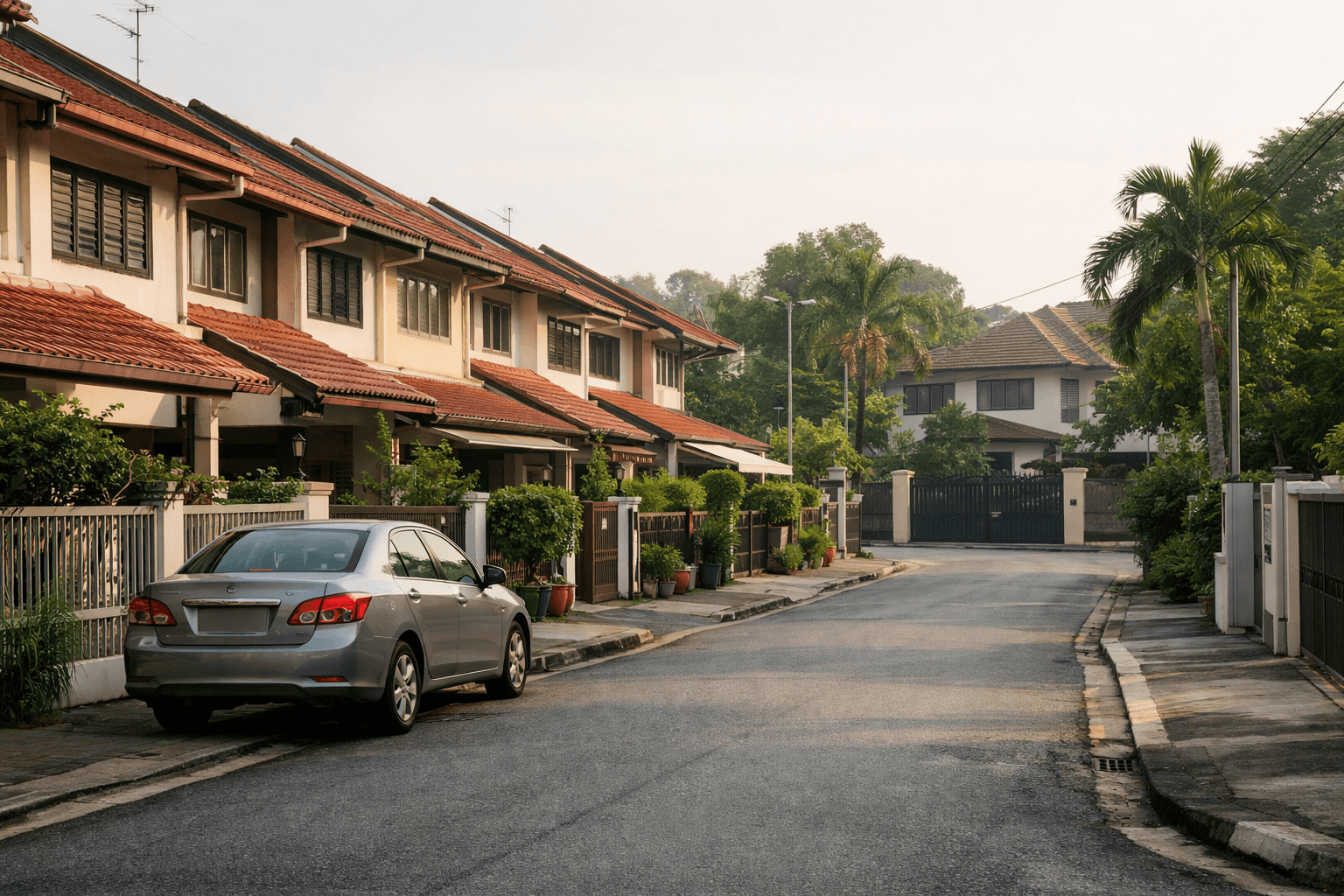
Landed property in Singapore comes in three house forms, detached, semi-detached and terrace, and two kinds of title: a house on its own land, or a strata-titled house in a shared development such as a cluster house.
This guide defines each type in URA's words, sets out the plot rules that shape them, and uses 11,369 landed sales from 2021 to 2025 and URA's latest stock figures to show how common each is, what it costs and who may buy it.
What are the types of landed property in Singapore?
Three house forms, detached (bungalows), semi-detached and terrace, each built either on its own land title or strata-titled on a shared site, which is what a cluster house or townhouse is. Singapore had 73,902 landed private homes in 2026Q2, 17.4% of all private homes (URA).
URA's definition of landed property is "detached houses, semi-detached houses, terrace houses, townhouses, strata bungalows and cluster housing" (URA). Underneath the names are two questions: how is the house joined to its neighbours, and does it have its own land title?
| Type | What URA says it is | Sales 2021–2025: land-titled | Strata-titled | Land-titled median price, latest 12 months | Median land (sq ft) |
|---|---|---|---|---|---|
| Detached house (bungalow) | "A detached landed house with its own land title" (URA) | 1,250 | 123 | $12,680,000 | 6,485 |
| Semi-detached house | "One half of a pair of two houses, each with its own land title, separated by a common party wall" (URA) | 3,003 | 463 | $6,300,000 | 3,412 |
| Terrace house | "A dwelling house with its own land title that forms part of a row of at least 3 dwelling houses" (URA) | 5,371 | 1,159 | $4,500,000 | 1,873 |
| All landed | 9,624 | 1,745 |
Sales: PropKaki analysis of 11,369 URA caveats for landed homes with a sale date from 2021 to 2025. Strata-titled sales are the same three forms on a shared site: cluster houses, townhouses and strata bungalows. Medians: PropKaki's landed-sales view, land-titled houses, 12 months to August 2026, the same figures as our semi-detached vs terrace comparison.
How many exist: URA counted 73,902 landed private homes in its stock for 2026Q2, against 350,679 non-landed ones, so landed homes are 17.4% of Singapore's private homes. URA does not split its stock by house type, so the sales columns show which types trade most, not how many of each exist. Landed property and the other basic terms are defined in our Singapore property glossary.
Two tests sort every landed home: how it joins its neighbours, and whether the land is yours alone.
What is a bungalow in Singapore?
In Singapore, a bungalow is a detached house: URA defines it as "a detached landed house with its own land title", and the word says nothing about storeys. Outside Good Class Bungalow Areas the plot must be at least 400 sqm and 10 m wide. A bungalow can also be strata-titled, as a strata bungalow in a shared development.
URA: "A bungalow is a detached landed house with its own land title. It may be built in areas designated for landed housing developments or on land zoned for residential use if the development site area meets the minimum plot size, plot width and site coverage requirements for a bungalow development" (URA). Bungalows "may be strata-titled when approved as strata bungalows" (same page), which makes them strata landed homes.
The rules that define a bungalow plot (URA):
| Location | Minimum plot | Minimum width | Minimum depth |
|---|---|---|---|
| Inside a Good Class Bungalow Area | 1,400 sqm | 18.5 m | 30 m |
| Outside a Good Class Bungalow Area | 400 sqm | 10 m | No minimum |
Detached houses are the least traded landed homes: 1,373 of the 11,369 landed sales from 2021 to 2025 (12.1%, land and strata titles together). Their median price and land are in the table above.
In Singapore "bungalow" means detached, not single-storey.
What is a Good Class Bungalow?
A bungalow in one of URA's 39 Good Class Bungalow Areas, where only bungalows may be built and the plot must be at least 1,400 sqm, 18.5 m wide and 30 m deep. Some GCB areas, such as White House Park/Nassim Road and Chatsworth Park, are also conservation areas.
URA lists "The 39 Good Class Bungalow Areas (GCBA) in Singapore", among them Belmont Park, Binjai Park, Bukit Sedap, Cluny Park, Holland Park, Leedon Park, Nassim Road, Raffles Park, Victoria Park and White House Park (URA). "In Good Class Bungalow Areas (GCBA) or in other bungalow areas, only bungalow developments are allowed" (URA).
What sets a GCB apart is the plot: at least 1,400 sqm, 18.5 m wide and 30 m deep, against 400 sqm for a bungalow elsewhere (URA). Conservation rules add a layer in some estates: they "apply for landed housing gazetted for conservation, such as ... Good Class Bungalow Areas like White House Park/Nassim Road, Chatsworth Park, and Holland Park/Ridout Park Conservation Areas; and black and white bungalows" (URA).
Even a strata development inside a GCBA is sized to the GCB pattern: URA caps the number of strata units there at 35% of the site area divided by a typical GCB footprint of 500 sqm (URA).
To check whether a particular address falls in a GCB area, use PropKaki's landed house checker. A permanent resident or foreigner needs the Singapore Land Authority's approval to buy a land-titled house (see "Who owns" below).
A GCB is defined by where it stands and how much land it sits on, not by how grand the house is.
What is a terrace house, and what is a corner terrace?
A terrace house is "a dwelling house with its own land title that forms part of a row of at least 3 dwelling houses" (URA). The houses at the ends of the row are corner terraces, which need a wider plot (8 m against 6 m), and for Type I terraces a bigger one (200 sqm against 150 sqm). Terraces are the most traded landed homes.
URA: "A terrace house is a dwelling house with its own land title that forms part of a row of at least 3 dwelling houses abutting the common boundary party walls", and "There are 2 types of terrace house typology - Terrace Type I and Terrace Type II. These are differentiated by their setback requirements"; Type II houses "shall also be sited within their own enclave" (URA).
| Terrace type | Minimum plot | Minimum width |
|---|---|---|
| Type I, intermediate | 150 sqm | 6 m |
| Type I, corner | 200 sqm | 8 m |
| Type II, intermediate | 80 sqm | 6 m |
| Type II, corner | 80 sqm | 8 m |
Source: URA. These are rules for building, not the size of any existing house.
The Type I corner terrace shares its plot minimum with a side-to-side semi-detached house, 200 sqm and 8 m (URA); what a corner unit costs against the rest of the row is in our semi-detached vs terrace comparison. Terraces are the most traded landed homes: 6,530 of the 11,369 landed sales from 2021 to 2025, land and strata titles together.
"Terrace" on a strata unit's floor plan is something else. In its strata landed housing rules, URA uses "Private Roof Terrace" for "a semi-outdoor area located at the roof level of a strata unit" that "forms part of the private strata area" (URA). A terrace house is a whole house in a row.
A terrace is a house in a row of three or more; the corner is the end of the row, on a wider plot.
What is a semi-detached house?
One of a pair of houses joined by a single party wall, side to side or back to back, each with its own land title (URA). Its minimum plot is 200 sqm, 8 m wide side to side or 10 m back to back. How it compares with a terrace, house by house and district by district, is in our semi-detached vs terrace comparison.
URA: "A semi-detached house is one half of a pair of two houses, each with its own land title, separated by a common party wall along one side of the premises. The pair of semi-detached houses is attached either side-to-side or back-to-back" (URA). The minimum plot is 200 sqm, 8 m wide side-to-side or 10 m wide back-to-back (URA). If one house of a pair is rebuilt as something else, the other stays a semi-detached house as approved (same page).
Semi-detached houses made up 3,466 of the 11,369 landed sales from 2021 to 2025, land and strata titles together; the median price is in the table at the top of this page. How to tell a semi-D from a terrace on the street, the price gap within each district and the drawbacks of each are in our semi-detached vs terrace comparison.
A semi-D shares one wall; a terrace in the middle of a row shares two.
What is a cluster house, and who can buy one?
A cluster house is a strata landed home: a terrace, semi-detached or detached house on a shared site with common facilities and one vehicle entrance, owned with a strata title. Singapore citizens may buy one freely; a permanent resident or foreigner needs SLA approval unless it sits in an approved condominium development. 267 strata landed homes sold in the 12 months to 2026-08-30.
URA: "A strata landed housing comprises strata-titled landed housing units occupying a common development site with shared communal facilities and a single vehicular access point", built as "Strata bungalows", "Strata semi-detached houses" or "Strata terrace houses", and each unit "shall have minimum ground contact of 50sqm" (URA). URA's glossary lists "strata bungalows and cluster housing" among landed homes (URA).
Who can buy one. A Singapore citizen, freely. A permanent resident or foreigner counts as a "foreign person" under the Residential Property Act (SLA) and needs the Singapore Land Authority's approval for a "Strata landed house which is not within an approved condominium development under the Planning Act (eg. townhouse or cluster house)"; a "Strata landed house in an approved condominium development" needs none (same page). Whether a development has condominium status is a planning fact, not a marketing one: where strata landed houses sit on a flats site, URA says "Such hybrid developments are not accorded condominium status" (URA). Check the status before you commit.
What they sell for. In the 12 months to 2026-08-30, 267 strata-titled landed homes changed hands (12.0% of landed sales), at a median $3,330,000, a median 3,305 sqft of strata area and a median $985 per sq ft of that area; none was a new sale from a developer. The count covers cluster developments and also houses inside some condominium developments, which URA's caveats record the same way. The most traded developments:
| Development (as named on URA's caveat) | Sales in the 12 months |
|---|---|
| Cabana | 19 |
| D'Manor | 11 |
| The Shaughnessy | 10 |
| Springhill | 8 |
| Hillcrest Villa | 7 |
| Belgravia Villas | 7 |
| Horizon Green | 7 |
PropKaki analysis of URA caveats lodged so far; 8 caveats named no development.
A cluster house is a landed home you own with your neighbours: a strata title, shared grounds and an MCST.
Is a cluster house worth buying?
That depends on what you value; the trade-offs are set by the rules. You get shared facilities and a single entrance, and usually a lower price than a land-titled house; you give up sole control, because the MCST sets by-laws and levies contributions on every owner, and a foreign buyer's right to buy depends on the development's status.
PropKaki does not rate homes as buys; here is what the rules and the data say you are choosing between.
- Shared control. A strata development is run by its management corporation (MCST). Under the Building (Strata Management) Act, "Every parcel comprised in a strata title plan is regulated by by‑laws", and contributions "are payable by the subsidiary proprietors in shares proportional to the share value of their respective lots" (Singapore Statutes Online). Even outdoor covers on a cluster house's private space need "MCST clearance prior to installation" (URA). How MCSTs work: what is an MCST.
- Price. The median strata landed home sold for $3,330,000 in the 12 months to 2026-08-30, against $5,230,000 for a land-titled house of any type in the same caveats. The two are not like for like: sizes, locations and tenure differ, and strata $psf is measured on floor area, not land (see the mistake below).
- Who you can sell to. Land-titled houses, and strata landed homes outside an approved condominium development, need SLA approval for a permanent resident or foreign buyer; strata landed homes inside one do not (SLA). That changes the pool of buyers when you sell.
- Supply. None of the strata landed sales in the window was a new sale from a developer.
To compare a specific development with nearby land-titled houses, use PropKaki's landed homes directory.
A cluster house trades sole ownership of land for shared facilities and a shared say; price the trade, not the label.
What is the difference between a terrace house and a townhouse?
Title. A terrace house, in URA's definition, has its own land title and sits in a row of at least three. URA counts townhouses with cluster housing as strata-subdivided homes, priced on their strata floor area; SLA names "townhouse or cluster house" as its examples of a strata landed house outside a condominium development.
URA lists townhouses separately from terrace houses in its definition of landed property (URA). The practical difference is the title:
| Terrace house | Townhouse | |
|---|---|---|
| Title | "Its own land title" (URA); may be strata-titled if approved as a strata terrace | Strata: URA treats "cluster housing and townhouses" as "strata sub-divided properties" (URA) |
| Site | Its own plot in a row of at least three | A shared development site with communal facilities (URA) |
| $psf measured on | Land area | Strata floor area (URA) |
| Permanent residents and foreigners | SLA approval needed | Approval needed for a "Strata landed house which is not within an approved condominium development under the Planning Act (eg. townhouse or cluster house)" (SLA) |
Read the title, not the brochure: it decides the price measure, the rules and who can buy.
How many bedrooms does a bungalow have?
No rule fixes it. URA controls the plot, the building height and the envelope, and a landed house's floor area is "resultant of the allowable building height and envelope"; landed houses outside designated landed housing areas and not guided by street block plans are held to 3 storeys. Bedrooms follow from the plot and the owner's layout.
URA does not define a bungalow, or any landed house, by its number of rooms. Its controls are on land and shape: "The allowable Gross Floor Area (GFA) for landed housing is resultant of the allowable building height and envelope" (URA), and "Landed houses outside Designated Landed Housing Areas and not guided by the street block plans are subject to a 3-storey height control" (URA).
So the answer for a real house is in its plans and its land: the median land-titled detached house sold in the latest 12 months sat on 6,485 sq ft of land, against 1,873 sq ft for a terrace. For a specific address, PropKaki's landed house checker shows its land size and the house type on record.
Bedrooms are a design choice inside URA's envelope, not part of the definition.
Who owns Singapore's landed homes, and can foreigners buy them?
Mostly Singaporeans: 95.0% of the 73,939 landed homes in URA's ownership count for 2026Q2, against 76.7% of non-landed private homes. Permanent residents and foreigners own 1,228 (1.7%). A permanent resident or foreigner needs the Singapore Land Authority's approval to buy most landed homes.
URA's ownership count for 2026Q2 (it counts assessed units, so its total differs slightly from the 73,902 in URA's stock count):
| Owner | Landed private homes |
|---|---|
| Singaporeans | 70,256 (95.0%) |
| Permanent residents and foreigners | 1,228 (1.7%) |
| Companies | 2,455 |
| All | 73,939 |
For non-landed private homes, Singaporeans' share is 76.7%. That gap is consistent with the Residential Property Act: "A foreign person who wishes to purchase a landed residential property, in Singapore, including at Sentosa Cove, is required to seek approval", with criteria including being "a permanent resident of Singapore for at least five years" and making "exceptional economic contribution to Singapore" (SLA). The main exception is a strata landed house in an approved condominium development (above). The full rules are in can foreigners buy landed property.
Two more URA readings for 2026Q2: 10.9% of landed homes were vacant, and 1,109 more landed homes were in the supply pipeline.
Landed Singapore is, by law and in fact, a citizens' market.
The biggest mistake people make comparing landed homes
Comparing price per square foot across titles. For land-titled houses URA measures $psf on land area; for strata landed homes such as cluster houses and townhouses, on strata floor area. The two numbers measure different things, so a low $psf on a strata house is not a bargain against a land-titled one.
URA's rule: "For detached, semi-detached and terrace houses, the median price per square foot is calculated based on their land area. For strata sub-divided properties, such as apartments, condominiums, cluster housing and townhouses, the median price per square foot is calculated based on their strata floor area" (URA).
That is why a strata landed home's median $985 per sq ft (on strata area) in the latest 12 months cannot be set against a land-titled terrace's $psf of land. Compare like with like:
- Same title, same type: land-titled terraces with land-titled terraces, strata with strata.
- Price and plot together: the table at the top of this page gives land-titled prices and land side by side.
- Tenure: leases vary among landed homes; our 99-year leasehold guide covers what a shorter lease means.
A price per square foot is only comparable when the square feet measure the same thing.
Official sources
The URA, SLA and statute pages this guide quotes.
Methodology and sources
Where the counts and prices come from, and what we have not claimed.
PropKaki figures. The landed stock, ownership, vacancy and pipeline figures are URA's own quarterly series for 2026Q2, as held in PropKaki's database. The sales mix counts 11,369 URA caveats for terrace, semi-detached and detached houses with a sale date from 1 January 2021 to 31 December 2025, split by URA's type of area ("Land" for land-titled, "Strata" for strata-titled landed homes). Land-titled medians are PropKaki's landed-sales view for the 12 months to August 2026, the same figures as our semi-detached vs terrace comparison. Strata landed figures use caveats lodged so far with sale dates from 2025-08-30 to 2026-08-30; the latest weeks are still being lodged, and caveats are voluntary. How we work: PropKaki methodology.
Rules. URA's development control handbooks (read 26 September 2026), URA's glossary, SLA and the Building (Strata Management) Act (read 19 September 2026). Planning rules change: check URA and SLA before you buy or build.
What we have not claimed: what any house is worth, what a particular plot allows you to build, or which type suits you. Plot minimums are rules for new building, not the size of existing houses. This is general information, not legal or financial advice.
Got a question this raised? Ask PropKaki.
Take any point from this analysis and apply it to your own project, budget or decision.
 PropKaki
For most buyers this year, staying well within budget beats trying to time the market.