
Nearly 150,000 Condo Homes Are in the Years When Defect Claims Get Hard. For 11,700, the Window Is Closing Now
Three condo disputes show what happens when defects appear long after completion. We counted how many developments sit in each legal window, and which are reaching the 15-year long-stop for latent-defect claims.
When condo defects emerge years after completion, recovery depends on time limits and on whether anyone is left to sue. As reported by The Straits Times, buyers have a one-year defects liability period from taking possession; contract and tort claims generally have a six-year limitation period; after that, a latent defect can still be claimed in tort within three years of discovery, subject to a 15-year long-stop from completion. Developers often use single-project companies that are wound up after completion. On our directory of private non-landed developments as at 2026, 740 developments with 147,595 homes are aged 7 to 15 years (past the 6-year limit, inside the long-stop); 95 developments with 11,723 homes were completed in 2011 and reach the 15-year long-stop around now, and 102 with 10,505 homes follow in 2027. Foresque Residences (2014), Canberra Residences (2013) and Waterwoods (2015), the three estates in the reporting, are all in that window.
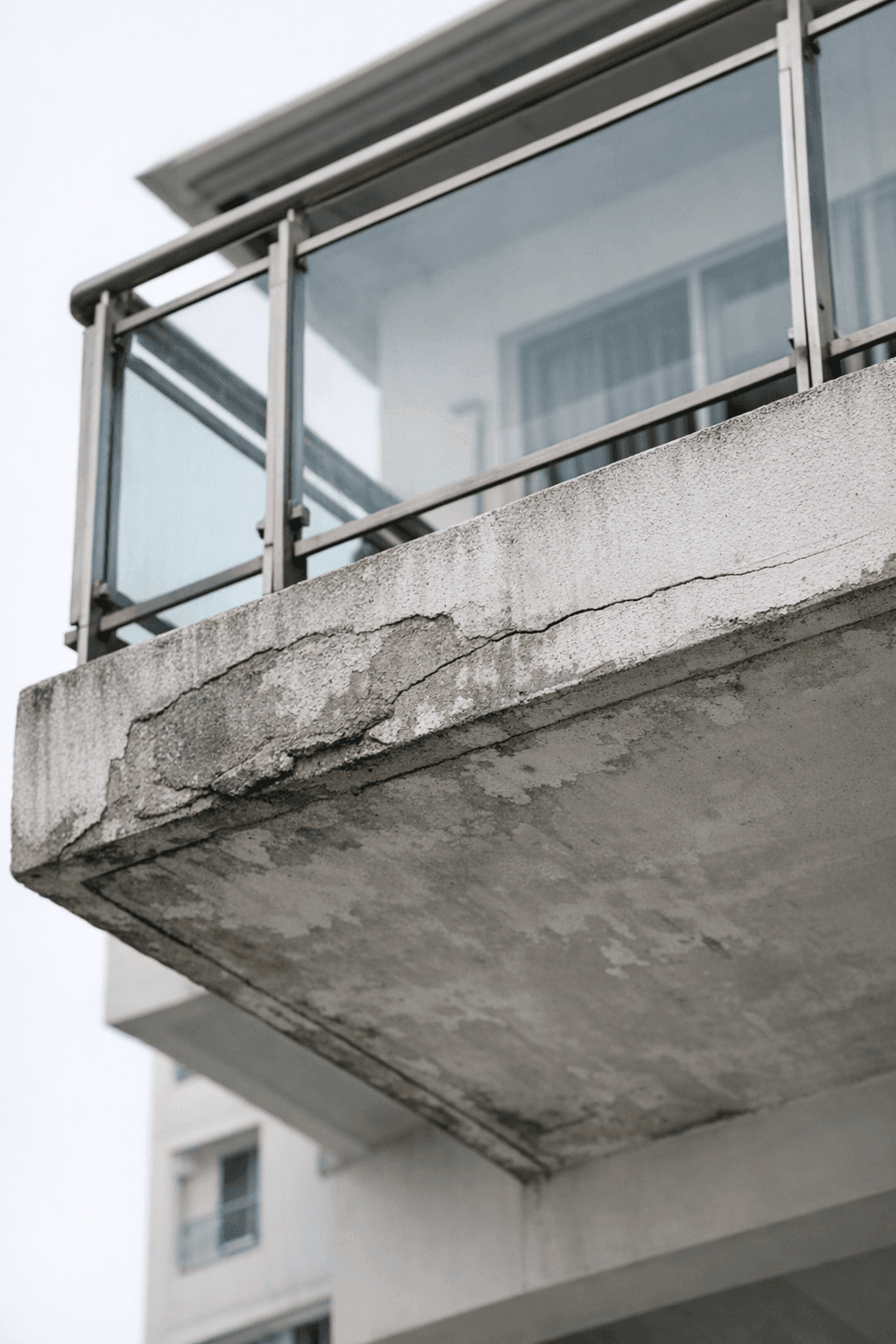
The Straits Times reported last month that on 15 February 2025, a piece of cement-based material came away from the underside of a third-floor balcony at Foresque Residences in Bukit Panjang and fell into the unit below. An engineer hired by the condo's management corporation later identified 88 balconies in the same block as affected by the same alleged defect.
The condo was completed in 2014. The management corporation has sued the developer, the architect, two engineering firms and a subcontractor. All deny liability. The developer also argues that the claim is simply too late. The main contractor is being wound up.
A follow-up explainer in The Straits Times set out the question this raises for every condo owner: when a defect turns up years later, who pays? We added a number the explainer did not have: how many Singapore condos are in the same window of time.
Twenty metres, and 88 balconies
In February 2025, a cement-based patch fell about 20m from a balcony at Foresque Residences. The MCST's engineer found 88 affected balconies in one block. Five defendants deny liability; the main contractor is being wound up.
Foresque Residences is a 99-year leasehold condo on Petir Road in Bukit Panjang: five blocks, 496 units, temporary occupation permit in June 2014.
On 15 February 2025, according to court documents reported by The Straits Times, a "cementitious patch" came off the underside of a third-floor balcony at Block 105 and landed in a first-floor unit. The Building and Construction Authority inspected the same day and issued a Notice to Maintain, requiring the management corporation (MCST) to make the area safe and carry out permanent repairs.
The MCST appointed an engineer to investigate. He reported that part of a balcony slab had not been built as designed: a 70mm section of concrete was missing, and the gap had been filled with cement mortar. Hammer-tapping tests found hollow sounds along about 60 per cent of the balcony slab edges in the block. In all, he identified 88 balconies in Block 105 as affected. The other four blocks did not show the same condition.
The MCST has sued the developer, the architect, the structural engineer, the railing engineer and a subcontractor. All five deny liability, each for different reasons. The developer, Wincheer Investment, says it did not build the condo itself and appointed competent contractors, and that the patch is a maintenance issue, not a structural defect. It also argues the claim is time-barred, because a six-year limitation period expired in 2021. The main contractor, Tiong Aik Construction, is in creditors' voluntary winding-up.
None of these claims has been decided by a court.
Three estates, three ways to run out of road
Foresque faces a time-bar argument and an insolvent contractor. Canberra Residences settled in 2020 and is back in court. At Waterwoods, the developer had been dissolved and the court refused to revive it.
The Straits Times' explainer set Foresque beside two other estates. Together they show the main ways a defect claim can fail even when owners believe they are right.
Foresque Residences (completed 2014): time. The alleged defect surfaced about ten years after completion. The developer argues the claim is out of time, and the main contractor is being wound up.
Canberra Residences, Sembawang (completed 2013): a settlement that did not settle it. Residents reported problems in 2013, soon after moving in. A settlement agreement to carry out repairs was reached in 2020. The MCST is now back in court, saying problems remain, including water seepage, ponding at lift lobbies and in the basement, defective paintwork and shattered balcony glass panels. The main contractor, MCC Engineering, disputes this.
Waterwoods EC, Punggol (completed 2015): nobody left to sue. Residents began finding defects, including seepage and cracks in external walls, from about 2019. By then the developer, a single-project company called Coral Edge Development, was being wound up. It was dissolved in 2020, and the main contractor, Greatearth Corporation, became insolvent in 2021. The MCST asked the High Court to declare the dissolution void so it could pursue about $3.9 million for repairs. The court refused, saying in 2022 that it was "pointless" to restore a developer with no assets to pay the claim.
Time, a dispute that drags on, and a defendant that no longer exists. Any one of them can leave the bill with the owners.
The clock, as the law sets it
Buyers get a one-year defects liability period. Contract and tort claims generally have six years. After that, a latent defect can be claimed within three years of discovery, up to a 15-year long-stop from completion.
The explainer set out the time limits, with lawyer Daniel Chen of Lee & Lee, who specialises in MCST disputes:
- The defects liability period: one year. It starts when buyers take possession. Defects reported in this period are rectified by the developer. This is the first and simplest line of protection.
- The limitation period: generally six years. Claims in contract or tort generally have to be brought within six years of when the right to sue arises.
- Latent defects: three years from discovery, up to 15 years. For defects that existed but were not discovered earlier, an MCST may still bring a claim in tort within three years of discovering the defect, but only up to a long-stop of 15 years from completion of the condo.
After 15 years, Chen said, the latent-defect exception can no longer be used against the developer, main contractor or subcontractors. Some contractor warranties assigned to the MCST may still be enforceable while they last.
The long-stop is the date that matters for an ageing condo. Before it, a hidden defect can still be pursued, if someone is left to pursue. After it, the latent-defect route is closed.
We explain the first stage in our guide to the defects liability period for new launches.
How many condos are in each window?
On our directory, 740 private non-landed developments with 147,595 homes are aged 7 to 15: past the six-year limit, inside the 15-year long-stop. That is 24.4% of developments we can date.
Here is how Singapore's private non-landed developments divide across those windows, by age as at 2026:
| Age | What applies | Developments | Share | Homes |
|---|---|---|---|---|
| Under 2 years | Inside or just past the 1-year defects liability period | 57 | 1.9% | 10,905 |
| 2 to 6 years | Inside the 6-year limitation period | 172 | 5.7% | 50,502 |
| 7 to 15 years | Latent-defect route only: 3 years from discovery, 15-year long-stop | 740 | 24.4% | 147,595 |
| Over 15 years | Past the 15-year long-stop | 2,064 | 68.1% | 201,353 |
Age from completion (TOP) year, so each edge is approximate to a year. Includes executive condominiums. 3,033 developments with a recorded completion year.
The middle band is the one these three cases fall into. 740 developments, holding 147,595 homes, are old enough that the ordinary six-year limit has probably passed, but young enough that a newly discovered hidden defect may still be claimed.
It is also a large band because of when Singapore built. Developments completed between 2011 and 2017 make up most of it: 684 of the 740.
And it is worth repeating what the table does not say. Being in a band does not mean a development has defects. It only tells you which time limits would apply if one were found.
Which condos are running out of time?
Developments completed in 2011, 95 of them with 11,723 homes, reach the 15-year long-stop around now. The 2012 cohort, 102 developments and 10,505 homes, follows in 2027.
The long-stop moves forward one year at a time. Here is the cohort currently in the latent-defect window, by completion year:
| Completed | Developments | Homes | 15-year long-stop |
|---|---|---|---|
| 2011 | 95 | 11,723 | around 2026 |
| 2012 | 102 | 10,505 | around 2027 |
| 2013 | 86 | 13,833 | around 2028 |
| 2014 | 123 | 22,827 | around 2029 |
| 2015 | 107 | 21,983 | around 2030 |
| 2016 | 112 | 25,983 | around 2031 |
| 2017 | 59 | 20,041 | around 2032 |
| 2018 | 33 | 12,521 | around 2033 |
| 2019 | 23 | 8,179 | around 2034 |
95 developments with 11,723 homes were completed in 2011. For them, the 15-year long-stop falls around now. Any latent defect not yet acted on is close to the point where the latent-defect route closes.
The three estates in the reporting sit further back:
| Development | Completed | Age | Homes | District |
|---|---|---|---|---|
| Canberra Residences | 2013 | 13 years | 320 | D27 |
| Foresque Residences | 2014 | 12 years | 496 | D23 |
| Waterwoods | 2015 | 11 years | 373 | D19 |
If you own in a condo completed between 2011 and 2014, this is the part of the window where waiting costs the most.
Why can't an MCST just sue the developer?
Often, the developer named on the project no longer exists. Large developers commonly use a single-project subsidiary that is wound up after completion, and the parent company cannot be sued for its debts.
Because the company that developed the condo may be gone.
Lawyer Daniel Tay of BR Law Corporation, who acted for the Waterwoods MCST, told The Straits Times it is common for larger developers to set up a subsidiary for each project. Once the project is completed and its liabilities are settled, the subsidiary is wound up. As a separate legal entity, its debts do not pass to the parent company. Once it is gone, there is nobody to claim against.
That leaves an MCST with two options, Tay said: pay for the repairs itself, which means owners pay through their contributions, or pursue the subcontractors responsible.
Both routes have problems. Subcontractors may also have closed, been wound up or, as Foresque's railing subcontractor told the court, no longer hold most of their records from 14 years earlier. And as Foresque shows, even when every party still exists, each may point at another.
This is the most important thing to understand about a defect found late. The law may give you until year 15. The companies may not last that long.
What should an MCST or owner do if a defect turns up?
Act early. Document the problem, get an engineer's report, check whether the developer and contractors still exist, and get legal advice on time limits before they pass.
The lawyers quoted in the explainer agreed on one thing: act early. Every year a dispute is left, the time limits get closer and the companies involved are more likely to be gone.
What that looks like in practice:
- Document everything as soon as it appears: photos, dates, residents' reports, any BCA notices.
- Get an independent engineer's report on the cause and extent, as Foresque's MCST did. It is the foundation of any claim.
- Check who still exists. The developer's project company, the main contractor and key subcontractors can be checked on ACRA's register. A company being wound up is a reason to move faster, not slower.
- Look for warranties. Some contractor warranties were assigned to the MCST at handover and may still be enforceable.
- Get legal advice on time limits early, especially if your condo was completed more than six years ago. Lee & Lee's Chen said defect claims usually take a year or two to resolve even by settlement, longer at trial.
For new-home buyers, the cheapest protection comes first: an inspection during the one-year defects liability period. But as the explainer noted, unit inspections do not cover common property, where many problems stay hidden for years.
Tay also suggested the insurance industry could offer cover for latent defects that appear years later, as a fallback if the responsible company is insolvent. No such retail product was mentioned as existing today.
Our guide to what an MCST is and does covers who makes these decisions.
Should buyers of older condos worry?
Not about every condo, but it is worth asking. Before buying, check the MCST's minutes for defect disputes and BCA notices, and how much is in the sinking fund.
Not about every condo. Most developments never have a serious structural defect, and the table above says nothing about which ones do.
But if you are buying a resale unit in a development completed roughly 7 to 15 years ago, the defect question is worth asking, because that is when hidden problems surface and when recovering the cost becomes hardest.
Practical checks before you buy:
- Read recent MCST minutes and AGM papers. Defect investigations, legal action against the developer and BCA notices usually appear there.
- Ask about the sinking fund and any planned special levies. If an MCST cannot recover repair costs, owners pay, often through a levy.
- Look at the common areas yourself: facades, balconies, car park ceilings and roof areas.
Owners who sell during a dispute may also find buyers asking the same questions. We wrote in July about a court ruling on what maintaining common property means for an MCST. Disputes of this kind sit in the background of many older condos.
This is general commentary, not legal advice.
The honest catch: a count of windows, not of defects
Our count shows which time limits apply, not which condos have defects. Ages are by completion year, the legal trigger can vary, and none of the three disputes has been decided.
Some limits worth stating clearly.
We have counted windows, not defects. Nothing in our data says which developments have defects. Most never will.
Ages are approximate. We use the completion (TOP) year, not an exact date, so a development close to a band edge may sit in the next band. The long-stop is counted from completion as it was reported; the precise legal starting point can differ case by case.
The law is summarised, not applied. Whether a particular claim is in time depends on its facts, and on when the right to sue arose or the defect was discovered. Get legal advice for your own case.
None of the three disputes has been decided. Every defendant in the Foresque case denies liability, and the Canberra Residences contractor disputes the claims. Nothing here suggests any party is at fault.
Our directory covers private non-landed developments, including ECs, and excludes 268 without a recorded completion year.
What we would not hedge on: about a quarter of Singapore's condos, holding nearly 150,000 homes, are in the years when hidden defects tend to surface and recovering the cost is hardest.
How we sourced this
The three cases, the legal time limits and the lawyers' comments come from The Straits Times. The count of developments by window is PropKaki's own, from our condo directory, as at 2026.
Two kinds of numbers, kept apart.
From the reporting: everything about Foresque Residences, Canberra Residences and Waterwoods (dates, findings, parties, claims, defences, the $3.9 million figure and the court's decision), the legal time limits, and the comments from Daniel Chen and Daniel Tay come from the two Straits Times reports linked below.
PropKaki's own data, as at 2026: the window counts band every private non-landed development in our directory with a recorded completion year (3,033 developments; 66 not yet completed and 268 without a recorded year are excluded) by age at 2026, against the time limits as reported. Homes are summed where unit counts are recorded. The cohort table counts developments completed in each year from 2011 to 2019. The three named estates' completion years, unit counts, tenure and districts come from the same directory.
Sources
Two Straits Times reports on condo defect disputes, and PropKaki's condo directory.
The news:
- The Straits Times: Who pays for condo defects years after completion?, 20 September 2026, with comment from Daniel Chen (Lee & Lee) and Daniel Tay (BR Law Corporation).
- The Straits Times: MCST sues developer, four others over alleged defects after concrete piece from condo balcony fell 20m, 13 September 2026.
The data:
- PropKaki directory of private non-landed developments (completion year, unit count), banded by age as at 2026.
About this commentary
Opinion and analysis from the PropKaki Editorial Desk, not legal advice. None of the disputes described has been decided.
This is commentary by the PropKaki Editorial Desk on reporting by The Straits Times. The cases, the claims and defences, and the legal commentary belong to that reporting and to the parties; the count of developments by window, the framing and the opinions are ours.
It is opinion and general information, not legal, financial or property advice. The disputes described are before the courts or have been decided as reported, and nothing here suggests any party is liable. MCSTs and owners dealing with defects should get advice from a lawyer and a professional engineer.
Published 6 October 2026.
Got a question this raised? Ask PropKaki.
Take any point from this analysis and apply it to your own project, budget or decision.
 PropKaki
For most buyers this year, staying well within budget beats trying to time the market.