

HDB Upgrading in 2026: HIP, NRP, SUP and HIP II, What You Pay and When Your Block's Turn Comes
What the Home Improvement, Neighbourhood Renewal and Silver Upgrading Programmes fix, which flats qualify, what owners pay, how the 75% vote works, how to check your block, and what HIP II means for flats reaching 60.
The Home Improvement Programme (HIP) repairs and upgrades the inside of HDB flats in blocks built up to 1997 that did not have the Main Upgrading Programme, usually when a block reaches about 30 years: essential repairs are free for citizen households, who pay 5% to 12.5% of the optional items by flat type. The Neighbourhood Renewal Programme upgrades blocks and precincts built up to 1999, and the Silver Upgrading Programme adds senior-friendly features to older precincts; both are fully funded. HIP needs 75% of a block's citizen households to vote yes. HIP II, for flats at 60 to 70 years, has no published scope, cost or start date.
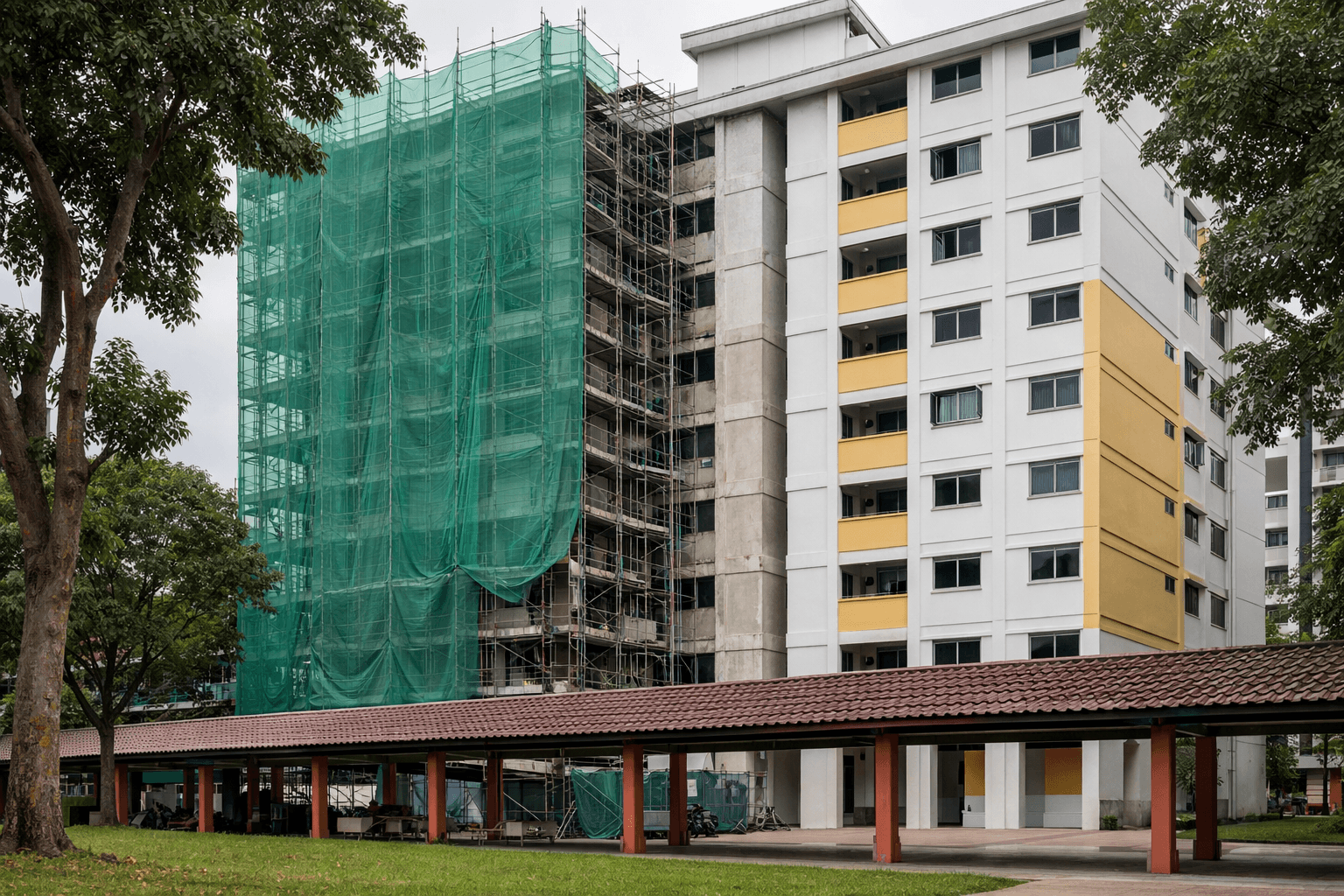
HDB upgrades its flats and estates in layers. The Home Improvement Programme (HIP) goes inside your flat, fixing spalling concrete and old pipes and offering a new toilet, door and gate at a small share of the cost. The Neighbourhood Renewal Programme (NRP) works on the block and precinct around it, and the Silver Upgrading Programme (SUP) adds senior-friendly features to older precincts that have already been upgraded; both cost residents nothing. HIP II is promised for flats reaching 60 to 70 years.
This guide covers which flats qualify and when, what each programme includes, what you pay and how, how the 75% vote works, how to check whether your block has been picked, and how many flats sit in each window today. Rules are HDB's and MND's, as at 19 September 2026.
What HDB upgrading programmes are there?
Three run today. The Home Improvement Programme (HIP) fixes the inside of flats in blocks built up to 1997; the Neighbourhood Renewal Programme (NRP) improves blocks and precincts built up to 1999; and the Silver Upgrading Programme (SUP) adds senior-friendly features to older precincts that have already been upgraded. EASE adds senior-friendly fittings inside the flat, and HIP II is promised for flats reaching 60 to 70 years.
| Home Improvement Programme (HIP) | Neighbourhood Renewal Programme (NRP) | Silver Upgrading Programme (SUP) | HIP II | |
|---|---|---|---|---|
| What it fixes | Inside your flat: spalling concrete, pipes, drying rack, electrical load; optional toilet, door, gate | The block and precinct: linkways, playgrounds, fitness corners, void decks | Senior-centric upgrades in the precinct | "More extensive than the current HIP" |
| Which flats | Blocks built up to 1997 without the Main Upgrading Programme, at about 30 years of age | Blocks built up to 1999 without the Main or Interim Upgrading Programme | Older precincts that have already been upgraded, with more seniors than average | Flats at 60 to 70 years |
| Who pays | Essential repairs free for citizen households; they pay 5% to 12.5% of optional items | Fully funded by the Government | Fully funded by the Government | Not yet announced |
| Support needed | 75% of the block's citizen households vote yes | 75% of the neighbourhood's flat owners support it | Residents are consulted on the design | Not yet announced |
Sources: HDB's HIP and NRP pages; HDB release of 18 April 2026 (NRP and SUP); Minister Chee Hong Tat at the Committee of Supply debate, 4 March 2026. EASE, senior-friendly fittings inside the flat, comes with HIP or by direct application.
What was the Main Upgrading Programme? HDB's earlier round of upgrading for older flats. MND describes a flat's first round of upgrades as either the Main Upgrading Programme or, for flats past 30 years, today's HIP, with HIP II as the second round (MND). Blocks that had the Main Upgrading Programme fall outside the original HIP.
HIP is about your flat; NRP and SUP are about everything outside your front door.
Which flats qualify for HIP, and when is your block's turn?
Flats in blocks built up to 1997 that have not had the Main Upgrading Programme: HIP started in 2007 for blocks built up to 1986 and was extended in 2018 to 1987–1997. HDB runs it when a block reaches about 30 years, and has selected about 512,000 flats, 9 in 10 of those eligible. Flats built after 1997 come next, once selection of older flats is substantially complete, subject to budget and industry capacity.
Here is where every HDB flat sits today, by the year its block was completed:
| Block completed | Programme window today | Blocks | Dwelling units | Share of flats |
|---|---|---|---|---|
| Built up to 1986 | HIP since 2007 (if no Main Upgrading Programme) | 4,129 | 459,996 | 39.3% |
| Built 1987 to 1997 | HIP since the 2018 extension | 2,874 | 233,589 | 20.0% |
| Built 1998 to 1999 | NRP only (not yet HIP) | 674 | 71,446 | 6.1% |
| Built 2000 to 2006 | Not yet eligible for either | 759 | 85,999 | 7.4% |
| Built 2007 or later | Not yet eligible for either | 2,316 | 318,331 | 27.2% |
PropKaki analysis of HDB's block records, counting every flat in each block. HDB puts the original HIP window at about 320,000 eligible flats (blocks built up to 1986 without the Main Upgrading Programme) and the 2018 extension at about 230,000; the first two rows are also inside the NRP window. Being inside a window does not mean your block has been picked; it still has to be selected and win the vote.
- The pace. HDB announced over 18,000 more flats for HIP on 16 May 2026, with over $253 million set aside. About 512,000 flats, "9 in 10 of eligible flats", have now been selected, and close to 409,000 have finished (HDB).
- Your block's age. HIP is "implemented when blocks reach around 30 years of age", and MND said in July 2026 that HDB will keep that rule.
- After 1997. HDB "will extend the programme to flats built after 1997" once the older flats have been substantially selected, depending on budget and industry capacity (MND). HDB has not said which years or when. For scale, 157,445 flats in blocks built from 1998 to 2006 reach 30 by 2036.
- Not eligible yet but have a defect? MND points residents of flats outside HIP to the Goodwill Repair Assistance scheme.
- From announcement to works. About one and a half years on average, then about 1.5 to 2 years for a typical precinct of 8 to 10 blocks. Work inside each flat takes 10 working days or less.
Check your block on HDB's upgrading status e-service: search by block and street to see if it has been announced for HIP, NRP or SERS.
Blocks built up to 1997 without the Main Upgrading Programme are eligible; flats built after 1997 come next, but HDB has not said which years or when.
What does the Home Improvement Programme include?
Three parts. Essential improvements are compulsory once the block votes yes and are free for citizen households: repairing spalling concrete and structural cracks, replacing old waste pipes and the clothes-drying pipe sockets, and upgrading the electrical load if needed. Optional improvements, which you choose flat by flat, cover a toilet upgrade, a new entrance door and gate, and a new refuse chute hopper. EASE adds senior-friendly fittings.
| Part | What is done | Your choice? |
|---|---|---|
| Essential | Repair spalling concrete and structural cracks; replace waste and soil discharge stacks (cast iron, mixed, or leaking UPVC); replace pipe sockets with a new clothes-drying rack; upgrade the electrical load if necessary | No: compulsory once the block votes yes |
| Optional | Toilet and bathroom upgrade package; new entrance door; new grille gate; new refuse chute hopper, where applicable | Yes, item by item |
| EASE | Senior-friendly fittings such as grab bars, ramps and slip-resistant flooring; a wheelchair lifter where ramps will not work | Yes: any household in a HIP precinct can opt in |
Source: HDB, Home Improvement Programme. You can skip the toilet upgrade only if your toilets pass a water test for leaks. The type of entrance door follows the fire code.
EASE can also be had without HIP: citizen households (and rental tenants) with a member aged 65 or above, or aged 60 to 64 who needs help with daily activities, can apply directly (HDB).
The essentials are the point of HIP: they fix the defects that ageing blocks develop.
How much does HIP cost you?
For citizen households, nothing for the essential repairs and 5% to 12.5% of the optional items, by flat type: about $599.50 for the full optional package in a 3-room or smaller flat and $1,498.75 in an Executive flat. PR households pay the full cost. The bill comes after the precinct's works are finished, and can be paid by CPF over up to 10 years.
| Flat type | Your share | Your estimated bill (full optional package) | Government's share |
|---|---|---|---|
| 1-, 2- and 3-room | 5% | $599.50 | $11,390.50 (95%) |
| 4-room | 7.5% | $899.25 | $11,090.75 (92.5%) |
| 5-room | 10% | $1,199.00 | $10,791.00 (90%) |
| Executive | 12.5% | $1,498.75 | $10,491.25 (87.5%) |
HDB estimates for projects polling after 30 March 2020, with a fire-rated main door and home fire alarm device, including 9% GST (HDB; HDB release of 16 May 2026, Annex B). The final amount is set when the works are done.
- PR households pay the full cost, though not for optional or EASE items they opt out of.
- When you pay. HDB bills after all the works in your precinct are complete, and you arrange payment within 1 month of the invoice (HDB).
- How you pay. In full, or in instalments by GIRO or by CPF (owners only, over up to 10 years); citizen households paying by instalments are charged 0.1 percentage point above the CPF rate, 2.60% a year through 2026. HDB's calculator on the HIP page works out your items and instalments.
- Selling before you pay it off? If the bill is issued before your resale completes, you must clear the whole balance, with interest, before completion, and CPF cannot be used once the resale is under way (HDB).
For a citizen household, HIP is a heavily subsidised renovation, and the repairs cost nothing.
How does the HIP vote work?
HIP goes ahead only if at least 75% of a block's eligible Singapore Citizen households vote yes; PR households do not vote. Owners can appoint a proxy. In the ten years to January 2026, only six blocks failed the vote, and the four allowed to re-poll after about a year all passed.
- The threshold. "At least 75% of a block's eligible Singapore Citizen households" must vote in favour (HDB). MND explains the high bar: HIP works are carried out inside residents' flats.
- Who votes. Citizen households; PR households are not eligible to vote, though they pay the full cost.
- Can't be there? Residents who cannot vote in person "may appoint a proxy" (MND, 3 February 2026).
- If the vote fails. Six blocks missed 75% in the past decade: one in Serangoon Avenue 2 (2017), three at Lengkong Tiga (2023) and two in Tiong Bahru (November 2025). The first four were allowed to re-poll after about a year, and all four passed. HDB is reviewing the voting process.
One block's vote decides for everyone in it, including the owners who do not vote.
What are the Neighbourhood Renewal and Silver Upgrading Programmes?
Both upgrade the estate rather than your flat, and both are fully funded by the Government. The NRP improves blocks and precincts built up to 1999 that have not had the Main or Interim Upgrading Programme, with items such as covered linkways and fitness corners, once 75% of flat owners support it. The SUP adds senior-friendly features to older precincts that have already been upgraded.
| Level | Examples of what the NRP can add |
|---|---|
| Block | New letterboxes, residents' corners, seating at void decks, first-storey lift lobby tiling |
| Precinct | Drop-off porch, covered linkways, playground, footpath or jogging track, fitness corner, pavilion or shelter, landscaping |
Source: HDB, Neighbourhood Renewal Programme. Residents are consulted on the items during a Consensus Gathering Exercise, and at least 75% of eligible flat owners in the neighbourhood must indicate their support.
- NRP: who pays. Nobody in the neighbourhood: it is "fully funded by the Government and implemented by the Town Councils".
- NRP: which blocks. Blocks built up to 1995 earlier, now up to 1999, if they have not had the Main Upgrading Programme or the Interim Upgrading Programme (or its Plus version).
- NRP: the latest batch. On 18 April 2026 HDB picked 17 projects for Batch 17, with more than $130 million; over $1.6 billion had been set aside for 246 NRP projects in the previous 16 batches (HDB).
- SUP: what it is. Launched in August 2024, it offers "senior-centric upgrades" to older precincts, including ones that "have previously undergone upgrading", chosen for having more residents aged 55 and above than average.
- SUP: where. Batch 3 (April 2026) covers 10 precincts in Ang Mo Kio, Bukit Merah and Queenstown, about 9,000 households, with works from the second half of 2026; HDB will extend it to towns such as Bedok, Clementi and Kallang-Whampoa.
NRP and SUP change the estate around you without a bill; HIP changes your flat for a small one.
What is HIP II?
A second, bigger round of upgrading for flats reaching 60 to 70 years old, first announced at the 2018 National Day Rally so that every flat can be upgraded twice in its lease. The government says it will be more extensive than today's HIP, but has not published its scope, cost-sharing, vote or start date.
- What has been said. Minister Chee Hong Tat, March 2026: flats will be upgraded "via HIP II when their flats reach the 60- to 70-year mark", HIP II "will be more extensive than the current HIP", and "We will share more about the scheme in due course" (MND).
- Why it matters now. On today's stock, 1,335 flats are already 70 or older and 23,328 are in their 60s, by the year their block was completed (PropKaki analysis of HDB's block records).
- What we do not know. HDB has no HIP II page yet. Treat any figure for its cost or timing as speculation until HDB publishes one.
HIP II is a promise with an age trigger, not yet a scheme with rules.
What is the biggest mistake people make with HIP?
Getting the bill wrong when a flat changes hands. HDB bills whoever owns the flat on the billing date on its invoice. If the invoice is issued before a resale completes, the seller must clear the whole balance, with interest, before completion; if it comes after, the buyer pays.
HDB's rule: "If you are the flat owner as of the date of billing on our invoice, you are required to pay the upgrading cost" (HDB). Billing comes after the works in the precinct are completed, and works in a typical precinct take 1.5 to 2 years.
- Selling? If the invoice is issued before your resale completes, you must settle the outstanding cost in full, including interest, before completion: from your cash proceeds if they are enough, otherwise in cash. To use CPF, pay in full before the first resale appointment.
- Buying a resale flat? If the invoice comes after your purchase completes, it is yours. Check the block on HDB's upgrading status e-service and the precinct's scheduled billing date on the HIP page, and ask the seller which optional items were chosen.
- A PR household? You pay the full cost of what is done, and you do not get a vote.
Check the precinct's billing date before you buy or sell, and settle who pays in the deal.
Official sources
Check HDB directly for your block and your bill.
Methodology and sources
Where every figure comes from, and what we deliberately did not claim.
Official figures and rules. HIP eligibility, parts, cost shares, voting, timing and billing are from HDB's HIP page (updated 17 September 2026), its paying-for-upgrading pages (including who pays when a flat changes hands, updated 18 November 2025) and its release of 16 May 2026 with Annex B. NRP and SUP are from HDB's NRP page and its release of 18 April 2026; EASE from HDB's EASE page. The 30-year trigger, the post-1997 extension, proxies, the one-and-a-half-year lead time and the failed polls are from MND's written answers of January to July 2026; the Main Upgrading Programme's place from MND's answer of 24 September 2025. HIP II is from Minister Chee Hong Tat's Committee of Supply speech of 4 March 2026 and the 2018 National Day Rally. All read on 18 and 19 September 2026.
Proprietary figures. The table of upgrading windows and the counts of older flats are PropKaki's analysis of HDB's block records, grouped by the year each block was completed; a flat's lease can start a year or two later. HDB's figure of 230,000 flats added to HIP in 2018 is within 2% of our count of 233,589 flats in blocks built 1987 to 1997; our count for blocks built up to 1986 includes flats that had the Main Upgrading Programme and rental flats, so it is higher than HDB's eligible figure. How we work: PropKaki methodology.
What we have not claimed: that any block will be selected, or when; what HIP II will cost or include; or the NRP items your precinct will get, which residents help decide. This is a practical explainer, not legal or financial advice. Check hdb.gov.sg before you rely on it.
Got a question this raised? Ask PropKaki.
Take any point from this analysis and apply it to your own project, budget or decision.
 PropKaki
For most buyers this year, staying well within budget beats trying to time the market.