

Parliament Debated VERS This Week. By Lease, the First Flats Reach Its 70-Year Mark in 2036
MPs asked whether HDB should borrow the private sector's new age tiers. We counted the flats on both sides of that question: on the lease records we hold, no sold flat reaches VERS's 70-year mark before 2036, while the private 40-year tier would take in two fifths of the stock.
On 8 September 2026, Law Minister Edwin Tong told Parliament that MinLaw will share learning points from the private collective sale regime with MND as the Voluntary Early Redevelopment Scheme (VERS) framework is worked out. The same sitting passed amendments lowering the private collective sale threshold from 80% to 70% for developments 40 to 59 years old and 65% for those 60 and older. VERS — whose details are still unannounced — would let owners of HDB flats that reach the 70-year mark of their 99-year leases vote on a government buy-back before their leases expire. Counted by lease, as MND counts it, none of the 1,104,421 sold flats in PropKaki's block record whose lease start can be dated has reached that mark: holding today's stock constant, the first 120 get there in 2036, 24,464 by 2041 and 78,552 — 7.1% — by 2046. Applying the private regime's 40-year tier to HDB building age instead would take in 459,996 of 1,169,361 homes, or 39.3% of the stock.
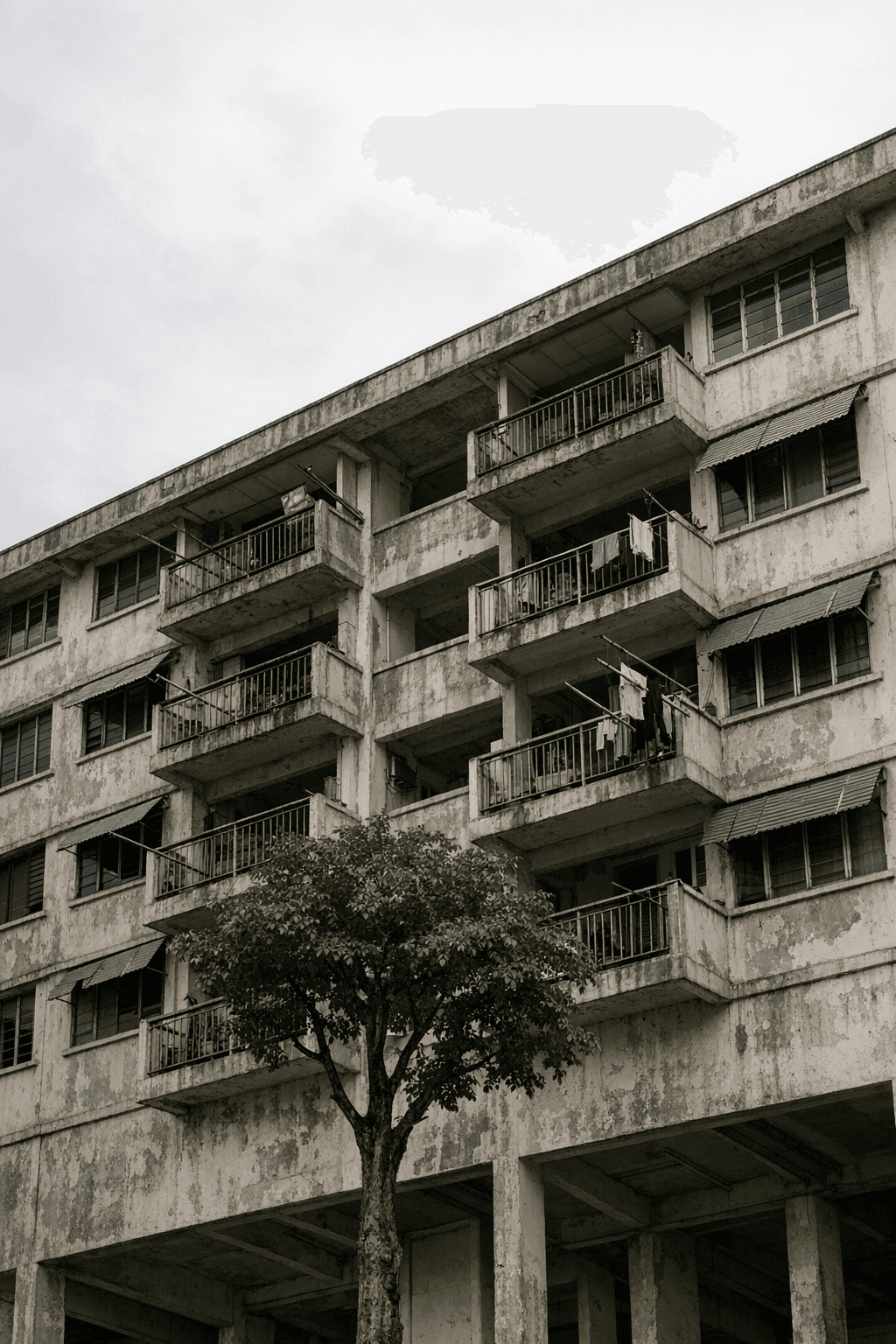
Parliament spent 8 September lowering the bar for private collective sales, tiered by how old a development is. Several MPs asked the obvious follow-up: should VERS, the scheme meant to do something similar for ageing HDB flats, work the same way? It is a good question, and it has a number attached that nobody put on the record. So we counted. On today's stock, the 70-year mark VERS uses, counted on the lease as the Ministry of National Development counts it, reaches no sold flat on our records until 2036.
The question nobody put a number on
Cassandra Lee, the MP for West Coast-Jurong West, made an argument in Parliament this week that is hard to disagree with.
As buildings age, she said, maintenance gets more expensive, repairs get more frequent, upgrading gets harder and slower — and at some point "redevelopment starts to make more sense than maintenance". Singapore has a well-worn set of answers for the first part of that sentence: the Home Improvement Programme, the Lift Upgrading Programme, the Neighbourhood Renewal Programme. Her question was about the second part.
"Not what do we need to repair, or what should we upgrade next," she said, "but when does comprehensive redevelopment make better sense?"
She was asking it about VERS — the scheme that will one day let HDB owners vote on selling their flats back to the government before the lease runs out — on a day when Parliament had just answered a version of the same question for private housing.
The Straits Times reported the exchange. What it did not carry — what nobody in the chamber put on the record — is how many flats the answer would actually touch.
Two schemes, two very different age gates
It is worth laying the two side by side, because they are usually discussed separately and the contrast is the whole story.
Private collective sales, as amended on 8 September (in force from a commencement date still to be announced): the consent threshold drops from 80% to 70% for developments aged 40 to 59, and to 65% for those 60 and older. Age is the trigger — counted from the building's latest temporary occupation permit — and it starts biting at 40 years.
VERS, per the reporting: owners of HDB flats aged 70 years and older would vote on whether the government should buy back their homes before the leases expire. The Ministry of National Development's own wording is more exact: the clock is the lease, with more flats reaching "the 70-year mark of their 99-year leases" from the late 2030s (MND, 24 September 2025). Details — the payout basis, the voting mechanics, the order of towns — have not been announced.
Law Minister Edwin Tong told the House that MinLaw would share its experience of the collective sale regime with MND, and that the learning points would be passed across agencies. MPs He Ting Ru (Aljunied GRC), Cassandra Lee and NCMP Andre Low had all noted that changes to the private framework could have implications for VERS.
Lee's framing was the sharpest: the two schemes share a policy objective — the voluntary redevelopment of an ageing estate — so any significant difference in how they treat age "should have a clear policy basis".
Thirty years is a significant difference. Here is what it costs.
How old is the HDB stock by building age?
We hold HDB's block directory — every residential block, its completion year and how many dwelling units it contains. Aged by completion year against 2026 (building age, not lease age), that is 1,169,361 homes across 10,752 blocks.
| Building age | Blocks | Dwelling units | Share of stock |
|---|---|---|---|
| 70 years and older | 52 | 1,335 | 0.1% |
| 60–69 years | 224 | 23,328 | 2.0% |
| 50–59 years | 718 | 112,261 | 9.6% |
| 40–49 years | 3,135 | 323,072 | 27.6% |
| 30–39 years | 2,566 | 202,277 | 17.3% |
| Under 30 years | 4,057 | 507,088 | 43.4% |
By building age, 52 blocks and 1,335 flats are 70 or older, all of them in Tiong Bahru: blocks completed in 1937–38 and in 1949.
But building age is not the clock VERS runs on. MND counts to the 70-year mark of the 99-year lease, and the oldest blocks were sold years after they were built: the 1949 Tiong Bahru blocks' leases began in 1973–74, and across blocks completed before 1970 the lease began a median three years after completion. The 1937–38 blocks have no HDB resale record, so their leases cannot be dated. By lease, none of the sold flats we can date has reached the 70-year mark, so on the records we hold, a 70-year gate has no flats to act on in 2026.
The bulge is somewhere else entirely. The biggest single band is under 30 years at 43.4% — the Punggol, Sengkang and Sembawang build-out — and the second is 40 to 49 years at 323,072 homes, the great 1970s and 1980s expansion now entering middle age.
So when does VERS actually become a large programme?
The late 2040s and the 2050s. Counting by lease, the clock VERS runs on, and holding today's stock constant — no new blocks, no demolition, no SERS — here is when today's sold flats reach the 70-year mark of their leases:
| By year | Blocks | Sold flats at 70+ years of lease | Share of today's sold flats | For comparison: sold flats by building age |
|---|---|---|---|---|
| 2026 | 0 | 0 | 0.0% | 1,335 |
| 2031 | 0 | 0 | 0.0% | 1,584 |
| 2036 | 3 | 120 | 0.0% | 15,867 |
| 2041 | 216 | 24,464 | 2.2% | 32,985 |
| 2046 | 642 | 78,552 | 7.1% | 101,734 |
| 2051 | 1,551 | 194,272 | 17.6% | 212,564 |
Ten years out, only 120 flats in three blocks have reached it. Fifteen years out, 24,464, or 2.2% of today's sold flats. Twenty years out, 78,552, or 7.1%. It is not until around 2050 that the scheme becomes something that shapes the national housing picture: by 2051, 17.6%. MND's own timetable is a few selected sites "likely in the first half of the next decade", scaling up "by the late 2030s, when more HDB flats reach their 70-year mark". Our SERS and VERS explainer uses the same lease-based figures.
This is the most useful thing we can tell an HDB owner reading about VERS today: for the overwhelming majority of you, this is not a scheme about your flat. It is a scheme about your flat's second or third owner. If you are 45 and your flat's lease began in 1985, it reaches the 70-year mark in 2055.
Which reframes the parliamentary debate somewhat. The urgency in the chamber was real, but it was about designing VERS well, not about a queue of buildings waiting on it.
Where the oldest blocks are, by building age
By building age, the 60-and-older stock — 24,663 homes — is not spread across Singapore. It is concentrated in a handful of central, mature areas:
| Planning area | Dwelling units |
|---|---|
| Bukit Merah | 6,519 |
| Geylang | 5,958 |
| Queenstown | 5,872 |
| Toa Payoh | 1,685 |
| Novena | 1,668 |
| Kallang | 1,028 |
| Outram | 989 |
| Rochor | 455 |
Three areas — Bukit Merah, Geylang and Queenstown — hold roughly three quarters of it.
By lease, the flats closest to VERS are the 11,130 whose leases began in 1966–69 and reach the 70-year mark in 2036–39. We have not mapped that group by area, so read this table as where the oldest buildings are, not as a VERS queue.
That concentration cuts both ways, and it is worth sitting with. These are central locations with high land values, which is precisely what makes redevelopment economics work. It is also what makes the displacement question He Ting Ru raised so pointed: if the oldest estates come first, the households facing an early VERS vote will be in some of the best-located public housing in Singapore, and what they could afford to move to with the proceeds is a different question entirely.
Her framing in the House was about the private amendments, but it transfers directly: the debate has to balance property rights against urban renewal, and "minimise the impact on the minority who disagree and may otherwise feel bullied into having to accept the decision of the majority".
What if HDB borrowed the private tiers instead?
This is the thought experiment Cassandra Lee's question invites, and our numbers answer it directly.
The private regime now treats 40 years as the age at which redevelopment logic starts applying, counted from a building's latest temporary occupation permit. Apply that same line to HDB building age and the scope changes beyond recognition: 459,996 homes — 39.3% of the entire stock.
Set that against a 70-year lease mark that, on the records we hold, no sold flat has reached today, and that only 7.1% will have reached by 2046.
We are not arguing HDB should adopt it. There are obvious reasons the two cannot be symmetrical: a private collective sale is a transaction between owners and a developer at a market-cleared price, while VERS is the government buying back a lease it granted, at a price it sets, with the public purse and the resettlement of entire towns on the other side of the ledger. A 40-year trigger across two fifths of the housing stock is not a policy, it is a fiscal event.
But that is exactly the point Lee was making. The difference in treatment is enormous, and if it is deliberate — and it plainly is — the reasoning for it deserves to be stated rather than assumed. Our contribution is simply to show how large the gap it has to justify really is.
The honest reality-check: what these numbers are not
Five limits, and the second is the one that matters most.
- This is standing stock, not transactions. We are counting homes that exist, from HDB's block directory. It is not comparable to the resale-volume shares we publish elsewhere, and it is our record of the directory rather than an official flat count. The lease counts cover sold flats only, since HDB's own rental flats are not part of a buy-back.
- Two clocks, and only one is VERS's. The building-age tables (the stock by age, the areas and the private comparison) age each block from its completion year. The VERS counts use lease age, as MND does: each block's lease start is the most common lease commencement year in HDB's resale records since 1990, which dates 99.6% of sold flats in blocks completed by 1990. The clocks agree for most flats (82% of those leases began within a year of completion) but not for the oldest: across blocks completed before 1970 the lease began a median three years later, and in Tiong Bahru's 1949 blocks 24 to 25 years later. 1,133 sold flats in older blocks have no HDB resale record, so their leases cannot be dated and they are left out of the lease counts; 779 of them are in the 1937–38 Tiong Bahru blocks.
- Blocks already taken back under SERS have left the record. That means the oldest bands understate what was built — some of Singapore's earliest flats are gone, which is itself the historical answer to what happened to ageing stock before VERS existed.
- The forward table freezes time. It assumes no demolition, no SERS, no new building. It is a clock on flats that exist today, not a forecast of what the stock will look like in 2046.
- VERS has no published rules. The 70-year mark is MND's, measured on the 99-year lease. Payout basis, voting thresholds, sequencing and eligibility are all unannounced, and any of them could change the arithmetic above. MND has said VERS will start with a few selected sites, and that not every older flat needs to go through it.
What is VERS, and is my flat eligible?
VERS would let owners of HDB flats that reach the 70-year mark of their 99-year leases vote on a government buy-back before the lease expires. Its details are unannounced, and by lease no sold flat we can date has reached that mark today; the first 120 do in 2036.
The Voluntary Early Redevelopment Scheme would let owners of HDB flats that reach the 70-year mark of their 99-year leases vote on whether the government should buy their flats back before the leases expire. It is the voluntary, vote-based counterpart to SERS, which is selective and government-initiated.
Its details have not been announced — not the payout basis, not the voting threshold, not the order in which towns would be offered it.
On eligibility, the blunt arithmetic: counted by lease, as MND counts it, no sold flat whose lease we can date has reached the 70-year mark today, and only 120 will have by 2036, so for almost every HDB owner in Singapore the answer right now is no. If your flat's lease began in 1985, it reaches the 70-year mark in 2055. Take the year your lease began and add 70 — that is the earliest your flat could come into scope. Don't work from the block's completion year: in the oldest blocks the lease began years after the building was finished.
Do the new en bloc rules apply to HDB flats?
No. The changes amend the Land Titles (Strata) Act, which covers private strata developments only. HDB flats are unaffected, though MPs asked whether the same age-tiered logic should inform VERS.
No. The amendments passed on 8 September change the Land Titles (Strata) Act, which governs private strata-titled developments — condominiums and apartments. They lower the collective sale consent threshold to 70% for developments 40 to 59 years old and 65% for those 60 and older, from a commencement date the Ministry of Law has yet to announce.
HDB flats are not strata-titled in that sense and are not covered. Nothing about your flat's tenure, your options or your timeline changed this week.
The connection is indirect but real: MPs asked whether the tiered-by-age logic should inform VERS, and the Law Minister said MinLaw would share its learning points with MND as the VERS framework is developed. So the private change may eventually influence the public one — as an input to a design that has not been settled, not as a rule that now applies to you.
How we sourced this
⚠️ Corrected 23 September 2026. The version of this page published on 12 September counted flats by the age of their blocks and presented that as VERS's reach: 1,335 flats at the 70-year mark today, 24,663 by 2036 and 136,924 by 2046. VERS runs on the lease, not the building: MND times it by "the 70-year mark of their 99-year leases" (oral answer, 24 September 2025), and the oldest blocks were sold years after they were built. Corrected as at 12 September 2026, counting by lease: no sold flat whose lease we can date has reached the 70-year mark; the first 120 do in 2036, 24,464 by 2041 and 78,552 by 2046. The headline, the summary, the projection and the FAQ now use lease age. The building-age tables remain, labelled as building age, and so does the comparison with the private regime's 40-year tier, which the Land Titles (Strata) Act counts from a building's latest temporary occupation permit.
The parliamentary material — Edwin Tong's statement, the amended private thresholds, the VERS description, and the contributions from Cassandra Lee, He Ting Ru and Andre Low — comes from The Straits Times' report of 8 September 2026, linked below; the 70-year lease mark is from MND's oral answer of 24 September 2025. We did not attend the sitting. VERS's own parameters are unpublished; we have not inferred any.
The stock analysis is PropKaki's own, from public.hdb_blocks, HDB's block directory as we hold it. For the building-age tables we counted residential blocks carrying at least one dwelling unit — 10,752 blocks, 1,169,361 units — and aged each block as 2026 minus its completion year, then weighted every band by dwelling units rather than by blocks, so a 140-unit slab does not count the same as a 12-unit walk-up. For the VERS counts we dated each block's lease instead: we matched it, by block and street, to HDB's resale records since 1990, took the most common lease commencement year, and counted its sold flats (1,104,421 in all). The forward projection re-runs the 70-year test at five-year intervals against that fixed stock.
The band shares sum to 100.0%, which is the check we run before publishing any distribution.
Sources
- Learning points from private housing market to be taken into account as VERS framework is developed — The Straits Times, 8 September 2026. Edwin Tong's statement, the amended thresholds, the VERS description and the MPs' contributions.
- Oral answer by Ministry of National Development on Voluntary Early Redevelopment Scheme (VERS) — Ministry of National Development, 24 September 2025. VERS timed to the 70-year mark of the 99-year lease, and its timetable.
- PropKaki —
public.hdb_blocks(HDB block directory), residential blocks with at least one dwelling unit, aged by completion year (building age). As of 2026. - PropKaki —
public.hdb_transactions(HDB resale records since 1990), the lease commencement year per block, for the lease-age counts. As of 2026.
About this commentary
This is opinion and analysis from the PropKaki Editorial Desk, not financial or housing advice. The parliamentary reporting belongs to The Straits Times; the stock analysis, the 70-year projection and the comparison with the private tiers are ours.
VERS does not yet exist as a published scheme. Nothing here should be used to estimate what any flat would receive under it, when any block would be offered it, or whether a purchase decision should turn on it. We have deliberately not modelled a payout, because the basis for one has not been announced.
If you are weighing an older flat, the lease and its remaining years are the thing to underwrite — not a scheme whose rules are still being written.
Published 12 September 2026. Corrected 23 September 2026: the VERS counts now run on lease age, the clock MND uses. An earlier version aged flats by their blocks' completion year, which put 1,335 flats at the 70-year mark when, by lease, none has reached it.
Got a question this raised? Ask PropKaki.
Take any point from this analysis and apply it to your own project, budget or decision.
 PropKaki
For most buyers this year, staying well within budget beats trying to time the market.