
Tampines Is Voting on Three Colours for Its Red Blocks. None of Them Is "Leave It"
An award-winning 1992 brick facade is about to be painted to stop water getting in. The residents' poll closes on 13 September — and every option on it involves paint.
Eight HDB blocks at Tampines Street 45 — 497A to D, 497F to H and 497J, formally Tampines Neighbourhood 4 Contract 24 — are scheduled for a Repairs and Redecoration exercise to address water seepage, which would paint over a fair-faced brick facade left largely unpainted for over 30 years. Residents are voting on three colour schemes between 31 August and 13 September 2026; one closely matches the original palette, one varies it, one is a full overhaul. Tampines Town Council says professional evaluations now support painting, and that repairing only affected areas — as it did in the 2017 to 2019 cycle — left recurring seepage. SUTD conservation professor Yeo Kang Shua and architectural photographer Darren Soh argue paint treats the symptom and may stop the brickwork drying. The 620-unit project was the first awarded under HDB's Design and Build scheme in 1992 and received an honourable mention at the 1995 SIA Architectural Design Awards.
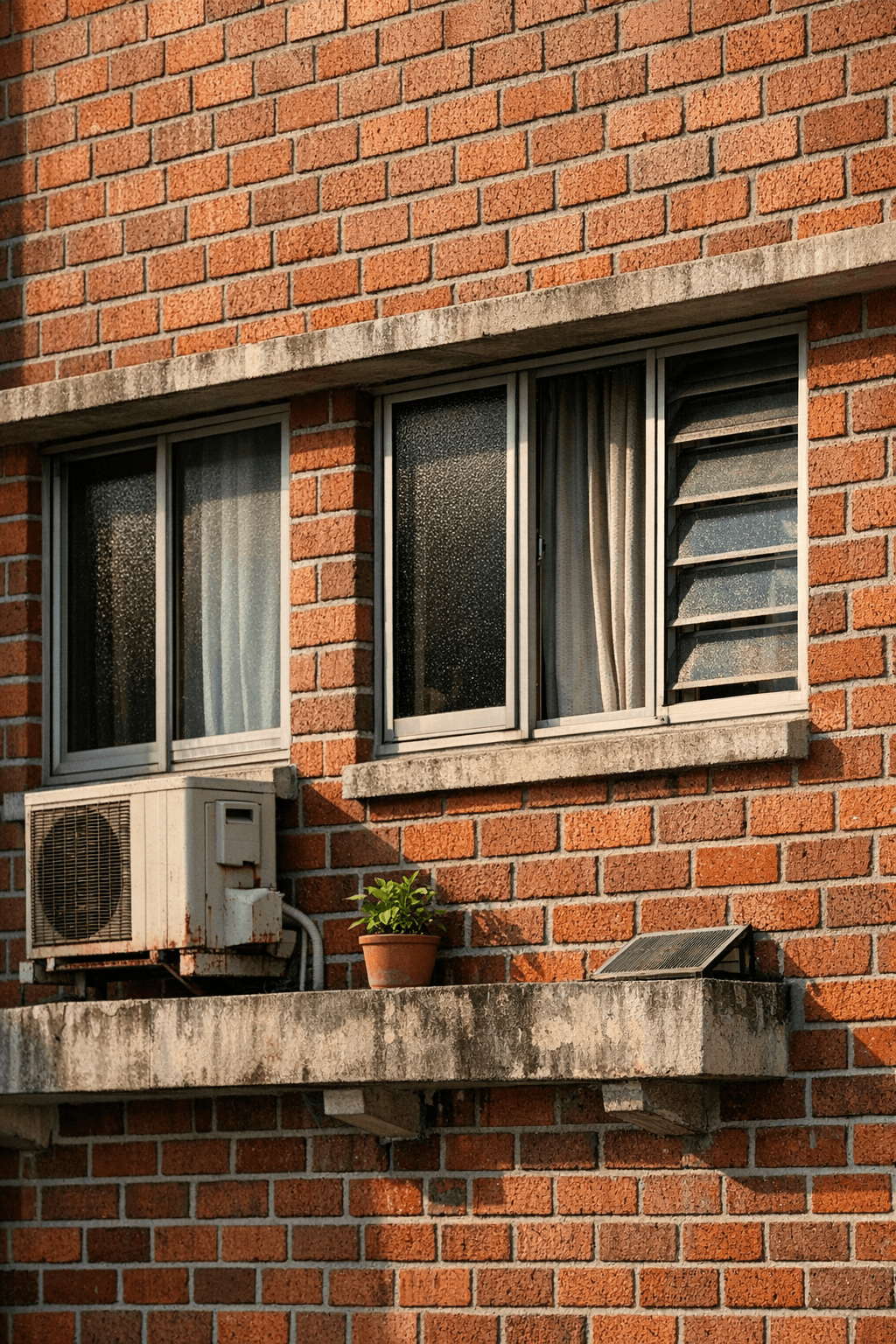
There is a cluster of blocks in Tampines that taxi drivers navigate by. Eight of them, red brick, unpainted for more than thirty years, well enough regarded that they took an honourable mention at the national architecture awards in 1995. They are about to be painted, to stop water getting into people's homes. Residents are being polled on which colour — and the poll closes on 13 September.
Eight blocks, three colours, one deadline
The Straits Times reported this week that residents of eight blocks at Tampines Street 45 — 497A to D, 497F to H and 497J — have been asked to pick a colour.
The blocks are going through a Repairs and Redecoration exercise to deal with water seepage. Three schemes are on the ballot: one closely matching the original palette, one broadly retaining it with variations, and one a complete overhaul of the look. The poll opened on 31 August and closes on 13 September.
Read the options again and the shape of the decision becomes clear. All three are paint schemes. The blocks have worn bare brick for more than thirty years, and the question being put to residents is not whether that ends — it is what shade replaces it.
That is not a conspiracy; it is how an R&R poll works. But it is why the argument spilled outside the ballot.
These blocks were a deliberate experiment
The project's formal name is Tampines Neighbourhood 4 Contract 24, and per the reporting it has a place in public housing history that its appearance rather understates.
In 1992 it became the first project awarded under HDB's Design and Build scheme, which opened public housing to private architects in the hope of getting more variety than the standard catalogue produced. Ten proposals came in. The winning team was P&T Consultants as architect and engineer, with Kajima Overseas Asia as contractor. The result was 620 units.
In 1995 it took an honourable mention at the Singapore Institute of Architects' Architectural Design Awards — which, as Darren Soh pointed out to The Straits Times, is a level of recognition normally reserved for far more expensive buildings. A review in an SIA journal that year praised its sense of identity achieved without surface decoration.
That phrase is the crux of the current fight. The brick was not a finish applied to the building. It was the building's architectural expression — which is what makes painting it a different act from repainting a rendered block.
The town council has a real problem, not an aesthetic whim
It would be easy to write this as heritage versus philistines. It is not that, and the town council's position deserves to be stated at its strongest.
Water is getting into people's flats. In its statement to The Straits Times on 8 September, Tampines Town Council said it had already tried the targeted approach: during the 2017 to 2019 R&R cycle, it painted only the areas affected by seepage, in a colour chosen to match the original brickwork. Since then the brickwork has aged further and seepage has continued to affect residents' homes.
Treating only the affected areas again, it said, would leave residents facing recurring seepage, repeated repairs and the disruption that comes with both. Its position is that professional evaluations now support painting the brick surfaces, because paint gives better protection against weather and water over time.
The council also said residents' views are divided — some want a more colourful scheme and a move away from brick, others want the brick kept — and that it will balance long-term maintenance against the estate's distinctive character.
That is a town council doing its actual job. Leaks in a 33-year-old building are not a style question to the household underneath them.
The technical objection is not really about beauty
The strongest argument against painting, as reported, is not sentimental. It is that paint may not work — and may make things worse.
Yeo Kang Shua, the Hokkien Foundation Professor in Architectural Conservation at SUTD, told The Straits Times that painting over fair-faced brickwork should not in itself be treated as a solution to water ingress, because it addresses the symptom rather than the cause. The better approach, he said, is to diagnose where the water is actually getting in and repair that.
His technical warning goes further: an impermeable or insufficiently vapour-permeable coating can stop brickwork drying naturally, which can cause more damage rather than less. Brick is a material that breathes; sealing it changes how moisture moves through the wall.
On the aesthetic side he was more concise — once an opaque coating goes on, much of the texture and variation is inevitably lost. Soh, who called for localised repairs in an Instagram post on 4 September, framed the loss in stronger terms, arguing a full paint-over would wipe out the estate's essence.
Soh also placed it in a pattern, naming fair-faced brick estates already painted over: blocks 158 to 161 Hougang Street 11, and estates along Bishan Street 22 and 24. Painting brick red to match brick, he argued, is not the same as leaving brick alone.
Note what is genuinely unresolved here. Two sets of professionals — the town council's evaluators and the conservation academics — disagree about whether paint solves the water problem. That is a building science dispute, and it is not one a colour poll can adjudicate.
Does architectural character show up in Tampines resale prices?
We should be honest about the limits of our own data before we reach for it: we cannot price a brick facade. Nothing in our transaction record identifies a block's cladding, and any claim that these eight blocks command a "heritage premium" would be invented.
What we can do is establish the scale of the market this sits inside. Across the most recent complete half-year, 2026 H1, Tampines was one of the largest and most liquid HDB resale markets in Singapore:
| Town | Median 4-room price | Resales (n) |
|---|---|---|
| Central Area | $1.17M | 44 |
| Queenstown | $1.02M | 143 |
| Toa Payoh | $1.00M | 192 |
| Bishan | $790k | 99 |
| Punggol | $680k | 421 |
| Tampines | $668k | 428 |
| Bedok | $585k | 244 |
| Yishun | $550k | 393 |
Tampines sits 10th of 25 towns on price, above the national 4-room median of $630k, and second only to Woodlands on volume with 428 four-room resales in the half-year.
That is the useful frame. This is not a boutique enclave — it is a big, mid-priced, high-turnover town where roughly 428 four-room households changed hands in six months. The eight blocks in question are 620 units inside that. Whatever the case for keeping the brick, it is a case about identity and craft, not about a measurable price effect. We are not going to manufacture one.
What a colour poll cannot decide
Here is what strikes us as the real problem, and it is procedural rather than aesthetic.
The question that matters — is painting the right fix for this water problem? — is a technical one, with qualified people publicly on both sides. The question being asked of residents is which of three colour schemes they prefer. Those are not the same question, and answering the second does not settle the first.
It also means a resident who thinks the brick should stay has nowhere to put that view on the ballot. The closest available option is the scheme that most nearly imitates the original palette — which is, as Soh argues, precisely the substitution being objected to.
The five residents The Straits Times spoke to are worth noting on this: none raised concerns about seepage through their own walls, and they were generally against a full overhaul. One, a resident since the blocks were built, said the brick made them an icon for Tampines. Another observed that taxi drivers know the "Tampines red blocks" the way they know the chap laus elsewhere. A third pointed to a nearby cluster off Tampines Avenue 9, once fair-faced brick, now black and white.
Five residents out of 620 households is not a survey, and the town council explicitly says views are split — households actually suffering leaks may weigh this very differently, and have every right to. But the gap is instructive: the people quoted were not debating colour. They were debating whether to paint at all, which is the one thing the poll does not ask.
The honest reality-check
Four things we cannot tell you, stated plainly.
- We do not know whether paint is the right repair. We are not building scientists. Both sides cite professional judgement, and we are reporting a genuine disagreement rather than resolving it.
- We cannot price architectural character. Our data holds no facade attribute, and the Tampines figures above describe a whole town, not these eight blocks. Do not read them as a valuation of the brick.
- These blocks are not conserved. As Yeo himself noted, they carry no formal conservation status — his argument is that architectural character can have value without it. There is no legal protection in play here.
- The resident views are a handful of interviews. Five people spoke to The Straits Times; the town council reports divided opinion across the estate. Neither is a measurement of what the 620 households want, and the poll itself will be the only real count.
One more, on timing: the poll closes on 13 September 2026. If you live in those blocks, that is the number in this article that actually affects you.
What is fair-faced brickwork, and why does painting it matter?
Fair-faced brickwork is brick left as the finished surface, where its colour, texture and mortar joints are the architectural expression. Painting it permanently loses that texture and may also interrupt how the wall dries out.
Fair-faced brickwork is brick left as the finished surface — not covered over with plaster or paint. It is meant to be seen.
As Yeo Kang Shua explained to The Straits Times, the colour, texture, mortar joints and natural variations of the brick are all part of the architectural expression of a building designed this way. Once an opaque coating is applied, much of that texture and variation is inevitably lost, and it cannot be restored by choosing a paint in a similar shade.
There is also the technical dimension. Brick manages moisture by allowing it to move through and dry out. A coating that is impermeable, or not vapour-permeable enough, can interrupt that drying — which is the basis of the conservationists' concern that painting could cause more damage rather than prevent it.
Yeo made the point that this applies to HDB blocks with brick facades generally, not only the Tampines project.
What are Tampines residents actually voting on?
Three colour schemes for the repainting — one close to the original palette, one a variation on it, and one a full overhaul. Not painting is not one of the options.
Three colour schemes for the Repairs and Redecoration exercise, in a poll running from 31 August to 13 September 2026.
Per the reporting, the options are: one that closely matches the blocks' original colour palette; one that largely retains that palette while introducing some variation; and one that is a complete overhaul of the blocks' look.
What is not on the ballot is the option of not painting. All three schemes involve coating the facade — so a resident who wants the bare brick retained has no direct way to register that through the poll itself. The objections reported by The Straits Times came through the press, an Instagram post and direct comment to the town council rather than through the vote.
The town council has said residents' views are an important part of the process and that it will balance maintenance needs against the estate's distinctive character.
How we sourced this
The blocks and their addresses, the poll and its dates, the three colour schemes, the town council's statement, the project's 1992 Design and Build history, the 1995 award and the comments from Yeo Kang Shua, Darren Soh and the residents all come from The Straits Times' report of 9 September 2026, linked below. We have not inspected the blocks, seen the seepage reports or the professional evaluations the town council refers to, and we have not spoken to residents.
The resale figures are PropKaki's own, from our HDB resale record: median 4-room prices by town for 2026 H1, the most recent complete half-year, as of 8 September 2026. Four-room flats are used so towns compare like-for-like, since a town's all-flats median moves with its mix of flat sizes. Towns with fewer than 10 resales of that type in the half-year are excluded. Prices are gross, before any resale levy, commission or fees.
We hold no data identifying a block's facade material, and we have made no estimate of one.
Sources
- Plan to paint iconic brick-faced Tampines HDB project draws criticism — The Straits Times, 9 September 2026. The poll, the colour schemes, Tampines Town Council's statement, the project's history and award, and the comments from Yeo Kang Shua, Darren Soh and residents.
- PropKaki — HDB resale record, median 4-room price by town, 2026 H1. As of 8 September 2026.
About this commentary
This is opinion and analysis from the PropKaki Editorial Desk, not technical, legal or financial advice. The reporting belongs to The Straits Times; the market framing and the conclusions drawn are ours.
We have deliberately not taken a side on the building science. Whether painting is the correct remedy for seepage in a 33-year-old brick facade is a question for qualified professionals with access to the actual condition surveys, and both the town council and the conservation experts quoted have a defensible position on the record.
Where we do have a view, it is narrower: a decision this consequential to an estate's identity deserves to be argued on the technical merits in public, not settled only as a choice between three shades. Residents of those eight blocks have until 13 September to vote.
Got a question this raised? Ask PropKaki.
Take any point from this analysis and apply it to your own project, budget or decision.
 PropKaki
For most buyers this year, staying well within budget beats trying to time the market.