
A Rubber Warehouse in Kallang Is About to Become 2,500 Homes — And a Private Owner, Not the State, Made the Call
URA has proposed carving Kallang Distripark into three housing plots and a park. The site has been zoned for housing since 2003. What finally moved it was a private development proposal.
On 14 August 2026 URA published a proposed Master Plan amendment to redevelop Kallang Distripark, a 13-hectare site owned by entities associated with Lee Rubber Company, into private housing. The plan creates three housing plots: a 3.6ha largely freehold plot next to Kallang Bahru (analysts estimate ~1,200 condo units), a 1.6ha largely freehold plot abutting Pelton Canal (450–550 units), and a 2.4ha leasehold plot zoned for first-storey commercial use (600–800 units) — roughly 2,250 to 2,550 homes in total. The rest is a 2ha park, new roads and a 1.8ha reserve site with no use yet decided. Part of the site is freehold; the remainder sits on a 99-year lease expiring in 2067. URA says the amendment facilitates a private development proposal, not a state tender, and that it is studying whether one of the three octagonal Lee Rubber Godowns can be retained as a heritage marker inside the park. No development timeline has been given.
The Straits Times reported this week that Kallang Distripark — a disused rubber factory turned warehouse estate on 13 hectares beside the Kallang River — is being prepared for private housing. On 14 August the Urban Redevelopment Authority published a proposed amendment to its Master Plan, carving the site into three housing plots, a two-hectare neighbourhood park, new roads and a reserve site.
The detail that matters is buried in URA's own reply. Asked why now, a URA spokesperson told both The Straits Times and Mothership that the amendments are to facilitate a private development proposal the agency had received. This was not a government land sale. Somebody knocked.
The site has been zoned for housing since as early as 2003. It took twenty-three years and a private owner for anything to happen.
The octagons you have driven past for years
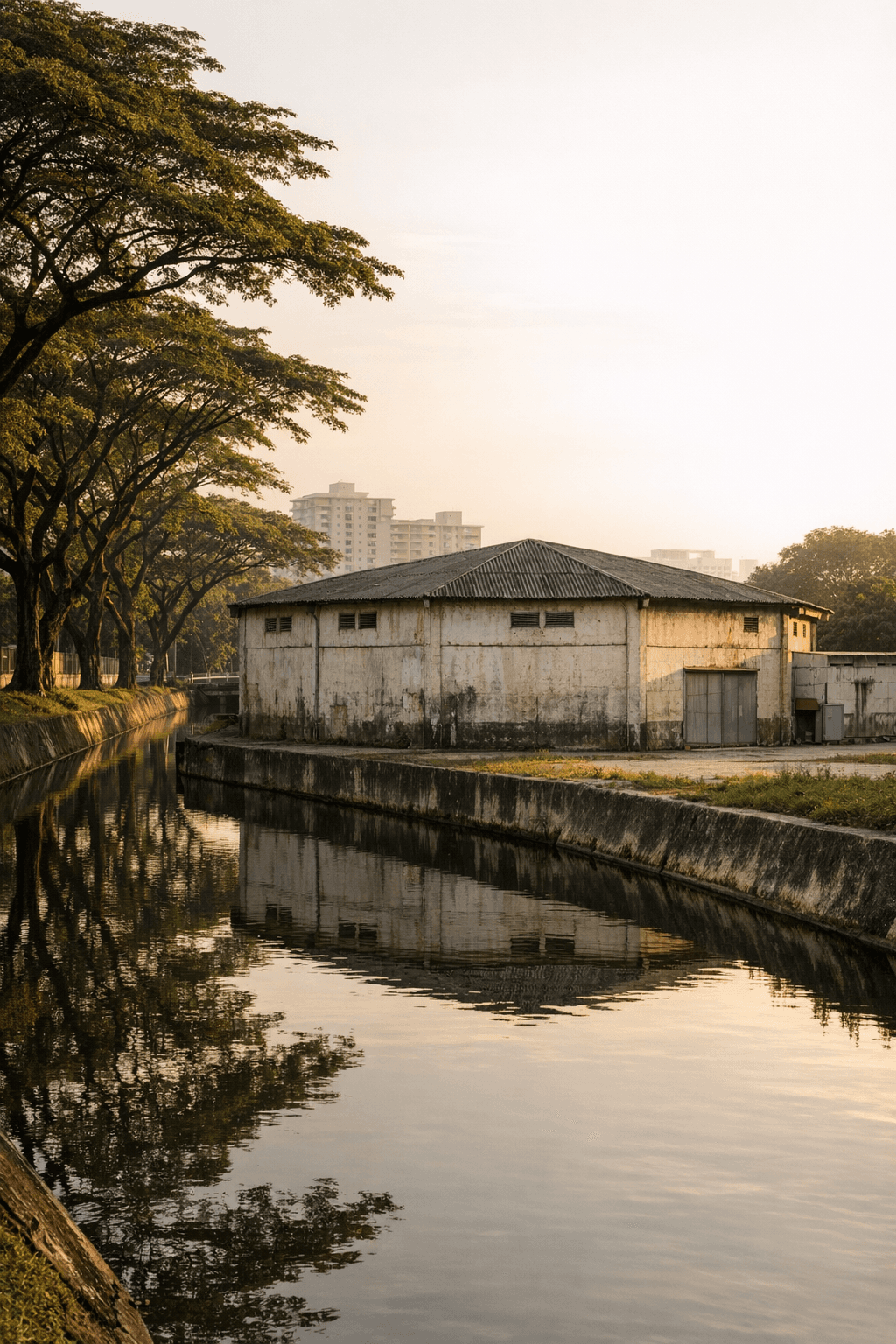
Three octagonal warehouses on the Kallang Bahru stretch, designed in the late 1950s, are the buildings this plan is about.
If you have ever driven the stretch between Kallang Bahru and the Pelton Canal, you have seen them without seeing them: three octagonal warehouses, low and pale, sitting on a piece of land that has always felt slightly out of time — an industrial pocket wedged between old HDB blocks and a canal.
They are the Lee Rubber Godowns, and The Straits Times reports they were designed by the late pioneer architect Victor Chew of Kumpulan Akitek. Wee Chwee Heng, a founding partner of the firm alongside Chew and Hisham Albakri, told the paper the multi-sided shape let the building be reached from several points at once — exactly what a rubber warehouse with shipments coming and going needed. They were likely among the first projects the practice took on after it was founded in 1958.
Veteran architect Hoong Bee Lok, whose 1981 bachelor's thesis was built around Chew's work, told ST that Chew designed the octagons to be modular, so new warehouses could simply be joined onto the old ones. Nearly seventy years on, they are still in use. That is a quietly remarkable thing for a building to be able to say.
The land that waited twenty-three years
The site has been zoned for housing since as early as 2003, and URA showcased redevelopment plans in 2017. Nothing happened.
Here is the part that should reframe how you read the announcement.
According to The Straits Times, this 13-hectare site has been zoned for housing since as early as 2003. URA showcased plans to redevelop it back in 2017, as part of an exhibition on turning the 10km Kallang River into a lifestyle hub. It appeared again among the waterfront neighbourhoods in the latest Master Plan, gazetted in 2025.
And for twenty-three years, it stayed a warehouse.
That is not a failure of planning. It is a reminder of something owners of any older, well-located site already know: zoning gives you permission, not motive. The land is privately held — ST's checks show it is owned by entities associated with Lee Rubber Company, whose founder was the entrepreneur and philanthropist Lee Kong Chian. Part of it is freehold; the rest sits on a 99-year lease running to 2067. Nobody could make the owner do anything with it, and for two decades the owner did not.
What changed: somebody knocked
URA told both newsrooms the Master Plan amendment is to facilitate a private development proposal it received — not a state tender.
The trigger is the most interesting line in the whole story, and it is easy to skim past.
Asked by The Straits Times on 17 August why the amendment had appeared, a URA spokesperson said the proposed amendments are to facilitate a private development proposal that the agency had received. URA gave Mothership the same answer, adding that the specific use for the reserve site has yet to be determined and that “more details, including the development timeline will be shared when ready.”
Read that again, because it inverts the usual sequence. Most large new supply in Singapore arrives because the state decides to sell land — a Government Land Sales site, a tender, a winning bid, a launch. Here, a private owner and a developer appear to have moved first, and the Master Plan is being amended to catch up with them.
That difference is not academic. A GLS site comes with a published timeline and a bid price the market can see. A private proposal comes with neither. Which is why the honest answer to “when will this launch” is: nobody outside the deal knows.
How many homes are we actually talking about?
Three plots, with analyst estimates of about 1,200, 450–550 and 600–800 units — roughly 2,250 to 2,550 homes.
The Straits Times set out the three housing plots and the unit estimates property analysts attach to each:
| Plot | Size | Tenure | Zoning | Analyst unit estimate |
|---|---|---|---|---|
| Adjacent to Kallang Bahru | 3.6 ha | Largely freehold | Residential | ~1,200 |
| Abutting Pelton Canal | 1.6 ha | Largely freehold | Residential | 450–550 |
| Third plot | 2.4 ha | Leasehold | Residential + 1st-storey commercial | 600–800 |
| Neighbourhood park | 2.0 ha | — | Park | — |
| Reserve site | 1.8 ha | — | Use not yet determined | — |
Add the three housing plots and you get roughly 2,250 to 2,550 homes, on a site where a meaningful slice of the land is going to a park and a reserve plot instead.
The tenure column is the one to stare at. Two of the three residential plots are largely freehold. New freehold condo supply at this scale, this close to town, is not a thing that happens often — nearly all large new supply in Singapore arrives on 99-year leases, because it arrives through Government Land Sales. This is arriving through a private owner who happens to hold freehold title.
What do homes around Kallang actually transact at today?
Our transacted-price data puts the nearest districts at roughly $1,750–$1,813 per sqft — well below the central districts.
This is where our own numbers can add something the announcement cannot. We hold URA caveat data for private sales, so we can say what the area around this site actually transacts at right now, rather than what anyone hopes it will.
The site sits on the seam between District 12 — the Kallang Bahru and Bendemeer stretch — and District 14. Across the last twelve months:
| District | Median price | Median PSF | Sales | Projects |
|---|---|---|---|---|
| D12 — Balestier / Toa Payoh / Serangoon | $1.75M | $1,813 | 390 | 84 |
| D14 — Geylang / Eunos | $1.44M | $1,750 | 621 | 128 |
| D15 — East Coast / Marine Parade | $2.47M | $2,327 | 1,492 | 265 |
| D03 — Alexandra / Queenstown | $2.27M | $2,820 | 1,761 | 37 |
| D09 — Orchard / River Valley | $2.55M | $2,969 | 1,342 | 153 |
So the immediate neighbourhood trades around $1,750 to $1,813 per sqft, against $2,820 in Alexandra and $2,969 in Orchard. Across all 27 districts we count 24,187 private sales in the window.
Two things follow. First, there is real headroom between Kallang and the central districts it is genuinely close to — which is the entire investment case anyone will make for this site. Second, and less comfortably: that headroom is already visible to everyone, including whoever made the private proposal. You are not early to this observation. The owner priced it in before the Master Plan did.
Why the park plot may be the most valuable land on the site
An analyst quoted by ST says the park sits where two streams converge — the best waterfront position on the whole site.
There is a detail in the ST piece that rewards a second read. Nicholas Mak, chief research officer at Mogul.sg, noted that the plot earmarked for the park is the most valuable land in Kallang Distripark, because it is where two streams converge and will command good waterfront views.
In other words, the plan gives away its best frontage.
That is not a criticism — it is arguably the point. A two-hectare park at the water's edge is what turns three condo plots into a neighbourhood, and the value of that frontage does not vanish; it gets redistributed into every unit that looks onto it. Eugene Lim, key executive officer of ERA Singapore, told ST the combination of waterfront position, central location and nearby amenities — Geylang Bahru MRT station, the market and food centre — means the homes will likely draw high demand. Christine Sun, chief researcher and strategist at Realion Group, said the redevelopment can inject new vibrancy into an area where, apart from the Kallang View HDB project now under construction, most flats in Kallang Bahru and Geylang Bahru were completed in the 1970s.
It is also worth noting the neighbouring 6ha Geylang Bahru Industrial Estate, right next to the MRT station, is also zoned for housing, on a 99-year lease expiring in the mid-2070s. This may not be the last announcement about this corner of Singapore.
The honest reality-check: this is a zoning amendment, not a launch
A proposed Master Plan amendment has no price, no timeline and no guarantee. The last plan for this site sat for 23 years.
It would be easy to read “2,500 new homes in Kallang” as something you can plan around. Several reasons to slow down:
This is a proposed amendment. URA has published it for the Master Plan; that is a planning step, not a development approval, and certainly not a launch. URA explicitly told Mothership the timeline will be shared “when ready” — which means there isn't one yet.
The unit counts are analyst estimates, not a scheme. The 1,200 / 450–550 / 600–800 figures are property analysts' readings of what the plots could yield, reported by ST. No public scheme has been filed. The real numbers will move.
Our district PSF is resale stock, not new-launch pricing. This is the caveat most likely to mislead you. The $1,813 and $1,750 figures above are transacted prices for existing homes, much of that stock decades old. A new freehold waterfront launch would not price at the district resale median — new launches routinely clear well above it. Do not use these numbers to guess a launch price. Use them to understand the neighbourhood a launch would sit in.
Transacted-price windows under-lodge. Recent caveats are still being filed, so the sales counts above are a floor, not a final tally. Median PSF also reflects whatever mix of unit sizes happened to sell in each district.
And the site has form for waiting. Zoned for housing since 2003. Showcased in 2017. Still a warehouse in 2026.
Does this mean condo prices in Kallang will go up?
Not mechanically. New supply cuts both ways, and the announcement itself changes nothing about today's stock.
There are two opposing forces here, and it would be dishonest to mention only one.
The upgrade case: a 2ha waterfront park, new roads, first-storey shops and 2,000-plus new private homes would genuinely change the character of a neighbourhood whose flats mostly date to the 1970s. Areas that receive that kind of investment often re-rate, and the agents quoted by ST expect strong demand.
The other side, which nobody selling you anything will lead with: roughly 2,250–2,550 new units is a large amount of supply arriving in one place. When it eventually completes, owners of existing homes nearby are competing with all of it — for buyers and for tenants.
And the timing is the real point. Nothing here completes soon. A proposed Master Plan amendment with no published timeline, on a site that has waited since 2003, is not a reason to transact this month.
Will any of the old rubber warehouses be kept?
URA says it is studying retaining one of the three octagonal godowns as a heritage marker in the future park. It is not settled.
URA told both newsrooms it has engaged the owner on the potential to retain one of the warehouses as a heritage marker within the proposed future park, and that studies on the proposal are ongoing.
The spokesperson also set out the fallback: “Where physical retention is not possible, agencies will work with the owner and relevant stakeholders to document and commemorate the history of the place through heritage interpretation initiatives, such as digital documentation or storyboards.”
Read plainly, that is a genuine possibility of retention alongside an explicit Plan B of storyboards. Architect Hoong Bee Lok suggested to ST that a retained octagon could work as sheltered courts for racquet sports — which, for a building designed to be modular and reachable from several sides, is a rather elegant second life. Nothing is decided.
How we sourced this
News facts from ST and Mothership; the district price table is our own URA caveat data over a trailing 12-month window.
The news — the site details, plot sizes, tenure, analyst unit estimates, URA's statements and the architectural history all come from The Straits Times (17 August 2026) and Mothership (18 August 2026), linked in full below. We did not independently verify the ownership or the Master Plan filing.
The data — the district price table is PropKaki's own cut of URA caveat data for private residential sales over a trailing twelve-month window, as at 20 August 2026, covering 27 districts and 24,187 sales. Median PSF is the more like-for-like comparison across districts; median price reflects the mix of unit sizes that happened to sell. Landed is excluded, and districts below a minimum sample threshold are omitted rather than shown thin.
We have deliberately not estimated a launch price for the site. Doing so from resale medians would be guesswork dressed as analysis.
Sources
The two news reports this commentary is built on, and our own transacted-price data.
The news:
- The Straits Times — Kallang Distripark set to be redeveloped for thousands of new private homes, 17 August 2026.
- Mothership — Kallang Distripark set to be redeveloped for thousands of private homes, 18 August 2026.
The data:
- PropKaki's cut of URA caveat data — private residential transacted prices by postal district, trailing 12 months to 20 August 2026.
About this commentary
Opinion and analysis from the PropKaki Editorial Desk — not property, financial or investment advice.
This is commentary by the PropKaki Editorial Desk on reporting by The Straits Times and Mothership. The account of the Master Plan amendment, the site's ownership and history, and the analyst estimates belong to those newsrooms; the price analysis, the framing and the opinions are ours.
It is opinion and general information, not property, financial or investment advice. A proposed Master Plan amendment is an early planning step that can change or stall, and no development timeline has been published. Anyone making a decision on the strength of it — buying nearby, holding, or selling — should work from URA's own published amendment and take proper professional advice.
Published 20 August 2026.
Got a question this raised? Ask PropKaki.
Take any point from this analysis and apply it to your own project, budget or decision.
 PropKaki
For most buyers this year, staying well within budget beats trying to time the market.