
The En Bloc Bar Just Dropped for Older Condos — We Counted Exactly Which Ones
A Bill tabled on 4 August lowers the collective sale consent threshold from 80% to 70% for developments aged 40 to 59, and to 65% for those 60 and older. Counting the developments still standing, that is 251 — and 246 of them are in the 70% band.
Under the Land Titles (Strata) (Amendment) Bill, introduced in Parliament on 4 August 2026 (passed on 8 September; not yet in force), the collective sale consent threshold falls from 80% to 70% for developments aged 40 to 59 years, and from 80% to 65% for those 60 years and older. Thresholds for younger developments are unchanged — 80% for 10-to-39-year-olds and 90% under 10 years. Counting only the private non-landed developments in our directory that are still standing, 251 sit in the two eased bands — 10.5% of the 2,390 standing developments, containing 20,980 homes, close to the Ministry of Law's own count of around 20,000 homes in close to 250 developments. The split is lopsided: 246 of those are in the 40-to-59 band that moves to 70%, and only 5 are old enough for the 65% tier. 217 of the 251 are freehold or 999-year, and they cluster in Districts 9, 10, 11 and 15.
The Straits Times reported this month that ageing developments could get a materially better shot at a collective sale, under amendments to the Land Titles (Strata) Act introduced in Parliament on 4 August. Developments aged 40 to 59 would need consent from 70% of owners instead of 80%; those 60 and older, 65%.
It is the first move on those numbers in nearly three decades — the current thresholds date to 1999. And it raises a question the reporting does not answer, which is the one an owner actually cares about: how many buildings does this really reach, and is yours one of them?
We hold a directory of Singapore's private non-landed developments, so we counted.
The building that has run out of road
Singapore has a stock of small, ageing private blocks where the maintenance bill has outgrown the sinking fund.
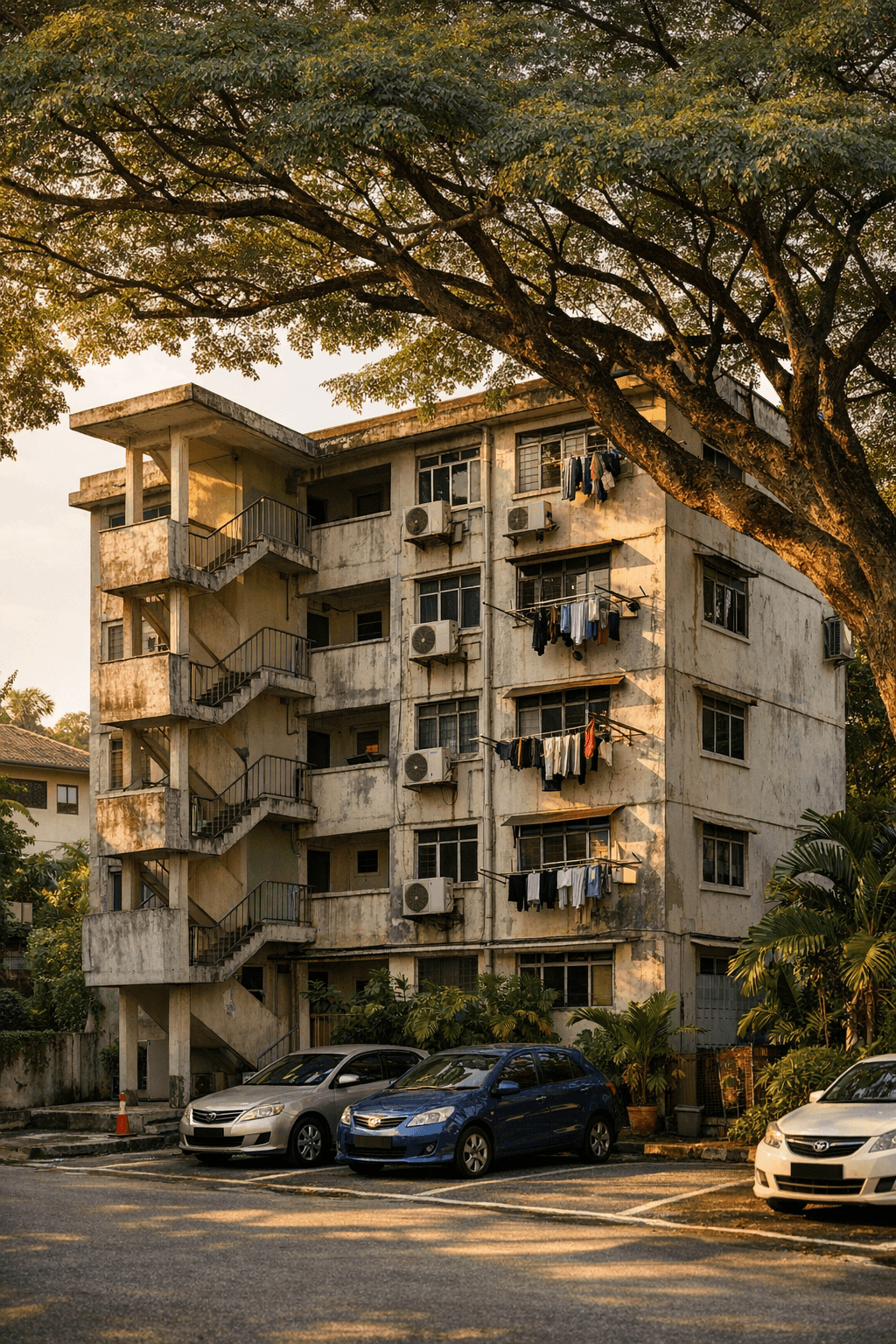
There is a type of building you have walked past a thousand times without registering it. Four storeys, no lift or one lift that has been rebuilt twice, a car park with more space than cars, and a bougainvillea that has been there longer than most of the owners.
Thirty-odd families live in it. It went up when Whitley Road still had kampong at the edges. And at every annual general meeting for the last decade, the same conversation has happened: the roof deck needs redoing, the riser pipes are original, the sinking fund covers about a third of it, and a special levy would fall hardest on the retired owners who can least afford it.
That is the building this Bill is about. Not the mega-estate with 1,400 units and a marketing agent on retainer. The small one, where the arithmetic of keeping the place standing stopped working a while ago.
Why 80% was the wall
In a 30-unit block, an 80% threshold means 24 owners must agree — and six can stop it.
Since 1999, an owner in a development more than ten years old has needed 80% consent, measured by share value and by strata area, to force a collective sale through. Under ten years old, it is 90%.
Those numbers were set when the ageing problem was hypothetical. Singapore's private stock was young. A twenty-year-old block was old.
They are not hypothetical any more, and in a small building the threshold behaves very differently than it does in a large one. In a 30-unit block, 80% is 24 owners. Six holdouts — one estranged sibling on a jointly-held unit, one owner overseas and unreachable, one who simply does not want to move — and the exercise is dead before the marketing agent is appointed. The bigger the building, the more the law of large numbers works in the committee's favour. The smaller it is, the more a single family's circumstances decide the fate of everyone else's.
The Ministry of Law's own explanation, as reported, runs along these lines: developments have aged significantly since 1999, they need substantial investment in maintenance, repairs and upgrading to stay safe and liveable, and rising maintenance costs against depleting sinking funds make that harder every year. Lowering the threshold, it said, gives owners of older developments a more practical option where there is broad support.
What the Bill actually changes
Two new age bands with lower thresholds; the two younger bands are untouched.
The amendments, introduced in Parliament on 4 August 2026, replace one threshold with a ladder that steps down as a development ages.
A development 40 to 59 years old would need 70% consent instead of 80%. One 60 years or older would need 65%. Below that, nothing moves: 10-to-39-year-olds still need 80% by share value and strata area, and anything under ten years old still needs 90%.
As The Straits Times reported, this follows multiple rounds of consultation since 2023 with academics, lawyers, property consultants, industry associations, developers and representatives from the strata titles boards — and it comes a week after the government extended the ABSD sales deadline for large collective sale sites to as much as seven years. Two different levers, aimed at two different ends of the same stalled market.
The review itself has a traceable origin. In November 2025, the Ministry of Law said it was looking at policies under the Land Titles (Strata) Act. That came after a letter from the Neptune Court Owners' Association circulated online earlier that month, suggesting the threshold be lowered.
How many developments does the lower threshold actually reach?
251 of the 2,390 private non-landed developments still standing — about one in ten — holding 20,980 homes.
This is where our own data can say something the announcement cannot. We keep a directory of Singapore's private non-landed developments, and we date each one by its completion year, our stand-in for the latest temporary occupation permit (TOP) that the Act measures age from. The directory still holds developments that have since been demolished or sold en bloc, so we counted only those still standing: a strata sale that was not an en bloc sale, or a rental, since 2020, and no en bloc caveat without a later resale. Then we bucketed them into the Bill's four bands.
| Age band | Consent threshold under the Bill | Threshold today | Developments | Homes |
|---|---|---|---|---|
| Under 10 years | 90% | 90% | 286 | 83,488 |
| 10–39 years | 80% | 80% | 1,853 | 233,915 |
| 40–59 years | 70% | 80% | 246 | 20,878 |
| 60 years and older | 65% | 80% | 5 | 102 |
251 developments move to an easier threshold — 10.5% of the 2,390 standing developments. Between them they contain 20,980 homes. That is close to the Ministry of Law's own figure: "around 20,000 dwelling units in close to 250 developments" (second reading speech, 8 September 2026).
Hold those two numbers next to each other, because the gap between them is the finding. Two hundred and fifty-one buildings, twenty-one thousand homes. The 10-to-39-year band alone holds 233,915 homes across 1,853 developments. The stock this Bill reaches is not just older — it is much smaller per building. These are walk-ups and boutique blocks, not estates.
And that is precisely the population where 80% was doing the most damage.
The 65% tier is almost empty
Only five standing developments are 60 years or older — 102 homes in total.
The 65% figure is the one that made the headlines. Counting only developments still standing, it reaches five developments, holding 102 homes altogether.
| Development | Completed | Age | Homes |
|---|---|---|---|
| Villaea Vista | 1959 | 67 yrs | 6 |
| Kai Fook Mansion | 1960 | 66 yrs | 32 |
| Lloyd Mansion | 1963 | 63 yrs | 36 |
| Wan Tho Lodge | 1966 | 60 yrs | 12 |
| Eastville Apartments | 1966 | 60 yrs | 16 |
Six-unit and twelve-unit buildings from the late fifties and sixties. For a development of that size, 65% versus 80% is the difference between needing four of six owners and needing five — which, in a building where two units might be held by the same family, is genuinely the difference between possible and impossible.
But it is not a market-moving tier. It is a tier written for a handful of specific buildings, and it will stay small for a while — the cohort behind it, completed in the late 1960s, crosses 60 one year at a time.
The real work is being done one rung down, by the 246 developments in the 40-to-59 band. That is the change worth paying attention to.
Where are the developments that qualify?
Concentrated in Districts 10, 15, 9 and 11 — and 217 of the 251 are freehold or 999-year.
The eased stock is not spread evenly across the island. It sits where Singapore's oldest private housing sits.
| District | Developments |
|---|---|
| Ardmore / Bukit Timah / Holland Road / Tanglin | 58 |
| Katong / Joo Chiat / Amber Road | 39 |
| Orchard / Cairnhill / River Valley | 33 |
| Watten Estate / Novena / Thomson | 23 |
| Upper Bukit Timah / Clementi Park / Ulu Pandan | 15 |
| Little India | 13 |
| Geylang / Eunos | 10 |
| Bedok / Upper East Coast | 8 |
Prime and East Coast, overwhelmingly. And one more attribute matters more than the geography: 217 of the 251 eased developments are freehold or 999-year.
That is not a coincidence, and it is the most commercially significant line in this piece. Leasehold blocks from the 1970s have been running their leases down and getting redeveloped or written off; what survives at 40-plus years, in good locations, skews heavily freehold. Freehold land in District 10 or District 15 is the single thing a developer most wants to buy.
So the Bill lowers the consent bar on a pool of stock that is small, old, well located and freehold. Whatever else you think of the policy, it is not aimed at land nobody wants.
The honest reality-check: a threshold is not a buyer
Being in a band only changes the vote you need. It does not create redevelopment upside, a willing majority, or a bid.
It would be easy to read "251 developments" as "251 en bloc sales", and that would be an expensive mistake.
Age is a filter, not a verdict. Falling into a band changes one thing: the percentage of owners who must agree. It says nothing about whether the site has redevelopment upside under its permitted plot ratio, whether a majority actually wants to sell, or whether any developer will bid. The collective sale market has been largely tepid since the 2018 boom, and a lower threshold does not change what land is worth. Most of these 251 will never go en bloc.
Our count is an estimate, not a census. Our directory also holds 172 non-landed developments with no recorded completion year, which we could not age, and 54 that have not completed yet. The standing test is ours: a development with no sale or rental on record since 2020 is left out even if it still stands. And the age the Act uses runs from "the date of the issue of the latest temporary occupation permit" for the development's buildings, not from the lease (s84A(1)); completion year is our stand-in for it, and a phased or re-TOP'd development may differ — so a development sitting near a band boundary should be checked properly, not read off our table.
And our denominator is not the vote's denominator. The real regime measures consent by share value and strata area. We counted developments and homes. Those are different things, and in a building with unequal unit sizes they can point in different directions.
Finally: this is a Bill, not a law. It was introduced on 4 August 2026. It is not in force until it is passed and commenced. Update, 23 September 2026: Parliament passed the Bill on 8 September 2026. It is not yet in force; the Ministry of Law says the commencement date will be announced.
Does a lower en bloc threshold make my condo more likely to be sold?
Only if it is 40 years or older, and only if there was already a near-majority wanting to sell.
Two conditions have to hold, and the second is the one people forget.
First, age. If your development is under 40 years old, nothing in this Bill changes your threshold — it stays at 80%, or 90% if the building is under ten. That covers the large majority of Singapore's private stock — 1,853 developments in the 10-to-39 band and 286 under ten years old, against 2,390 standing developments in total.
Second, and more important: a lower threshold only matters if you were close. Dropping from 80% to 70% rescues exercises that were stalling in the seventies. It does nothing for a building where 45% of owners want to sell, because the gap was never procedural — it was that most of your neighbours want to stay.
The honest way to read it: this Bill converts a certain number of near-misses into completions. It does not manufacture willingness where there was none.
What happens to a collective sale attempt that is already running?
If the first signature on the sale agreement was obtained before commencement, the existing framework continues to apply.
The Bill draws the line at the first signature on the collective sale agreement, as reported.
If that first signature has not been obtained by the date the amendments commence, the new framework applies to the exercise. If it was obtained before commencement, the existing framework continues to govern it — described in the reporting as preserving fairness for those who had already signed.
There is a middle case. Committees that are part-way through collecting signatures at commencement may choose to terminate the existing agreement and approve terms for a new one under the enhanced regime, and they would get seven months from the commencement date to obtain that fresh mandate.
That choice will not be obvious for every committee, because the Bill also tightens several rules that cut the other way — a shorter signature window and a higher bar to convene in the first place. Anyone in the middle of an exercise should be taking legal advice on which regime serves them, not guessing from a news summary.
How we sourced this
The policy comes from the reporting; the counts of developments, homes, districts and tenure are ours.
⚠️ Corrected 23 September 2026. The version of this page published on 12 August counted every development in our directory by completion year, including developments since demolished or sold en bloc, and put 532 developments and 36,206 homes in the two eased bands. Counting only developments still standing (ages as at 2026, as before), it is 251 developments and 20,980 homes — 246 aged 40 to 59 and 5 aged 60 or more — close to the Ministry of Law's "around 20,000 dwelling units in close to 250 developments" (second reading speech, 8 September 2026). The 65% tier's list drops Eastern Mansion (1962), which does not pass our standing test; 217 of the 251 are freehold or 999-year; the district table is re-counted. The earlier version also said a development's age runs from its lease. The Land Titles (Strata) Act counts it from the latest temporary occupation permit for the development's buildings (s84A(1)), and the amending Bill keeps that clock (its new section 84FE).
Every detail of the policy — the 4 August 2026 introduction, the 70% and 65% thresholds, the age bands, the 1999 origin of the current rules, the consultation history, the November 2025 review and the Neptune Court letter, and the transitional treatment of exercises already under way — comes from the reporting of The Straits Times and CNA, linked below. Those are the reporters' facts, attributed rather than claimed as ours.
The counting is ours. We took our directory of private non-landed developments, kept those still standing (a strata sale that was not an en bloc sale, or a rental, since 2020, and no en bloc caveat without a later resale), bucketed them by completion year into the Bill's four age bands as at 2026, and summed developments and recorded unit counts per band, then broke the eased bands down by district and tenure.
The caveats are load-bearing here. 172 developments in our directory have no recorded completion year and 54 have not completed yet, and the standing test can leave out a development that still stands but has had no sale or rental since 2020. The Act measures age from the latest TOP, not the lease; completion year is our stand-in for it. Unit counts are missing for 7 of the 251, so 20,980 homes is a floor. And the actual consent regime is measured by share value and strata area, not by counting developments — a different denominator from ours.
Sources
The Bill as reported, and our own private-development directory.
The news:
- The Straits Times — Ageing properties may get better shot at en bloc sales with proposed lowering of consent thresholds, 4 August 2026.
- CNA — New law proposed to lower en bloc thresholds for older condominiums, 4 August 2026.
The law and the ministry:
- Ministry of Law — Second Reading Speech of the Land Titles (Strata) (Amendment) Bill 2026 by Minister Edwin Tong SC, 8 September 2026.
- Singapore Statutes Online — Land Titles (Strata) Act 1967, section 84A, current version as at 23 September 2026.
The data:
- PropKaki's directory of Singapore private non-landed developments, standing developments only (a strata sale or rental since 2020, no unreversed en bloc caveat), bucketed by completion year into the Bill's consent bands as at 2026.
About this commentary
Opinion and analysis from the PropKaki Editorial Desk — not legal or property advice.
This is commentary by the PropKaki Editorial Desk on reporting by The Straits Times and CNA. The account of what was tabled belongs to those newsrooms; the counting, the framing and the opinions are ours.
It is opinion and general information, not legal, financial or property advice. Collective sale law is technical and the consequences are permanent — anyone whose decision turns on a threshold, a band boundary or a transitional provision should work from the Bill itself once passed and take proper legal advice. A Bill introduced in Parliament is also not final: provisions can change before passage, and commencement is a separate step.
Published 12 August 2026. Corrected 23 September 2026: the counts now cover only developments still standing (251, not 532), and a development's age runs from its latest temporary occupation permit, not its lease.
Got a question this raised? Ask PropKaki.
Take any point from this analysis and apply it to your own project, budget or decision.
 PropKaki
For most buyers this year, staying well within budget beats trying to time the market.