
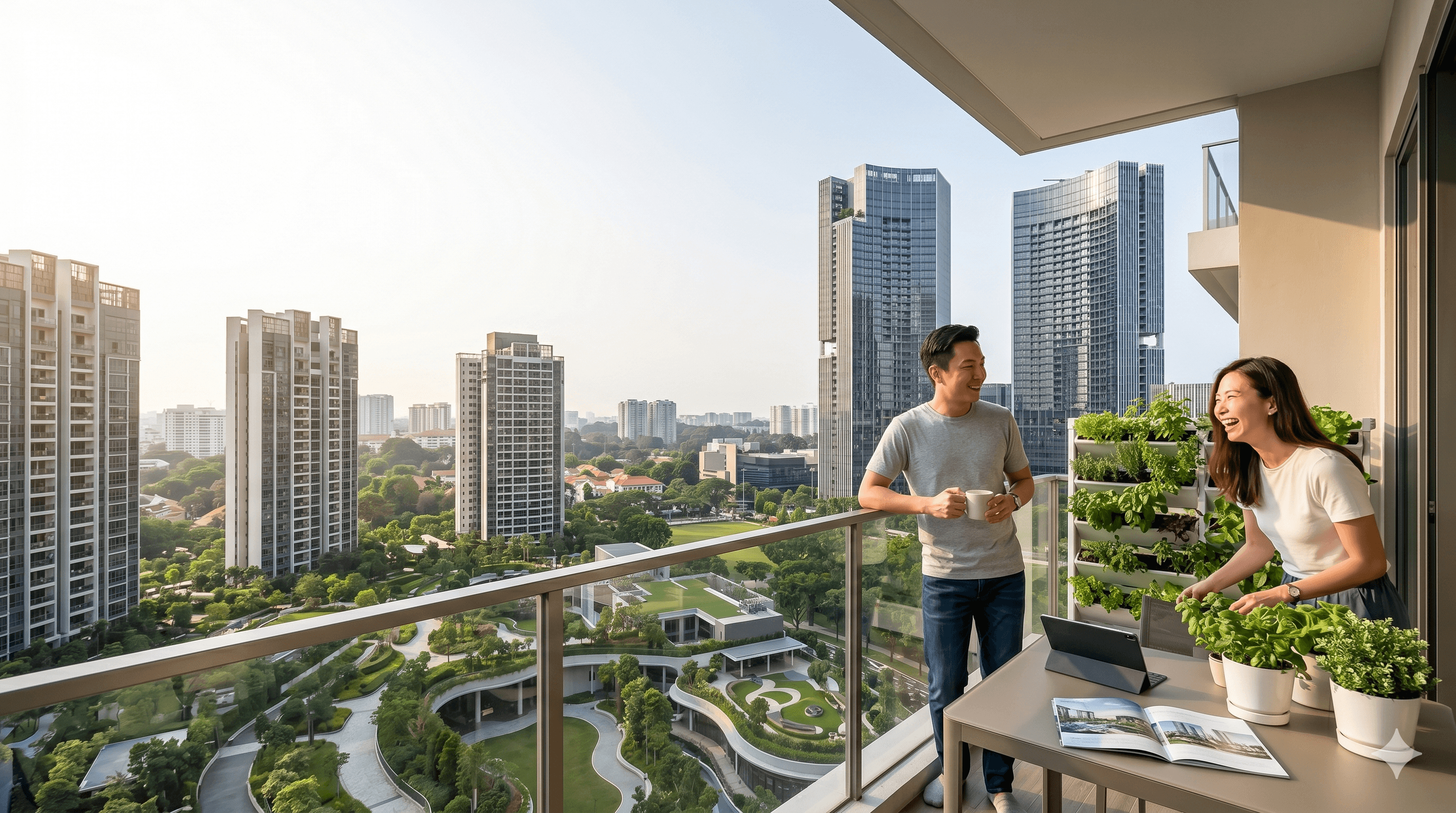
She Rented a Room to Grieve, and Borrowed Money to Stay in It
The number of under-35s living alone in Singapore has more than doubled since 2016. The Government is now studying Build-To-Rent and co-living to meet them. The question nobody has answered is what it costs to be that tenant.
On 3 August 2026, National Development Minister Chee Hong Tat said Singapore is studying more rental housing options — co-living, long-stay serviced apartments and Build-To-Rent — to meet demand from younger Singaporeans renting before they buy, while stressing that homeownership remains central. Separately, a new SG Youth Plan independent-living initiative announced in July 2026 has two private co-living operators offering more than 100 subsidised rental units to those aged 21 to 35, at rates reported to start around $1,800 a month. Department of Statistics figures cited in the reporting show citizens and PRs under 35 living alone more than doubled, from 10,500 in 2016 to 22,600 in 2025. For scale, our own transacted-rent data puts the median private non-landed rent at $4,300 a month islandwide, and a 1-bedroom at $3,300 — though these are whole units, not rooms.
The Straits Times reported this week that National Development Minister Chee Hong Tat is looking at more rental housing options for Singaporeans — co-living, long-stay serviced apartments and Build-To-Rent models — as demand grows from younger Singaporeans who want to rent before they buy.
The day before, the same paper told the story of the people this is about: a generation of under-35s moving out of their family homes years before they are eligible to buy one of their own. It is worth starting there, because the policy makes a lot more sense once you have met the tenant.
The year she rented a room to grieve
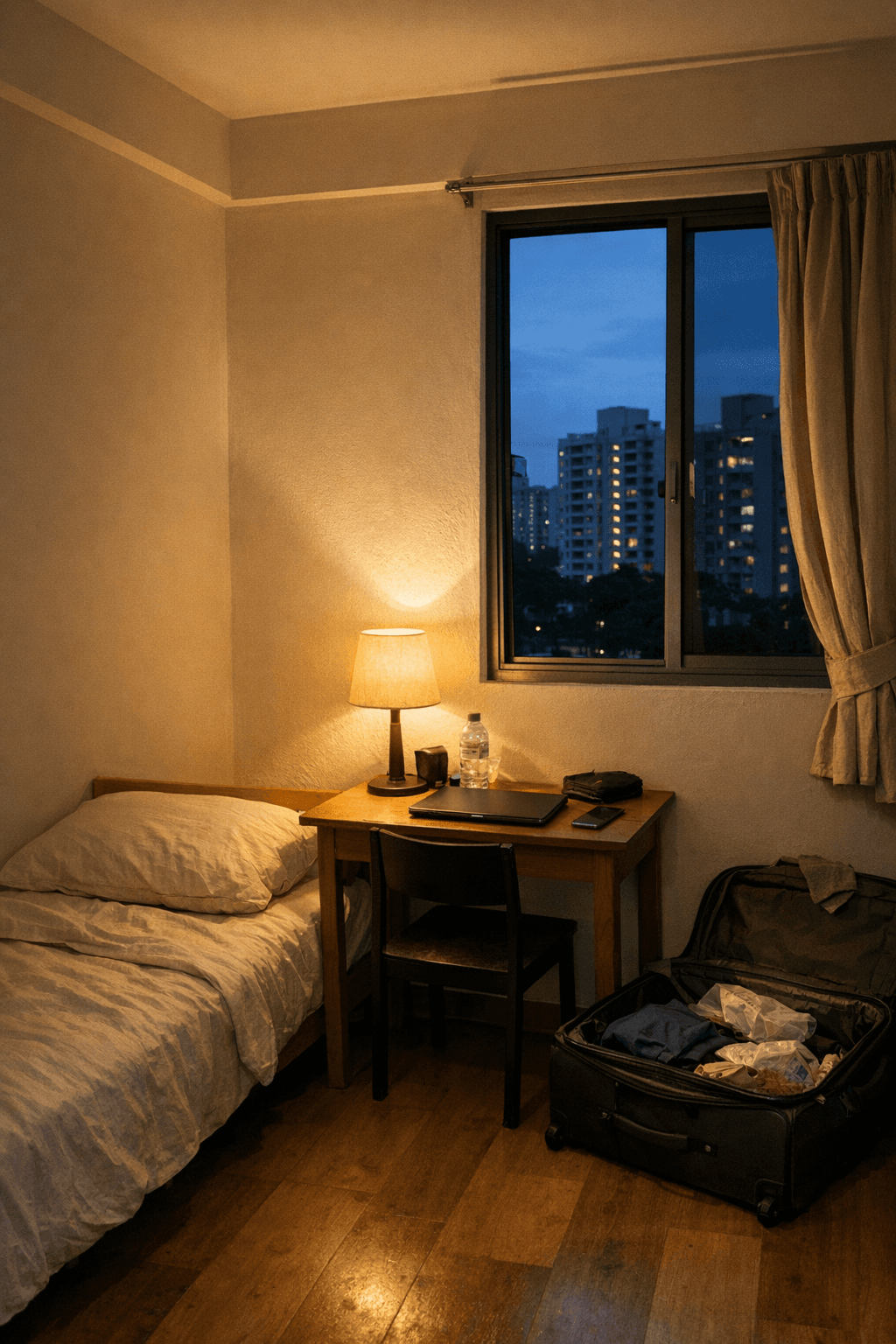
A 26-year-old moved out of her family's three-room flat after her father died, paid $1,400 a month for a condo room, and ended up borrowing money to cover the rent.
In 2024, Kaelen Ong left her childhood home and rented a room in a condominium. Her father had died, and she wanted space to grieve that she could not find in her family's three-room HDB flat, where she lived with her mother and her elder brother.
As The Straits Times reported, the rent was $1,400 a month, which she knew was steep. She took it anyway. She described the feeling of being at home then as a pressure "to have to continue living my life (normally)."
The year that followed is the part worth sitting with. Rent and utilities took more than half her salary as a freelance drama instructor. By the end of the lease she was borrowing money to make rent. She has since moved back in with her family — and says the thing that changed was not her finances but her mother, who came home to a daughter who had proved she could look after herself.
That is not a housing-market anecdote. It is a fairly precise description of what the market currently offers a 26-year-old who needs somewhere to live and cannot yet buy: something they can just barely afford, for a while, at a cost to everything else.
She is not an outlier any more
Citizens and PRs under 35 living alone more than doubled between 2016 and 2025 — from 10,500 to 22,600.
For most young Singaporeans, moving out before marriage or before 35 — the age at which singles become eligible to buy public housing — is still uncommon. But the direction is unmistakable.
According to Department of Statistics figures cited in the reporting, the number of Singaporean citizens and permanent residents under 35 living alone more than doubled between 2016 and 2025, from 10,500 to 22,600.
Property professionals quoted in the piece describe the same trend from the other side of the counter. ERA Singapore's key executive officer Eugene Lim said young people are leaving their childhood homes for independence and a more conducive living environment — a point that got sharper once working from home became normal. Realion's chief researcher Christine Sun observed that those who go tend to be slightly older: a few years into work, often having studied overseas or travelling often.
What that adds up to is a cohort that has tasted living alone somewhere else, come home to a bedroom they had as a teenager, and done the arithmetic.
What the minister actually said
Co-living, long-stay serviced apartments and Build-To-Rent are being studied — framed explicitly as a stage before buying, not a replacement for it.
Speaking on 3 August at the opening of Mber Co-Living and Serviced Apartments in Serangoon, Chee Hong Tat said more rental options could come to market: co-living, long-stay serviced apartments, and Build-To-Rent models.
His framing was careful. "While homeownership remains a key tenet of Singapore's social compact, we recognise that there is also demand for flexible accommodation options, such as by younger Singaporeans who are looking to rent initially before buying their own homes," he said. And then, more plainly: "Maybe not forever, but for that period before you buy a home."
Build-To-Rent is the genuinely new word in that list. Co-living already exists here commercially, and long-stay serviced apartments were piloted in 2023. Build-To-Rent means housing designed and built from the outset to be rented rather than sold — a different asset, a different operator, and a different assumption about how long someone stays.
There is already a live pilot of the demand side. Under the SG Youth Plan, announced in July 2026, two private co-living operators are offering more than 100 subsidised rental units to people aged 21 to 35. The Government has said this is not meant to address housing or supply issues — it is a private-sector effort to give young Singaporeans a chance to live on their own. Reported rates start at around $1,800 a month.
What does renting actually cost in Singapore right now?
A median private non-landed home rents for $4,300 a month, and even a 1-bedroom runs $3,300 — on 89,307 leases over the past year.
Before judging whether $1,800 for a room is a good deal, it helps to see the market it sits inside. These are transacted rents from URA rental contracts over the trailing 12 months — what people actually signed, not what landlords asked:
| Bedrooms | Median rent | Rent psf | Leases (n) |
|---|---|---|---|
| 1-bed | $3,300 | $6.36 | 22,604 |
| 2-bed | $4,100 | $5.16 | 32,263 |
| 3-bed | $5,300 | $4.29 | 27,879 |
| 4-bed | $8,500 | $4.53 | 6,236 |
| 5+-bed | $10,800 | $4.03 | 325 |
The islandwide median across all private non-landed homes is $4,300 a month, on 89,307 leases. The cheaper quartile still sits at $3,500; the pricier quartile at $5,600.
By region, the spread runs from $3,900 in the OCR to $4,300 in the RCR and $5,672 in the CCR.
Note what the cheapest row says. The single most affordable whole private home you can rent, at the median, is a 1-bedroom at $3,300 a month — and it is also the most expensive thing in the table per square foot, at $6.36 psf. Small homes are never cheap by the foot. That is the wall a 26-year-old on a freelance income runs into.
So is $1,800 a month for a room expensive or not?
Our data honestly cannot say — it prices whole homes, not rooms. What it can say is that the cheapest whole private home costs roughly twice that.
This is where we have to be straight with you about the limits of our own numbers.
PropKaki's rental data covers whole private non-landed units — a lease on an apartment. It does not cover rooms, and it excludes HDB sublets entirely, which is a separate market. So we cannot tell you what a room "should" cost, and we are not going to reverse-engineer it by dividing a flat by its bedrooms. That would be a made-up number wearing a data costume.
What we can do is put the two things side by side honestly. The reported co-living rate is around $1,800 for a room. The median whole 1-bedroom private home is $3,300. So the scheme is pitched at roughly half the cost of the cheapest whole private home in our data — for a room in a shared building rather than a home of your own.
The people quoted in the reporting disagree about whether that is fair, and the disagreement is instructive. PropNex chief executive Kelvin Fong argued the co-living units compare best with an en-suite master bedroom in a private condo with shared facilities like a gym, and on that basis $1,800 is broadly in line with the market. PropertyGuru Singapore's managing director Yao Lu cited July asking rents on the platform with median room rents of $1,755 in Jalan Besar, $1,500 in Bukit Timah and $1,200 in Boon Lay — the three areas where the scheme's properties sit — while cautioning those figures are not directly comparable because they reflect a wide mix of options.
Both can be true. A subsidised co-living room can be reasonable against a condo master bedroom and still be more than a plain room in Boon Lay. Which comparison matters depends entirely on which one you would otherwise have rented.
Who does this actually help?
People with an income that clears the rent and a reason to leave that will not wait — and, on the reporting's own evidence, not everyone who needs it.
Read the two articles together and a fairly clear dividing line appears, and it is not about desire. Everyone in these stories wanted to move out.
On one side, Alicia, a 29-year-old engineer, has signed up for the scheme and hopes to rent a twin room at a Bukit Timah property, closer to work than her family's flat in Woodlands. She said plainly: "I want my own freedom." She is within budget, and is looking for a roommate to split the cost anyway.
On the other, Ren, a 29-year-old project coordinator, wants out because of difficult family dynamics — "It's hard to break out of it unless you leave that space" — and has chosen to save for a flat instead. And Kaelen Ong, whose $1,400 room was already the ceiling: "$1,400 was the steepest I could go, and I could barely afford it."
The pattern is uncomfortable. The scheme works best for people whose reason for leaving is preference — independence, a shorter commute, space to work from home — because they can weigh it against money and decide. It works least well for those whose reason is need, because need does not come with a bigger salary attached, and $1,800 is above what the most financially stretched person in the reporting could pay.
That is not a criticism of a hundred subsidised units. It is a note about what a hundred subsidised units are and are not. The Government has itself said this is not aimed at housing or supply.
The honest catch: rent before buying is a trade, and the currency is your down payment
Every month of renting is a month not saving. That is fine if you have priced it — and quietly expensive if you have not.
There is a version of this policy conversation that treats renting-before-buying as a pure gain: more options, more flexibility, more freedom. It is not costless, and the reporting contains the cost in plain sight.
Realion's Christine Sun made the point directly — the cost of long-term rental eats into savings for a flat, which is itself a reason young adults do not move out. Kelvin Fong made a version of it too: interim living options may not get people closer to ownership.
Run it against our numbers and the scale is easy to feel. If a whole 1-bedroom is $3,300 a month at the median, a year of it is close to $40,000 of housing cost with nothing owned at the end. Even the subsidised room at a reported $1,800 is upwards of $21,000 a year. Against a flat down payment, those are not rounding errors — they are a meaningful part of the thing you are saving for.
We are not saying don't rent. Kaelen Ong's year was not a financial decision and should not be judged as one, and there are situations — grief, a difficult household, a job across the island — where paying to leave is obviously right. Amanda Ng, 30, took the other path entirely and bought a two-bedroom condo in the east in March, funded with CPF, cut holidays and a loan from her parents she intends to repay in instalments. Both are legitimate.
The point is narrower: this is a trade with a price, and the price is denominated in the deposit for a home you cannot buy yet. Anyone offering the flexible-renting future without that sentence attached is telling you half of it.
And a caveat on our own figures while we are here: these are transacted rents on private non-landed homes over a trailing year. They exclude HDB sublets, which is where a great many young renters actually live, and they are gross of agency fees, maintenance and tax. They set the scale of the market. They do not price your room.
Is co-living cheaper than renting a whole flat in Singapore?
Almost always yes, because you are renting a room rather than a home — the reported $1,800 sits at roughly half our $3,300 median for a whole 1-bedroom.
Yes, and the reason is structural rather than a bargain: you are buying less space.
Our transacted-rent data puts the median whole 1-bedroom private non-landed home at $3,300 a month, with the islandwide median across all sizes at $4,300. Even the cheapest quartile of the whole private market sits at $3,500. Against that, a reported $1,800 co-living rate is roughly half the cheapest whole-home option.
What you give up for that is a home of your own. Shared kitchens, shared common areas, a room rather than a flat, and neighbours the operator chose. For some people that is the appeal — several of those quoted in the reporting liked the idea of meeting other young people. For others it is exactly what they were trying to escape.
The fairer comparison, as PropNex's Kelvin Fong argued, is against an en-suite master bedroom in a condo with shared facilities, not against a whole apartment. We have no room-level data of our own to test that claim, so we report it as his view rather than as a finding.
Does renting before 35 hurt your chances of buying a flat later?
Not through any rule — but it does compete directly with your down payment, which is the constraint most first-time buyers actually hit.
Renting does not disqualify you from anything. Singles become eligible to buy public housing at 35 whether they spent their twenties at home or in a rented room, and renting creates no penalty in the eligibility rules.
The effect is financial, not regulatory, and it is the one the property professionals in the reporting keep returning to. Rent is money that does not become equity. At our median of $3,300 for a whole 1-bedroom, or a reported $1,800 for a subsidised co-living room, a few years of independence can absorb a large share of what would otherwise have been a deposit.
So the question to ask yourself is not "can I afford the rent?" — Kaelen Ong could afford it, right up until she couldn't. It is "what does this cost me in years, on the thing I am saving for?" If the answer is one year and the reason is a good one, that is a decision most people would make again. If the answer is five years and the reason is that you never sat down and did the sum, that is the one worth catching early.
This is general commentary and not financial advice. Your own numbers — income, CPF, family support, what you are buying and when — decide this, not a median.
How we sourced this
The people, the policy and the co-living rates come from the reporting; the transacted rent figures are ours.
The story belongs to The Straits Times. The named and unnamed renters and their circumstances, the minister's remarks and quotes from the 3 August Mber opening, the SG Youth Plan scheme details, the reported $1,800 starting rate, the Department of Statistics figures on under-35s living alone, and the comments from ERA, PropNex, PropertyGuru and Realion — including PropertyGuru's July asking-rent medians of $1,755, $1,500 and $1,200 — all come from the two articles linked below. Those are the reporters' facts, attributed rather than claimed as ours.
The rental figures are ours. Median rents by bedroom count and by region come from PropKaki's read of URA rental contracts over the trailing 12 months, covering 89,307 leases of private non-landed homes.
The caveats matter more than usual here. These are transacted rents, not asking rents, and a trailing-year snapshot that moves with the market. They cover private non-landed homes only — HDB sublets are excluded, and that is a large part of where young renters actually live. Rent is gross, before agency fee, maintenance or tax. And most importantly for this story: our data prices whole units, not rooms, so it sets the scale of the rental market without pricing a co-living bed. Where a room-level number was needed, we cited someone else's and said whose.
Sources
The two Straits Times reports behind the story, and the rental data behind our figures.
The news:
- The Straits Times — More rental housing options being studied as demand from young Singaporeans grows, 4 August 2026, reporting remarks by National Development Minister Chee Hong Tat on 3 August.
- The Straits Times — More young S'poreans under 35 want to live independently. Will a new co-living initiative help?, 3 August 2026, including comment from ERA Singapore, PropNex, PropertyGuru Singapore and Realion.
The data:
- PropKaki median private residential rents by bedroom count and region, from URA rental contracts over the trailing 12 months (89,307 leases, private non-landed only).
Related reading on PropKaki:
About this commentary
Opinion and analysis from the PropKaki Editorial Desk — not financial or property advice.
This is commentary written by the PropKaki Editorial Desk on reporting by The Straits Times. The people in it, their words and their circumstances belong to that newsroom's journalism; the rental analysis, the framing and the opinions are ours.
It is opinion and general information, not financial, legal or property advice, and it is not a recommendation to rent, buy or wait. The Build-To-Rent and long-stay options described here are being studied, not announced — treat them as direction, not policy. The SG Youth Plan co-living initiative is a live scheme with limited units and its own eligibility conditions, so check the operators' and the scheme's own published terms rather than relying on figures quoted in news coverage.
Published 4 August 2026.
Got a question this raised? Ask PropKaki.
Take any point from this analysis and apply it to your own project, budget or decision.
 PropKaki
For most buyers this year, staying well within budget beats trying to time the market.