
193 Flats in the Million-Dollar Capital: HDB Is Building on a Toa Payoh Carpark
Shorter-waiting-time flats are under construction in Sin Ming and Lorong 4 Toa Payoh — 1,076 units and 193 units, both on brownfield sites. Our numbers say one of those towns has more million-dollar resale flats than anywhere else in Singapore.
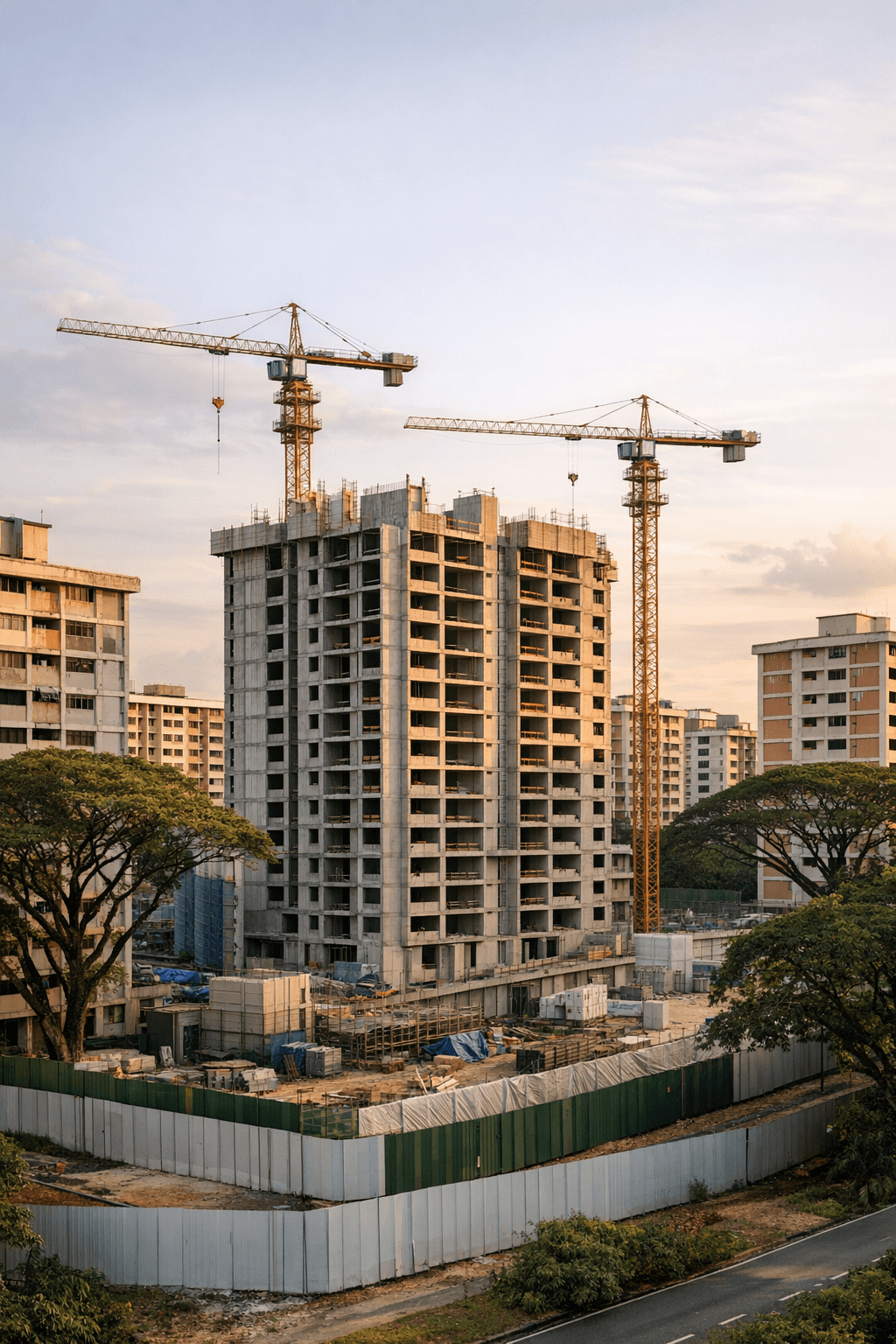
HDB is building shorter-waiting-time BTO flats on two brownfield sites: a 1,076-unit project at Sin Ming Street in Bishan, with a childcare centre and supermarket, opposite the 984-unit Sin Ming Residences; and a 40-storey, 193-unit block at Lorong 4 Toa Payoh on a former open-air carpark of about 0.78ha. Construction has started on both, completion is slated for mid-2030, and launch dates are not yet announced — the timeline points to mid-2027 at the earliest. Shorter-waiting-time flats have waits of under three years, with construction beginning before launch. Analysts quoted expect the Toa Payoh project to be classified Prime or Plus and are split on Sin Ming between Plus and Standard. On our read of HDB resale data, these land in expensive towns: the median 4-room resale flat is $1.00M in Toa Payoh and $790k in Bishan, against a national median of $630k — and Toa Payoh has recorded 463 million-dollar resales since January 2025, more than any other town.
The Straits Times reported this week that hundreds of BTO flats with shorter waiting times are being built in Sin Ming and Toa Payoh, with construction already underway and completion slated for mid-2030. HDB told the paper that launch dates and estimated waiting times will be announced later, though the completion timeline suggests both will go on sale in mid-2027 at the earliest.
On the face of it this is a supply story, and a modest one. Two projects, one of them tiny. But look at where they are going, and it becomes a story about what a subsidised flat is worth in a town that has quietly become the most expensive place in Singapore to buy a resale flat that isn't in the city centre.
The carpark that is about to become forty storeys
A 40-storey, 193-unit block is replacing a 0.78ha open-air carpark in Toa Payoh — HDB redeveloping brownfield land because little else is left.
If you have ever parked at Lorong 4 Toa Payoh, you may know the plot without knowing it: an open-air carpark sitting between Blocks 62B and 66 Lorong 4, and Block 63 Lorong 5. Flat, unremarkable, the kind of space a mature estate accumulates and then forgets about. About 0.78 hectares.
A 40-storey HDB block with 193 flats is going up on it, along with a multi-storey carpark topped by a roof garden, a precinct pavilion and other community facilities.
Asked by The Straits Times why it would develop a site that small, wedged that close to existing homes, HDB's answer was blunt: "Given our limited land, we must redevelop where we can to optimise our land use." Toa Payoh has been built up progressively for sixty years and has very little left.
That is the sentence to hold onto. This is not a masterplanned new town. It is Singapore running out of easy places to put people, and building anyway.
What is actually being built, in both places
Sin Ming: 1,076 units with a childcare centre and supermarket. Lorong 4 Toa Payoh: 193 units in a 40-storey block. Both brownfield, both completing mid-2030.
Two projects, quite different in scale, both on brownfield land — sites that were previously developed rather than fresh ground.
Sin Ming Street, in Bishan town. A 1,076-unit project with a childcare centre and a supermarket, under construction across the road from Sin Ming Residences — an 984-unit project nearing completion. The land previously held an HDB rental block and several industrial buildings, since demolished.
Lorong 4 Toa Payoh. The 193-unit, 40-storey block described above. PropNex's Wong Siew Ying told the paper this could be the smallest BTO project in Toa Payoh since March 2012, when 188 units at the studio apartment block Golden Clover went on sale.
Both are slated for completion by mid-2030. HDB has not announced launch dates or estimated waiting times, and the reporting notes that the completion timeline implies a sale in mid-2027 at the earliest.
Analysts expect healthy demand for both, and the reasons given are the ordinary ones: location, amenities and track record. Wong noted that five BTO projects launched in Bishan since August 2020, Sin Ming Residences among them, were oversubscribed with at least three applicants per flat.
What a shorter waiting time actually buys you
Under three years instead of four or five, because construction starts before launch. You trade influence over the project for time.
The phrase does specific work. A shorter-waiting-time flat has a wait of under three years, against the four-to-five years a standard BTO project has typically required. HDB achieves it by starting construction before the flats are launched for sale — which is exactly what is happening at both these sites right now.
The trade is straightforward and worth stating plainly. You give up the ability to shape anything: the layout mix, the block orientation and the timeline are already fixed by the time you see the listing. In exchange you get years of your life back, and you skip the most expensive part of waiting — renting, or living apart, or staying with in-laws while a project is built.
For a couple who have already been through several unsuccessful ballots, that trade is not close. Time is the scarcest thing in the queue, and shorter-wait projects are the only lever HDB has that returns it directly.
Which is precisely why these two projects will be competitive, and why the classification question below matters so much.
What do flats in these towns actually cost?
Toa Payoh's median 4-room resale flat is $1.00M, third dearest of 25 towns; Bishan is $790k. The national median is $630k.
Here is where our own numbers change the complexion of the story. Comparing towns like-for-like on 4-room resale flats, for the most recent settled half-year:
| Town | Median 4 Room price | Resales (n) |
|---|---|---|
| Central Area | $1.17M | 44 |
| Queenstown | $1.02M | 143 |
| Toa Payoh | $1.00M | 192 |
| Bukit Merah | $938k | 196 |
| Kallang/Whampoa | $920k | 145 |
| Clementi | $800k | 105 |
| Bishan | $790k | 99 |
| Tampines | $668k | 428 |
| Woodlands | $550k | 440 |
| Jurong West | $534k | 302 |
Toa Payoh's median 4-room resale flat is $1.00M — the third dearest of the 25 towns we can rank, behind only the Central Area and Queenstown, and roughly $370,000 above the national median of $630k. Bishan, at $790k, is seventh.
So HDB is not adding supply to an affordable corner of Singapore. It is adding a small number of subsidised flats to two of the most expensive mature towns outside the centre — one of which is only a few thousand dollars from a seven-figure median.
How concentrated are million-dollar flats in Toa Payoh?
Toa Payoh has recorded 463 million-dollar resales since January 2025, more than any town in Singapore. Our Bishan count of 144 corroborates ERA's reported figures.
Medians understate what is happening at the top of these towns. Counting HDB resales that crossed $1,000,000 since the start of 2025:
| Town | $1m+ resales |
|---|---|
| Toa Payoh | 463 |
| Bukit Merah | 352 |
| Queenstown | 321 |
| Kallang/Whampoa | 230 |
| Ang Mo Kio | 174 |
| Clementi | 164 |
| Bishan | 144 |
| Tampines | 122 |
| Geylang | 95 |
| Central Area | 88 |
Toa Payoh leads the country — 463 million-dollar resales since January 2025, more than any other town, including the Central Area itself. Bishan sits seventh with 144.
Our Bishan count is a useful cross-check on the reporting. ERA's Eugene Lim told The Straits Times that about a quarter of the 376 flats sold in Bishan in 2025 crossed $1 million, with 46 of 230 doing so in the first seven months of 2026 — which totals roughly 140 across a similar window. Our own count of 144 lands in the same place, which is a small but genuine reassurance that two independent readings of the Bishan market are describing the same thing. The windows are not identical, so treat this as corroboration rather than a match.
For context, million-dollar flats are the tail rather than the market: they were 6.4% of all HDB resales in 2025, up from 1.8% in 2023. But they cluster, and Toa Payoh is where they cluster hardest.
Why the Prime-or-Plus question is the entire story
Toa Payoh is expected to be Prime or Plus, which means a subsidy clawback on first resale. The more valuable the location, the tighter the strings.
HDB has not said how these projects will be classified, and the analysts quoted do not agree — which tells you it is genuinely finely balanced.
For Lorong 4 Toa Payoh, both analysts expect Prime or Plus, given the proximity to the town centre and an MRT station. For Sin Ming, they split: Wong suggested Plus, noting the site is not at any MRT station's doorstep and sits some distance from the town centre, much like Kebun Baru Breeze in Ang Mo Kio; Lim suggested Standard, pointing to the same distance from the MRT and the quieter part of Bishan.
The classification is not a label. Prime and Plus flats carry a subsidy clawback — owners must return additional subsidies to HDB when they first sell on the resale market — along with tighter resale conditions.
Set that against the numbers above and the tension is obvious. A subsidised flat in the town with the most million-dollar resales in Singapore is, on paper, the single most valuable thing HDB allocates by ballot. Prime and Plus status exists precisely to stop that from becoming a lottery ticket. So the more attractive these projects look on our price tables, the more likely they carry the conditions that limit what a buyer can eventually do with them.
That is the design working as intended. It is also the thing an applicant most needs to understand before treating a Toa Payoh flat as an investment.
The honest catch: 193 flats do not change a town
Roughly 1,200 flats is meaningful to the families who get them and immaterial to the town's prices. Launch, classification and mix are all still unannounced.
Some perspective is owed here, in both directions.
On supply: 1,076 units and 193 units are meaningful to the families who get them and close to irrelevant as market forces. Wong noted that the number of HDB flats in Bishan grew about 11% between 1996 and 2025, against 67% nationally — a town that has barely expanded in thirty years. Adding roughly a thousand flats is a real correction to that, and it is still small against national volumes. Nobody should expect these projects to move Toa Payoh's $1.00M median.
On timing: completion in mid-2030, launch mid-2027 at the earliest, and HDB has explicitly not committed to a launch date. Anyone planning around these projects is planning around a range, not a date. The classification, the flat mix and the price have all yet to be announced.
On the flat mix: both analysts expect a mix weighted to 2- and 4-room units, and Wong pointed to muted demand for 3-room flats at Sin Ming Residences — 177 applications for 105 units, against 2,293 applications for 627 4-room flats. Lim suggested some 5-room units might suit families drawn by Ai Tong School and Catholic High School within 1km. Those are analysts' expectations, not HDB's announcements, and we are reporting them as such.
And on character: Sin Ming is still substantially an industrial estate. Both analysts expect the area to change as hundreds of households move in, while noting industrial uses will remain. That is a real consideration for a buyer choosing a flat there in 2027 and living in it from 2030 — and it is a judgement, not a number.
When will the Sin Ming and Toa Payoh flats go on sale?
HDB has not announced launch dates. Completion is slated for mid-2030, which implies a sale in mid-2027 at the earliest — an inference, not a commitment.
HDB has not announced launch dates or estimated waiting times for either project.
What is known is that construction is already underway at both sites and completion is slated for mid-2030. Because shorter-waiting-time flats are launched with under three years left to completion, that timeline implies a sale in mid-2027 at the earliest, which is how The Straits Times read it.
That is an inference from the construction schedule, not a commitment from HDB, and it should be treated as one. If you are choosing between applying in an earlier exercise and holding out for one of these, you are weighing a known opportunity against an unannounced one.
Will these flats be Prime, Plus or Standard?
HDB has not announced it. Analysts expect Prime or Plus for Toa Payoh and are split on Sin Ming. It determines whether a subsidy clawback applies on first resale.
HDB has not said, and this is the detail with the largest financial consequence for a buyer.
The analysts quoted expect Lorong 4 Toa Payoh to be Prime or Plus, given its proximity to the town centre and MRT. For Sin Ming they disagree — Plus on one reading, Standard on the other — because the site is some distance from both an MRT station and the town centre.
It matters because Prime and Plus flats require owners to return additional subsidies to HDB when they first sell on the resale market, and carry tighter resale conditions. In a town where our data shows 463 flats have crossed $1 million since January 2025, that clawback is the difference between a home and a windfall.
Until HDB announces the classification, treat any projection of resale value for these flats — including any you are shown by anyone — as speculation.
How we sourced this
Project details and analyst views come from the reporting; the town medians and million-dollar counts are PropKaki's own, with the tail and partial-year caveats stated.
Two kinds of numbers, kept apart.
The project details are not ours. The unit counts, the 40-storey block, the site sizes and histories, the brownfield designation, the mid-2030 completion, the under-three-year definition of a shorter-waiting-time flat, HDB's quoted statements, and every analyst view — the Plus and Standard expectations, the Bishan oversubscription record, the 11%-versus-67% flat growth figures, the Sin Ming Residences application counts, the Golden Clover comparison and the ERA million-dollar figures — come from the reporting linked below. They are attributed to The Straits Times and to the named analysts, not claimed as our findings.
The price figures are ours. The median 4-room resale prices by town are our own matched medians across HDB resale transactions for 2026 H1. The million-dollar resale counts by town are our own counts over HDB resale records for transactions at $1,000,000 or above since 1 January 2025.
The caveats matter here more than usual. The town medians are a dated half-year snapshot using 4-room flats only, so towns compare like-for-like rather than on their mix of flat sizes; towns with fewer than ten such resales are omitted; and a specific block, storey or remaining lease can sit well away from the median. The million-dollar counts are a tail, not the market — they cluster in mature and central towns and in larger, newer or recently-MOP flats — and the current year is a partial, under-lodged window that must not be annualised. All prices are gross of any resale levy, agent commission or legal fees.
One more limit: resale prices are not a forecast of BTO prices. These projects will be priced by HDB with subsidies, and nothing in our resale tables tells you what they will cost.
Sources
The Straits Times report on both projects, and the HDB resale records behind our price and million-dollar figures.
The news:
- The Straits Times — Shorter waiting time flats to be launched in Sin Ming and Toa Payoh, 29 August 2026, including comment from Wong Siew Ying of PropNex and Eugene Lim of ERA Singapore.
The data:
- PropKaki median 4-room HDB resale prices by town, 2026 H1, 25 towns with at least ten 4-room resales.
- PropKaki counts of HDB resale transactions at $1,000,000 or above, by town and year, since 1 January 2025.
About this commentary
Opinion and analysis from the PropKaki Editorial Desk — not financial or property advice.
This is commentary written by the PropKaki Editorial Desk on reporting by The Straits Times. The account of what is being built, and the views of the analysts quoted, belong to that newsroom; the price analysis, the framing and the opinions are ours.
It is opinion and general information — not financial, legal or property advice, and not a recommendation to buy, sell or apply for anything. Neither project has an announced launch date, price, flat mix or Prime/Plus/Standard classification, and all four will materially affect what these flats are worth to a buyer. Check HDB's own announcements before making any plan that depends on them.
Published 30 August 2026.
Got a question this raised? Ask PropKaki.
Take any point from this analysis and apply it to your own project, budget or decision.
 PropKaki
For most buyers this year, staying well within budget beats trying to time the market.