
The Botany at Dairy Farm Review: The Cheaper, Near-Ready Alternative to Narra?
At about $2,048 psf it undercuts every other launch in the Dairy Farm nature belt — Narra, Hillhaven and The Myst — and hands you the keys around 2027, years before them. We test whether cheaper-and-sooner is the smarter way into the forest-fringe address.
The Botany at Dairy Farm is a 386-unit, 99-year leasehold on Dairy Farm Walk (District 23, OCR) by Sim Lian JV (Dairy Farm) Pte. Ltd., with vacant possession expected 31 December 2027. Across 386 developer-sale caveats its pricing is about $2,048 psf (median ~$2.04M) — roughly 40% above District 23 resale, yet the cheapest of the four Dairy Farm nature-belt launches, undercutting Narra (~$2,170), Hillhaven (~$2,108) and The Myst (~$2,058). Launched in early 2023, it is now near sold out and near-ready. It suits the forest-fringe own-stayer who wants a lower per-foot entry and keys sooner, not the buyer who needs a wide choice of unsold stacks.
Most new-launch reviews ask whether a project is worth its premium. The Botany at Dairy Farm invites a sharper question: if you want a home on the edge of the Bukit Timah nature belt, why pay up for the newest, priciest door when the one beside it costs less per square foot and hands you the keys years sooner? The Botany is the cheapest of the four recent Dairy Farm nature-belt launches and, with vacant possession due at the end of 2027, the closest to ready. This review is about whether cheaper-and-sooner is the smarter trade — or whether you simply get what you pay for.
Our verdict: is The Botany at Dairy Farm the value pick in the nature belt?
At ~$2,048 psf The Botany is the cheapest of the four Dairy Farm nature-belt launches — under Narra (~$2,170), Hillhaven (~$2,108) and The Myst (~$2,058) — and, with vacant possession due end-2027, the nearest to ready. It is a buy for the forest-fringe own-stayer who wants a lower per-foot entry and keys sooner; less so if you need wide unsold choice or the newest product.
The Botany at Dairy Farm is a buy for one specific person: the owner-occupier who wants a home on the edge of the Bukit Timah nature belt, at the lowest per-foot entry the enclave offers, with the keys arriving soon rather than in half a decade. Its case is not scarcity or prestige — it is value and certainty.
Start with the price. At about $2,048 psf, The Botany is the cheapest of the four recent launches in the Dairy Farm nature belt. It sits below its newer, pricier neighbour Narra Residences at ~$2,170, below Hillhaven at ~$2,108, and a shade under The Myst at ~$2,058. Same forest-fringe address, same 99-year tenure, lower entry PSF. If Narra's story is 'the most expensive door in Dairy Farm', The Botany's is the mirror image: the least expensive door on the same street.
Now add timing. The Botany launched back in early 2023, and its vacant possession is due 31 December 2027 — so you are roughly eighteen months from keys, against Narra's January 2030. That is close to two years sooner, on a project that is already nearly built and, on our data, all but sold out. You are buying certainty: a near-finished building, a near-complete price picture, and a far shorter wait.
So the verdict turns on what you value. If you want the forest-and-trails lifestyle without paying the enclave's top PSF, and you would rather have keys in 2027 than a show-unit promise for 2030, The Botany is the value-and-certainty pick — and the big family units are where its discount bites hardest. If you need a wide choice of unsold stacks and facings, or you are chasing the newest product with the most usable floor area, the fresher launches next door earn their premium. Buy The Botany because cheaper-and-sooner genuinely suits you — not because cheaper always means better.
This review shows the full workings. For the market-wide picture, see our roundup of every 2026 new launch benchmarked against resale.
The Botany at Dairy Farm at a glance: the key facts
The Botany at Dairy Farm is a 386-unit, 99-year leasehold condo on Dairy Farm Walk (District 23, OCR) by Sim Lian JV (Dairy Farm) Pte. Ltd., with vacant possession expected 31 December 2027 and indicative pricing around $2,048 psf (median ~$2.04M).
| Detail | The Botany at Dairy Farm |
|---|---|
| Developer | Sim Lian JV (Dairy Farm) Pte. Ltd. |
| Tenure | 99-year leasehold (from 8 June 2022) |
| Location | Dairy Farm Walk, off Upper Bukit Timah Road, District 23 |
| Planning area / segment | Bukit Panjang · Outside Central Region (OCR) |
| Total units | 386, across five blocks (up to ~15 storeys) |
| Unit types | 1- to 5-bedroom, from sub-550 up to ~1,765 sq ft |
| Expected TOP | ~2027 (vacant possession 31 December 2027; legal completion 31 December 2030) |
| Launched | early 2023 |
| Indicative pricing | ~$2,048 psf · median ~$2.04M |
Two notes on these figures. First, the developer, tenure, expected completion and unit sizes come from the project's own brochure and legal disclosure — Sim Lian's joint venture won the Dairy Farm Walk site (Lot 2800V MK16), and the brochure's legal page states vacant possession on 31 December 2027. We always take the completion date from the brochure because automated directories often carry a wrong year for newly-tendered sites; here the brochure is the source of the ~2027 date. Second, the pricing is our own, the median of 386 URA developer-sale caveats. One piece of context on the builder: Sim Lian is an established local developer with a 40-plus-year record — its projects include Hillion Residences and Hillion Mall two MRT stops away in Bukit Panjang, plus Clover by the Park and Waterview — so this is a familiar hand building in its own backyard.
The Botany vs Narra and the Dairy Farm launches: why it is the enclave's value door
Against its true peers — Narra (~$2,170), Hillhaven (~$2,108) and The Myst (~$2,058) — The Botany (~$2,048) is the cheapest of the four Dairy Farm nature-belt launches. Its +40% over District 23 resale is smaller than Narra's +49% and inflated by a cheap resale base, not proof of overpricing. But part of the lower PSF reflects older, pre-harmonisation area counting — verify usable space on the floor plans.
This is the comparison that decides the case, because these are the projects you would actually cross-shop — the same District 23 nature-fringe belt, all recent launches.
| Project | New-Sale caveats (n) | Median launch PSF |
|---|---|---|
| Narra Residences | 232 | $2,170 |
| Hillhaven | 337 | $2,108 |
| The Myst | 211 | $2,058 |
| The Arden | 58 | $1,808 |
| Lumina Grand | 516 | $1,521 |
| Altura | 48 | $1,491 |
Drop The Botany's ~$2,048 psf into that stack and the picture is clear: it slots below Narra (~$2,170), below Hillhaven (~$2,108), and just under The Myst (~$2,058) — the four launches that share the Dairy Farm nature belt. Among that quartet, The Botany is the cheapest door. (The three sub-$1,850 entries are different animals: The Arden is a small boutique in another Bukit Panjang pocket, while Lumina Grand and Altura are executive condos — an eligibility-restricted, subsidised tier — so the like-for-like private-launch comparison is really Narra, Hillhaven, The Myst and The Botany.)
What about the scarier number — the +40% premium over District 23's ~$1,461 resale median? Treat it the way you should treat every launch-versus-resale gap: with suspicion of the denominator. District 23 is one of Singapore's cheapest resale pools, weighed down by older leasehold and executive-condo stock across Bukit Panjang, Choa Chu Kang and Bukit Batok, so any fresh 99-year launch prints a big percentage gap. The honest takeaway is that The Botany's +40% is not evidence of overpricing — and it is a smaller step than Narra's +49%, which is the same point from the other side: The Botany is simply the more conservatively priced of the two. For how big a launch premium should be, see how much a new-launch premium should be and new launch vs resale.
One honest deduction, though: part of The Botany's lower PSF is a measurement difference, not free money. Its floor plans state that the quoted area includes the aircon ledge, balcony, PES and strata voids — the older way of counting saleable space. Narra, launched two years later, is drawn under the 2023 GFA-harmonisation rules that stopped counting things like aircon ledges as saleable area. So a 1,000 sq ft unit at The Botany packs a little less liveable internal space than a 1,000 sq ft unit at Narra, and a slice of the raw PSF gap is that accounting change rather than a pure discount. Verify unit efficiency on the actual floor plans before you bank the full saving. To run a structured head-to-head on any two projects, use our two-project comparison scorecard; for where this sits among the year's launches, see the complete guide to 2026's new launches.
What 'near-ready' changes: keys in 2027, not 2030
The Botany's vacant possession is 31 December 2027, roughly two years before Narra's. Keys sooner means a near-finished product and less completion risk — but also that your progressive-payment drawdowns and full instalments start sooner, and that its 99-year lease (from June 2022) has already run about three years longer than Narra's.
The Botany's second advantage over Narra is time. Its vacant possession is 31 December 2027 (legal completion 31 December 2030); Narra's is January 2030. Buying today, you are roughly eighteen months from keys instead of three-and-a-half years — and that reshapes three practical things.
Your money moves sooner. New launches are paid under the progressive payment scheme, where you draw down your loan in stages as the building rises. Because The Botany is nearly built, a purchase now steps straight into the later, heavier stages — more of your loan is disbursed quickly, so your full mortgage instalments start sooner. That is the flip side of getting keys early: less of the long, cheap 'construction runway' of light early payments that a 2030 project like Narra still offers. If cash-flow timing matters, weigh that honestly.
You are buying a near-finished product, not a model. With TOP a year or so away, the building, the landscaping and the actual unit stacks are close to done — far less of the 'will it match the brochure' risk you carry on a project years from completion. (This review is still a desktop analysis, not a showflat visit — but the point holds: near-ready is lower-uncertainty.)
Your lease clock started earlier. The Botany's 99 years run from 8 June 2022; Narra's from mid-2025. So while you get keys sooner, you also buy a lease that has already been ticking about three years longer — a small but real trade-off when you eventually sell into an OCR market that watches remaining lease closely. See how lease decay affects condo prices. For the mechanics of buying a launch this late in its cycle, read the new-launch condo process.
How much does The Botany cost? Prices and PSF by unit size
Across 386 developer-sale caveats, The Botany's median is ~$2,048 psf and ~$2.04M, with most units $1,990–$2,114 psf. Unusually, PSF falls as units get bigger, so the discount is deepest on the large family homes. The median cheque tops Narra's only because Botany's buyers bought bigger, not because it is dearer per foot.
Across the 386 developer-sale caveats on record, The Botany's median is about $2,048 psf, with most units transacting between roughly $1,990 and $2,114 psf and a median price near $2.04M.
| Unit size (from our caveats) | Caveats (n) | Median PSF | Median price |
|---|---|---|---|
| ≤550 sqft (studio/1BR) | 33 | $2,151 | $1.09M |
| 550–750 sqft (1–2BR) | 101 | $2,073 | $1.40M |
| 750–1,100 sqft (2–3BR) | 170 | $2,046 | $2.07M |
| 1,100–1,500 sqft (3–4BR) | 65 | $1,993 | $2.57M |
| 1,500+ sqft (4BR+/penthouse) | 17 | $1,983 | $3.05M |
Size bands are reconstructed from our own New-Sale caveats — the bedroom labels are size proxies, not the developer's official unit mix.
Two patterns matter here. First — and unlike Narra, where PSF rose with size — at The Botany the PSF falls as units get bigger: the compact sub-550 sqft homes carry the top rate (~$2,151 psf) while the 1,500-plus sqft five-bedders clear the lowest (~$1,983 psf). That is the normal shape, and it means the project's discount is deepest exactly where the space is. If you are a family buying a large unit, you get The Botany's best per-foot deal and its keys-sooner certainty — the strongest version of its value case.
Second, read the quantum carefully. The Botany's median cheque (~$2.04M) is actually higher than Narra's (~$1.60M) despite the lower PSF — not because it is dearer, but because its buyers have skewed toward larger family layouts (the biggest band of sales sits in the 750–1,100 sqft, 2–3 bedroom range at ~$2.07M). So read the value as per square foot, not per cheque: for a given size you pay less here, but the typical home sold is bigger, so the typical bill is bigger too. If you want the lowest cash outlay, the sub-550 sqft band (~$1.09M median) is the entry point — though, as with most projects, going small buys a lower quantum, not a lower PSF. To think through paying on total price versus per-square-foot, read quantum vs PSF when buying a condo.
Where is The Botany, and how good is the connectivity?
The Botany is on Dairy Farm Walk (District 23, Bukit Panjang), in the same nature belt as Narra. Nearest MRT is Hillview on the Downtown Line, about a 9-minute walk per the brochure, with a future Cross Island Line interchange at King Albert Park — improving rail, but not a doorstep. Dairy Farm Mall is a 2-minute walk, the BKE two minutes' drive, and the German European School is right next door.
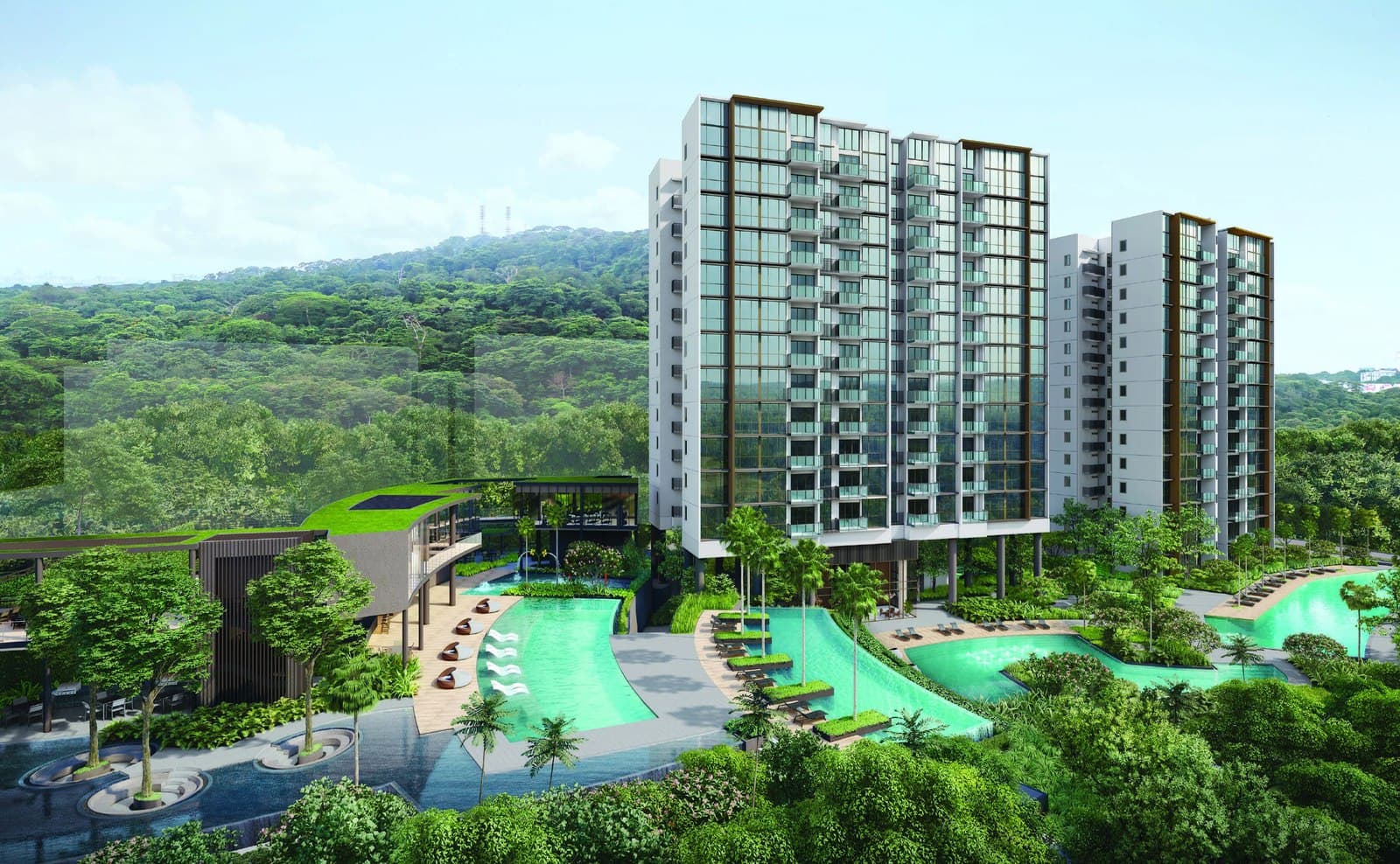
The Botany sits on Dairy Farm Walk, in the Bukit Panjang planning area of District 23, wedged against the same green belt that frames Narra a few minutes away. You choose it for the setting first — and the connectivity comes with a genuine upside and one honest catch, much like its neighbours.
The nature is the whole point, and it is real. The brochure counts Dairy Farm Nature Park about a 3-minute walk away, the Dairy Farm Park Connector a 2-minute cycle, and the 24km Rail Corridor a 3-minute cycle, with Chestnut, Zhenghua and Bukit Timah nature reserves and the Central Catchment all ringing the address. This is a forest-bathing, weekend-hiking, low-density daily life — the shared draw of the whole Dairy Farm enclave.
Rail is improving, but not on your doorstep. The nearest station is Hillview on the Downtown Line, about a 9-minute walk per the brochure, with Cashew also on the DTL nearby; the line runs to Beauty World, Botanic Gardens and into town, and a future Cross Island Line interchange at King Albert Park (two stops away) will add a second line. The honest catch is that 9-minute walk — this is a stroll-or-shuttle-to-the-platform location, not a station-on-top launch. Sim Lian softens it with a complimentary shuttle to Bukit Panjang Integrated Transport Hub and Hillion Mall for the first year. Drivers get the BKE about two minutes away, with the PIE beyond it, putting town roughly 20 minutes off.
Daily needs and schools are a real strength. The new Dairy Farm Mall is about a 2-minute walk, HillV2 and The Rail Mall are a short drive, and Bukit Panjang's Hillion and Junction 10 are two stops down. The catchment is unusually education-rich for the OCR: the German European School Singapore sits right next door, with CHIJ Our Lady Queen of Peace and Bukit Panjang Primary within 1km — an international-school anchor that matters for the tenant pool in the next section. For how tenure and segment shape an OCR buy, see CCR, RCR and OCR: a buying guide.
Is The Botany at Dairy Farm a good investment? What the data says
The Botany has never been resold, so there is no track record. The honest proxy — OCR resales — shows 86.3% sold above cost with a +27.6% median gain (gross, a base rate not a forecast). Rental drivers (the German European School next door, nature-wellness tenants, the Downtown Line) are real but specific; we quote no yield. The cushion is the lower entry PSF; the risks are thin remaining choice and a cheap OCR resale pool at exit.
The Botany has been sold and lived-in only on paper so far — as a not-yet-completed launch it has no resale track record, so anyone promising you a return is guessing. The honest proxy is how comparable homes in its segment have actually performed. Across matched resale pairs, 86.3% of OCR (Outside Central Region) private resales sold above their purchase price, with a median gross gain of 27.6%. Treat that as a base rate, not a forecast, and remember it is gross — before commission, stamp duties, any Seller's Stamp Duty and loan interest.
On rental we will not quote a yield, because a pre-completion project has no rental history and any figure would be invented. Qualitatively, the demand drivers are specific but genuine: the German European School next door seeds a steady pool of expatriate family tenants, the nature-and-wellness setting draws renters who want greenery over nightlife, and the Downtown Line gives a clean commute once you are at Hillview. It is a lifestyle-and-schools rental location, not a CBD-adjacent rental machine. To pressure-test a specific unit against your own holding period, financing and a realistic rent you supply, run it through the PropKaki profitability model, and read how to tell if a property will be profitable.
The investor's catch here is different from Narra's. You are not buying at the district's record PSF — you are buying cheaper, which helps. But you are buying at the tail of a nearly sold-out launch: the easy early-bird pricing is gone, the best stacks and facings are largely taken, and your eventual resale still competes against District 23's structurally cheap pool of older leasehold and executive-condo stock. The lower entry PSF is your cushion; the thin remaining choice and the lifestyle-not-centrality nature of the premium are the risks. For the segment lens, see OCR condo investment.
The Botany pros and cons: who should buy it
Pros: the lowest PSF in the Dairy Farm nature belt, near-ready keys (end-2027), the deepest discount on big family units, real nature adjacency and a familiar local developer. Cons: near sold out so little choice, an older 2023 vintage counted the pre-harmonisation way, a lease already running since 2022, a 9-minute walk to the MRT and a cheap OCR resale pool. Best for forest-fringe own-stayers and space-buyers; less so if you need choice or the newest product.
The strengths are real and specific:
- The lowest PSF in the nature belt — cheaper per foot than Narra, Hillhaven and The Myst, on the same forest-fringe address and the same 99-year tenure.
- Near-ready — vacant possession end-2027 means keys in roughly eighteen months, a near-finished product, and less completion risk than a 2030 launch.
- Best value on space — because PSF falls with size, the large family units carry the deepest discount.
- Genuine nature adjacency — Dairy Farm Nature Park, the Rail Corridor and the Bukit Timah reserves within minutes.
- Schools and a familiar developer — the German European School next door, and Sim Lian building in the Bukit Panjang backyard where it already delivered Hillion.
The trade-offs are just as real:
- Near sold out — you are choosing from the last of the stock, not a full launch, so stack, facing and floor choice is thin.
- Older vintage and older accounting — a 2023-launched design, with saleable area counted the pre-harmonisation way (aircon ledges and voids included), so a little less usable space per square foot than the newest neighbours.
- A lease already three years in — the clock started June 2022.
- MRT is a 9-minute walk, not a doorstep, and the nature premium is a softer, lifestyle premium on a 99-year lease.
- A structurally cheap resale district — your exit competes with older OCR stock and deep future supply.
Best for: owner-occupiers who want the forest-fringe lifestyle at the enclave's lowest per-foot price and keys sooner, and families buying a large unit. Think twice if: you need a wide choice of unsold stacks, you want the newest and most space-efficient product, or you need the MRT at your door. For a disciplined head-to-head, use our two-project comparison scorecard.
The one thing to weigh before buying The Botany
The Botany's lower PSF and 2027 keys are real, but you are buying at the tail of a near-sold-out, 2023-vintage launch on a lease running since June 2022 — with thin stack choice and part of the 'discount' just older area-counting. You are buying certainty and a keen per-foot price, not a fresh appreciation runway.
The Botany's two big advantages — a lower PSF and keys by end-2027 — are genuine, but they come bundled with one fact you must price in: you are buying at the very tail of a launch that is nearly sold out, on a 2023-vintage product whose lease has already been running since June 2022. The cheaper entry is partly a measurement effect (its square footage counts aircon ledges and voids that the newest launches no longer do), the best stacks and facings are largely gone, and the 'new launch' upside that rewards early buyers has mostly been captured by the people who bought in 2023. What is left to you is the certainty — a near-finished home at the enclave's lowest per-foot price — not the appreciation runway of a fresh release. Buy The Botany because you want the forest-fringe lifestyle, keys soon, and a big unit at a keen PSF; do not buy it expecting the discount to compound quickly, because the easy part of that story has already happened.
How much does The Botany at Dairy Farm cost?
About $2,048 psf median (~$2.04M), with most units $1,990–$2,114 psf, from our URA caveat data — the cheapest of the four Dairy Farm nature-belt launches.
Based on 386 URA developer-sale caveats, The Botany's indicative pricing is about $2,048 psf (median unit ~$2.04M), with most units between roughly $1,990 and $2,114 psf. That makes it the cheapest of the four recent Dairy Farm nature-belt launches, under Narra (~$2,170), Hillhaven (~$2,108) and The Myst (~$2,058). Pricing is a live snapshot from caveats lodged so far and, because the project is nearly sold out, reflects close to its full and final price picture.
When will The Botany at Dairy Farm be completed (TOP)?
Around 2027 — expected vacant possession is 31 December 2027, per the developer's materials, roughly two years before Narra.
Per the developer's legal disclosure, The Botany's expected vacant possession is 31 December 2027 (expected legal completion 31 December 2030), so a TOP around 2027. Launched in early 2023, that makes it one of the nearest-ready launches in the Dairy Farm enclave — roughly two years ahead of Narra Residences (January 2030). We take the date from the brochure because automated directories often carry a wrong completion year.
The Botany at Dairy Farm vs Narra Residences — which is cheaper?
The Botany (~$2,048 psf) is about 6% cheaper than Narra (~$2,170) and readier (end-2027 vs 2030). Narra is newer and more space-efficient with full choice of units; The Botany is nearly sold out. Cheaper-and-sooner versus newer-and-roomier.
By indicative PSF, The Botany (~$2,048) is cheaper than Narra Residences (~$2,170) — about $122 psf, or roughly 6%, less — and it is nearer completion (end-2027 versus Narra's January 2030). Both are 99-year leasehold in the same Dairy Farm nature belt. The catch: Narra is the newer project, drawn under the 2023 GFA-harmonisation rules, so it packs more usable space per square foot, and it has a full spread of unsold stacks, whereas The Botany is nearly sold out. Cheaper-and-sooner versus newer-and-more-space-efficient — that is the real trade.
Is The Botany at Dairy Farm sold out, or can you still buy?
Effectively near sold out: 386 developer-sale caveats have been logged against 386 total units after nearly three years of selling. Little developer stock is likely left, so availability and unit choice — not price — are the binding constraint.
On PropKaki's data, The Botany has logged 386 developer-sale caveats — essentially matching its 386-unit count — which tells you the launch is deep into its sell-down and effectively near sold out after nearly three years on the market. In practice that means very little developer stock is likely to remain, and whatever is left is the tail end of the price list rather than early-bird pricing. If you are set on the project, treat availability, stack and facing as the binding constraint, not price — and confirm what is actually released with the developer. It also means that, as completion nears in 2027, the resale and sub-sale market will increasingly be where units change hands.
Methodology and sources
Pricing from our 386 URA New-Sale caveats; the +40% from District 23 resale caveats; comparables from each project's caveats; segment odds from matched OCR pairs. Developer, tenure, TOP and sizes are brochure-sourced (vacant possession 31 December 2027). A desktop analysis, not a showflat visit; no yield quoted.
Where the figures come from. The Botany's indicative pricing is the median of 386 URA private-sale caveats flagged New Sale for the project (window 3 March 2023 to 2 February 2026), from PropKaki's own transaction data. The ~40% premium compares that to the median PSF of Resale caveats in District 23 over the last ~18 months (1,344 caveats). The comparable-launch PSFs are the medians of each rival project's own New-Sale caveats in the same district over the last ~30 months, deduped per project. The 86.3% segment resale odds and +27.6% median gain come from matched private buy-to-sell pairs in the OCR segment via PropKaki's profitability model. Developer, tenure, expected completion and unit sizes are from the project's official brochure and legal disclosure — Sim Lian JV (Dairy Farm) Pte. Ltd., 99-year lease from 8 June 2022, vacant possession 31 December 2027 — which we use in preference to the directory's completion field.
What we did not do, and did not claim. This is a data and desktop analysis, not a showflat visit — we have not toured the units or verified finishes in person, even though the project is near completion. Indicative PSF is a dated snapshot that moves as units sell; PSF is price divided by area, so a median shifts with which units transact — the by-size table controls for that. The resale benchmark is a district median, not a unit-matched valuation, and District 23's is unusually low, a point this review leans on rather than hides. The comparable-launch table is a broad district reference, not a like-for-like specification match, and the aircon-ledge / GFA-harmonisation point means square footage is not measured identically across these projects. Segment profit odds are gross and are a base rate, not a forecast — The Botany has never been resold. We quote no rental yield, because the project has no rental history. Nothing here is financial advice; verify current rules and figures with URA, IRAS and HDB.
Got a question this raised? Ask PropKaki.
Take any point from this analysis and apply it to your own project, budget or decision.
 PropKaki
For most buyers this year, staying well within budget beats trying to time the market.