

Progressive Payment Scheme Explained: How New Launch Condo Payments Work in Singapore
How staged payments, construction milestones, CPF usage, and bank loan drawdowns usually work from booking to TOP.
For an under-construction condo, the progressive payment scheme means you pay in stages as the project reaches certified milestones. CPF and bank loan funds are usually used progressively too, so the key is to understand timing, cash flow, and upfront gaps clearly rather than looking only at total price.
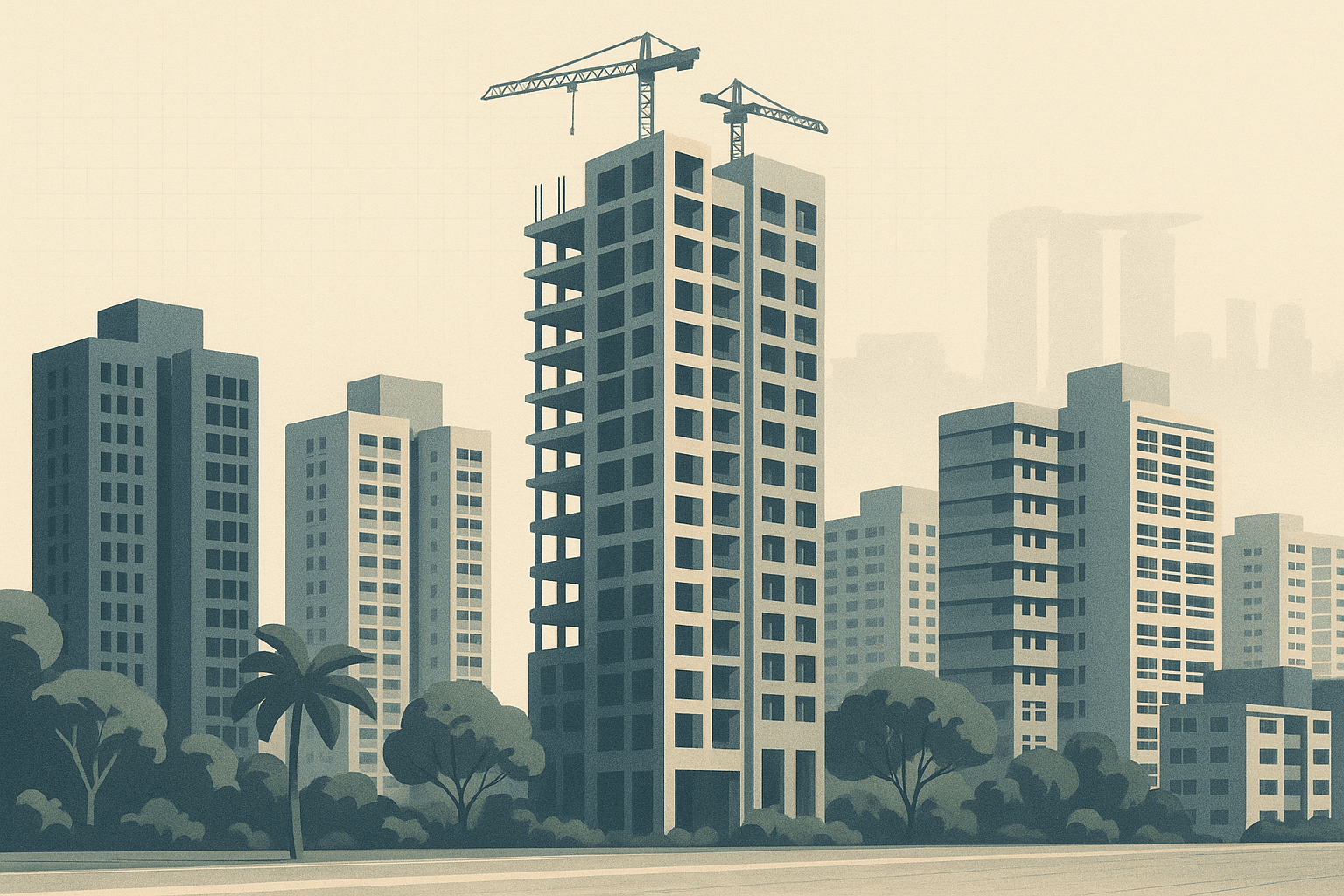
For under-construction private condos, the progressive payment scheme spreads payment out over the build period instead of requiring the full purchase price upfront. The real value of understanding it is simple: you can see not just what you are buying, but when the money is likely to go out. This guide focuses on the payment mechanism commonly used for Singapore new launch condos; exact milestone percentages and current financing policy figures should be confirmed from the project documents, the bank, and official sources before you rely on them.
What is the progressive payment scheme for a new launch condo?
It is the staged payment system used for under-construction condos, where you pay as the project progresses instead of funding the full purchase upfront.
The progressive payment scheme is the usual staged payment framework for under-construction private residential purchases in Singapore. Instead of paying as if the unit were already completed, you pay across the construction period as legal and building milestones are reached.
The simplest way to picture it is: you secure the unit early, but the money usually goes out in stages as the building gets built.
That distinction matters because many buyers compare a new launch against a completed condo as if the cash flow is the same. It usually is not. A new launch often feels lighter at the start because the financing burden ramps up over time, but the total purchase commitment still remains.
As a rough shape of the schedule, the standard Sale and Purchase Agreement in the Housing Developers Rules runs: a booking fee of 5% to 10%, topped up to 20% when you sign the Sale and Purchase Agreement (a further 15% if your booking fee was 5%; or within 8 weeks of the option date, if your S&P Agreement allows it), then 40% across six construction stages, 25% at the Temporary Occupation Permit (TOP), and the last 15% around the Certificate of Statutory Completion (CSC) and legal completion (Housing Developers Rules). The stage-by-stage table (as of 2026) is in the payment schedule FAQ below; verify the exact schedule against your project's S&P Agreement. For the full buying journey around this stage, pair this page with our new launch condo buying process guide. For a general market reference on how staged condo payments are commonly presented, see PropertyGuru’s condo payment schedule guide.
Work out the payment schedule for your own purchase price on the Property Financial Planner.
How does the payment timeline usually work from booking to TOP?
The typical flow is booking, signing the sale documents, milestone-based instalments during construction, and final stages around TOP or legal completion.
A clear way to picture the timeline is to break it into four practical stages:
- Booking stage: you secure the unit and start the purchase process.
- Sale and Purchase stage: the legal documents are signed and the financing setup is put in place.
- Construction stage: payments are triggered progressively as certified milestones are reached.
- TOP or completion stage: the later instalments are paid as the project nears handover and completion.
Within the construction stage, the standard prescribed schedule draws in smaller tranches as each stage is certified — foundation 10%, reinforced-concrete framework 10%, then 5% each at partition walls, roofing/ceiling, door and window frames with wiring and plumbing, and the car parks, roads and drains serving the project — as of 2026; verify the exact split on the project's S&P Agreement.
The important point is that this is a sequence, not a universal calendar. The actual timing depends on construction progress, certification, and how the bank processes each drawdown. A buyer who books at launch may have a longer runway between stages than a buyer who enters when the project is already far advanced.
A practical example: if you buy a unit close to TOP, you may wrongly expect a slow ramp-up because you heard "new launch means progressive payment." In reality, several stages can arrive much faster when the project is already near completion.
For a lender-side overview of how under-construction purchases are commonly financed, see DBS’s guide to buying property under construction. Related PropKaki reads: New Launch OTP in Singapore: Booking Fee, Exercise Deadline, and What Happens Next and When Can You Collect Keys After TOP for a New Launch Condo?.
How are CPF and bank loan funds typically used under progressive payment?
Each stage is usually funded through your financing mix at that point, which may include cash, CPF OA savings, and bank loan drawdowns, subject to your setup and current rules.
Under progressive payment, the funding usually follows the instalment schedule rather than appearing in one lump sum. In practice, buyers often use a mix of:
- cash for some upfront or non-loan costs,
- CPF OA savings for eligible housing payments, subject to CPF rules and available balance, and
- bank loan disbursement released progressively as stages are triggered.
The key point is this: affordability is not just about getting a loan approval. It is about matching the timing of each payment stage to your actual funding sources.
Three checks make the picture clearer:
- Do you have enough CPF OA balance for the stages you expect CPF to cover?
- Is the loan approval realistic once your other debts and future commitments are considered?
- Is there enough liquid cash for the items CPF and the bank will not automatically solve?
A common mistake is to assume that once a loan is approved, every payment issue is settled. In reality the bank typically draws progressively, and CPF usage still depends on current rules and balances. Before relying on any specific figure, confirm the latest lender process and housing loan preparation steps. For a useful reference on the financing side, see PropertyGuru’s guide to loan pre-qualification and approval. For a broader overview, see Progressive Payment vs Deferred Payment Scheme for New Launch Condos in Singapore.
What do construction milestones have to do with payment?
Construction milestones are the trigger points. Once a milestone is certified, the next instalment and related loan drawdown usually follows.
Construction milestones are central to the scheme because the condo is still being built. The practical logic is straightforward: no certified milestone, no next progressive payment stage.
You may hear milestone labels such as foundation work, structural completion, or finishing stages. The exact labels and sequence can differ by project, but the mechanism is usually the same:
- the project reaches a recognised stage,
- the developer's qualified person (a registered architect or professional engineer) certifies that progress, and
- the next payment and bank drawdown process is triggered.
Under the standard prescribed schedule, once a stage is certified you are typically given 14 days to pay that instalment — as of 2026; confirm the notice period on your S&P Agreement.
A simple way to think about it if you are asking "Why am I paying again now?" is: the payment is linked to certified construction progress, not random billing dates.
That framing also helps set expectations. You may see visible work on site and expect immediate billing, while the actual trigger depends on formal certification and lender processing. For another plain-English reference on how condo payment schedules are commonly structured, see 99.co’s condo payment schedule overview. For a broader overview, see What Is TOP for a New Condo in Singapore? Difference Between TOP and CSC.
What cash flow advantages are easy to overlook?
The main advantage is timing: the outlay usually ramps up gradually during construction, which can make the build period easier to manage.
The biggest benefit is not that the home becomes cheaper. It is that the payment burden is spread across time.
That can help in practical situations such as:
- an upgrader who is still carrying another housing commitment for a period,
- a buyer who wants to preserve emergency cash instead of deploying too much too early, or
- someone planning a sale, tenancy exit, or move closer to TOP.
So it helps to see progressive payment as a cash flow shape, not a discount. The build period gives you time, but it does not remove the need to budget for the full obligation and related costs such as legal fees, stamp duties, renovation, moving, or temporary housing.
One line worth remembering: progressive payment eases timing, not the total bill.
That framing helps reset unrealistic expectations early. For a broader market discussion on how cash flow can differ between new sale and resale purchases, see EdgeProp’s new sale vs resale cash flow comparison. For a broader overview, see When Can You Collect Keys After TOP for a New Launch Condo?.
What are the common misunderstandings about progressive payment?
The usual confusion is between lower early payments and lower total cost, or between progressive payment and other financing arrangements such as deferred payment.
There are three misunderstandings worth clearing up early.
First, you may treat the first payment you hear about as if it represents the whole upfront cost. It does not. A new launch purchase still has different payment stages and other non-instalment costs to plan for.
Second, it is easy to mix up progressive payment with deferred payment. They are not the same arrangement, and the distinction matters when you are comparing cash flow or marketing claims. If that comparison comes up, see our guide to progressive payment vs deferred payment.
Third, smaller early instalments do not mean the property is cheaper. They only mean the payment burden starts lighter and builds up over time.
A quick comparison table can help:
| What buyers often think | What is actually the case |
|---|---|
| "New launch means I pay very little for a long time." | Early outlay may feel lighter, but the schedule usually ramps up as milestones accumulate. |
| "Progressive payment means the unit is more affordable overall." | It may be easier on timing, not lower in total commitment. |
| "Progressive and deferred payment are basically the same." | They are different structures and should not be treated interchangeably. |
A typical scenario: a first-time upgrader calls the new launch "more affordable" because the early stages look manageable. The better framing is that the timing is friendlier at the start, but you still need to check whether the full journey to TOP fits your budget.
What should you check before relying on an affordability estimate?
Check your full funding path, not just the headline loan amount: cash, CPF, staged drawdowns, overlap risk, and non-mortgage costs.
- ✓Confirm you are buying an under-construction unit that follows progressive payment, not a completed unit with a different payment profile.
- ✓Check the project stage so you know whether you are entering early or close to TOP, which can materially change payment timing.
- ✓Map out the likely payment sequence from booking to TOP instead of treating affordability as one single lump sum.
- ✓Verify that you have enough liquid cash for upfront and non-loan costs.
- ✓Review your CPF OA availability and do not assume CPF will cover more than current rules and balances allow.
- ✓Get the latest loan approval or pre-qualification and focus on the staged drawdown pattern, not just the maximum amount approved.
- ✓Stress-test your own comfort level against later-stage repayments when more of the loan has been drawn down.
- ✓Check whether you are also servicing another property, bridging another move, or carrying major debt obligations during the build period.
- ✓Budget separately for legal fees, stamp duties, renovation, moving costs, and temporary housing if needed.
- ✓Confirm the developer’s current construction status and ask the banker or mortgage broker how milestone billing and drawdown processing are usually handled for this purchase.
What is the standard payment schedule for a new condo in Singapore?
Under the standard progressive payment schedule for a new condo in Singapore (Form 5 of the Housing Developers Rules), you pay 20% by signing the S&P Agreement (the 5% to 10% booking fee included), 40% across six construction stages and 25% at TOP. The developer gets the last 15% as 8% on the CSC, 2% on legal completion and 5% on the Final Payment Date about a year after handover, less any defect deductions; anything you pay before its trigger waits with the Singapore Academy of Law.
The standard Sale and Purchase Agreement for a condo unit (Form 5 in the Housing Developers Rules) sets the schedule, and licensed developers must use it (Housing Developers Rules):
| Stage | Share of the price | Running total | When it is due |
|---|---|---|---|
| Booking fee | 5% to 10% | 5% to 10% | To get the option to purchase |
| Signing the S&P Agreement | The balance to 20% | 20% | On signing (you exercise the option within 3 weeks of receiving the S&P Agreement), or within 8 weeks of the option date if the agreement allows it |
| Foundation (including pile caps) | 10% | 30% | Within 14 days of the developer's notice |
| Reinforced concrete framework | 10% | 40% | Within 14 days of notice |
| Partition walls | 5% | 45% | Within 14 days of notice |
| Roofing and ceiling | 5% | 50% | Within 14 days of notice |
| Door and window frames, wiring, plastering and plumbing | 5% | 55% | Within 14 days of notice |
| Car park, roads and drains | 5% | 60% | Within 14 days of notice |
| TOP (or CSC), with the building, roads, drainage and sewerage done and water and power connected | 25% | 85% | Within 14 days |
| CSC | 8% | — | Within 14 days of receiving the CSC, or on legal completion (paid to the stakeholder) if completion comes first |
| Legal completion | 2% | — | On the completion date, to the developer |
| Final Payment Date | 5% | — | Released to the developer 12 months after you get vacant possession, or 12 months after the 15th day from receiving the TOP and completion notice if that is earlier, less any deductions for defects; you pay it to the stakeholder at the CSC or on completion if either comes first, or within 14 days of the developer's Final Payment Date notice if that date comes first |
Which of the last three you pay first depends on the order of three dates: the CSC, legal completion and the Final Payment Date. So the last 15% can fall due in one to three payments, and money you pay before its trigger is held by the Singapore Academy of Law as stakeholder, not by the developer. That last 5% is your leverage on defects: if the developer does not fix a defect within a month of your notice, send a second written notice with a contractor's quotation, saying you will have the work done yourself if it is not done within 14 days. If it is still not done, you can have it fixed and deduct the cost from the 5% the stakeholder holds, but only if you serve a notice of deductions on the Singapore Academy of Law and the developer at least 7 working days before the Final Payment Date.
Pay on time. Late payments carry interest under the agreement, and if a payment stays unpaid for more than 14 days after it is due, the developer can treat the agreement as repudiated, annul it and forfeit 20% of the price (URA's Home Buyer's Guide).
When can payment timing differ from the standard pattern?
Payment timing often shifts when the project is already advanced, when milestone certification is delayed, or when lender processing takes longer than expected.
The usual model is milestone-based, but real-world timing is rarely perfectly neat. Entering late in the project may mean a compressed schedule. A project moving quickly can bring forward the next stage. A certification or bank admin delay can push a drawdown later than expected.
A practical rule: do not assume dates from memory. Confirm the project’s current status and the bank’s handling timeline before you set your expectations on payment timing.
If you are looking at the handover end of the process, it helps to pair this with What Is TOP for a New Condo in Singapore? Difference Between TOP and CSC and When Can You Collect Keys After TOP for a New Launch Condo?.
What is the simplest way to sum up progressive payment?
In short: you usually do not pay the full amount upfront; payments and loan drawdowns are spread out as construction reaches milestones.
A simple summary is:
For a new launch condo, you usually do not pay the full amount upfront. Payments are spread out as construction reaches certified milestones, and the bank usually draws the loan progressively. That helps with cash flow during the build period, but you still need to plan for upfront costs and bigger instalments later on.
And if the next question is "So is it cheaper?", the short answer is: usually easier on timing, not cheaper in total.
That is the whole idea in two lines — short, accurate, and easy to remember. For the wider context around booking, documents, and next steps, see our new launch condo buying process guide or our New Launch OTP guide.
Methodology and sources
Where every figure comes from — and what we deliberately did not claim.
Verified figures. New-launch process figures here come from URA and the Housing Developers Rules — as of 2026; individual project terms vary, so confirm the specifics with the developer and your lawyer before you commit. The payment stages, the booking-fee range and the defects holdback are from the standard Sale and Purchase Agreement (Form 5) in the Housing Developers Rules on Singapore Statutes Online and URA's Home Buyer's Guide, read on 19 September 2026.
What we have not claimed: the terms of any specific project or unit (check the developer's documents); price or availability; or a legal ruling — a practical explainer, not advice.
Got a question this raised? Ask PropKaki.
Take any point from this analysis and apply it to your own project, budget or decision.
 PropKaki
For most buyers this year, staying well within budget beats trying to time the market.