
Older Flats Really Are Taking Over the Resale Market — but Not for the Reason Everyone Gives
Flats aged 40 and over have gone from 18.4% of resale volume in 2023 to 28.4% this year, the largest single age band. The usual explanation is that buyers want affordability and space. On our numbers, the old flats are the small ones.
Flats aged 40 years and older now make up 28.4% of HDB resale volume in 2026 year-to-date — the largest single age band, up from 18.4% in 2023. Across 39,423 resales lodged since January 2025, that band has a median price of $470k at a median size of 797 sqft, the smallest median size of any age band; the largest is the 20–29 year band at 1,184 sqft. Per square foot the picture is a step rather than a slope: $723 for flats under 10 years and $717 for 10-to-19-year-olds, then $557, $558 and $563 for the 20–29, 30–39 and 40-plus bands respectively. In other words, the discount arrives at about twenty years and then stops — a 45-year-old flat is not cheaper per square foot than a 25-year-old one at the median.
The Straits Times reported this month that demand for older HDB flats remains high, and that in terms of market share, older flats now account for the largest proportion of total sales. The explanation offered was that concerns about ageing flats are no longer deal-breakers: with fewer large flats being built and cost pressures persisting, buyers are prioritising affordability and space.
The report cited two deals — a spacious 104 sqm four-room resale flat in Yishun Street 22 that sold for $265,000 in July 2026, and a centrally located 64 sqm three-room in Toa Payoh at $288,000 a month earlier.
We hold every HDB resale caveat, and lease commencement is recorded on each one, so the share claim is directly testable. We tested it. The headline holds. The explanation underneath it does not survive contact with the data.
The viewing that changes someone's mind
A buyer who came for a newer flat walks into a forty-year-old one and finds it hard to argue with.
A couple has spent four months looking at flats around fifteen years old. They know the price band by heart now — the shortlist, the disappointments, the one that went for twenty thousand over ask on the same afternoon they viewed it.
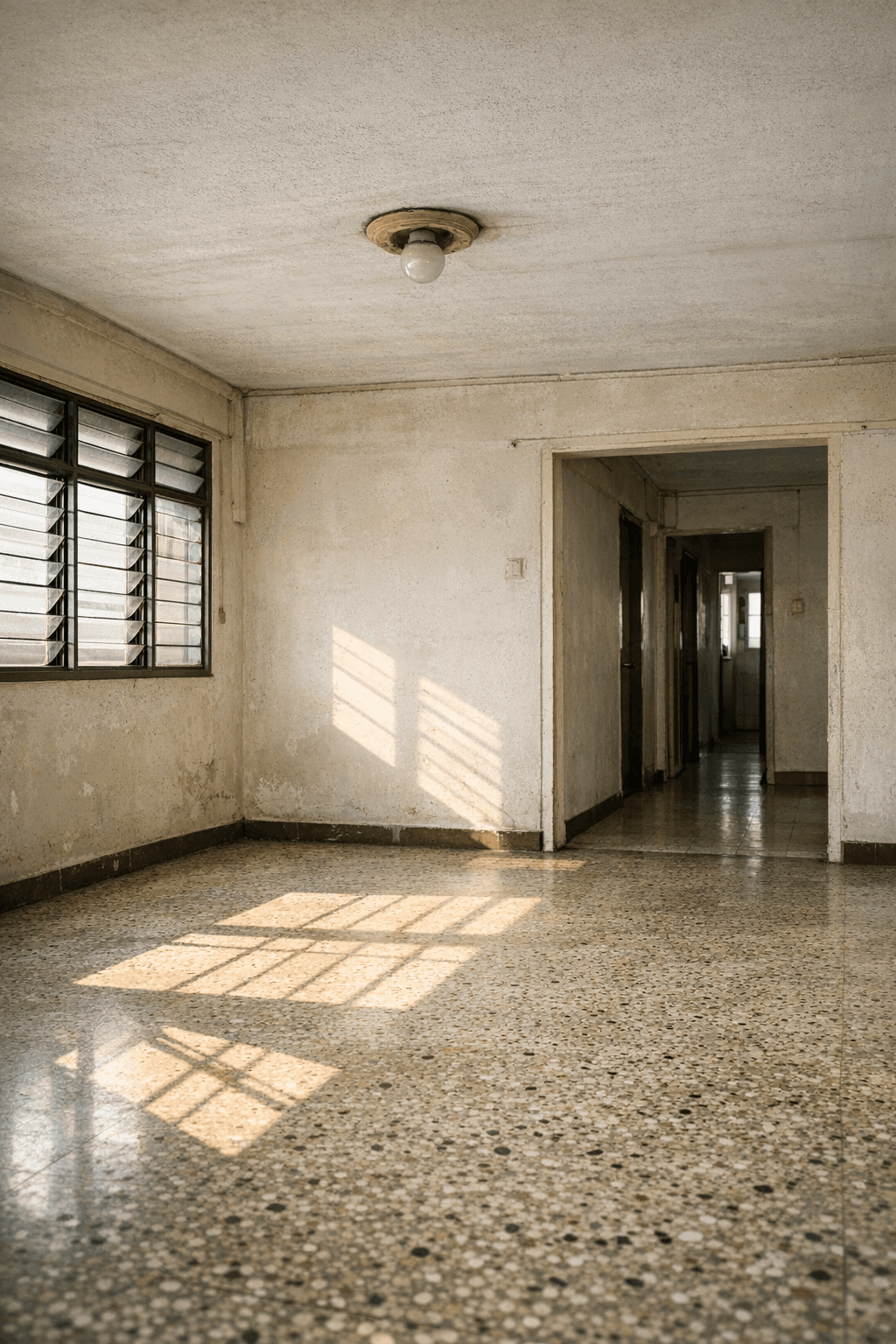
Then an agent talks them into seeing something older, on a street they had written off. Third floor of a block that went up before either of them was born. The lift lobby is tired. The corridor is wide in a way nothing built since is wide, and there is a mature tree outside the kitchen window that is taller than the block.
And the number is a hundred and fifty thousand dollars lower than everything else they have seen this month.
They talk about it all the way home. The lease, obviously. What happens at the end. Whether their parents will say something. But the arithmetic keeps pulling in one direction, and by the weekend they have made an offer.
Multiply that scene enough times and it shows up in the national statistics — which is exactly what has happened.
The claim, and whether it holds
It holds. Flats 40 and older went from 18.4% of resale volume in 2023 to 28.4% this year.
We took every HDB resale caveat we hold, computed each flat's age as the transaction year minus its lease commencement year, and bucketed the volume by age, year by year.
| Year | All resales | Under 10 yrs | 10–19 yrs | 20–29 yrs | 30–39 yrs | 40 yrs and older |
|---|---|---|---|---|---|---|
| 2023 | 25,754 | 27.4% | 8.6% | 21.3% | 24.2% | 18.4% |
| 2024 | 27,832 | 26.0% | 8.8% | 22.3% | 21.0% | 21.9% |
| 2025 | 25,086 | 21.8% | 12.8% | 21.4% | 16.8% | 27.2% |
| 2026 (YTD) | 14,337 | 19.0% | 15.8% | 19.8% | 17.0% | 28.4% |
The report is right. The 40-and-older band has gone from 18.4% to 28.4% in four years, and it is now the largest single band by a clear margin. Meanwhile the under-10 band has fallen from 27.4% to 19.0%.
That is a genuine, sizeable shift in what Singaporeans are buying, visible in four consecutive years of data. The 2026 figure is year-to-date and under-lodged, so treat it as a running picture rather than a settled full-year number — but the direction has been consistent for long enough that the trend is not a lodgement artefact.
Are buyers of older flats really getting more space?
No. At the median, the 40-plus band is the smallest of all five age bands.
This is where we part company with the explanation.
The reasoning offered is that with fewer large flats being built, buyers are prioritising affordability and space, and older flats deliver both. The Yishun example — a spacious 104 sqm four-room — is chosen to make exactly that point.
Here is what the median actually looks like across 39,423 resales lodged since January 2025:
| Flat age | Median price | Median $/sqft | Median size | Resales (n) |
|---|---|---|---|---|
| Under 10 years | $710k | $723 | 1,001 sqft | 8,181 |
| 10–19 years | $685k | $717 | 990 sqft | 5,485 |
| 20–29 years | $650k | $557 | 1,184 sqft | 8,216 |
| 30–39 years | $640k | $558 | 1,152 sqft | 6,660 |
| 40 years and older | $470k | $563 | 797 sqft | 10,881 |
The 40-and-older band has the smallest median size of any band — 797 sqft. The most spacious band is 20 to 29 years, at 1,184 sqft, nearly four hundred square feet larger.
That is not a subtle difference, and it makes sense once you think about what was built when. The generous, big-layout HDB stock is largely the 1990s and early-2000s cohort — now twenty to thirty-five years old. Go back past forty years and you are into a lot of three-room and smaller flats.
So the space story is real. It is just a story about 20-to-39-year-old flats, not about the 40-plus band that is actually gaining share. The Yishun flat in the report is a genuine bargain and a striking one — its $265,000 price is well below the $470k median for its band — but a 104 sqm four-room is not what the typical 40-plus resale looks like.
The lease discount is a step, not a slope
Price per square foot falls sharply at about twenty years, then barely moves for the next quarter-century.
Look down the $/sqft column again, because it is the most interesting thing in the table and nobody talks about it.
- Under 10 years: $723
- 10–19 years: $717
- 20–29 years: $557
- 30–39 years: $558
- 40 years and older: $563
There is one cliff, between the 10-to-19 band and the 20-to-29 band. After that the line is essentially flat — and the oldest band is fractionally higher per square foot than the two bands beneath it.
That is not what a lease-decay story predicts. If remaining lease were driving the market smoothly, per-square-foot values would step down at every band. They do not. What the data looks like instead is a newness premium — for a recently completed or recently-MOP flat, with modern layouts, current fittings and a long lease — that is worth roughly a hundred and sixty dollars a square foot, and that has fully evaporated by about the twenty-year mark.
After that, at the median, age stops being the thing setting the price.
The honest qualification: the oldest band sitting slightly higher is very likely mix, not strength. Its flats are smaller, and smaller flats carry higher per-square-foot values; it also contains more of the mature, central towns. We would not read $563 against $557 as older flats outperforming. We would read the whole right-hand side of that column as flat, which is surprising enough on its own.
So why is the old-flat share really rising?
Partly buyer choice, partly arithmetic — the stock itself is ageing, and more old flats are simply coming to market.
There are two mechanisms, and volume share cannot separate them.
The first is the one everyone reaches for: buyers changing their minds. That is clearly happening in part — a hundred and fifty thousand dollars is a persuasive argument, and cost pressure has been real.
The second is duller and probably larger. Singapore's HDB stock is ageing. A flat that was 38 in 2023 is 41 now. Every year, a cohort crosses into the 40-plus band and stays there, and the pool of flats that can be sold as 40-plus grows mechanically — no change in anyone's preferences required.
You can see the same effect further up the table. The 10-to-19 band nearly doubled its share, from 8.6% to 15.8%, over the same four years. Nobody is arguing that buyers suddenly developed a taste for fifteen-year-old flats. Those are the big BTO cohorts of the 2010s coming through their minimum occupation period and reaching the resale market.
When two bands rise, the others must fall, and the under-10 band's slide from 27.4% to 19.0% is the mirror image: fewer recently-MOP flats available relative to everything else.
So the fair reading is that both things are true, and the ageing of the stock is doing a lot of the work that gets attributed to changing taste.
The honest reality-check: what this data cannot tell you
Age bands mix flat types and towns, volume share is not demand, and none of this settles what happens at lease end.
Mix runs through every row. Age bands contain different flat types, towns and storeys. Older bands hold more three-room and smaller flats, so a lower median price there is partly size and mix, not only lease. That is exactly why we put the $/sqft column in — it is the more like-for-like comparison — and even that does not fully control for town.
Volume share is not demand. A rising share of older flats can mean buyers shifted, or simply that more old flats came to market as the stock aged. Our data cannot separate those two, and we have tried to say so rather than pick the flattering interpretation.
The current year is partial. 2026 is year-to-date and under-lodged. Its 28.4% is a running figure, not a full-year one.
Age here is measured from lease commencement, which is how remaining lease is computed — a 99-year flat that commenced in 1980 has roughly 53 years left. That is the right basis for this question, but it is not the same as the building's physical age or its last upgrading.
And nothing here answers the lease-end question. A flat with 50 years left and one with 30 both sit in our 40-plus band, and they are not the same asset. Financing rules, CPF usage limits and eventual lease expiry all tighten as the lease runs down, and the flat market's behaviour at the very short end is not something four years of aggregate volume share can tell you about. Prices are also gross — before any resale levy, commission or fees.
Is buying an older HDB flat a good idea?
It can be, but the case is about price and location — not about getting more space, which the data does not support.
It depends on which version of the argument convinced you.
If the case is price, the data supports it strongly. The 40-plus band's median is $470k against $710k for flats under ten years old. That gap is real money, and for a household that would otherwise stretch, it is the difference between comfortable and not.
If the case is space, the data does not support it. The 40-plus band has the smallest median size of any band at 797 sqft. If you specifically want a large flat, the evidence points at the 20-to-29-year band, which has the largest median size at 1,184 sqft and sits at essentially the same per-square-foot level.
And if the case is value per square foot, notice that you stop being paid for accepting age at around twenty years. Going from a 25-year-old flat to a 45-year-old one costs you two decades of remaining lease and, at the median, buys you nothing per square foot.
The genuinely strong position on this data is a 20-to-39-year-old flat: post-premium pricing, the largest layouts, and decades more lease than the band everyone is talking about.
Will an older flat be harder to sell later?
Our data cannot answer that, and anyone who tells you confidently either way is guessing.
We can tell you what has happened to volume and price levels over the last four years. We cannot tell you what a flat with 30 years of lease left will be worth in 2040, and neither can anyone else.
What this data does establish is narrower and still useful: at the median, the market currently prices a 45-year-old flat at about the same per-square-foot level as a 25-year-old one. That is evidence that buyers today are not applying a steep, smooth discount for age in the middle of the lease.
Whether that continues as those flats age further is a different question. The considerations that tighten as a lease runs down — CPF usage limits, loan tenure, the buyer pool that can finance it — are structural, and they bite hardest at the short end, beyond where most of the flats in our 40-plus band currently sit.
The practical version: for a flat you will live in for a decade or two, the price gap is a present-day certainty and the resale risk is a future uncertainty. Weigh them as such. For a flat bought principally to resell, the shorter the lease, the more you are relying on a forecast nobody can make.
How we sourced this
The claim and the two example flats come from The Straits Times; every age, share, price and size figure is ours.
The claim we tested — that demand for older flats remains high, that older flats now account for the largest proportion of total sales, and that buyers are prioritising affordability and space as fewer large flats are built — comes from The Straits Times, linked below, as do the two example transactions: the 104 sqm four-room in Yishun Street 22 at $265,000 in July 2026, and the 64 sqm three-room in Toa Payoh at $288,000. Those are the reporter's facts, attributed rather than claimed as ours.
Everything else is ours. We took our record of HDB resale caveats, computed each flat's age as the transaction year minus its lease commencement year, and produced the share of resale volume by age band for each of the last four years, plus median price, median price per square foot and median size by age band across the 39,423 resales lodged since January 2025.
The caveats are set out in full in the reality-check section above. The most load-bearing: age bands mix flat types, towns and storeys, so median price differences are partly mix; volume share cannot distinguish shifting demand from an ageing stock; and the current year is partial and under-lodged.
Sources
The report we tested, and our own HDB resale records.
The news:
- The Straits Times — Demand for older HDB flats remains high, 6 August 2026.
The data:
- PropKaki — HDB resale caveats, bucketed by flat age (transaction year minus lease commencement year): share of resale volume by age band 2023 to 2026 year-to-date, and median price, price per square foot and size by age band across 39,423 resales lodged since January 2025.
About this commentary
Opinion and analysis from the PropKaki Editorial Desk — not financial or property advice.
This is commentary by the PropKaki Editorial Desk on reporting by The Straits Times. The claim, the framing being tested and the two example transactions belong to that newsroom; the testing, the analysis and the opinions are ours.
We want to be fair about the disagreement. The report's central claim — that older flats are now the largest share of resales — is correct, and our own data confirms it independently. Our objection is narrower: the accompanying explanation about space does not hold at the median, and we think that matters, because a buyer who chooses an older flat expecting a larger one is likely to be disappointed by the typical listing.
This is opinion and general information, not financial, legal, tax or property advice. Remaining lease has significant consequences for financing, CPF usage and eventual value, and anyone buying an older flat should take that seriously and seek professional advice.
Published 12 August 2026.
Got a question this raised? Ask PropKaki.
Take any point from this analysis and apply it to your own project, budget or decision.
 PropKaki
For most buyers this year, staying well within budget beats trying to time the market.