

Do HDB Flats Make Money? Your Real Odds on an HDB Resale
73.3% of 4-room resales beat their purchase price — real, but well short of the "HDB always appreciates" belief, and short of the 85.3% for private homes.
Across 375,562 matched HDB 4-room resale pairs, 73.3% sold above the purchase price on a gross basis, with a median gain of 23.9% (about 4.4% a year). So most owners profited — but roughly one in four did not, and a full quarter gained just 0.4% or less, barely clearing cost before a single fee. That is lower than the 85.3% odds for private homes, so "HDB always appreciates" overstates it. Holding longer helped markedly (gain rose about 4.42% for each extra year held; hold-gain correlation 0.649). Every figure is gross — before agent commission, any HDB resale levy and legal fees — and covers 4-room flats islandwide, a representative slice, not a guarantee for your block.
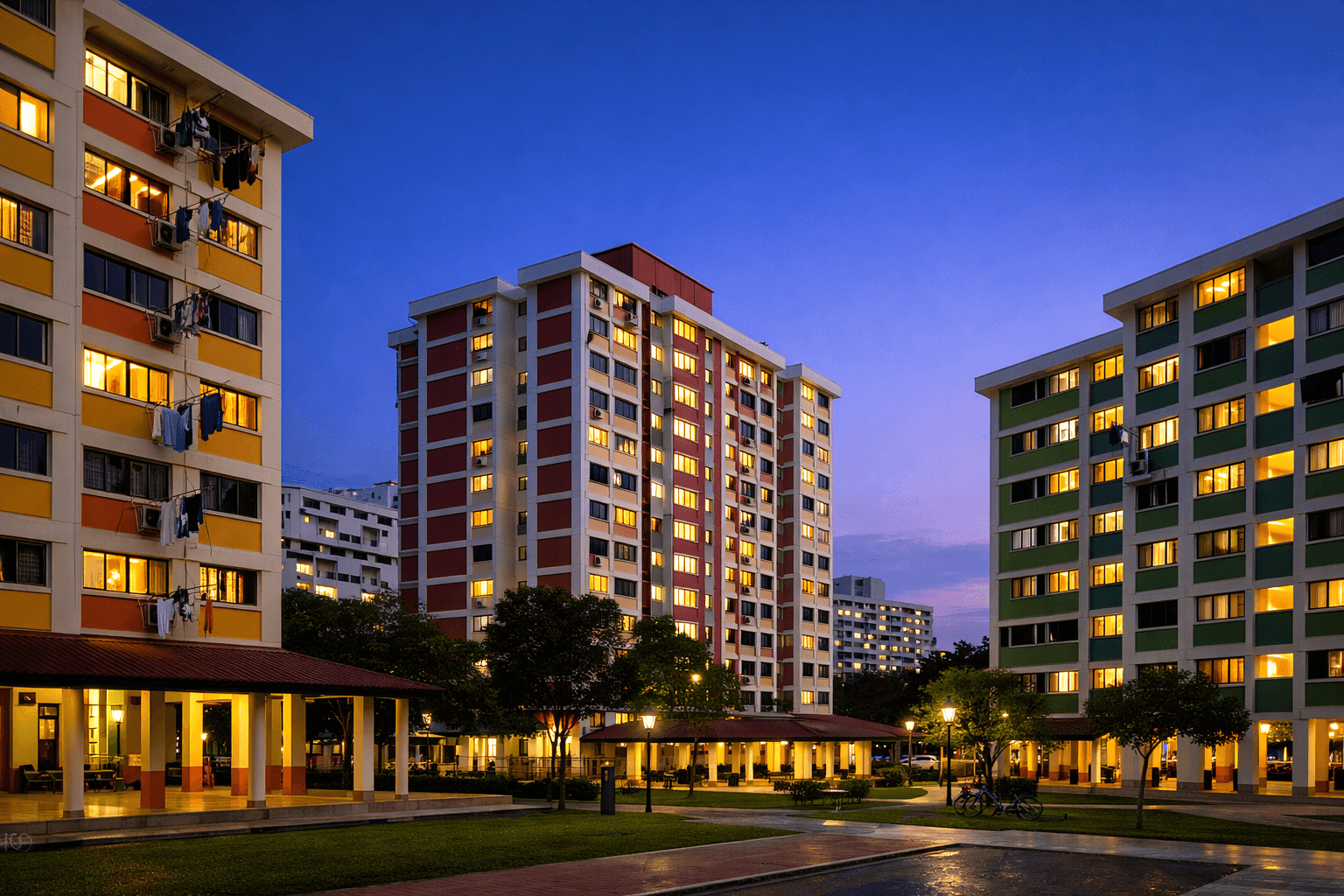
Almost everyone in Singapore grows up believing an HDB flat is a one-way bet: buy it, hold it, sell it for more. It's such settled wisdom that few people ever check it against the record.
So we did. PropKaki matched 375,562 HDB 4-room resale transactions into buy-and-sell pairs — the same flat bought, then later sold — and traced what actually happened to each one. The result is more honest than the folklore: 73.3% sold for more than the owner paid on a gross basis. That's a solid majority, and the typical winner was comfortably up (median +23.9%). But it also means roughly one in four resales did not beat the purchase price — a far cry from "always," and noticeably weaker than the 85.3% odds private homes posted in our private-property study. This guide gives you the real base rate for an HDB flat, where it holds, and where the belief quietly breaks.
Do HDB flats make money on resale in Singapore?
Usually, but less reliably than the folklore claims. Across 375,562 matched HDB 4-room resales, 73.3% sold above the purchase price, with a median gross gain of 23.9%. That's a healthy majority — but roughly one in four did not profit, and it trails the 85.3% odds for private homes.
Yes — more often than not, an HDB flat resold for more than the owner paid. But the honest number is smaller than the belief.
Across 375,562 matched HDB 4-room resale pairs — the same flat bought, then later sold — 73.3% sold for more than the purchase price, on a gross basis, with a median gain of 23.9%. So the typical seller didn't just break even; the middle of the pack was comfortably ahead. That is the reassuring half of the story, and it's real.
The half people skip is the other quarter. Roughly one in four resales — about 26.7% — did not beat the purchase price (again, gross, before any costs). "HDB always appreciates" rounds a 73.3% base rate up to 100%, and the gap between those two numbers is where owners get surprised. It's also lower than private housing: private resales profited 85.3% of the time in our matched-pairs study of private homes — about 12 percentage points more reliable than the 4-room HDB flat. So the folklore has the direction right and the confidence wrong.
Read the 73.3% as your starting point, not your verdict: it's the base rate for 4-room flats islandwide, and your specific flat, town and holding period move it. To pressure-test a specific flat's numbers, run it through the Profitability model.
What did we actually measure — and why matched pairs beat a price index?
Every figure comes from 375,562 HDB 4-room flats that were bought and then later sold — the same flat's real buy and sell price — not a resale price index or an average of different flats. Gains are gross, before commission, any resale levy and legal fees, and the scope is 4-room flats islandwide.
A number that pushes back on settled wisdom lives or dies on method, so here's exactly what sits behind every figure below.
- Matched pairs, not an index. We took HDB flats with a recorded purchase and a later sale and paired them, so we compare the same flat's buy price to its own sell price. HDB's own Resale Price Index tracks the market's average level over time; matched pairs instead ask "did this specific flat sell for more than it cost," which is the question an owner actually has.
- HDB resale only, not private. These are HDB resale transactions — not condos, not private. Private homes behave differently and have their own, higher base rate in the private-property study.
- Gross, not net. "Profit" here means the sale price beat the purchase price. It does not deduct agent commission, any HDB resale levy, or legal fees. That gap matters, and we return to it below.
- 4-room flats, islandwide. We scoped to 4-room flats — the most common flat type — as a large, representative slice. Other flat types (3-room, 5-room, executive) and specific towns can differ, so read this as the 4-room base rate, not every flat.
- 375,562 pairs. A pair needs a prior recorded purchase, so first-sale flats bought straight from HDB are under-represented — but the sample is enormous, so the patterns aren't a fluke of one town or one year.
The honest frame throughout: this is a base rate for the scope, not a guarantee for your block. Read every figure as "what usually happened to 4-room flats like this," not "what will happen to yours."
Isn't 73% profitable good enough to call HDB a safe bet?
It's good, not a sure thing. The typical winner gained a healthy 23.9% gross, but a quarter of resales gained just 0.4% or less — barely above breakeven before costs — while the stronger quarter gained 43.2% or more. Same flat type, very different outcomes.
The 73.3% is genuinely reassuring, and the median winner didn't just scrape through — the middle of the pack gained 23.9% gross. On paper, most 4-room owners made money.
The reason you can't stop there is the spread. A quarter of resales gained 0.4% or less — that is barely above the purchase price, effectively breakeven, and once you subtract costs a chunk of that weaker quarter turned into a real loss. Meanwhile the stronger quarter gained 43.2% or more. Two owners in the same flat type, the same decade, walked away with completely different outcomes — and the difference wasn't luck, it was mostly how long they held and when they bought.
So "73% profit" is the right place to start and the wrong place to finish. It tells you the flat is likely to clear its cost, not that it's guaranteed to, and it says nothing about which half of that spread you'll land in. A base rate tells you the odds; it doesn't tell you your outcome. That quiet quarter sitting at 0.4% is the single most overlooked fact about HDB resale — the flats that technically "profited" but never really got ahead.
How does HDB compare with private property on profit odds?
HDB 4-room flats profited 73.3% of the time; private homes profited 85.3% — about 12 percentage points more reliable. HDB's typical gain was also a touch lower (median +23.9% vs +25.8%). Private won on the odds, but it also costs far more to enter and carries costs HDB doesn't.
This is the comparison the folklore never makes, because it complicates the story.
| Scope | % profitable | Median gross gain |
|---|---|---|
| HDB 4-room flats | 73.3% | +23.9% |
| Private homes (all) | 85.3% | +25.8% |
HDB from 375,562 matched 4-room pairs; private from 267,641 matched private pairs. Both gross, before costs.
Read across the row and the pattern is clear: private resales profited 85.3% of the time versus 73.3% for the 4-room HDB flat — roughly 12 percentage points more likely to beat cost — and the private median gain was a shade higher too (+25.8% vs +23.9%). On the pure odds of clearing your purchase price, private property was the more reliable performer.
But "more reliable odds" is not the whole ledger, and this is where the comparison stays honest. Private entry prices are multiples of an HDB flat's, so you're risking far more capital for that extra reliability; private buyers and sellers can be hit with Additional Buyer's Stamp Duty going in and Seller's Stamp Duty going out — duties that first-time HDB buyers largely sidestep; and an HDB flat is somewhere you can live cheaply while it does its work. The takeaway isn't "private is better" — it's that HDB's edge was never a higher profit rate; it was a lower entry price and a lower-cost hold. If you want the six factors that moved the private odds, they're in the full private-property guide; to compare a specific HDB flat's numbers, use the Profitability model.
Does holding an HDB flat longer improve your odds of profit?
Yes, clearly. Holding period and gain moved together — a correlation of 0.649 — and each extra year held was associated with about 4.42% more gross gain. Time did the heavy lifting: the flats that gained most were, as a rule, the ones held longest.
If there's one lever that reliably moved an HDB resale into profit, it was time.
In the matched pairs, holding period and gain rose together with a correlation of 0.649 — strong, for messy real-world housing data — and each additional year held was associated with roughly 4.42% more gross gain. In plain terms: the longer a 4-room flat was owned, the more it tended to have gained by the time it sold, and the relationship was consistent enough that it wasn't just noise. The weaker, near-breakeven quarter of resales skewed heavily toward shorter holds; the flats up 40%-plus were, as a rule, the long-held ones.
There's a structural reason HDB rewards patience specifically. Every flat carries a 5-year Minimum Occupation Period (as of 2026 — verify with HDB) before you can sell at all, so your holding period starts at five years whether you like it or not. That floor tends to keep owners in past the early, low-gain window — and the data says that's where the gains accumulate. With an HDB flat, time in the flat did more for your return than trying to time the market. We cover the timing decision in full in should you sell your HDB after MOP or wait.
Profitable versus what? The gross-to-net reality check for HDB
Every figure here is gross. The median 4-room resale gained about 4.4% a year before costs — but agent commission, any HDB resale levy on a second subsidised flat, and legal fees all come out of that. Note it's the resale levy, not Seller's Stamp Duty — SSD is a private-property duty that doesn't apply to HDB.
There's a final adjustment that separates "made money" from "made a good investment," and for HDB the cost list is different from private property's — so it's worth getting right.
Every gain above is gross — the sale price beat the purchase price, full stop. Out of that headline number still come:
- Agent commission — if you use a property agent to sell (commonly around 2% plus GST, though it's negotiable).
- Any HDB resale levy — this is the HDB-specific one people forget. If you're selling a subsidised flat and buying another subsidised flat or EC, HDB charges a resale levy to level the subsidy (as of 2026 — verify with HDB). It doesn't apply to every sale, but when it does it takes a fixed sum straight off the top. The full mechanics are in the HDB resale levy guide.
- Legal and conveyancing fees.
Here's the trap worth flagging plainly: HDB owners do not pay Seller's Stamp Duty. SSD is a private-property duty — it does not apply to HDB flats, so don't budget for it and don't let a private-property article scare you with it. Your HDB cost stack is commission + any resale levy + legal, not SSD.
Now put the return in context. The median 4-room resale gained about 4.4% a year gross. That's a respectable rate — but after commission, any resale levy and legal fees, the net is meaningfully thinner, and for the weaker quarter that gained 0.4% or less, costs turned a nominal "profit" into a loss. None of this makes an HDB flat a bad buy — you lived in it, the entry price was subsidised, and the alternative was paying rent — but the honest question isn't only "did it profit," it's "did it profit enough to beat what the money and the effort could have done elsewhere." Work out where a specific flat lands after costs with the Profitability model.
So should you count on your HDB flat making money?
Count on it as a likelihood, not a certainty. 73.3% of 4-room resales profited, so the odds favour you — but a quarter barely cleared cost, holding through and past the MOP matters, and every figure is gross. Treat it as a home that usually appreciates, not a guaranteed investment.
Pulling it together: an HDB 4-room flat is more likely than not to resell above what you paid — 73.3% of them did — and the typical winner was comfortably ahead at +23.9% gross. If you buy sensibly and hold, the base rate is on your side. That's a genuinely reassuring foundation, and it's why the folklore exists.
But plan around the full distribution, not the headline. A quarter of resales gained 0.4% or less, near breakeven before costs; the flats that did best were the ones held longest (each extra year worth about 4.42% more gross); and every figure here is gross, before commission, any resale levy and legal fees. The flats that disappointed their owners weren't cursed — they were usually sold early, into a soft window, at a price that left little room once costs came out.
So the right posture is neither "HDB always goes up" nor "it's a gamble." It's this: an HDB flat is a home that usually appreciates — treat the appreciation as a likely bonus you help along by holding, not a payout you're owed. Read the base rate, respect the quiet quarter, hold with intent, and budget the costs before you celebrate the gain.
What's the biggest mistake people make about HDB resale profit?
Assuming an HDB flat always appreciates, and treating gross as net. Only 73.3% of 4-room resales profited, a quarter gained 0.4% or less, and costs eat into every figure. Read your flat by the odds and the holding period, not the folklore.
The biggest mistake is hearing "HDB always goes up" and quietly rounding a 73.3% base rate up to a personal guarantee.
Three corrections keep you honest. First, it's a likelihood, not a law — roughly one in four 4-room resales did not beat the purchase price, and a full quarter gained just 0.4% or less, barely clearing cost. Second, gross is not net — agent commission, any HDB resale levy and legal fees all come out of the headline gain, and for that weakest quarter they can erase it entirely. Third, time is the lever — the longer-held flats gained far more (about 4.42% per extra year, a 0.649 correlation), so selling early is exactly when the belief lets people down. Anchor on "HDB always appreciates" and you'll over-expect and under-budget; anchor on the real odds and the holding period, and the base rate becomes a tool instead of a promise.
Common questions about HDB resale profit in Singapore
HDB flats don't always go up, private homes profited more reliably, and there's no Seller's Stamp Duty on HDB — the details are below.
Do HDB flats always go up in value? No. Across 375,562 matched HDB 4-room resales, 73.3% sold above the purchase price — which means roughly one in four sold at or below cost, on a gross basis, before costs. A full quarter gained just 0.4% or less. "Usually" is accurate; "always" is not. The typical flat did gain a healthy 23.9%, but that's a median, not a promise.
Do HDB flats or private properties make money more reliably? Private, on the odds. Private homes profited 85.3% of the time versus 73.3% for 4-room HDB flats — about 12 percentage points more reliable — with a slightly higher median gain (+25.8% vs +23.9%). But private property costs far more to enter and can attract Seller's Stamp Duty and ABSD that first-time HDB buyers largely avoid, so higher odds came with higher stakes, not a free lunch.
Do I pay Seller's Stamp Duty when I sell my HDB flat? No — Seller's Stamp Duty is a private-property duty and does not apply to HDB flats. What can apply is the HDB resale levy, but only if you're selling a subsidised flat and buying another subsidised flat or EC; it doesn't apply to every sale. Your likely selling costs are agent commission, any resale levy, and legal fees (all as of 2026 — verify with HDB and IRAS).
Methodology and sources
Where every figure comes from — and what we deliberately did not claim.
What we counted. 375,562 matched HDB 4-room resale pairs — one flat with a recorded purchase and a later sale, so we compare the same flat's buy and sell price. Figures come from PropKaki's HDB resale data via the app's hdb_profitability_base_rate function — the same function the PropKaki app calls, reused here rather than re-derived. Headline figures: 73.3% profitable, median gross gain 23.9%, median annualized 4.4%, weaker-quarter gain (p25) 0.4%, stronger-quarter gain (p75) 43.2%, about 4.42% extra gross gain per additional year held, and a 0.649 correlation between holding period and gain. The private-property comparison figures (85.3% profitable, +25.8% median) come from our separate matched-pairs study of 267,641 private resale pairs.
What we did not claim. That any of these numbers is a forecast — they are historical base rates that move with the market. That gross equals net — every gain is before agent commission, any HDB resale levy and legal fees; there is no Seller's Stamp Duty on HDB. That this covers every flat — the scope is 4-room flats islandwide, a representative slice; other flat types and specific towns differ. That a base rate is a guarantee for a specific block or unit — it is not. We deliberately do not publish a profit-by-holding-period breakdown here: HDB matched pairs at the individual-year level thin out too far to report reliably against a sample this size, so we ground the holding-period point on the overall correlation and the per-year figure only, not a year-by-year table. Regulatory figures (the 5-year MOP, the HDB resale levy) are stated as of 2026 — verify with HDB. This is general information, not financial advice. To assess a specific flat, use the Profitability model.
Got a question this raised? Ask PropKaki.
Take any point from this analysis and apply it to your own project, budget or decision.
 PropKaki
For most buyers this year, staying well within budget beats trying to time the market.