

Why Most Singapore Property Videos Fail — and What the Top 1% Decide Before Recording
We analysed nearly 10,000 videos from 54 Singapore property channels. The uncomfortable finding: half get under 1,000 views, and the difference is almost never production quality. It is three decisions you make before the camera is on.
Across ~10,000 Singapore property videos, success was decided before recording, not by production quality. The three levers that mattered most: film an aspirational format (landed and luxury tours earn about 4x the median of HDB tours), put a real price in the title (roughly 17-18x the median views versus titles without one), and earn the first ten seconds. Curiosity-question titles and even the word MRT in the title did nothing.

Here is the uncomfortable truth in the data: of nearly 10,000 videos we analysed from 54 Singapore property channels, about half earned under 1,000 views, while the top 1% captured roughly a quarter of all views. Property video is a lottery.
But it is a riggable lottery. The winning videos were rarely better filmed than the losers — they made better decisions before recording. This piece argues that most agents optimise the wrong things, and shows, with the numbers, which few decisions actually move views.
Is property video on YouTube worth it, or is it a lottery?
It is a lottery — but a riggable one. Nearly half of Singapore property videos get under 1,000 views and the top 1% capture about a quarter of all views, yet the winners are not better filmed. They share a small set of decisions made before recording.
Property video looks like a lottery because, statistically, it is one. Across the nearly 10,000 videos we studied, about 49% earned under 1,000 views, the top 10% of videos captured around 70% of all views, and the top 1% alone captured roughly a quarter. Most uploads disappear.
That distribution is exactly why the usual advice — "just post consistently and improve your editing" — quietly fails most agents. Consistency without the right decisions means consistently talking to an empty room.
The central argument of this study is that the lottery is riggable, and not by production value. When we compared winners to the mass of low-view videos, the separators were not camera quality, drone shots, or edit polish. They were three decisions made before the camera turned on: the format you film, the title you give it, and how you spend the first ten seconds. The rest of this piece defends that claim with the numbers, and pushes back on the popular advice it contradicts.
You cannot out-edit a bad format-and-title decision — and you rarely need to out-edit anyone if you get those right.
Why is the title worth more than the camera for a property video?
Because the title is where the biggest, cheapest gains are. Videos with a real price in the title earned roughly 17-18x the median views of those without. Specific, concrete words won; hype words and curiosity questions did not.
If you only change one thing, change the title. It is free, it takes seconds, and it was the single strongest signal in the entire dataset. We checked every title for simple words and compared median views across the property videos.
| Title contains… | Median views WITH | Lift vs without |
|---|---|---|
| A price (e.g. $4.58M) | ~15,000 | ~18x |
| "tour" | ~8,400 | ~11x |
| A structured title with "|" | ~3,200 | ~8x |
| "freehold" / "terrace" / "bungalow" | ~8,000 | ~8x |
| "review" | ~6,500 | ~7x |
| "condo" | ~2,700 | ~3x |
| "luxury" (hype word) | ~3,100 | ~3x |
| "MRT" | ~1,080 | ~1x (nothing) |
Two arguments fall out of this. First, specificity beats hype. A real number, a real tenure ("freehold"), a real house type ("terrace", "bungalow") all multiplied views 8x or more. Vague intensifiers barely moved the needle — "luxury" managed 3x, "rare" 3.3x, an exclamation mark just 1.8x. The market rewards information, not adjectives.
Second, and more provocatively: the advice to use curiosity questions is wrong here. In our data, question-style titles ("why…", "should you…") performed slightly worse than titles without them. And "MRT" — the feature agents assume sells — added nothing in a title. A title's job in Singapore property is to make a concrete promise, not to tease.
A formula that matches the winners: [specific place or project] + [price or size] + [one concrete feature] — "Freehold Inter-Terrace at Serangoon Gardens | $3.99M | Renovated."
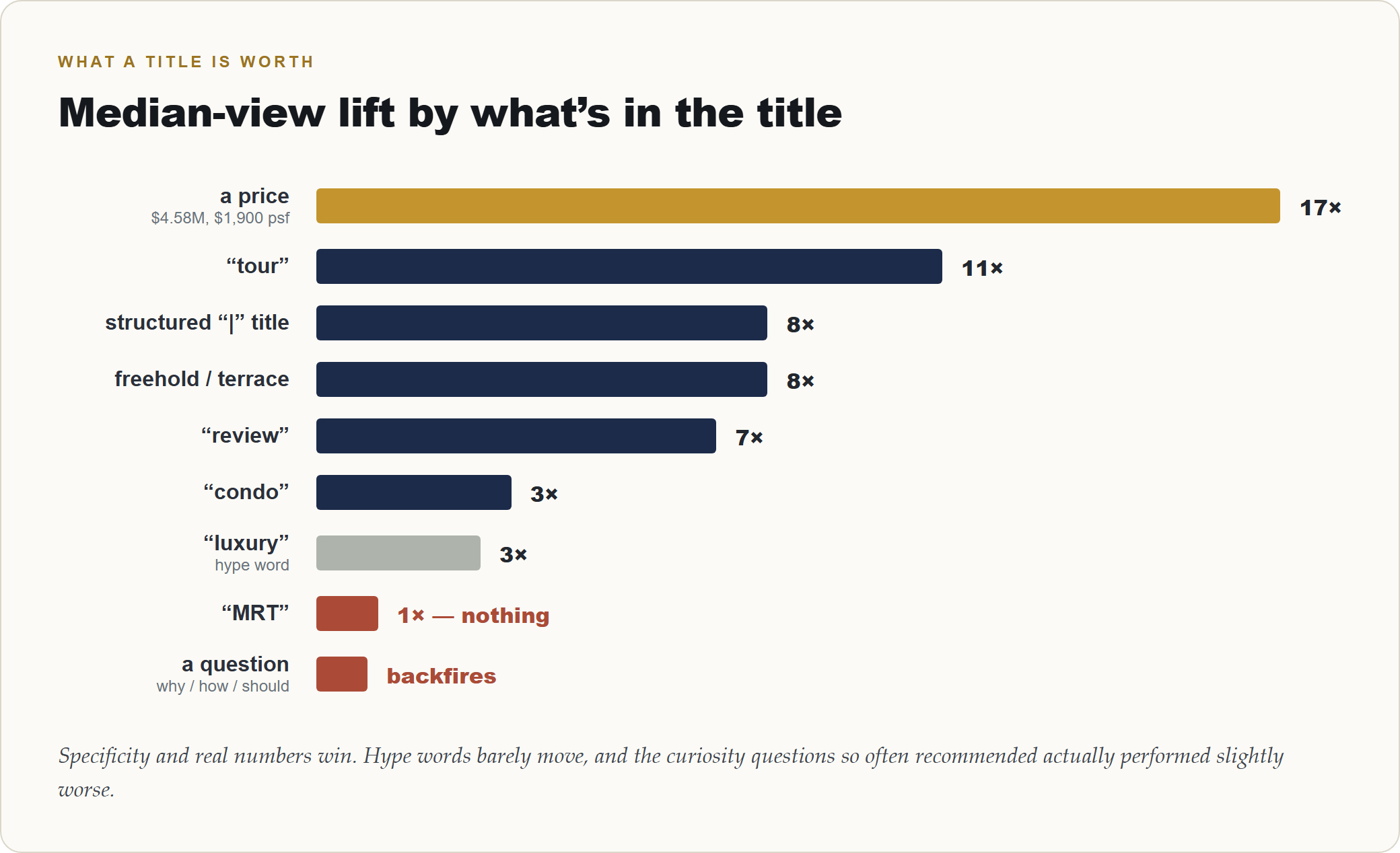
Median-view lift by title element across ~8,900 property videos. A real price multiplies views ~17x; hype words barely move, and questions and “MRT” add nothing.
Your title should read like a listing headline, not a thumbnail dare.
Which format should you film — and does it matter if you can't sell those homes?
Format sets your ceiling. Luxury and landed tours earned about 4x the median views of HDB tours, so film aspiration even if your business is mass-market — a Good Class Bungalow tour is content marketing, not a listing.
The format decision quietly caps everything else. When we grouped videos by what they actually were, landed and luxury tours earned a median of ~7,000 views versus ~1,700 for HDB tours — about a 4.2x aspiration premium — while making up only about a tenth of videos but a quarter of all views.
The obvious objection: "But I work HDB and mass-market condos. I can't tour bungalows." Two responses. First, your bread-and-butter tours are still the reliable engine — condo and HDB tours are where steady, if smaller, views come from, and they map directly to the clients you actually serve. Second, and more importantly: an aspirational tour is content marketing, not a listing. You are not filming the $30M bungalow because a viewer will buy it; you are filming it because it earns the reach that makes people discover you. Agents who only ever film their own modest listings put a low ceiling on their own channel.
The strategic read: pick a reliable format for volume (your real listings) and an aspirational format for reach (the best homes you can get access to, co-broke tours, or high-floor stacks with a view). Do not confuse the two jobs. For where video sits in the wider mix, see the property agent marketing pillar.
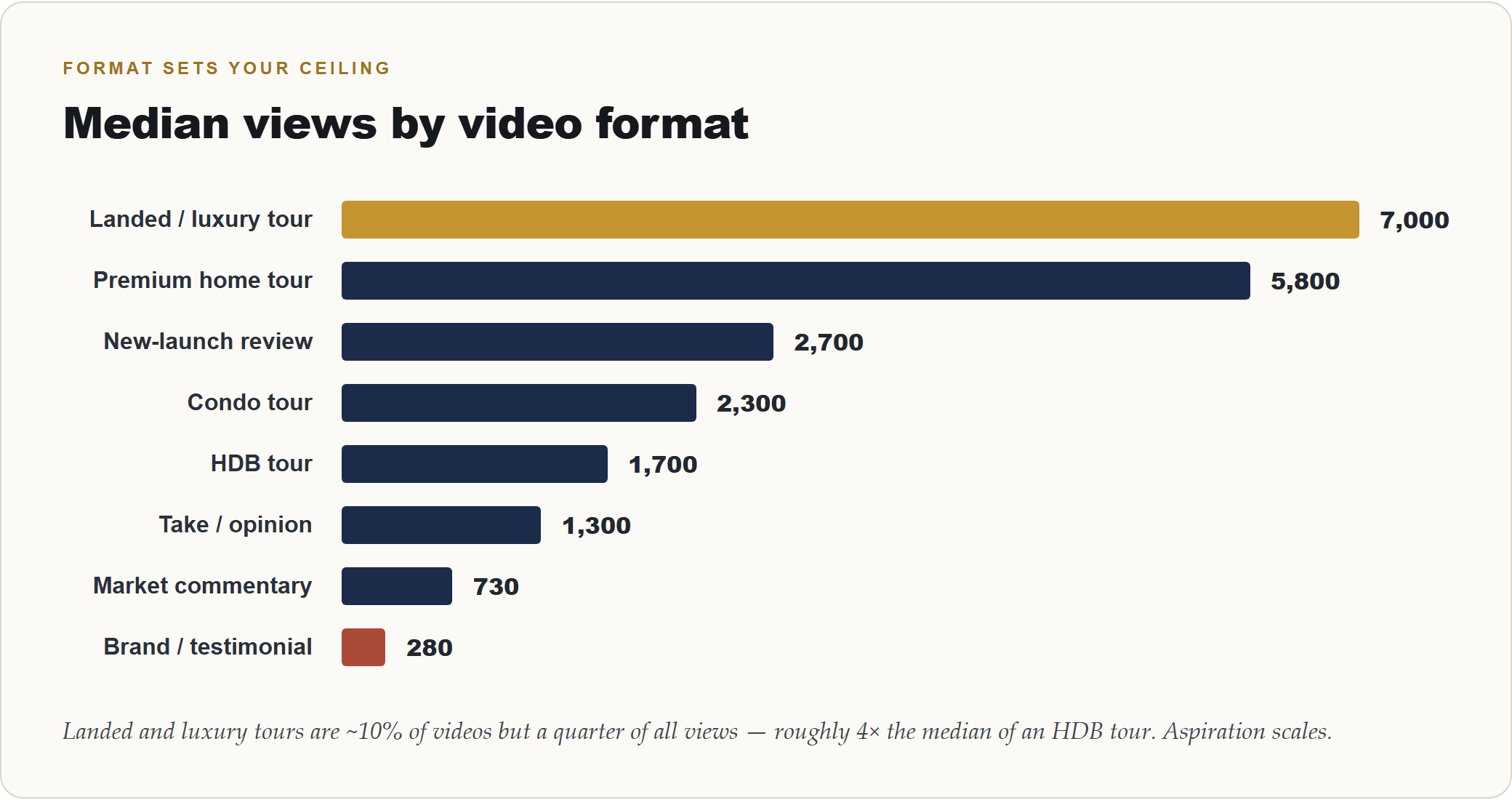
Median views by format. Landed and luxury tours are ~10% of videos but a quarter of all views; brand and testimonial videos trail badly.
Film the home that earns attention, then convert the attention on the homes you actually sell.
Is short-form really the answer for property videos?
No — for property, depth outperforms brevity. Videos under three minutes had a median of about 250 views; ten-to-twenty-minute videos had a median of about 12,400. Sub-three-minute clips are where property views go to die.
This is where we have to argue with popular advice — and, honestly, with an earlier version of our own. "Keep it short" is close to gospel in agent-marketing circles. The data on property video says the opposite.
| Video length | Median views |
|---|---|
| Under 3 min | ~250 |
| 3–6 min | ~1,300 |
| 6–10 min | ~4,200 |
| 10–20 min | ~12,400 |
| 20 min+ | ~2,200 |
Median views climbed steadily with length up to the 10–20 minute band, then fell off past 20 minutes. The sub-three-minute clips — the format short-form advocates push hardest — were the worst performers in the entire study.
The honest nuance: this is partly what gets made at each length. Short clips are often throwaway teasers and flythroughs; the 10–20 minute videos are substantial reviews, analytical breakdowns, and full luxury tours from established channels. Length is a proxy for seriousness. But that is the point — on YouTube, substance is the product. A viewer searching "5-room HDB tour" or a project name wants a proper walk-through, not a 45-second tease.
Where does short-form fit, then? As a discovery layer that points back to the substantial video — not as the main event. If you only make 60-second clips, the data says you are competing in the lowest-view tier there is. For the short-form side specifically, see what a property agent should post each week.
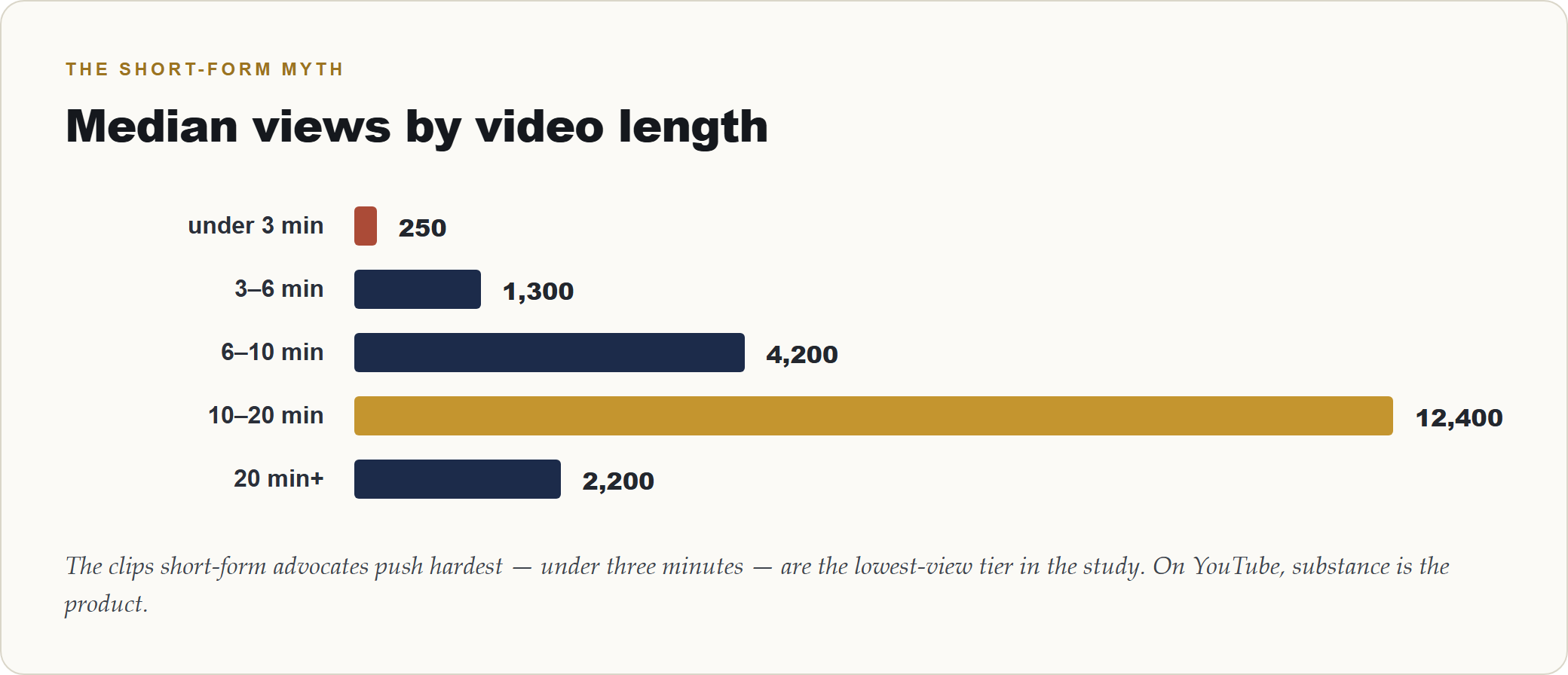
Median views by length. Views climb steadily to the 10–20 minute band; the sub-three-minute clips short-form advocates push are the lowest-view tier.
On YouTube, brevity is not a virtue — shallowness is the enemy.
Should you chase views or loyalty? The two games agents can play.
They are different games. Tours win reach but are feast-or-famine; opinion and market videos win engagement and consistency. If you want predictable results, the audience-builder's game beats the tour lottery.
Not all views are equal, and not all channels are playing the same game. Two patterns in the data make this concrete.
First, engagement. Measured as likes per thousand views, commentary out-earned tours: market videos drew about 8.1 and opinion/take videos about 4.9, versus roughly 3.8 for condo tours. Tours get watched; takes get felt. One buys reach, the other builds a relationship.
Second, and more strategically important, consistency. Compare two strong channels. Savvy Eric Chiew, who makes opinion and review content, has a median of about 24,600 views with only a ~5x gap between his median and his best video — nearly every upload lands. JNA Real Estate, a tour channel, has a lower median (~2,700) but a single 841,000-view hit — a ~300x gap between median and max. That is feast-or-famine.
So the argument: tours are a reach lottery; commentary and market analysis are a relationship annuity. The tour channel prays for the occasional viral home; the opinion channel banks reliable, engaged views every week and compounds an audience that remembers who they are. Neither is wrong — but most agents drift into the tour lottery by default without realising the annuity game is more predictable and, over time, more defensible. If discovery and trust are your goal, building a recognisable point of view beats hoping a listing goes viral.
A viral tour is a lucky day; a loyal audience is a business.
Do "why hire me" and testimonial videos actually work?
For almost everyone, no. About 72% of brand and testimonial videos got under 1,000 views, and the rare hits all belonged to already-famous names. Brand content is a reward for attention you already have, not a way to earn it.
This is the trap the data is most emphatic about. Pure brand and testimonial content — "why choose me", "our story", "meet the team" — had the lowest median views of any format (about 280), and roughly 72% of these videos got under 1,000 views.
The counter-argument writes itself: "But PropertyLimBrothers' brand films have hundreds of thousands of views." Exactly — and that is the point. Every brand-content outlier in our dataset belonged to a name that was already famous: PropertyLimBrothers, Savills, PropNex. Their brand videos work because the audience already exists. The average brand video, made by an agent nobody is searching for yet, is a speech to an empty room.
The argument, then: brand content is a lagging reward for attention, not a leading way to earn it. You do not build an audience by talking about yourself; you build it by being useful — tours, honest analysis, market explainers — and let the brand accrue as a by-product. Once people already watch you, a well-made "how we work" video converts. Before that, it mostly counts views you never had.
The practical exception: a short, specific proof clip (a real client outcome, a genuinely distinctive process) can support a listing or a landing page, where the viewer already has intent. That is different from expecting brand content to discover new people for you. Related: how to ask clients for testimonials covers gathering that proof for the places it actually helps.
Usefulness earns the audience; brand content only cashes it in.
What should the first ten seconds — and the body — of the video do?
Open with the payoff, not an intro. Among top performers, videos that opened with a strong hook earned many times more views, and tours that actually covered schools and MRT inside the video earned about 2.6x more — even though putting MRT in the title did nothing.
Once format and title are right, the video itself has two jobs: earn the first ten seconds, then deliver real substance.
On the hook: among the top-performing videos we transcribed, those that opened with a direct hook — a price, a bold claim, or a clear "here's what you'll see" — had a median of about 13,500 views versus about 1,200 for those that did not, and tours that opened by stating the price ran even higher. Almost none of the winners opened with a channel-intro animation or "hi guys, don't forget to subscribe." The value came first. The right hook depends on format: lead with the number for luxury, the selling points for HDB and condo, a contrarian claim for opinion pieces, and urgency for new-launch reviews.
On the body, one finding is delightfully counter-intuitive. Tours whose transcripts actually discussed schools and MRT connectivity earned about 2.6x the views of tours that skipped them — yet, from the title analysis, putting "MRT" in the title added nothing. The lesson is precise: do not spend title space on transport; spend video time on it. Buyers care about schools and connectivity deeply, but they want it delivered as substance inside the tour, not dangled as a title tease.
The repeatable tour arc behind the winners: a cold-open hook in the first ten seconds, a quick project-facts block, a room-by-room walk-through, a genuine schools-and-MRT section, then a recap and a single soft call to action — "DM for a viewing" — with a consistent sign-off. Runtime of roughly 6–8 minutes for tours; longer for analytical content, per the length data above.
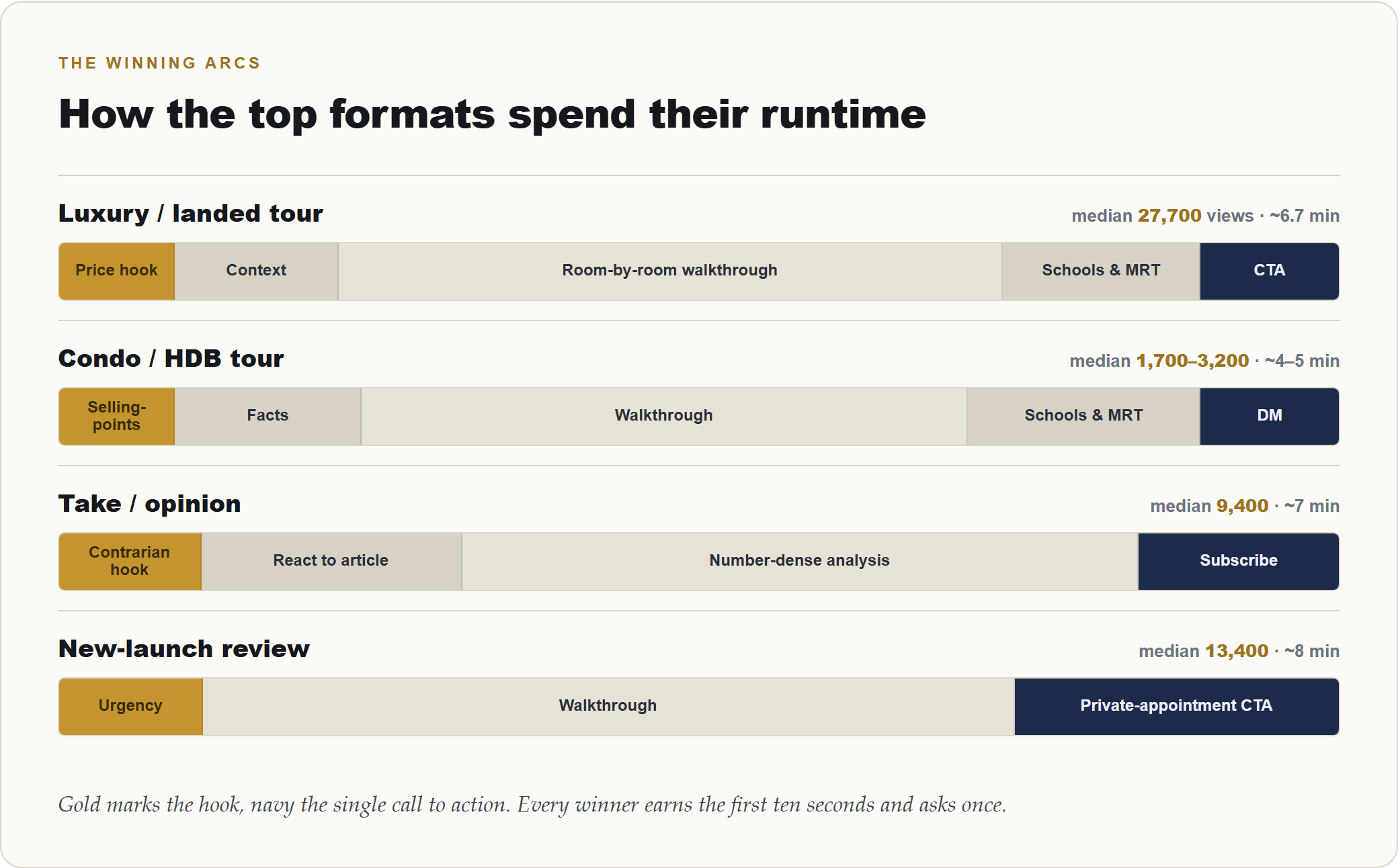
How each winning format spends its runtime. Gold marks the hook; navy the single call to action.
Promise concretely in the title, then over-deliver on the substance buyers actually weigh.
How was this analysed, and where could the argument be wrong?
We analysed nearly 10,000 videos from 54 Singapore channels by public view count and read the transcripts of the 700+ top performers. It is correlational and a snapshot, so treat it as strong direction to test, not proof.
In the interest of not overselling: this is observational data, and a good argument states its own weaknesses.
- It is correlational, not causal. A price in the title correlating with 17x the views does not prove the price caused them — bigger channels and better homes also tend to have specific titles. But the effect is large, consistent across formats, and free to act on, so it is a low-risk thing to copy.
- Length is confounded with content. The 10–20 minute videos that top the view charts are disproportionately serious reviews and luxury tours; length is partly a proxy for substance. The takeaway ("don't default to sub-three-minute clips") still holds.
- It is a July 2026 snapshot of public view counts, so older videos have had longer to accumulate. Formats were auto-classified from titles, so a minority may be mislabelled, and non-English videos were harder to include.
- Views are not leads. A viral tour is discovery, not a closed deal. These patterns win attention; your follow-up and service convert it.
Read the whole thing as a well-evidenced starting hypothesis for your own channel, not a guarantee.
What is the evidence-based checklist for your next property video?
Decide format and title before you film, open with the payoff, go deep rather than short, and pick reach or loyalty on purpose.
- ✓Decide the format first — an aspirational tour for reach, or your real listing for relevance — because format sets your ceiling
- ✓Put a concrete price, size, or exact project or street in the title; a price alone is worth roughly 17-18x the views
- ✓Write a declarative, specific title — skip curiosity questions and hype words like "luxury" and "rare"; they add little
- ✓Do not waste title space on "MRT" — it does nothing there
- ✓Open in the first ten seconds with the payoff (the price or the top selling points) and cut every channel intro
- ✓Go deep, not short — aim for a substantial 6–10+ minute video; sub-three-minute clips are the lowest-view tier there is
- ✓Cover schools and MRT connectivity inside the video — it earns about 2.6x the views when you actually discuss it
- ✓Use one soft call to action at the end, not five stacked asks
- ✓Choose your game deliberately: tours for reach (feast-or-famine), or opinion and market content for engagement and consistency
- ✓Skip "why hire me" brand videos until you already have an audience; earn attention with usefulness first
- ✓Expect a hit-driven pattern — half of videos underperform, so keep publishing and let the winners compound
Got a question this raised? Ask PropKaki.
Take any point from this analysis and apply it to your own project, budget or decision.
 PropKaki
For most buyers this year, staying well within budget beats trying to time the market.