
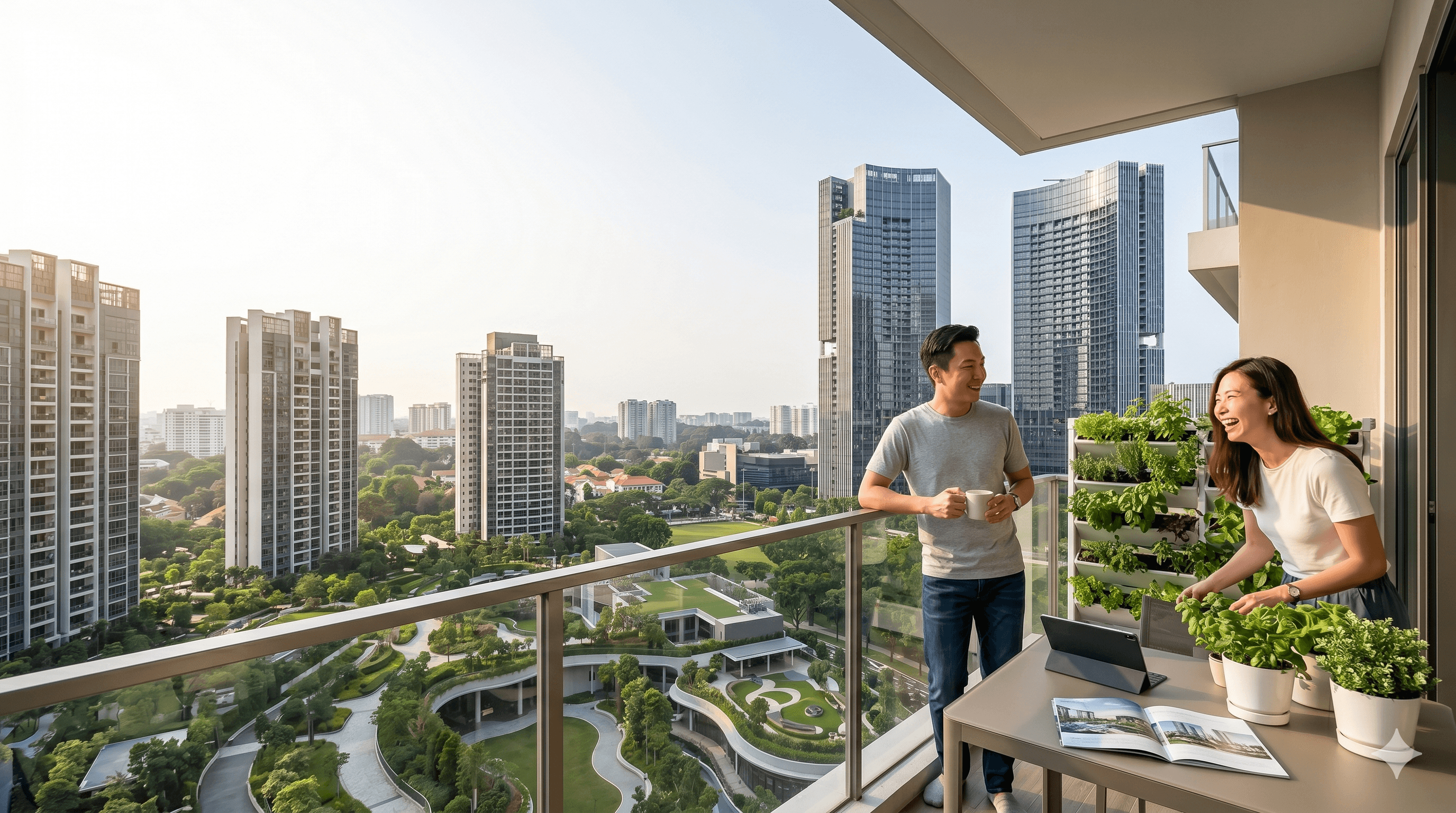
How to Calculate Your Monthly Home Loan Repayment in Singapore
What sets your instalment — loan, rate and tenure — how much of each payment is interest, and why the bank sizes you at 4%.
Your monthly home loan repayment in Singapore depends on the loan amount, the interest rate, and the tenure. A $1,000,000 loan over 25 years costs about $5,278 a month at 4%, or $4,537 at the 2.6% HDB rate. Early on, most of each payment is interest — about $3,333 of that first $5,278 — and the split shifts to principal over time. Banks size your maximum loan on a 4% stress rate even if your actual rate is lower.

A home loan repayment is not a percentage of the price — it is the result of an amortisation formula that spreads the loan, plus interest, evenly across the tenure.
This guide shows you how the monthly figure is calculated, how much of each payment is interest versus principal, and how rate and tenure change the number.
How do you calculate your monthly home loan repayment in Singapore?
The instalment depends on three inputs: the loan amount, the interest rate, and the tenure. A $1m loan over 25 years is about $5,278 a month at 4%, or $4,537 at the 2.6% HDB rate.
Your repayment is not a share of the price — it is an amortising instalment that repays the loan plus interest in equal monthly amounts over the tenure. Three inputs set it:
- Loan amount — how much you borrow (up to 75% of the property's value if you have no other housing loan).
- Interest rate — the HDB rate is 2.6%. A bank rate is fixed for a lock-in period, or pegged to a benchmark plus the bank's spread. A common benchmark, MAS's 3-month compounded SORA, was 1.22% as published on 23 September 2026 (MAS); the spread comes on top.
- Tenure — up to 25 years for an HDB loan. A bank loan can run to 30 years on an HDB flat or 35 on a private home, but the 75% limit applies only up to 25 and 30 years respectively and not past age 65; beyond that, it is 55%.
For a $1,000,000 loan, the monthly instalment works out as:
| Tenure | 2.6% (the HDB rate) | 3% | 4% (the bank stress-test rate) |
|---|---|---|---|
| 25 years | $4,537 | $4,742 | $5,278 |
| 30 years (bank loans only) | $4,003 | $4,216 | $4,774 |
A longer tenure lowers the monthly figure but costs more interest overall. Work out the instalment for your own loan, rate and tenure on the Property Financial Planner.
Rates as of 2026 — verify with MAS, HDB and your bank. Figures are illustrative, not personalised advice.
What actually determines the size of the repayment?
Loan, rate and tenure — in that order of impact. Doubling the loan doubles the instalment; a higher rate or shorter tenure both raise it.
The instalment moves with three levers, and it helps to know which matters most:
- Loan amount has a direct, proportional effect. A $500,000 loan costs exactly half the instalment of a $1,000,000 loan on the same terms.
- Interest rate raises both the instalment and the total interest. The gap between the 2.6% HDB rate and 4% is about $742 a month on a $1m, 25-year loan.
- Tenure trades monthly comfort for total cost. Stretching from 25 to 30 years drops the monthly figure but adds years of interest.
The formula behind it is standard amortisation: the loan is divided into equal payments where the interest portion is charged on the outstanding balance each month, so it starts high and falls as the balance shrinks.
Worked example: the repayment on a $1,000,000 loan
At 4% over 25 years, the instalment is about $5,278 a month. Over the full term you repay roughly $1.58m — about $584,000 of it interest.
Take a $1,000,000 loan at 4% over 25 years. The monthly instalment is about $5,278.
Two numbers put that in perspective:
- The first payment is mostly interest. In month one, about $3,333 of the $5,278 is interest (4% a year on $1,000,000, divided by 12), and only $1,945 repays the loan itself.
- The total interest is large. Over 300 payments you pay about $1,583,500 in all — so roughly $584,000 is interest, more than half the loan again.
Drop the rate to the 2.6% HDB rate and the same loan costs about $4,537 a month — around $742 less — and far less total interest. This is why the rate, not just the loan size, decides what the home really costs.
How much of each payment is interest, and how much is principal?
At a 4% rate, most of each early payment is interest and it flips to principal about eight years in; at the 2.6% HDB rate, principal is the larger part from the start. On a $1m loan at 4%, the first payment is about $3,333 interest and $1,945 principal.
Every instalment is split between interest (charged on the outstanding balance) and principal (which reduces the balance). Because the balance is highest at the start, so is the interest portion.
On a $1,000,000 loan at 4% over 25 years:
- Month 1: about $3,333 interest, $1,945 principal.
- About eight years in (month 93): the two portions cross over. At the 2.6% HDB rate, principal is the larger part from the very first payment.
- Final years: almost the entire payment is principal.
This is why paying down or refinancing early saves the most interest — you are attacking the balance while the interest portion is still large. It is also why the first few years of a loan barely dent the amount you owe.
HDB loan or bank loan — how does the rate change the repayment?
The HDB concessionary rate is 2.6% a year (pegged 0.1% above the CPF Ordinary Account rate and reviewed quarterly); a bank rate is fixed for a lock-in period or set at a benchmark plus the bank's spread (MAS's 3-month compounded SORA was 1.22% as published on 23 September 2026). On a $1m, 25-year loan, 2.6% against 4%, the stress-test floor, is about $742 a month.
The two loan types price very differently:
- HDB concessionary loan — a rate of 2.6% a year, pegged 0.1% above the CPF Ordinary Account rate and reviewed quarterly. Stable and predictable, available only for HDB flats.
- Bank loan — available for HDB flats and private property, at a fixed rate for a lock-in period or a floating rate pegged to a benchmark plus the bank's spread. A common benchmark is MAS's 3-month compounded SORA, which was 1.22% as published on 23 September 2026 (MAS). A SORA-pegged package charges that plus the spread in its offer, so it moves with SORA; a fixed rate can change when its lock-in ends. PropKaki does not track bank packages, so get the rate and spread from the bank.
On a $1m, 25-year loan, the HDB rate costs about $4,537 a month versus about $5,278 at 4% — a difference of roughly $742 a month, or nearly $9,000 a year. 4% is the stress-test floor, not a bank's quote; a package priced below it narrows the gap. Whether to take the HDB loan or a bank loan is a trade-off between that stability and a potentially lower floating rate — see fixed vs floating home loan rates.
Why does the bank size your loan at 4% when my rate is lower?
Because of the TDSR stress test: banks compute your maximum loan at a 4% floor, not your actual rate, so you can still afford it if rates rise.
When a bank decides how much it will lend you, it does not use the rate you are quoted — it uses a 4% stress-test floor. Your actual instalment follows your actual rate, but your borrowing limit is calculated as if the rate were 4%.
That protects you from a rate rise, and it has a practical consequence: a low headline rate does not let you borrow more. Two bank borrowers quoted 3% and 4% with the same income get the same maximum loan, because both are assessed at 4%. HDB loans have their own floor: HDB works out how much you can borrow at the higher of 3.0% or the HDB rate, so a 2.6% HDB loan is sized as if the rate were 3.0% (HDB).
So there are two different numbers to keep straight: the instalment you pay (at your real rate) and the instalment the bank tests (at 4%). Plan around the higher one. More on this: the TDSR stress-test rate and how to calculate TDSR.
What is the monthly repayment on a $500k, $1m or $1.5m loan?
At 4% over 25 years, roughly $2,639 a month on a $500k loan, $5,278 on $1m, and $7,918 on $1.5m. At the 2.6% HDB rate, each is lower.
Because the instalment is proportional to the loan, you can scale it. At a 4% rate over 25 years:
| Loan amount | Monthly at 2.6% | Monthly at 4% |
|---|---|---|
| $500,000 | $2,268 | $2,639 |
| $1,000,000 | $4,537 | $5,278 |
| $1,500,000 | $6,805 | $7,918 |
Stretch the tenure to 30 years and each figure drops (a $1m loan at 4% falls to about $4,774), but you pay more interest overall. For your exact loan, rate and tenure, use the Property Financial Planner.
What is loan amortisation, and what does the schedule look like?
Amortisation (amortization in US spelling) is repaying a loan in equal monthly instalments that each cover that month's interest plus some principal, until the balance reaches zero. On a $1m loan at 4% over 25 years, year 1 pays about $39,567 of interest and $23,773 of principal; by year 20 it is $12,571 and $50,769.
Each monthly loan instalment stays the same, but what it pays for changes. The interest part is charged on the balance still owed at the start of the month (HDB's own formula is the outstanding balance times the annual rate divided by 12), and whatever is left of the instalment repays principal. As the balance falls, so does the interest, and more of each payment goes to principal.
On a $1,000,000 loan at 4% over 25 years ($5,278 a month):
| Year | Interest paid that year | Principal repaid that year | Balance at year end |
|---|---|---|---|
| 1 | $39,567 | $23,773 | $976,227 |
| 5 | $35,450 | $27,891 | $871,046 |
| 10 | $29,286 | $34,054 | $713,594 |
| 15 | $21,760 | $41,580 | $521,345 |
| 20 | $12,571 | $50,769 | $286,610 |
| 25 | $1,351 | $61,989 | $0 |
After 10 years you still owe about 71% of the loan, which is why early prepayment or refinancing saves the most interest. For your own schedule, use the Property Financial Planner.
How much is the monthly repayment on an HDB loan?
At the 2.6% HDB rate over 25 years, about $1,361 a month on a $300,000 loan, $1,815 on $400,000 and $2,268 on $500,000. An HDB loan covers up to 75% of the price and runs for at most 25 years, less if you are older or the lease is short.
The HDB concessionary rate is pegged 0.1% above the CPF Ordinary Account rate and reviewed quarterly; it was 2.60% a year from April to September 2026 (HDB). Over 25 years at 2.6%:
| HDB loan | Monthly repayment | Total interest over 25 years |
|---|---|---|
| $300,000 | $1,361 | about $108,300 |
| $400,000 | $1,815 | about $144,400 |
| $500,000 | $2,268 | about $180,500 |
Three HDB rules decide the loan itself (HDB):
- Loan-to-value: up to 75% of the price for a new flat, or of the lower of the price or value for a resale flat, where the lease covers the youngest buyer to age 95.
- Loan period: the shortest of 25 years, 65 minus the buyers' average age, or the remaining lease minus 20 years. A shorter period means a bigger instalment.
- Assessment rate: HDB works out how much you can borrow at the higher of a 3.0% floor or the HDB rate, so the loan you qualify for is sized as if the rate were 3.0%.
For your own numbers, run the Property Financial Planner; for the 30% income cap that applies to HDB loans, see how MSR works for an HDB loan.
The biggest repayment mistake buyers make
Budgeting around today's low promotional rate instead of the 4% the bank stress-tests at — then feeling the squeeze when the lock-in ends and the rate resets.
The most common repayment mistake is budgeting around the teaser rate.
Two habits cause trouble:
- Planning on the promo rate. A low fixed rate often lasts only 2–3 years. Budget on the rate you would pay after it resets, not the introductory one.
- Ignoring the stress figure. The bank already assumes 4%. If the instalment at 4% would strain you, you are borrowing at the edge — regardless of today's rate.
A safe habit: work out the instalment at 4%, confirm you are comfortable there, and treat any lower rate as a bonus rather than the plan. And diarise your lock-in expiry so you can refinance or reprice before the rate jumps.
Official sources
Go straight to the authorities for the current rules and figures — they change.
Methodology and sources
Where every figure comes from — and what we deliberately did not claim.
Regulatory figures. The HDB concessionary loan rate (2.60% for April to September 2026), HDB's 25-year loan cap and 3.0% assessment floor, the 4% TDSR stress-test floor, and MAS's 30-year (HDB flat) and 35-year (private) bank-loan caps with the 75%/55% loan-to-value bands are from HDB and the Monetary Authority of Singapore, read on 19 September 2026. All are current as of 2026 — verify the live figure on MAS, CPF or HDB, and confirm your actual rate with your bank.
Worked examples. Instalments are computed with the standard amortisation formula (equal monthly payments, interest charged on the reducing balance) — the same method as the PropKaki Property Financial Planner. The 4% column is MAS's stress-test floor, used as a round illustration, not a bank's quoted rate: PropKaki tracks no bank packages. The benchmark is MAS's 3-month compounded SORA, 1.2200% as published on 23 September 2026 in MAS's Domestic Interest Rates table, read that day; a SORA-pegged rate adds the bank's spread. Figures use round illustrative loan amounts.
Corrected 23 September 2026. Earlier versions said bank rates "float around 3–4%" in 2026. That had no source, and PropKaki does not track bank packages; the page now gives the benchmark and its date, with the bank's spread on top.
What we have not claimed: that any specific rate is available to you; that rates are fixed — they move with the market; or that this is personalised advice. This is general information, not financial advice. For your own numbers, run the Property Financial Planner.
Got a question this raised? Ask PropKaki.
Take any point from this analysis and apply it to your own project, budget or decision.
 PropKaki
For most buyers this year, staying well within budget beats trying to time the market.