
Faber Residence Review: Is a ~$2,155 PSF Launch a Bargain or a Capped Bet?
It carries the thinnest premium of this launch season — only ~18% over nearby resale, and it undercuts every other District 5 launch. We test whether that's genuine value or a location the market has already priced a ceiling on.
Faber Residence is a 399-unit, 99-year leasehold launch by GuocoLand on Faber Walk in District 5 (Clementi, RCR), with expected vacant possession on 31 December 2030. Across 391 New-Sale caveats it prices at about $2,155 psf (median ~$1.85M) — only ~18% above District 5 resale and below every other launch in the district, the thinnest premium of the season. That is genuine value for an own-stay or long-hold family at a low ~$1.39M entry quantum, but the same thinness signals a steady, capped location, not a fast re-rating. Buy it to live in, not to flip.
Faber Residence is the rare new launch that looks cheap — about $2,155 psf, only ~18% above the resale homes around it, and priced below every other launch in its district. That thin premium is the whole review: it is either a quiet bargain the market underpriced, or a fair discount for a set-back, riverside Clementi pocket whose upside is capped. We price it against resale, against its rivals, and against your own holding period to tell the two apart.
Faber Residence review: is the year's thinnest launch premium a bargain, or a capped ceiling?
Faber Residence's ~$2,155 psf is only ~18% above District 5 resale and undercuts every other launch in the district — the thinnest premium of the season. That is genuine value for an own-stay, long-hold buyer, but the same thinness signals a steady, capped location rather than a fast re-rating. Buy it to live in, not to flip.
Faber Residence is a buy if you are going to live in it — and a hard question mark if you are buying it to flip. Almost everything about this launch points one way: it is cheap for what it is, and the debate is whether that cheapness is an opportunity or a warning.
Start with the one figure that frames the whole review. Across 391 New-Sale caveats, Faber Residence is pricing at a median of about $2,155 psf — only about 18% above District 5's median resale (~$1,824 psf). For a brand-new launch, that is a strikingly thin premium: new projects routinely open 30–60% above the older resale stock around them. Faber Residence is barely a fifth above, and it undercuts every other recent District 5 launch in our data — Terra Hill (~$2,690), Elta (~$2,552), Bloomsbury Residences (~$2,528) and the rest all sit well above it.
There are two honest ways to read that. The bullish read: GuocoLand priced a large 399-unit project to move, the market agreed — 391 of 399 units already have caveats, effectively a sell-out — and you are buying a fresh 99-year home by a river, inside the NUS/one-north education-and-jobs belt, at an RCR-low entry quantum (from ~$1.39M). The skeptical read: the market rarely leaves free money lying around, and a thin premium usually prices a thin story — a quieter, set-back Faber Walk pocket with no MRT at its doorstep, whose resale ceiling is anchored by the ordinary resale stock next door, not by the pricier one-north launches.
Our verdict leans practical: the value here is real, but you collect it by holding and living in the home, not by flipping it. Best for own-stay families and long-hold buyers who want space, a fresh lease and a green address at a sensible quantum. Think twice if you are counting on Faber Residence to re-rate hard — the same thin premium that makes it a comfortable entry is the market's quiet vote that this is a steady location, not a stellar one. This review shows the full workings; for the market-wide picture, see our roundup of every 2026 new launch.
The number that defines Faber Residence: an 18% premium over resale
At ~$2,155 psf, Faber Residence is only ~18% (about $330 psf) above District 5's ~$1,824 resale median — a low premium for a new launch, where 30–40%+ is common. A small premium is not proof of a bargain; it means the market priced this launch close to its resale neighbours, not far above them.
Every new-launch review turns on one comparison: how much more does the shiny new project cost than the lived-in homes around it? For Faber Residence, the answer is unusually small. Its ~$2,155 psf median sits about 18% — roughly $330 psf — above the ~$1,824 psf median of District 5 resale (1,090 resale caveats over the last ~18 months).
Context is everything here. A new-launch premium is normal and expected: you are comparing a brand-new, full-facility, fresh-99-year building against older stock on shorter leases and in lived-in condition, so some gap is simply the price of new. What is notable is how little Faber Residence charges for that newness. An 18% premium is at the bottom of the range for a 2026 launch — where premiums of 30%, 40% or more are common — and it is the crux of this review. To see why a premium is not the same thing as overpricing, and how to size a fair one, read how much a new-launch premium should be and new launch vs resale.
So which is it — bargain or ceiling? The premium alone cannot tell you; it only tells you the market has priced Faber Residence close to its resale neighbours rather than far above them. That is the reading the rest of this review pressure-tests: against the other launches (where Faber looks cheap), against the location (where the discount starts to make sense), and against your own holding period (where it either pays off or does not).
Faber Residence prices and PSF: what you pay by unit size
Faber Residence's median is ~$2,155 psf (~$1.85M), with most units in a tight $2,124–$2,193 band. PSF barely varies by size (~$2,147–$2,173), so a smaller unit lowers your quantum, not your PSF. The entry quantum is low for an RCR launch — about $1.39M in the smallest band.
Across the 391 New-Sale caveats lodged so far (from 18 October 2025 to 2 June 2026), Faber Residence's median works out to about $2,155 psf, with most units in a tight band between $2,124 and $2,193 psf and a median quantum near $1.85M. Here is how that breaks down by size:
| Unit size (from our caveats) | Caveats (n) | Median PSF | Median price |
|---|---|---|---|
| 550–750 sqft (1–2BR) | 81 | $2,151 | $1.39M |
| 750–1,100 sqft (2–3BR) | 201 | $2,147 | $1.82M |
| 1,100–1,500 sqft (3–4BR) | 109 | $2,173 | $2.71M |
Two things stand out. First, PSF barely moves across sizes — from the smallest band to the largest, the median only travels from ~$2,147 to ~$2,173 psf. Normally big units earn a per-square-foot discount because the larger quantum is harder to sell; here the biggest homes are, if anything, a touch pricier per foot. The developer priced the whole stack evenly, so going smaller does not buy you a cheaper PSF — it only lowers your total outlay (read quantum vs PSF for why that distinction matters).
Second, the entry quantum is genuinely low for a new RCR launch: the smallest band's median is about $1.39M, and even the mid 2–3BR band sits near $1.82M. That accessible quantum — not a headline PSF discount — is a big part of why the project sold through so quickly. (Bands are reconstructed from our own caveats, so the bedroom labels are size proxies, not the developer's official unit mix; the brochure's own floor plans span 2- to 5-bedroom layouts, roughly 646 to 1,485 sq ft.)
Why Faber Residence undercuts every other District 5 launch
Against District 5's other launches — Terra Hill (~$2,690), Elta (~$2,552), Bloomsbury (~$2,528), down to Lyndenwoods (~$2,465) — Faber Residence at ~$2,155 is about $310–$535 psf (13–20%) cheaper. The discount is real; the honest question is what you give up for it — mostly proximity to one-north and Clementi's MRT core.
Comparing a launch to resale flatters it; comparing it to other launches is the honest test, because those are the projects a buyer actually cross-shops. On that test, Faber Residence is not just cheap — it is the cheapest launch in the district in our data:
| Project | New-Sale caveats (n) | Median launch PSF |
|---|---|---|
| Terra Hill | 109 | $2,690 |
| Elta | 429 | $2,552 |
| Bloomsbury Residences | 338 | $2,528 |
| The Hill @One-North | 141 | $2,498 |
| Hudson Place Residences | 263 | $2,467 |
| Lyndenwoods | 346 | $2,465 |
At ~$2,155 psf, Faber Residence sits about $310 to $535 psf below this pack — roughly 13% to 20% cheaper than the other District 5 launches, from the closest (Lyndenwoods, ~$2,465) to the priciest (Terra Hill, ~$2,690). That is a wide, consistent discount, not a rounding difference.
The question a value-hunter has to answer honestly is what you are paying less for. Several of these pricier launches sit closer to one-north's biotech-and-media job core or to Clementi's MRT-and-mall centre, and Terra Hill is the list's one freehold name. Faber Residence trades those for a quieter, greener, set-back riverside position — which is exactly the kind of thing the market discounts. So the gap is real value if those location differences do not matter to how you will live; it is a fair discount if they do. Use our two-project comparison scorecard to weigh a specific rival head-to-head, and the complete 2026 new-launch guide for the full field.
Faber Walk, the river and the NUS–one-north belt: the location, honestly
Faber Residence is on Faber Walk, a green, riverside landed enclave in Clementi (District 5), inside a strong school belt and near NUS/one-north and Jurong Lake District. The honest catch: it is bus-and-AYE connected, not walk-to-MRT — Clementi's MRT and mall are a short ride, not a stroll, away.
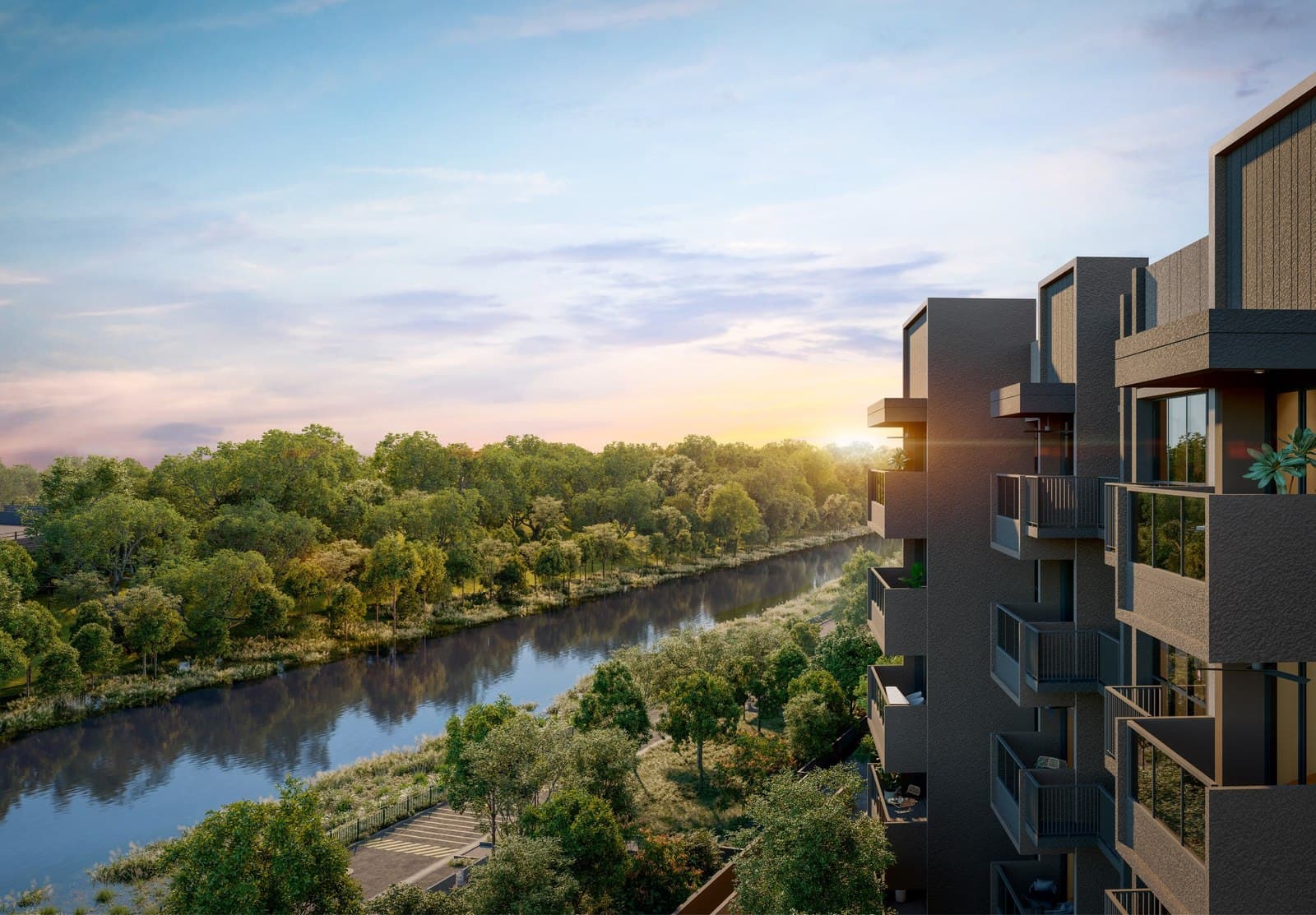
Faber Residence sits on Faber Walk, an established enclave of landed houses and wide streets in the Clementi/West Coast pocket of District 5. The developer's pitch is 'rare riverfront living' — the site fronts a waterway, which is genuinely unusual for a Singapore condo and the clearest thing you are paying the (small) premium for. This is a low-density, green, residential address first.
The fundamentals underneath it are better than the quiet setting suggests. You are inside one of the island's strongest education belts — Nan Hua Primary is within 1 km, with Pei Tong Primary, Clementi Town Secondary, NUS, Singapore Polytechnic and Ngee Ann Polytechnic all nearby — and within reach of two major job engines, NUS/one-north and the growing Jurong Lake District. For an own-stay family, that combination of schools, greenery and nearby employment is the real draw.
Now the catch, stated plainly: this is not a walk-to-the-MRT location. The brochure leans on buses and the Ayer Rajah Expressway (AYE) for connectivity — Clementi town and its MRT and mall are a short ride, not a stroll, away. If a train at your doorstep is non-negotiable, several of the pricier District 5 launches serve that better, and that is part of what their higher PSF buys. Faber Residence's location case is 'quietly well-connected by road, genuinely green, strong for families' — not 'transit-integrated convenience.' Whether that is a plus or a minus is the most personal call in this whole review.
A fresh 99-year lease and a 2030 TOP: what leasehold means here
Faber Residence is 99-year leasehold with the lease starting 24 February 2025 — a fresh, full runway that sidesteps the lease decay dragging on older resale nearby. It is still leasehold, not freehold. Expected vacant possession is 31 December 2030 (a ~2030 TOP), taken from the brochure since our directory had no completion year.
Faber Residence is 99-year leasehold, with the lease commencing 24 February 2025 — so as you buy, the clock is barely ticking and you are getting effectively the full runway. That matters more than it sounds: a big reason resale homes in the area price lower is that many sit on shorter remaining leases, and lease decay quietly drags on their value over time. A fresh-lease launch sidesteps that entirely for decades. It is one honest justification for paying any premium over older resale stock.
But leasehold is still leasehold. Unlike a freehold, a 99-year home does eventually feel lease decay in the back half of its life, and that caps how a very-long-hold or legacy buyer should think about it. If tenure is central to your decision, read how lease decay affects condo prices — for a home you will hold 10–20 years and live in, a fresh 99-year lease is rarely the thing that hurts you.
On timing: per the developer's particulars, expected vacant possession is 31 December 2030 (legal completion 31 December 2033), so a TOP around 2030. That is a multi-year build, which means you will fund it progressively while it goes up (see the progressive payment scheme) and wait before you can move in or collect rent. Our own directory did not carry a completion year for this site, so we have taken the date straight from the brochure — the reliable source for it.
Faber Residence as an investment: near sell-out demand vs the resale ceiling
The bull case is the near sell-out — 391 of 399 units already have caveats, a strong demand signal at ~$2,155 psf. The caution: it has never been resold (the RCR base rate is 86.4% sold above cost, +24.8% median gross gain — a base rate, not a forecast), and your exit competes with hundreds of identical units plus cheaper resale nearby. No yield figure — the data does not support one.
Two facts pull in opposite directions here, and an honest investment read has to hold both.
The demand signal is strong. 391 of the project's 399 units have already lodged New-Sale caveats — near-complete take-up. Whatever the skeptics say about the location, a large project selling through this fast is a real market verdict: at ~$2,155 psf, buyers found Faber Residence easy to say yes to.
The ceiling argument is the counterweight. Faber Residence has never been resold — it is brand new — so there is no track record, and anyone promising you a return is guessing. The honest proxy is how its segment has behaved: across matched resale pairs, 86.4% of city-fringe (RCR) private homes sold above their purchase price, with a median gross gain of 24.8%. Treat that as a base rate, not a forecast, and remember it is gross — before commission, stamp duties, any Seller's Stamp Duty and loan interest. And weigh the specific exit here: when you sell, you will compete against up to 398 near-identical units in the same project, plus the cheaper resale pool next door, while buyers who can stretch will still eye the better-located one-north launches. A low entry premium is a comfortable place to buy; it does not guarantee a wide spread when you sell.
We deliberately quote no rental-yield figure — the data here does not support one, and the NUS/one-north tenant demand is better described than dressed up as a number. To pressure-test a specific unit against your own holding period, costs and financing, run it through the PropKaki profitability model and read how to tell if a property will be profitable.
The one thing to weigh before you buy Faber Residence
The ~18% premium is real value on the way in — but it is also the market pricing Faber close to its resale neighbours, not above them, because the location does not command a one-north premium. You collect that value by holding and living in it, not by banking on a fast re-rating.
Faber Residence's thin ~18% premium is the whole story — and it cuts both ways at once. On the way in, it is genuine value: you are paying barely a fifth over the resale homes next door for something brand-new, full-facility and on a fresh 99-year lease, at a quantum (from ~$1.39M) that most 2026 RCR launches cannot match. That is why 391 of 399 units are already spoken for. But that same thinness is the market's quiet verdict on the way out: buyers priced this launch close to its resale neighbours, not far above them, because the location — set-back, riverside, bus-and-AYE rather than walk-to-MRT — does not command a one-north premium. So you capture Faber Residence's value by living in it and holding the fresh lease, where the low entry and family-friendly setting do their work. If your plan instead depends on a fast re-rating or a wide resale spread, the very cheapness that attracted you is the signal to be careful: the market has already decided this is a steady address, not a stellar one.
Is Faber Residence worth buying?
Yes for an own-stay or long-hold buyer who wants value, space and schools at a low quantum; less so if you need fast capital growth or a walk-to-MRT location.
For the right buyer, yes. Faber Residence is one of 2026's best-value new launches on entry price — about $2,155 psf, only ~18% above District 5 resale and cheaper than every other launch in the district in our data — on a fresh 99-year lease in a green, school-rich Clementi pocket. It suits an own-stay family or a long-hold buyer who values space, schools and a sensible quantum (from ~$1.39M). It is a weaker fit if you are banking on rapid capital growth or need a walk-to-MRT address, because the location that makes it cheap also caps how far above its resale neighbours it is likely to trade.
How much does Faber Residence cost?
About $2,155 psf median (~$1.85M), with most units $2,124–$2,193 psf, from 391 URA New-Sale caveats.
Based on 391 URA New-Sale caveats (18 October 2025 to 2 June 2026), Faber Residence's indicative pricing is about $2,155 psf, with a median quantum near $1.85M and most units between $2,124 and $2,193 psf. By size, the smallest band (550–750 sqft) medians about $1.39M, the 750–1,100 sqft band about $1.82M, and the 1,100–1,500 sqft band about $2.71M. Pricing is a live snapshot from caveats lodged so far and shifts as more units transact.
Who is the developer of Faber Residence?
GuocoLand (through the entity Faber Residence Pte. Ltd.) — the developer behind Guoco Tower, Guoco Midtown and the Lentor and Martin Modern residences.
Faber Residence is a GuocoLand development, built through the project entity Faber Residence Pte. Ltd. GuocoLand's Singapore portfolio includes Guoco Tower and Guoco Midtown, plus residential projects such as Wallich Residence, Martin Modern, Lentor Modern, Lentor Mansion and Springleaf Residence — an established developer with a track record in large, design-led projects, which is consistent with the scale and quick take-up seen at Faber Residence.
When is Faber Residence's TOP, and is it freehold or leasehold?
It is 99-year leasehold (lease from 24 February 2025), not freehold, with expected vacant possession on 31 December 2030 — a TOP around 2030.
Faber Residence is 99-year leasehold, with the lease commencing 24 February 2025 — a fresh, near-full runway. It is not freehold. Per the developer's particulars, expected vacant possession is 31 December 2030 (legal completion 31 December 2033), so a TOP around 2030. We take the completion date from the brochure, as our automated directory did not carry a reliable year for this site.
Methodology and sources
Pricing from 391 URA New-Sale caveats; the premium from District 5 resale caveats; comparables from each project's caveats; segment odds from matched RCR pairs. Developer, tenure and the 2030 TOP are from the brochure. A data and desktop analysis, not a showflat visit; not financial advice.
Where the figures come from. Faber Residence's indicative pricing is the median of 391 URA private-sale caveats flagged New Sale for the project (18 October 2025 to 2 June 2026), from PropKaki's own transaction data. The ~18% premium compares that median to the median PSF of Resale caveats in District 5 over the last ~18 months (1,090 caveats). The comparable-launch PSFs are the medians of each rival project's own New-Sale caveats in the district (last ~30 months, deduped per project). The 86.4% segment resale odds and +24.8% median gain come from matched private buy→sell pairs in the RCR (city-fringe) segment via PropKaki's profitability model. Developer, tenure, lease commencement, expected completion and unit sizes are from the project's official brochure — including the 31 December 2030 vacant-possession date, which our directory did not carry.
What we did and did not claim. This is a data and desktop analysis, not a showflat visit — we have not toured the units or checked finishes in person. Indicative PSF is a dated snapshot that moves as more units sell; PSF is price ÷ area, so a median shifts with which units transact (the by-size table controls for this). The resale benchmark is a district median, not a unit-matched valuation, so some launch premium is expected and is not proof of overpricing. The segment profit odds are gross (before commission, stamp duties, any SSD and interest) and are a base rate, not a forecast — Faber Residence has never been resold. We quote no rental-yield figure because the data does not support one. Nothing here is financial advice; verify current rules and figures with URA, IRAS and HDB.
Got a question this raised? Ask PropKaki.
Take any point from this analysis and apply it to your own project, budget or decision.
 PropKaki
For most buyers this year, staying well within budget beats trying to time the market.