
A $600 Room in Central Singapore: The Rule That Makes Half This Market Illegal
CNA went inside the market for “pocket-sized” rental rooms. HDB's own eligibility rule contains a sentence that decides which of those rooms can legally be let at all — and it has nothing to do with size.
CNA reports that rooms in central Singapore let for around S$600 a month, at severe space cost. On the rules: for HDB flats, only bedrooms originally constructed by HDB may be rented out — a partitioned room may not, which excludes stud-wall subdivisions and rooms that were never bedrooms. Only a 3-room or larger flat may rent out spare bedrooms at all; 1-room and 2-room flats may not. A 3-room flat may rent out 1 bedroom with a maximum of 6 occupants; a 4-room or larger flat may rent out 2 bedrooms with a maximum of 8 occupants — reverting to 6 for rental periods extending beyond 31 December 2028. Occupants include owners and authorised occupiers, not just tenants. Renting out bedrooms does not require the MOP to be met and the owner may be a citizen or PR, unlike renting out a whole flat. HDB's approval must be obtained before the tenancy begins, applied for online with a $9 fee per bedroom. For private property, the occupancy cap is 6 unrelated persons under 90sqm, or 8 for 90sqm-plus with registration and a $20 fee.
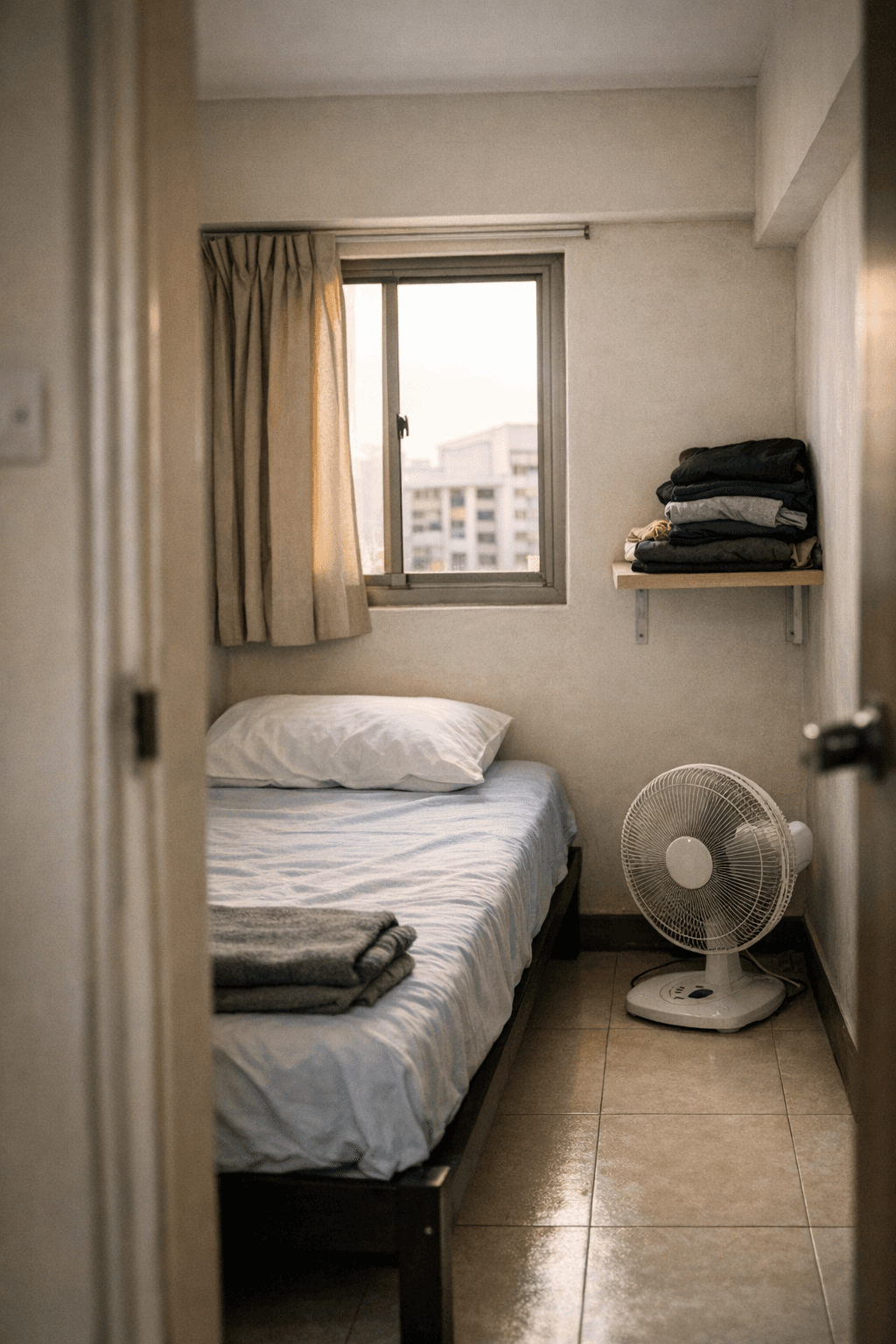
CNA went inside Singapore's market for “pocket-sized” rental rooms this week — rooms in central locations going for around S$600 a month, which sounds like a bargain until you see how little space is involved. The report speaks to tenants adjusting to life in extremely small rooms, where there is barely room for basic belongings, and asks what the rules say about renting out utility rooms, storerooms and bomb shelters.
That last question has a much crisper answer than most people expect, and it is not about square feet.
HDB's eligibility conditions contain a single sentence that decides the whole thing: only bedrooms originally constructed by HDB count. A partitioned room may not be rented out.
Six hundred dollars, and almost nowhere to put a suitcase
CNA's report is about people trading space for location and price, in rooms small enough to make that trade visible.
The number in CNA's report is the kind that stops you: around S$600 a month for a room in central Singapore.
In a city where that figure sounds impossible, the explanation is not a subsidy or a hidden scheme. It is simply that the room is very small. CNA speaks to tenants adjusting to life in extremely small rental rooms, where space for even basic belongings can be limited, and looks at why some renters choose them anyway.
The answer, when you strip it back, is that they are buying two things that are genuinely expensive here — a central address and a low monthly outgoing — and paying for them with the one thing that can still be compressed. There is a real and unsentimental logic to it. Somebody working shifts in town, saving hard, or staying a year before moving on, may quite rationally decide that a bed and a commute of ten minutes beats a proper room and a commute of fifty.
What that person usually does not know is whether the room they are renting is one their landlord is allowed to rent.
The sentence that decides it
HDB's eligibility conditions: only bedrooms originally constructed by HDB count, and a partitioned room may not be rented out.
We keep a rules layer — the actual conditions, their source, and the date we last checked them — because property rules in Singapore change quietly and get repeated wrongly for years afterwards.
On this question, HDB's eligibility conditions for renting out bedrooms, which we last verified on 15 August 2026, say something unusually clear:
Only bedrooms originally constructed by HDB count — a partitioned room may not be rented out.
Read what that excludes. Not “rooms below a minimum size”. Not “rooms without a window”. Rooms that were not built as bedrooms.
A stud wall thrown across a living room does not create a rentable bedroom. Neither does a storeroom, a utility room, or a household shelter — none of them were constructed by HDB as bedrooms, whatever has since been put inside them.
This is why the rule is more useful than a size limit would be. A size limit invites argument about the tape measure. “Originally constructed by HDB” is a matter of the floor plan, and the floor plan is not a matter of opinion.
The rest of the conditions, which are stricter than most people assume
3-room minimum, bedroom caps, occupant caps that include the owners, and approval before the tenancy starts.
The partitioning rule sits inside a set of conditions that catch people out individually. All of the following are from HDB's own eligibility page, verified 15 August 2026:
| Condition | What it says |
|---|---|
| Minimum flat size | Only a 3-room or bigger flat may rent out spare bedrooms. A 1-room or 2-room flat may not rent out a bedroom at all. |
| Bedrooms lettable | 3-room: 1 bedroom. 4-room or bigger: 2 bedrooms. |
| Occupant cap | 3-room: max 6 occupants. 4-room or bigger: max 8 — reverting to 6 for rental periods extending beyond 31 Dec 2028. |
| Who counts as an occupant | Owners and authorised occupiers, not just tenants. |
| Which rooms | Only bedrooms originally constructed by HDB. A partitioned room may not be let. |
| Approval | HDB's approval before the tenancy begins, applied for online, $9 per bedroom. |
| Ongoing duty | Changes of tenant particulars or a tenant moving out must be reported within 7 days; a new tenant needs approval before moving in. |
Two of these are routinely got wrong in opposite directions.
The occupant cap counts you. It is not a cap on tenants — it includes the owners and authorised occupiers living there. A family of four in a four-room flat does not have eight slots to let; it has four.
But the entry conditions are easier than people think. Renting out spare bedrooms does not require the Minimum Occupation Period to have been met, and the owner may be a Singapore Citizen or a Permanent Resident. That is the opposite of renting out the whole flat, which requires both that the MOP is met and that the owner is a citizen. Applying whole-flat conditions to a bedroom rental is one of the most common mistakes we see — people wait five years they did not have to wait.
What the alternative actually costs
Our transacted-rent data: $3,300 for a one-bedder, $4,300 islandwide median, $5,672 in the Core Central Region.
The pocket-room market exists because of a gap, and we can size the far side of that gap precisely even though we cannot price the rooms themselves.
Across 89,307 private non-landed leases transacted in the trailing twelve months:
| What you are renting | Median monthly rent |
|---|---|
| A 1-bedroom private unit | $3,300 |
| A 2-bedroom private unit | $4,100 |
| Any private non-landed unit, islandwide | $4,300 |
| Any private non-landed unit, Core Central Region | $5,672 |
So the alternative to a $600 room, for someone who wants their own front door in a central location, is a private lease with a median around $5,672 in the CCR, or $3,300 for the smallest whole unit type islandwide.
We want to be exact about what this comparison is and is not. These are whole-unit private leases. We do not hold room-level rent data, and we are not going to estimate it. The $600 figure is CNA's reporting, not ours, and nothing in our data confirms or contradicts it.
What the table does establish is the shape of the incentive. The distance between $600 and $3,300 is why this market exists, why it will keep existing, and why some landlords will keep partitioning rooms that HDB does not permit them to let.
Why the rule is right, even though it costs somebody a cheap room
The conditions that make a room cheap — no window, no second exit, more bodies per flat — are the ones that matter in a fire.
It would be easy to write this up as regulation getting in the way of affordable housing, and we do not think that is honest.
Consider what is actually being excluded. A household shelter is a reinforced concrete box with a heavy door and no window. A storeroom has no ventilation designed for a sleeping person. A partition across a living room can put a bed on the wrong side of the only route to the front door.
These are not aesthetic objections. They are the conditions that decide what happens at three in the morning when something goes wrong, and the person they fall on is invariably the person with the least ability to argue about it — which, at $600 a month in a central location, is close to a definition of the tenant involved.
The occupant caps work the same way. They are the reason the flat above yours does not hold fourteen people sharing one kitchen.
Our view: the rule is not the reason central rooms are expensive. The reason central rooms are expensive is that Singapore is small and central land is scarce, which is the same reason the whole-unit medians above look the way they do. Letting people sleep in unventilated boxes would not fix that. It would just move the cost onto whoever is least able to refuse it.
What should a tenant or a landlord actually check?
Tenants: ask to see the approval. Landlords: get it before the tenancy, and count yourself in the occupant cap.
If you are renting a room in an HDB flat, two questions settle most of it. Was this room on the original floor plan? And has HDB approved the rental? Approval must be obtained before the tenancy begins, so there is no legitimate version of “we will sort it out later.” A landlord who cannot answer the first question is telling you something.
If you are letting rooms, work through it in this order: confirm the flat is 3-room or larger; confirm the rooms are original bedrooms; count everyone who will be living there against the cap, including yourself and your family; apply online and pay the $9 per bedroom before anyone moves in; and diarise the 7-day reporting duty for tenant changes.
And note the 2028 date. The 8-occupant cap for 4-room and larger flats reverts to 6 for rental periods extending beyond 31 December 2028. A tenancy signed in 2028 that runs into 2029 is caught by the lower figure, not the one in force when you signed. That is the sort of detail that is obvious in hindsight and expensive in advance.
For private property, the rules are different again: an occupancy cap of 6 unrelated persons under 90sqm, or 8 for properties of at least 90sqm — but only where the owner has registered the property and paid a $20 fee. We wrote separately about how that cap, rather than short-term letting, is where most enforcement attention actually lands.
The honest reality-check: what we know, and what we deliberately did not do
We hold no room-level rent data and did not estimate any. The rules here are ours and verified; the $600 figure is CNA's.
We did not price a room. Our rental data covers whole-unit private non-landed leases from URA rental contracts. There is no room-level rent in it, so we have not produced a “typical room rent”, a per-room yield, or any comparison of the $600 figure against our own numbers. CNA's $600 is CNA's. If you see a room-rent benchmark presented as ours, it is not.
The whole-unit medians are gross and trailing. Transacted URA rental contracts over twelve months to 20 August 2026 — not asking rents, not current, and moving with the mix of units let. Rent is before agency fees, maintenance and tax. HDB sublet rents and landed rentals are excluded entirely, which matters here: the very market this story is about is not in our rent data.
The rules are verified but they are not advice. Every HDB condition above is recorded in our rules layer against HDB's own eligibility page and was last verified on 15 August 2026; the private occupancy caps against URA's guidelines on 9 August 2026. Rules change. Before acting, check the current pages, which we link below.
We have not verified a minimum room size, because we do not hold one. CNA's report concerns very small rooms; we have deliberately not stated any size threshold for HDB bedroom rental, because no such rule is in our verified layer. The constraint we can stand behind is about which rooms, not how big they are.
And enforcement is not covered here. We have not stated what penalties apply for letting a partitioned room, because we do not hold that verified either.
Can I rent out my HDB bomb shelter, storeroom or utility room?
No. Only bedrooms originally constructed by HDB may be rented out, and none of those were built as bedrooms.
No. HDB's eligibility conditions state that only bedrooms originally constructed by HDB count, and that a partitioned room may not be rented out.
A household shelter, storeroom or utility room was not constructed as a bedroom, so it falls outside what may be let regardless of what has since been placed in it. The same reasoning applies to a room created by partitioning a larger space — putting up a wall does not create an original bedroom.
This is also why the question “but how small is too small?” does not really arise for HDB bedroom rental. The condition is about which rooms were built as bedrooms, not about their dimensions. If it is on the original floor plan as a bedroom and you are within the bedroom and occupant caps for your flat type, size is not the operative test.
Do I need to have met the MOP to rent out a spare bedroom?
No. Renting out bedrooms does not require the MOP, and the owner may be a citizen or a PR — unlike renting out the whole flat.
No, and this is one of the most commonly confused points in Singapore property.
Renting out spare bedrooms does not require the Minimum Occupation Period to have been met, and the owner may be a Singapore Citizen or a Singapore Permanent Resident.
Renting out the whole flat is a different regime entirely: it requires both that the MOP has been met and that the owner is a Singapore Citizen. Applying the whole-flat conditions to a bedroom rental is a mistake that costs people years of foregone rent.
What bedroom rental does require is HDB's approval before the tenancy begins, applied for online with a $9 administrative fee per bedroom — plus staying within the caps for your flat type, and reporting tenant changes within 7 days.
How we sourced this
The story from CNA; every rule from our verified rules layer citing HDB and URA; whole-unit rents from URA rental contracts.
The news — the S$600 figure, the tenant accounts and the framing of the pocket-room market come from CNA's report of 17 August 2026, linked below. CNA's piece is a video report; we have relied on its published summary and have not reproduced its interviews.
The rules — every HDB condition stated above comes from PropKaki's rules layer, recorded against HDB's own bedroom-rental eligibility page and last verified 15 August 2026. The private-property occupancy caps come from the same layer, recorded against URA's renting-property guidelines and last verified 9 August 2026. Where we do not hold a rule verified — notably any minimum room size, and the penalties for breach — we have said so rather than filling the gap.
The data — whole-unit median rents are PropKaki's cut of URA rental contract data for private non-landed homes, trailing twelve months to 20 August 2026, across 89,307 leases. We hold no room-level rent data and produced no room-level estimate.
Sources
CNA's report, HDB's and URA's own pages, and our transacted-rent data.
The news:
- CNA — Inside Singapore's market for ‘pocket-sized’ rental rooms, 17 August 2026.
The rules:
- HDB — Renting out bedrooms: eligibility. Flat-type, bedroom, occupant, original-bedroom and approval conditions, as recorded in PropKaki's rules layer and last verified 15 August 2026.
- URA — Renting out your property. Private-property occupancy caps, last verified 9 August 2026.
The data:
- PropKaki's cut of URA rental contract data — transacted private non-landed whole-unit rents, trailing 12 months to 20 August 2026.
About this commentary
Opinion and analysis from the PropKaki Editorial Desk — not legal or property advice.
This is commentary by the PropKaki Editorial Desk on reporting by CNA, alongside published HDB and URA conditions and our own transacted-rent data. The account of the pocket-room market and the S$600 figure belong to that newsroom; the rules analysis, the framing and the opinions are ours.
It is opinion and general information, not legal or property advice. Renting out a room without approval, letting a room that is not an original bedroom, or exceeding an occupancy cap carries real consequences for an owner, and the 8-occupant cap for larger flats is time-limited to rental periods ending by 31 December 2028. Anyone letting or renting a room should work from HDB's and URA's own current pages, linked above, and take proper advice where the position is unclear.
Published 20 August 2026.
Got a question this raised? Ask PropKaki.
Take any point from this analysis and apply it to your own project, budget or decision.
 PropKaki
For most buyers this year, staying well within budget beats trying to time the market.