
Why Your Next Home Costs More to Build — and to Buy
Rising build costs are the quiet force under every new-launch price — the replacement cost that puts a floor beneath the sticker. Here's what the reporting warns, what URA's index actually shows, and why a floor isn't a forecast.
Rising construction costs matter to home buyers because build cost is part of the floor under a new-home price: a developer prices in land, construction and a margin, and won't sell for long below what it costs to replace the building. The Business Times reported that higher prices for concrete, cement, rebar and bitumen could pressure future housing prices. On PropKaki's read of URA's data, private home prices are still climbing but gently — the Property Price Index rose 2.9% year-on-year but just 0.5% quarter-on-quarter in 2026Q2, grinding up from 213.2 a year earlier (2025Q2) to 219.4. The honest caveat: a cost floor supports prices, it doesn't guarantee them — construction cost is one of several drivers, and the PPI is an index, not a dollar price.
The Business Times reported this month that something quietly expensive is happening on Singapore's building sites: the concrete, cement, rebar and bitumen that go into every new home have been getting dearer — enough, firms warn, that it could push up future housing prices.
It's the kind of story that's easy to scroll past, because construction costs sound like someone else's problem. But stand in a showflat, blink at the price tag, and you're closer to it than you think — because underneath every new-home price is a number most buyers never see.
The sticker that makes you blink
You tour a new-launch showflat, a price lands that makes you pause, and the instinct is to blame demand or developers — the usual suspects.
You've probably felt it. You walk into a new-launch showflat — the cool air, the scale model of the development under glass, the neat brochure in your hand — and somewhere near the end a number lands that makes you pause. A fairly modest unit, at a price that once bought something much larger.
The instinct is to reach for the usual suspects: developers chasing margins, investors bidding things up, too much demand for too few homes. Those forces are real, and they get all the headlines.
But there's a quieter number under the sticker, one nobody prints on the brochure — what it actually cost to build the thing you're standing in.
What a home costs before anyone moves in
Every new home is a construction project first — cranes, a concrete frame, steel, cement, crews — and lately that bill has been rising.
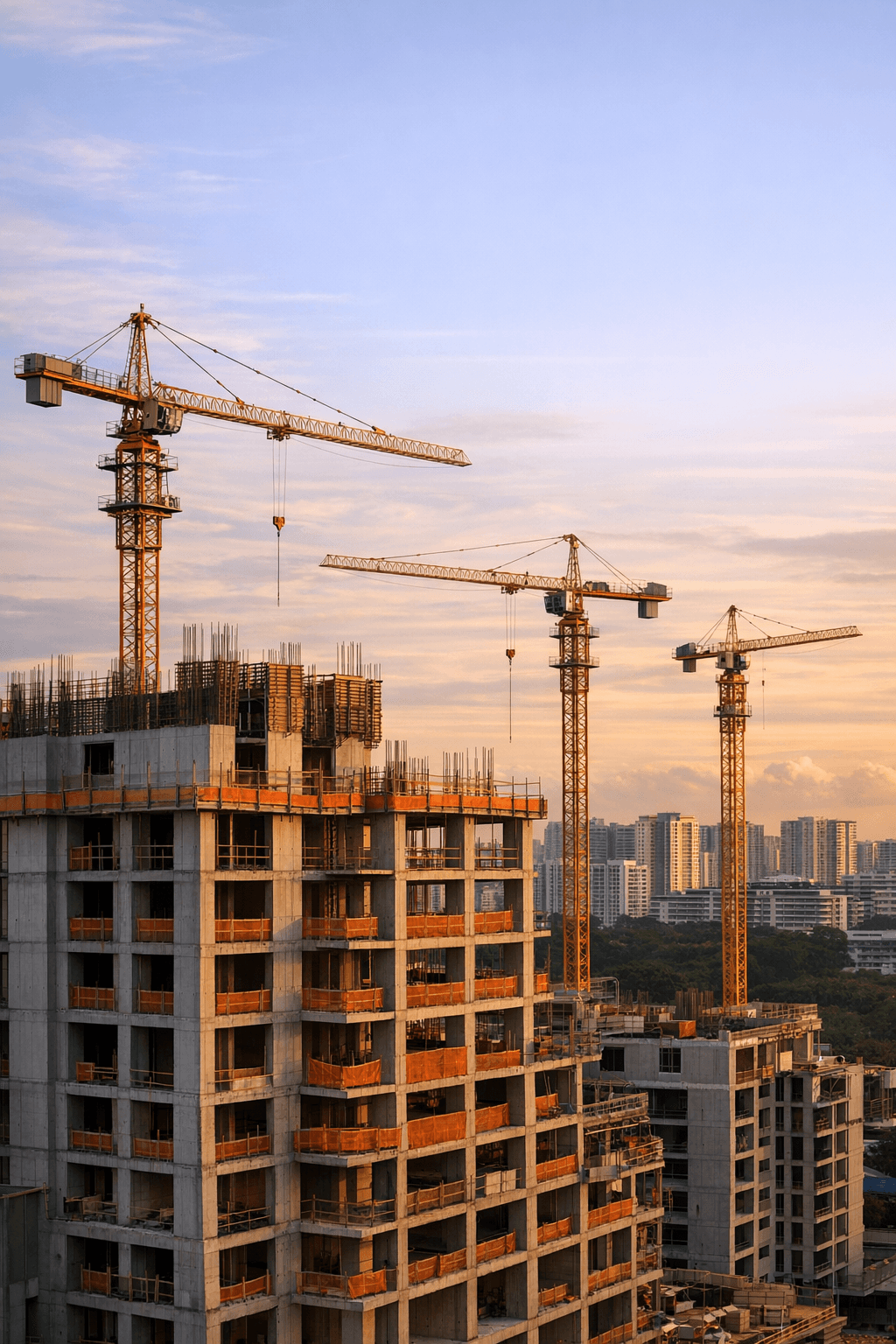
Every new home starts as a construction project long before it is a listing. Before there is a showflat, there is a site: tower cranes, a rising concrete frame, steel reinforcing bars, cement, and the crews who put it all together. All of it has to be bought and paid for.
And lately, according to the reporting, that bill has been climbing. Higher prices for concrete, cement, rebar and bitumen — the raw materials of any building — have been eroding contractors' margins and, The Business Times warns, could drive up future tender prices. Singapore imports most of these materials, so global shocks to oil, freight and commodities wash up on local sites too.
A more expensive build doesn't stay on the building site. It works its way, eventually, into the price of the finished home.
The floor beneath the price
A developer prices land plus build plus a margin — so a rising build cost lifts the least a new home can sell for. Economists call it replacement cost.
Here is why that matters more than it sounds. A developer, roughly speaking, prices a new home to cover three things: the land, the cost of building on it, and a margin to make the risk worthwhile. Push up the cost of building, and you push up the least a developer can charge and still come out ahead.
Economists have a plain name for this: replacement cost. If it costs more to build a home than to buy an equivalent existing one, buyers bid up the existing ones — and if new homes can't be sold for more than they cost to replace, they simply don't get built. Either way, rising build costs behave less like a one-off spike and more like a floor rising slowly under the whole market.
So the reporting raises a fair question: with build costs climbing, what are Singapore home prices actually doing? We went to URA's own numbers.
What are Singapore private home prices doing right now?
Still rising, but barely — the private Property Price Index was up 2.9% year-on-year in 2026Q2, yet just 0.5% quarter-on-quarter.
On PropKaki's read of the official URA figures, private home prices are still rising — but the pace has cooled to a crawl.
| Private Property Price Index — 2026Q2 | Change |
|---|---|
| Quarter-on-quarter | +0.5% |
| Year-on-year | +2.9% |
Up 2.9% on a year ago, but just 0.5% over the previous quarter — prices are higher, yet the last three months barely moved. The Straits Times reported the same quarter as home prices inching up 0.5%. It is the picture of a market grinding upward, not galloping — which is exactly the backdrop in which a cost floor does its quiet work.
Have prices actually kept climbing over the past year?
Yes — a steady, unglamorous grind. The index rose from 213.2 in 2025Q2 to 219.4 in 2026Q2, the 2.9% year-on-year gain.
Zoom out from a single quarter to a full year, and the direction is unmistakable:
| URA Property Price Index (private, incl. EC) | Index (2009Q1 = 100) |
|---|---|
| 2025Q2 | 213.2 |
| 2026Q2 | 219.4 |
Over the year the index climbed 6.2 points — the 2.9% rise from the table above — a year-long grind rather than a spike. That is the shape a floor tends to produce: not a boom, but a market that resists falling and edges up quarter after quarter. When the cost of building keeps rising, the least a new home can sell for rises with it — and the index grinds higher rather than sliding back.
How do construction costs actually feed into what you pay?
Through the developer's sum — land plus build plus margin against achievable selling prices. A pricier build lifts the minimum, so it acts like a floor, not a ceiling.
Through the developer's arithmetic. To bid for a site and build on it, a developer has to believe the finished homes will sell for more than land plus construction plus a margin. Every one of those inputs going up narrows the room — and the way developers protect the margin is to price the homes higher, or to bid less for the land so the sums still work.
That is why construction cost behaves like a floor rather than a ceiling. It rarely creates a dramatic jump on its own; instead it quietly lifts the minimum. A home that costs more to build is one a developer is less willing to sell cheaply — and, per the reporting, tomorrow's tenders are being priced with exactly that in mind. The effect shows up not as a spike, but as prices that are slow to fall.
Does a rising cost floor mean home prices can't fall?
No. A floor supports prices, it doesn't guarantee them — demand, rates, cooling measures and supply can all still push prices down. It makes prices sticky, not immune.
No — and this is the caveat that matters. A floor supports prices; it does not guarantee them. Construction cost is only one of several forces on a home's price. Demand, interest rates, cooling measures, the pipeline of new launches and the state of the wider economy all pull in their own directions, and any of them can push prices down even as build costs rise.
What replacement cost does is make prices sticky — slower to fall, and quicker to find a floor when they do. It is the difference between a market that can slide sharply and one that tends to grind. The gentle 0.5% quarter in the URA data is consistent with that: not runaway growth, but not a retreat either.
The honest read: a floor, not a forecast
Rising build costs are a genuine upward force on future prices, but they tell you which way one input is pushing — not where prices will land.
So hold the idea loosely. Rising construction costs are a real, upward force on future home prices — the reporting is right to flag it, and the mechanism, replacement cost, is sound. But it is a floor, not a forecast. It tells you which way one input is pushing, not where prices will end up.
The figures here are an index, not dollar prices, and the latest quarter can be a provisional flash estimate that URA later revises. And a specific project — its location, its land price, its launch timing — can move very differently from the market as a whole. Treat build cost as one hand on the wheel, not the driver.
How we sourced this
The price figures come from URA's private Property Price Index; the construction-cost pressure is from published reporting, attributed as such.
PropKaki reads URA's private residential Property Price Index directly — the official index (2009Q1 = 100) covering all private homes including executive condominiums — here for 2026Q2 and the same quarter a year earlier.
Two caveats we carry rather than bury. The PPI is an index: it tracks relative movement across the whole private market, not dollar prices or PSF, so any one project can move very differently from it. And the most recent quarter can be a provisional flash estimate that URA revises when the full figures land. The construction-cost pressure is from published reporting, not PropKaki data — we have attributed it as such throughout. Want the price trend for your own segment or district? You can ask PropKaki.
Sources
- PropKaki analysis of URA's private residential Property Price Index (2026Q2).
- The Business Times — rising construction material costs could put pressure on future housing prices (original reporting; accessed via TheFinance.sg).
- The Straits Times — private residential rents rise 0.7% in Q2 as home prices inch up 0.5%: URA.
About this commentary
This is editorial analysis by the PropKaki Editorial Desk, written for general information only — it is opinion and context, not a valuation, financial advice or a recommendation. The construction-cost pressure is drawn from published reporting; the price figures are from URA's index, analysed by PropKaki. Always verify prices and policy against official sources (URA, HDB, MAS) before acting.
Got a question this raised? Ask PropKaki.
Take any point from this analysis and apply it to your own project, budget or decision.
 PropKaki
For most buyers this year, staying well within budget beats trying to time the market.