
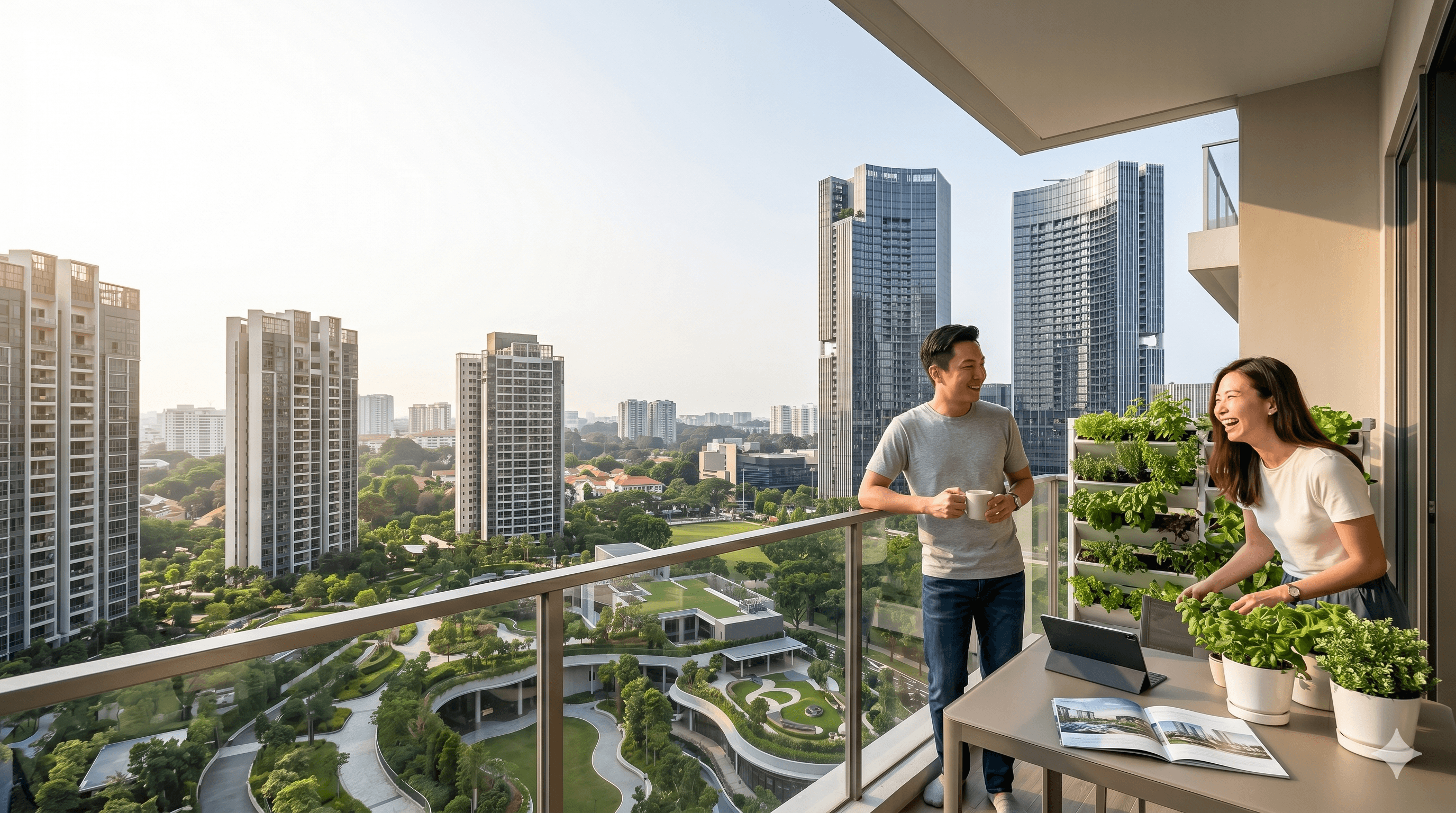
Tengah Garden Residences Review: Is Tengah's First Private Condo Worth ~$2,113 PSF?
It is the first private (non-EC) condominium in Singapore's new 'forest town' — and it prices about 20% above the Executive Condos next door. We work out what that premium buys, and whether it holds up in a town with no resale track record yet.
Tengah Garden Residences is an 863-unit, 99-year private condominium by Hong Leong Holdings, GuocoLand and CSC Land in Tengah (District 24, OCR), with TOP expected around 2031. Across a deep sample of 1,075 New-Sale caveats it prices at about $2,113 psf (median ~$1.80M) — roughly $360 psf, or about 20%, above the neighbouring Executive Condo Otto Place (~$1,754). That gap is mostly the private-versus-EC difference, not overpricing: you get unrestricted ownership with no income ceiling and no five-year lock-in, but forgo the EC subsidy and CPF grants. The catch is that Tengah is brand new, so there is no nearby resale market to value it against yet. It suits a buyer who cannot or will not take the EC route and believes in the forest-town masterplan; anyone eligible for the cheaper EC should weigh Otto Place first.
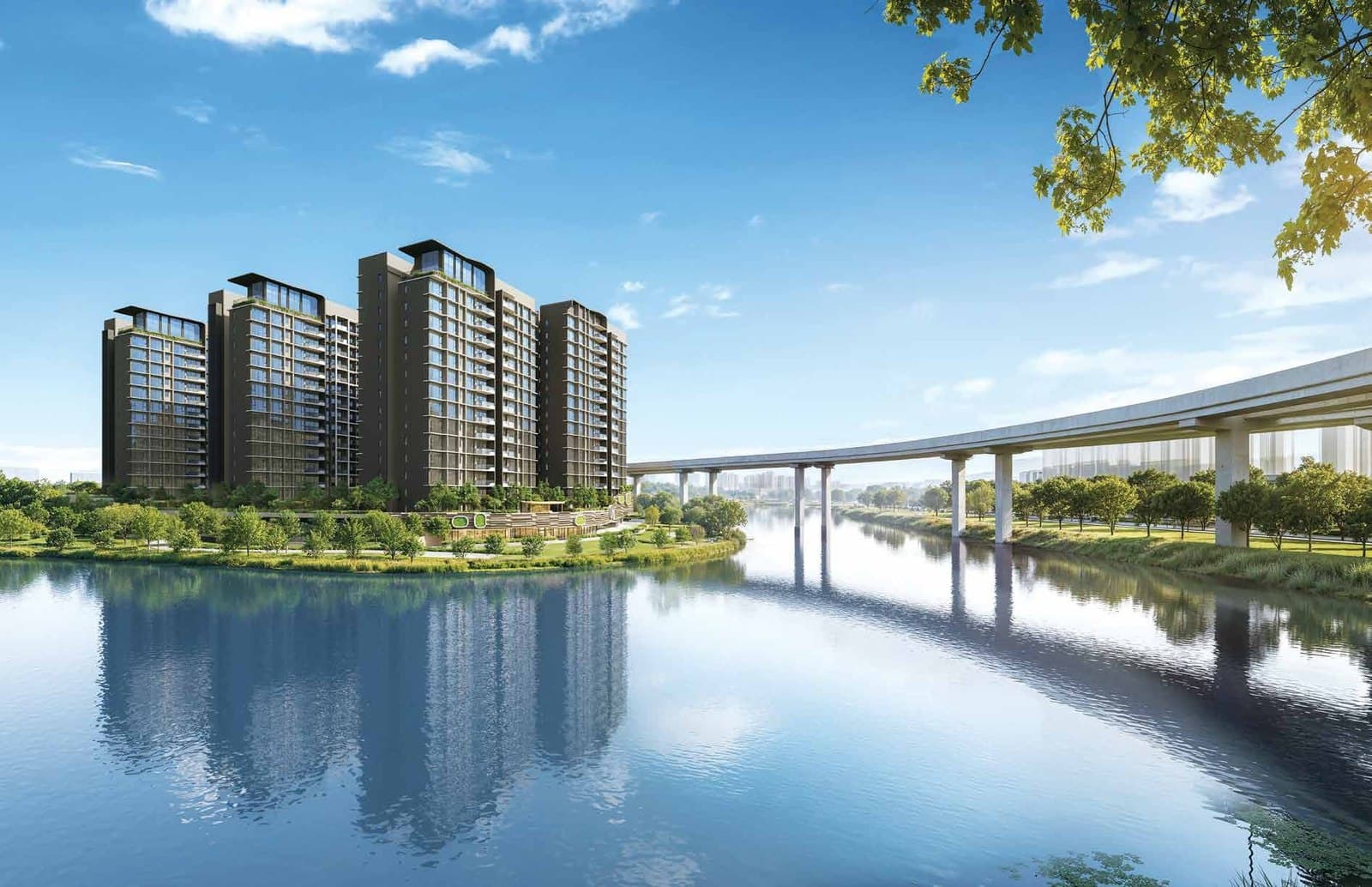
Tengah Garden Residences asks you to pay up for two things at once: a private condominium instead of an Executive Condo, and a bet on Singapore's youngest new town. At about $2,113 psf it sits roughly 20% above the ECs that launched in Tengah before it — a real step-up for two similar-looking products in the same unproven precinct. This review prices that premium against the cheaper EC sibling next door, Otto Place, and confronts the harder problem underneath it: how do you value a launch in a town where nothing has ever been resold?
Is Tengah Garden Residences worth the private-condo premium? Our verdict
Tengah Garden Residences is Tengah's first private (non-EC) condo, at ~$2,113 psf — about 20% above the Executive Condos next door like Otto Place. That premium buys unrestricted ownership and no five-year lock-in, not a better address per se. It suits buyers shut out of ECs or who want the flexibility; EC-eligible families chasing the lowest price should weigh Otto Place first.
Tengah Garden Residences is a buy for one specific buyer: the household that cannot take the cheaper Executive Condo route — or will not accept its strings — and genuinely believes in the Tengah 'forest town' story. For an EC-eligible family that just wants the lowest entry price, the sibling next door, Otto Place, is the sharper deal.
Here is the decision in one line. Tengah Garden Residences is the first private, non-EC condominium in Tengah, and it prices at about $2,113 psf (median unit near $1.80M) across a deep sample of 1,075 developer-sale caveats. The three residential launches that came before it in the district are all Executive Condominiums — Otto Place (~$1,754), Novo Place (~$1,650) and Copen Grand (~$1,625) — so Tengah Garden sits roughly $360 to $490 psf above them, about 20% over Otto Place.
That premium is not evidence of overpricing, and it is not a resale premium — it is the private-versus-EC gap. An EC is a subsidised hybrid sold only to eligible Singaporean households under an income ceiling, with a five-year lock-in; a private condo like Tengah Garden has none of those limits (anyone, including foreigners and investors, can buy; there is no Minimum Occupation Period; you can rent it out or resell on the open market), but it also gets no subsidy and no CPF housing grants. You are paying to buy your way out of the EC rulebook.
The catch that makes this launch genuinely hard to price is underneath all of it: Tengah is a brand-new town, so there is no nearby private resale market to value it against — nothing here has ever been resold. Every other review on our board can benchmark a launch against lived-in resale down the road; this one cannot. You are buying the masterplan on trust.
So the verdict turns on who you are. If you are shut out of ECs (over the income ceiling, a foreigner, a single buyer, or an investor) or you want the flexibility a private title gives you, Tengah Garden is the only private door into Tengah today, and the developer pedigree and Hong Kah MRT location are real. If you qualify for an EC and only want the cheapest way into this town, weigh Otto Place first — you would be paying Tengah Garden's premium for freedoms you may not need.
This review shows the full workings. For the wider market, see our complete guide to 2026's new launches and the full roundup of every launch benchmarked against resale.
Tengah Garden Residences at a glance: the key facts
Tengah Garden Residences is an 863-unit private condominium (not an EC) by Hong Leong, GuocoLand and CSC Land at Tengah Garden Avenue, District 24 — 99-year leasehold, nine towers, at the doorstep of the future Hong Kah MRT, with TOP expected around 2031 and indicative pricing near $2,113 psf.
| Detail | Tengah Garden Residences |
|---|---|
| Developer | Hong Leong Holdings, GuocoLand & CSC Land Group (joint venture) |
| Type | Private condominium (not an Executive Condo) |
| Tenure | 99-year leasehold (from 21 April 2025) |
| Location | Tengah Garden Avenue, District 24 (Tengah) |
| Market segment | Outside Central Region (OCR) |
| Total units | 863, across nine towers |
| Unit types | Studio/1-bed to 4-bedroom (size bands from our caveats) |
| Nearest MRT | Hong Kah MRT (under construction, Jurong Region Line) — at the doorstep |
| Ground floor | Commercial Plaza with retail and F&B |
| Expected TOP | ~2031 (vacant possession by 1 Sep 2031) |
| Launched | April 2026 |
| Indicative pricing | ~$2,113 psf · median ~$1.80M |
One fact on this table does more work than any other, and it is the one most likely to be gotten wrong elsewhere: Tengah Garden Residences is a private condominium, not an Executive Condominium. That matters because the three launches it is most often compared with in Tengah — Otto Place, Novo Place and Copen Grand — are all ECs, and some listings and directories lump the whole young town together. The developer's own materials are explicit that this is the first private residences in Tengah's Garden District, and independent coverage from StackedHomes, which visited the showflat, reviews it as a private condo and one of 2026's lower-priced launches. The distinction is the whole basis of this review: private ownership carries no EC income ceiling, no Minimum Occupation Period and no resale restrictions — and no subsidy either.
Where these come from: the developer, tenure, unit count, tower count and concept are read from the project brochure and cross-checked against public coverage; the pricing is our own, computed from URA developer-sale caveats. Note that automated property records can carry an unreliable completion year, so the brochure sets vacant possession no later than 1 September 2031 (legal completion by 1 September 2034), which we use over the less reliable directory completion year.
How much does Tengah Garden Residences cost? Prices and PSF by unit size
Across 1,075 developer-sale caveats, Tengah Garden's median is ~$2,113 psf and ~$1.80M, with most units between $2,037 and $2,177 psf. Unusually, PSF climbs with size (up to ~$2,198 for 3–4 bedders), so the cheapest per-square-foot entry is the small units — the lowest quantum starts near $1.0M.
Across the 1,075 developer-sale caveats lodged so far — a deep sample for a launch this fresh — Tengah Garden Residences' median is about $2,113 psf, with the middle of the market transacting between roughly $2,037 and $2,177 psf. The median quantum is about $1.80M. Coverage from StackedHomes, which toured the showflat, pegs entry pricing from around $980,000 and frames the project as one of 2026's lower-priced launches — a useful cross-check that our smallest-unit band (a ~$1.01M median) is in the right zone.
| Unit size (from our caveats) | Caveats (n) | Median PSF | Median price |
|---|---|---|---|
| ≤550 sqft (studio/1BR) | 7 | $1,959 | $1.01M |
| 550–750 sqft (1–2BR) | 299 | $1,996 | $1.30M |
| 750–1,100 sqft (2–3BR) | 563 | $2,121 | $1.89M |
| 1,100–1,500 sqft (3–4BR) | 206 | $2,198 | $2.61M |
The pattern here is worth pausing on, because it runs opposite to what many launches show. Normally the biggest units carry the lowest PSF, because the large quantum is harder to sell, so developers discount it per square foot. At Tengah Garden the PSF climbs steadily with size — from about $1,959 psf for the smallest homes to $2,198 psf for the 3–4 bedders. That tells you the developer is charging up for the larger, likely pond- and greenery-facing stacks rather than discounting them, and that the cheapest per-square-foot entry is in the small units, not the big ones. The flip side: the lowest cash outlay is the compact band (a ~$1.01M–$1.30M median), exactly the shoebox-friendly, investor-accessible product an EC — with its family-sized minimums — does not offer. If you care about the difference between a low quantum and a low PSF, read quantum versus PSF when buying a condo.
Why does Tengah Garden Residences cost more than Otto Place and the other Tengah launches?
The ~20% gap over Otto Place (and $360–$490 psf over the Tengah ECs) is almost entirely the private-versus-EC difference, not overpricing. The ECs are subsidised, income-capped and carry a five-year MOP; Tengah Garden is unrestricted and grant-free. You pay more for an asset with no strings.
Line the Tengah launches up and the gap is stark:
| Project | New-Sale caveats (n) | Median launch PSF |
|---|---|---|
| Otto Place | 615 | $1,754 |
| Novo Place | 505 | $1,650 |
| Copen Grand | 10 | $1,625 |
Tengah Garden's ~$2,113 psf sits about $360 psf (roughly 20%) above Otto Place, and $360–$490 psf above the trio overall. But before you read that as 'the expensive one', note the single fact that explains almost all of it: every project in that table is an Executive Condominium, and Tengah Garden Residences is not. This is not a like-for-like PSF comparison — it is two different products with two different buyer pools, and the gap is the price of the category, not a mark-up on the same thing.
Here is the trade, laid out honestly (EC rules below are the standard framework as of 2026 — verify your own case with HDB):
- An EC (Otto Place, Novo Place, Copen Grand) is a subsidised public-private hybrid. It is sold new only to eligible Singaporean-led households under a monthly income ceiling (around S$16,000), it can attract CPF housing grants, and in return it carries a five-year Minimum Occupation Period and resale restricted to Singaporeans and PRs until it fully privatises about ten years after completion. The discount and the strings are the same coin.
- A private condo (Tengah Garden Residences) has none of those strings — no income ceiling, open to Singaporeans, PRs, foreigners and companies, no MOP, rentable on completion and resellable on the open market from day one — and none of the subsidy or grants. You pay more up front because you are buying an unrestricted asset, not a subsidised one.
So the ~20% you pay over Otto Place is, in the main, the cost of unrestricted ownership and flexibility. Whether that is worth it depends entirely on whether you could have bought the EC in the first place, and whether you value the freedom to sell or let without waiting out a five-year lock-in. If you want the sibling's case in full, read our Otto Place review; for how region and tenure shape pricing across the island, see the CCR, RCR and OCR buying guide.
How do you value a launch in a town with no resale market? Tengah's missing benchmark
Tengah is a brand-new town, so District 24 has effectively no private resale market — there is no launch-versus-resale premium to quote, in either direction. The only proxy is the whole-OCR base rate (86.3% of resales beat cost, +27.6% median, gross) borrowed from established estates. Underwrite the masterplan and model your own unit, not a market median.
This is where Tengah Garden Residences is genuinely different from almost every other launch we review — and where you should be most careful. For a normal launch, the honest sanity check is the resale market next door: what do lived-in condos on the same street actually change hands for? In Tengah, there is no such market. District 24 has effectively zero private resale transactions to benchmark against, because the town is brand new and nothing has been built long enough to be resold. We are not withholding that number; it does not exist yet.
That has two consequences you have to sit with:
- There is no launch-versus-resale premium to quote here, in either direction. Anyone who tells you Tengah Garden is trading at 'X% over resale' is quoting a number that cannot exist. The only real price signals in the town today are the other new launches — the ECs in the table above — and this project itself.
- Even the segment odds are imported. The nearest honest proxy for how an OCR home tends to perform is the whole-segment base rate: across matched resale pairs, 86.3% of OCR private resales sold above their original purchase price, with a median gross gain of 27.6%. But read that with both eyes open — it is a gross figure (before commission, stamp duties, any Seller's Stamp Duty and loan interest), it is a base rate and not a forecast, and crucially it is drawn from established OCR estates that already have the resale track record Tengah lacks. It is the best reference available, not a promise Tengah will match it.
The first genuine read on Tengah values will not arrive until this project and the neighbouring ECs start reaching their resale windows toward the end of the decade. Until then you are underwriting a masterplan, and the sober way to do that is to model your own unit against your own holding period and costs rather than a market median. Run the numbers in the PropKaki profitability model, and for the wider logic read how to tell if a property will be profitable and our note on OCR condo investing. On rental, the demand thesis is real but still forming — the Jurong Region Line, the future Jurong Lake District 'second CBD' and the Jurong Innovation District should seed a tenant pool over time — but with the town and its MRT still under construction, treat day-one rental depth as thin and build it into your own model rather than a headline yield.
Where is Tengah Garden Residences? The 'forest town' and Hong Kah MRT
Tengah Garden sits in Tengah, Singapore's new car-lite 'forest town' (District 24), at the doorstep of the future Hong Kah MRT on the Jurong Region Line, with a ground-floor retail and F&B plaza and the Jurong Lake and Innovation Districts in the western catchment. The catch: the MRT, the town and the 'proposed' pond are largely still under construction — you are buying the masterplan.
Tengah Garden Residences sits in Tengah, Singapore's newest planned town and the one the URA has branded a 'forest town' — a car-lite, greenery-first district being built largely from scratch on former military and plantation land in the west (District 24). This is a frontier location in the most literal sense: much of what gives it its appeal is still being constructed.
The headline is transport. The development is at the doorstep of the future Hong Kah MRT station on the Jurong Region Line (JRL) — the new line that will stitch the western growth corridor together — and the brochure builds a ground-floor Commercial Plaza of retail and F&B directly into the project, so a first layer of daily convenience is on-site rather than a drive away. Look one ring out and the long-run case is about jobs: the Jurong Lake District, planned as Singapore's largest business district outside the CBD, and the Jurong Innovation District are both in the western catchment, which is the structural reason to believe in west-side housing demand over a 10–15 year horizon.
Now the honest caveat, because it is a big one. The Jurong Region Line is not open yet, the town is only part-built, and the waterfront 'Tengah Pond' the project overlooks is described in the brochure as proposed, based on the URA Master Plan. You are pricing in a neighbourhood that largely does not exist on the ground today. For an owner-occupier happy to grow into the town over the years you hold, that timeline can line up nicely. If you expect a finished, buzzing precinct the day you collect keys, Tengah is not that — and you should discount the marketing renders accordingly.
What do you get for the money? Scale, facilities and unit mix
Tengah Garden trades on scale, not boutique exclusivity: 863 units across nine towers fund a big resort-style deck (lap pool, waterscapes, pavilions, tennis and pickleball, sky decks and a Sky Gastrobar) plus a ground-floor retail plaza. The unit mix is broad — from sub-550 sq ft shoeboxes to 4-bedders — which an unrestricted private condo can sell but the family-sized ECs next door cannot.
For the premium, Tengah Garden Residences leans on scale and a resort-style facilities deck rather than a boutique address. It is a large development — 863 units across nine towers — which funds a big amenity set: the brochure shows a lap pool and a waterfront, waterscape-led landscape (a 'Water Lily Brook' and a water-feature wall), social and waterside gourmet pavilions, a children's aqua fun pool and play areas, tennis and pickleball courts, and a full spread of sky decks on the towers — a Hammock Deck, Swing Garden, Yoga Deck, an Outdoor Reading Deck and a Sky Gastrobar with a viewing terrace. The ground-floor Commercial Plaza adds shops and F&B inside the gate. This is a lifestyle-and-convenience pitch, and at this unit count it is credible.
On the mix, our caveats show a genuinely broad product — from sub-550 sq ft studio and one-bedroom homes up to 3- and 4-bedroom layouts around 1,100–1,500 sq ft. That breadth is itself a tell. Unlike the family-sized ECs next door, which start at three bedrooms to fit their eligibility rules, Tengah Garden includes small, investor-accessible units — the kind of shoebox-to-two-bed stock that only an unrestricted private condo can sell. It widens the buyer pool (own-stayers, downsizers, singles and investors all fit) but it also means your future neighbours and the eventual resale pool will be more mixed than in an owner-occupier-only EC. If you are weighing this project head-to-head against another, our compare condo projects framework gives you a like-for-like scorecard.
(Unit sizes and bedroom labels here are size proxies reconstructed from our own URA caveats, not the developer's official unit mix; the facilities list is from the brochure.)
Who should buy Tengah Garden Residences — and who should buy Otto Place instead?
It is a fork. Choose Tengah Garden if you cannot buy an EC (over the income ceiling, a foreigner, a single buyer), if you want flexibility (no five-year MOP, open resale and rental), or if you want a small unit ECs do not sell. Choose the cheaper Otto Place EC if you qualify, will live in it, and want the lowest entry price. Either way, both are masterplan bets with no Tengah resale record.
Because the cheaper Executive Condo alternative is right next door, the 'who is this for' question is really a fork. Start with the gate that decides it.
Lean Tengah Garden Residences (the private condo) if:
- You cannot buy a new EC — your household is over the ~S$16,000 income ceiling, you are a foreigner or a company, or you are a single buyer who does not fit the EC family rules. In that case Otto Place was never on your menu, and Tengah Garden is the only private door into Tengah today.
- You can qualify but you value flexibility — no five-year Minimum Occupation Period, the ability to rent out or resell on the open market from completion, and no restriction on who you can sell to.
- You want a small or investment-sized unit, which the family-minimum ECs do not offer.
Lean Otto Place (the EC) instead if:
- You are EC-eligible, buying to live in, and want the lowest entry price — the EC subsidy and possible CPF grants make it materially cheaper, and if you are going to occupy through the MOP anyway, the lock-in costs you little.
- You are comfortable trading liquidity for that discount.
Think hard, either way, if your whole thesis rests on a quick capital gain: neither project can point to a Tengah resale track record, so both are masterplan bets, and the private one simply costs more to place. The mechanics of a new-launch purchase — options, timelines and the progressive payment scheme — are the same for both; if you are new to it, our new-launch condo process guide walks through the steps.
In short: Tengah Garden is the answer when the EC route is closed to you or too rigid for you; Otto Place is the answer when it is open and you just want the cheapest key to the town.
The one thing to weigh before buying Tengah Garden Residences
You are paying ~$360 psf (about 20%) over the cheapest EC next door to enter a town with no resale market yet. The premium buys real freedoms and the MRT-doorstep plot, but the exit is unpriced — nothing in Tengah has ever been resold. Buy it for the flexibility and location, not for a resale comp that doesn't exist.
You are paying a private-condo premium of roughly $360 psf — about 20% — over the cheapest Executive Condo next door, to enter a town whose resale market does not exist yet. Both halves of that sentence matter at once. The premium is real and it buys real things: unrestricted ownership, no five-year lock-in, a small-unit option, and a plot at the doorstep of the future Hong Kah MRT. But the exit is genuinely unpriced — nothing in Tengah has ever been resold, so the value your money will hold depends on the masterplan delivering and on private title still commanding a premium over the neighbouring ECs by the time any of it changes hands, years from now. If you are buying to live in and you believe in the forest-town story, that is a coherent bet. If you are buying mainly for resale upside, you are paying the most to place a wager whose odds nobody in this town can yet quote. Buy the premium for the freedom and the location — not for a resale comparison, because there isn't one.
Is Tengah Garden Residences an EC or a private condo?
It is a private condominium, not an EC — the first non-EC condo in Tengah. No income ceiling, no MOP and no resale limits, but no EC subsidy or grants either.
Tengah Garden Residences is a private condominium — not an Executive Condominium. It is the first private, non-EC residential development in Tengah, by a Hong Leong Holdings, GuocoLand and CSC Land Group joint venture. This is the distinction that drives its pricing: unlike the Tengah ECs (Otto Place, Novo Place, Copen Grand), it has no buyer income ceiling, no Minimum Occupation Period and no resale restrictions, and it is open to Singaporeans, PRs and foreigners alike — but it also comes with no EC subsidy or CPF housing grants. If a listing describes it as an 'EC', that is an error worth correcting before you compare prices.
How much does Tengah Garden Residences cost?
About $2,113 psf median (~$1.80M), with most units between $2,037 and $2,177 psf, from our URA caveat data. Entry quantum starts near $1.0M.
Based on 1,075 URA developer-sale caveats, Tengah Garden Residences' indicative pricing is about $2,113 psf (median unit near $1.80M), with most homes transacting between $2,037 and $2,177 psf. By size, the smallest one-bedroom band medians around $1.01M and the 3–4 bedroom band around $2.61M. Independent showflat coverage from StackedHomes pegs entry pricing from about $980,000. Pricing is a live snapshot from caveats lodged so far and moves as more units and stacks are released.
When is Tengah Garden Residences expected to be completed (TOP)?
Around 2031 (vacant possession no later than 1 September 2031), on a 99-year lease from April 2025. Treat it as indicative, and note the nearby Hong Kah MRT is on its own under-construction timeline.
Tengah Garden Residences is expected to reach TOP (Temporary Occupation Permit) around 2031 — the brochure sets vacant possession no later than 1 September 2031 (legal completion by 1 September 2034) — on a 99-year lease that runs from 21 April 2025. Treat the year as indicative — completion dates on new launches can shift — and note that automated property directories sometimes carry an unreliable completion field, which is why we take the expected date from the project's own materials rather than a database row. The future Hong Kah MRT on the Jurong Region Line is on a separate, still-under-construction timeline.
Tengah Garden Residences vs Otto Place: which should you buy?
Otto Place (EC) is ~$1,754 psf, cheaper and possibly grant-eligible but income-capped with a five-year MOP. Tengah Garden (private) is ~$2,113 psf but open to all with no lock-in. Qualify and want to live in it? Otto Place. Shut out or want flexibility? Tengah Garden.
They are different products in the same town, so eligibility usually decides it. Otto Place is an Executive Condo — cheaper (about $1,754 psf versus Tengah Garden's ~$2,113), potentially grant-eligible, but income-capped and locked in by a five-year Minimum Occupation Period. Tengah Garden Residences is a private condo — about 20% dearer, but open to anyone (including foreigners and investors), with no MOP and open-market resale from completion. If you qualify for the EC and plan to live in it, Otto Place is the value pick. If you cannot buy an EC, or you want the flexibility to rent out or sell without a lock-in, Tengah Garden justifies its premium. Neither has a Tengah resale record yet, so both are bets on the town.
Methodology and sources
Pricing from our URA New-Sale caveats; comparables from each project's own caveats (all three are ECs). Developer, tenure, TOP, tower count and concept are brochure- and coverage-sourced. There is no resale benchmark because Tengah has no resale market yet; the OCR base rate is an imported proxy, and EC rules describe the comparison ECs, not this private condo. A desktop analysis, not a showflat visit.
Where the figures come from. Tengah Garden Residences' indicative pricing is the median of 1,075 URA developer-sale caveats flagged New Sale for the project (window 23 April to 30 May 2026), from PropKaki's own transaction data; the by-size bands are reconstructed from the area of those same caveats, so bedroom labels are size proxies, not the developer's official unit mix. The comparable-launch PSFs (Otto Place, Novo Place, Copen Grand) are the medians of each project's own New-Sale caveats in District 24 over roughly the last 30 months, deduped per project — and all three are Executive Condominiums, which is the basis for the private-versus-EC comparison throughout. The 86.3% segment figure and +27.6% median gain are a gross base rate from matched buy-then-sell pairs across the whole OCR private segment, via PropKaki's profitability model. Developer, tenure, unit and tower count, concept and expected completion are from the project brochure and public coverage, not an automated directory (whose completion field is unreliable). External context is cited inline: StackedHomes visited the showflat and reviews it as a private condo among 2026's lower-priced launches.
On the missing resale benchmark. Unlike our other launch reviews, this one carries no launch-versus-resale premium, because District 24 (Tengah) has effectively no private resale market yet — the town is new and nothing has been resold. We have deliberately not manufactured that number. The OCR segment base rate is offered only as an imported proxy from established estates, explicitly not a Tengah forecast.
EC rules, and what we did not claim. The EC income ceiling (~S$16,000), Minimum Occupation Period and privatisation timeline described here are the standard framework as of 2026 and apply to the comparison ECs, not to Tengah Garden itself — verify current rules with HDB. This is a data and desktop analysis, not a showflat visit — we have not toured the units or verified finishes in person. Indicative PSF is a dated snapshot that moves as more units sell (PSF is price ÷ area, so the median shifts with which units transact). We quote no rental yield — rental demand in a still-building town is discussed qualitatively only. Segment odds are gross (before commission, stamp duties, any SSD and interest) and are a base rate, not a forecast — Tengah Garden has never been resold. Nothing here is financial advice; verify current rules and figures with URA, IRAS, HDB and CPF.
Got a question this raised? Ask PropKaki.
Take any point from this analysis and apply it to your own project, budget or decision.
 PropKaki
For most buyers this year, staying well within budget beats trying to time the market.