
Proximity Housing Grant (PHG) Eligibility: Who Can Apply and What the 4km Rule Means
A practical PHG guide for HDB resale buyers choosing between living near parents or children and living with them.
The Proximity Housing Grant (PHG) is a CPF housing grant for buying an HDB resale flat to live with or near your parents or child: $30,000 to live together or $20,000 to live within 4km for families, and $15,000 or $10,000 for an eligible single aged 35 and above (HDB, as of 2026). You must be a Singapore Citizen — a family also needs at least one other SC or PR in the application — and you can take it only once; it has no income ceiling. 'Near' means your parent's or child's qualifying home is within 4km as HDB's e-service measures it, not driving distance.
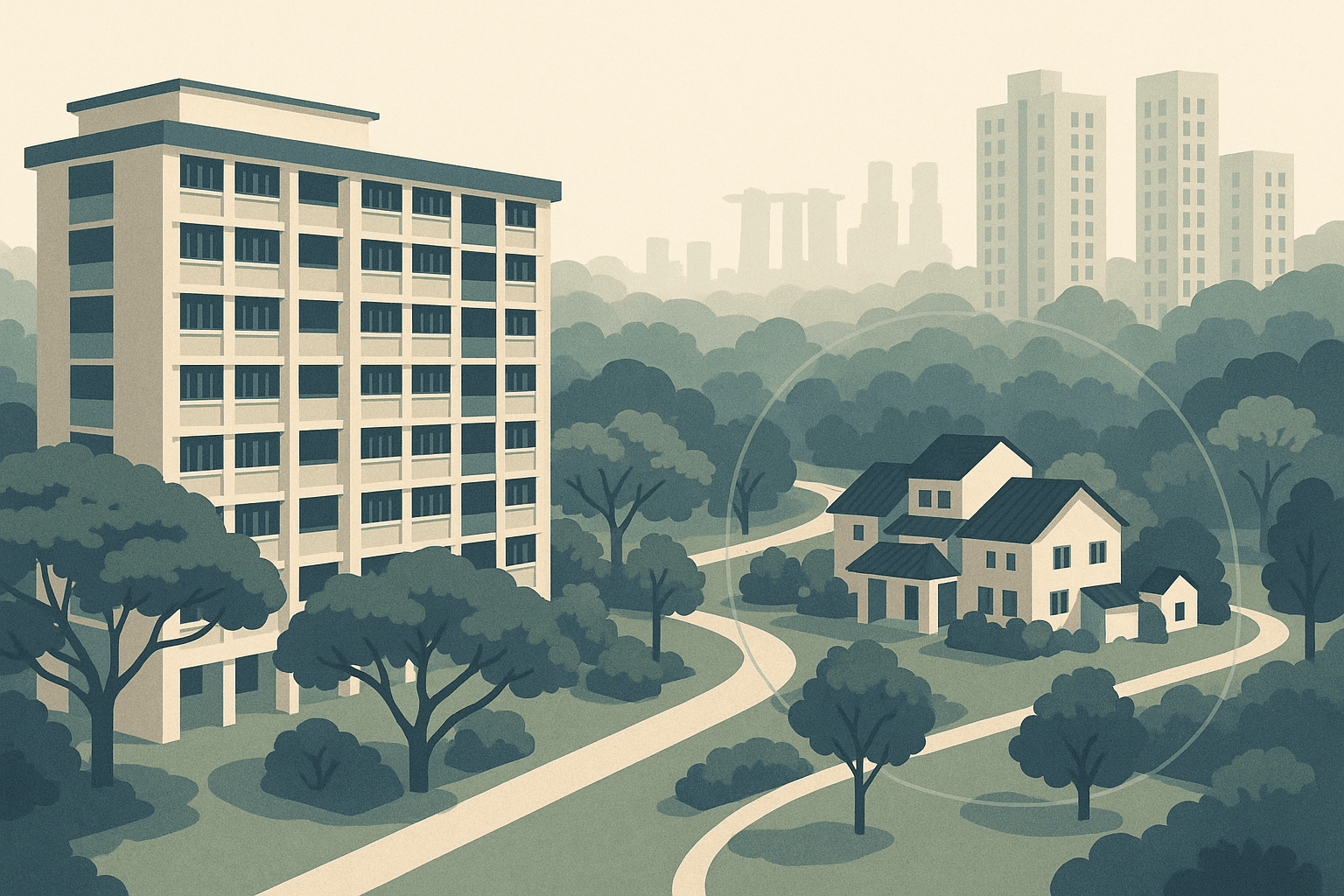
PHG is often mentioned early in resale budgeting, but it is best treated as a verification issue first. Before you count on the grant, confirm that the purchase is an HDB resale flat, that the family setup fits the relevant HDB route, and that the intended flat passes HDB's official proximity check where you plan to live near parents or children.
What is the Proximity Housing Grant and who is it designed to help?
PHG is a CPF housing grant for eligible HDB resale buyers who want to live with or near their parents or children. As of 2026 it is worth $30,000 (with) or $20,000 (near) for families, and $15,000 or $10,000 for singles, with no income ceiling and once per lifetime. It is a family-proximity grant, not a general subsidy for every HDB buyer.
PHG is meant to support family living arrangements, especially where you want easier day-to-day support, caregiving, or closer contact with parents or children. The practical point is simple: PHG is tied to a specific family setup and a resale purchase, not just a desire to reduce cost.
As of 2026, HDB sets the PHG for eligible resale families at $30,000 when the buyer lives with a parent or child in the same flat, and $20,000 when the buyer buys a separate flat and lives near them (within 4km). Eligible singles receive half of this: $15,000 for living with, and $10,000 for living near. Two important structural features shape how you can use it: PHG has no income ceiling, so a higher earner is not screened out, and it can be taken only once per lifetime. Confirm the current amounts on HDB before you build them into your budget.
Think of PHG this way: it rewards a qualifying family location decision. That is why the first questions are about who you will live with or near, and whether the purchase is under the HDB resale route.
Typical scenario: you want to move closer to ageing parents in another town. PHG may be relevant. Choosing resale purely because you heard there is an extra grant does not mean PHG applies until the family relationship and living arrangement are checked.
If you are still comparing grants more broadly, it helps to anchor the picture with our HDB housing grants guide before drilling into PHG-specific rules. Because PHG has no income ceiling, it can also sit alongside the income-tested Enhanced CPF Housing Grant for singles for an eligible single resale buyer.
The insight: PHG is about family proximity, not just affordability.
When does PHG apply to an HDB resale purchase?
PHG applies only when you are purchasing an HDB resale flat. If you are looking at BTO or another non-resale route, do not build PHG into the budget at all; for a new flat, see the Family Care Scheme (Proximity) answer below.
This is the first filter, and it should be checked before relying on grant-based affordability. PHG is tied to HDB resale flats. If you are still deciding between BTO and resale, PHG belongs only on the resale side of that comparison.
Why this matters in practice:
- It is easy to hear about "HDB grants" in general and assume all grants can be mixed into any purchase route.
- Shortlisting based on a grant that does not apply can distort price expectations and negotiation posture.
- Clearing this up early avoids a later situation where you suddenly have to reduce budget or widen the search area.
A useful way to frame it: PHG is not an all-purpose HDB grant. It only comes into play for eligible resale purchases. So before you use it in planning, confirm that you are definitely buying resale.
For the current official framing, see HDB's PHG page for couples and families.
Practical takeaway: confirm purchase route before relying on PHG amount, distance, or shortlist strategy. For a broader overview, see PHG Near vs With Parents or Children.
Who can apply for PHG?
The Proximity Housing Grant (PHG) is open to Singapore Citizens buying an HDB resale flat to live with or near a parent or child. A family needs at least one other Singapore Citizen or PR in the application and an applicant aged 21 or older; a single must be 35 or older (21 if buying with a non-resident spouse); the parent or child must be at least a PR; and you can't have had the PHG before (HDB, as of 2026).
PHG is not one flat rule for every buyer profile. In broad terms, family or couple applicants and eligible singles may both encounter PHG, but the qualifying path differs by household type. HDB's conditions, as of 2026 (families; singles):
| Condition | Families and couples | Singles |
|---|---|---|
| You | A Singapore Citizen, with at least 1 other SC or PR in the application | A Singapore Citizen |
| Minimum age | 21 | 35 (21 if buying with a non-resident spouse) |
| The parent or child | At least a PR; a single child must be 35 or older | At least a PR; a single child must be 35 or older |
| The flat | A resale flat with more than 20 years of lease left | The same; 2- to 5-room if you live near rather than with them (any type with a non-resident spouse) |
| Taken the PHG before? | Not eligible | Not eligible |
| Income ceiling | None | None |
Parents buying over their child's flat can't get the PHG. A single aged 35 or above who buys to live with their parents gets the singles amount ($15,000), even though the parents are in the application.
The with-or-near choice sets the amount; the table above sets who qualifies.
A common mistake is copying someone else's PHG outcome onto your own case. Two buyers may both want to live near parents, but their household structure can be different enough to change the eligibility picture.
Useful scenarios:
- A married couple buying a resale flat near the wife's parents: qualifies for $20,000 if one of you is a Singapore Citizen (the other a citizen or PR), you're 21 or older, you haven't had the PHG, and her parents' home qualifies and is within 4km.
- Hearing "my friend got PHG when buying near her parents": that is not enough. Verify the singles route against HDB's current PHG page for singles or our guide on PHG for singles buying resale flats.
Be careful with edge cases. For example, if the family home involved is private property, or if the relationship setup is not straightforward, do not assume eligibility from secondary articles alone. Use HDB's current page as the working reference before relying on it. On private homes, HDB's rule is specific: your parents or child must own and live in it, or live in one owned and lived in by their immediate family — a private home they only rent doesn't count.
The insight: PHG is not just about distance. It is distance plus the right household pathway. For a broader overview, see How to Check If a Resale Flat Qualifies for PHG Within 4km.
What does the 4km rule mean in real terms?
For the nearby-living scenario, the intended resale flat must pass HDB's official 4km proximity check to the parents' or children's home. Do not rely on travel time, same-town assumptions, or rough map estimates.
In practice, the 4km rule means one thing: the flat must pass HDB's own distance check. That check matters more than Google Maps, driving routes, MRT convenience, or how "close" the addresses feel.
Defined precisely, "near" means the parent's or child's home is within 4km of the resale flat, as HDB's e-service measures it, not the driving route. The home has to qualify: an HDB flat they live in as owners or registered occupiers (if they are occupiers, the owners must be immediate family who also live there); an HDB rental flat they live in as the registered tenant or occupier; or a private home they own and live in, or one owned and lived in by their immediate family (HDB). An HDB flat or private home they only rent on the open market doesn't count. Their NRIC must show that address, and they must keep to the 4km rule through your minimum occupation period. "With" means sharing the same flat, where no distance test applies. To get the "with" amount, your parents or child must be in your HFE letter and resale application and live in the flat through your MOP (their names can't be removed), and any HDB flat that you or anyone listed owns must be disposed of within 6 months of completing your purchase (HDB). HDB's official enquiry tool gives the result, so treat that output as the deciding figure.
The practical workflow should be:
- Confirm the exact address of the intended resale flat.
- Confirm the exact address of the parents' or children's residence.
- Run HDB's Check Distance for Proximity Housing Grant e-service (formerly the distance enquiry tool).
- Keep the result before you rely on PHG.
What is often misunderstood:
- Same estate does not automatically mean within 4km.
- Same block always passes the distance test, but the rest of the rules still apply.
- A shorter driving route does not replace HDB's official result.
- "It looks near on the map" is not usable for budget confirmation.
A realistic example: you narrow the search to flats near parents in another estate boundary. The addresses look close enough on a consumer map, but the official HDB check can still be the deciding factor. That is why PHG should be checked before the shortlist becomes too narrow.
If you need a more process-focused walkthrough, see our guide on how to check if a resale flat qualifies for PHG within 4km.
The insight: perceived convenience is not the test; HDB's official distance result is. For a broader overview, see PHG for Singles Buying Resale Flats: Eligibility, 4km Rule and Common Pitfalls.
What is the difference between living near parents and living with parents or children?
PHG treats living in the same flat and living nearby in a separate flat as two different setups. Do not use "near" and "with" interchangeably.
This distinction matters because it affects both eligibility framing and your actual housing choice.
Living with parents or children means one shared household in the same flat. Living near them means a separate flat that still satisfies HDB's official proximity requirement. It is easy to blur these together because the family intention sounds similar, but the housing setup is different.
Here is a simple comparison to work from:
| Setup | What it means | What to check first |
|---|---|---|
| Living with parents or children | You and family members will live in the same flat | Confirm the household arrangement and the relevant HDB eligibility route |
| Living near parents or children | You will live in a different flat near family | Confirm the household route, then run HDB's official distance check |
Typical trade-off to weigh:
- Living with family may solve care and daily support more directly, but it changes privacy and household dynamics.
- Living near family preserves separate households, but the chosen flat still has to pass the distance check.
Simple way to decide: if you want your own unit, you are looking at the 'near' setup and must verify the 4km rule. If you plan to share one home, that is a different PHG setup.
If you are weighing these two choices seriously, see our deeper comparison: PHG Near vs With Parents or Children.
The insight: same family intention does not mean same grant setup. For a broader overview, see How Much Is the Proximity Housing Grant (PHG)? Grant Amounts and What Affects It.
What common situations usually trip up PHG applicants?
The usual PHG mistakes are using the wrong property route, guessing the distance, and assuming family closeness alone is enough. Most problems start with assumptions made too early in the search process.
PHG issues usually surface before submission, not after. In many cases, a budget or shortlist has already been built around a grant that was never properly verified.
Common traps to screen for early:
- You are not actually buying an HDB resale flat but still expect PHG.
- You assume same block, same neighbourhood, or same town means automatic qualification.
- You check travel time or road distance instead of HDB's official result.
- The household structure is unclear, but the grant has already been included in affordability calculations.
- The family address used for the proximity idea may involve a private property or a more complex arrangement, and you treat that as settled without checking HDB's current rules.
A practical pre-screening example: if you can only afford an area if PHG applies, do not wait until the option stage. Run the distance check and confirm the household route while you are still broadening or narrowing the shortlist.
Another common issue is language. "Near my parents" gets used loosely, but what it really means may range from same block to same town to a 10-minute drive. Those are lifestyle descriptions, not eligibility tests.
Practical takeaway: PHG should be checked at shortlist stage, not after offer intent hardens.
Is there a proximity grant for BTO flats?
No. The PHG is for resale flats only. For a new BTO or Sale of Balance Flats (SBF) flat, HDB's Family Care Scheme (Proximity) gives you priority in the ballot — not a grant — if you apply to live with your parents or child, or in a project whose nearest block is within 4km of their home (HDB, from the July 2025 sales exercise).
The Family Care Scheme (Proximity) replaced the Married Child Priority Scheme and the Senior Priority Scheme (living with or near) from the July 2025 sales exercise. Who gets priority, per HDB's priority schemes page:
- Who qualifies: parents and their children, married or single, applying to live with or near each other. At least one parent or child must be a Singapore Citizen or PR, and a single child must be 35 or older.
- Who goes first: for families and first-timer singles, the quota goes first to applicants who will live with their parents or child; whatever is left goes to those applying to live near them.
- After you get the keys: your parents or child must keep living with you or within 4km through the minimum occupation period.
How much of a BTO exercise is set aside for non-seniors under the scheme:
| Applicant | Standard and Plus: 2-room Flexi | Standard and Plus: 3-room and bigger | Prime: 2-room Flexi | Prime: 3-room and bigger |
|---|---|---|---|---|
| First-timer families | 5% | 30% | 3% | 20% |
| Second-timer families | 5% | 5% | 2% | 3% |
| First-timer singles | 30% | — | 20% | — |
In SBF exercises the shares are 30% for first-timer families, 3% for second-timer families and 2% for first-timer singles (20%, 2% and 1% for Prime flats). For seniors, half of the seniors' quota in Standard and Plus projects, and a quarter in Prime projects, is set aside. Parents and children can also apply together for two units in the same BTO project under the FCS (Joint Balloting), which replaced the Multi-Generation Priority Scheme from October 2025.
You can apply under only 1 priority scheme, though a household that qualifies for the Family and Parenthood Priority Scheme can add 1 other, such as this one. Priority improves your ballot chances but, as HDB says, doesn't guarantee a good queue number.
What should you verify before assuming you likely qualify?
Verify the current HDB PHG route, the resale flat type, the family relationship setup, and the official distance result before you treat PHG as usable budget support.
Use a four-point check before settling on a confident view:
- confirm the current official PHG route on HDB or SupportGoWhere for families if relevant
- confirm the purchase is an HDB resale flat
- confirm whether the setup is living with parents or children, or living near them in a separate flat
- confirm the result from HDB's Check Distance for Proximity Housing Grant e-service for the nearby-living scenario
If any one of these is still unclear, do not treat PHG as "approved" or "secured." A safer way to hold it: PHG may apply, but verify the official route and distance check before you price around it.
How does PHG work, in one minute?
PHG is for eligible resale HDB buyers who want to live with or near parents or children, but the household setup and official 4km check must be confirmed before it is used in budgeting.
Here is the short version:
PHG is a grant for eligible buyers of resale HDB flats who want to stay with or near their parents or children. If you are buying a separate flat near them, you need to run HDB's official distance check. If you are planning to live in the same flat, you need to confirm the household setup under HDB's rules first. Until those official checks are done, treat the grant as possible support rather than confirmed.
An even shorter version:
PHG may help with a resale HDB purchase if your family setup fits and the official proximity check passes. Verify that before you rely on it.
Treat PHG as possible until your HFE letter and the distance check confirm it.
For official references, see HDB's PHG page for couples and families and CPF's guide to housing grants. If your next question is about value rather than eligibility, see our page on how much PHG is available.
If you want a flat in the same block as the parents, is PHG automatically okay?
No. A flat in your parents' block clears the 4km test, but that's all it settles. You get the "near" amount ($20,000 for a family, $10,000 for a single), and only if you meet HDB's other conditions: your parents' flat must qualify, their NRIC must show that address, they must stay through your MOP, and you can't have had the PHG before.
Treat "same block" as a location description, not an approval rule. It may sound obviously close, but PHG is still governed by HDB's current criteria and, for the nearby-living setup, the official distance result.
A flat in the same block is well within 4km, so the distance test isn't where it fails. What can still go wrong:
- your parents' flat must qualify: they must live in it as owners or registered occupiers
- their NRIC must show that address, and they must stay there through your MOP
- you can't have had the PHG before, and your household must meet HDB's other conditions
A separate flat in the same block earns the "near" amount, not the "with" amount — that needs you to live in the same flat.
Practical takeaway: do not let a "same block" assumption drive negotiations or budget confidence before the official checks are done.
Methodology and sources
Where the figures come from — and what this page does not claim.
Sources. PHG amounts and rules on this page are from HDB and the CPF Board, current as of 2026. The PHG has no income ceiling of its own, and HDB's eligibility conditions for it list none. Other grants change from time to time (EHG maximums, for example, were raised in August 2024). Grants are revised from time to time, so confirm the current figures and your own eligibility on the official HDB/CPF pages before relying on them.
Updated September 2026. The eligibility table, the qualifying-home rules and the MOP condition are from HDB's PHG page for families and PHG page for singles (both last updated 20 August 2026); the BTO priority rules from HDB's priority schemes page (last updated 23 August 2026). All read on 18 September 2026.
Scope. This is a practical explainer, not financial advice, and does not guarantee any grant for a specific household — eligibility depends on the full HDB assessment.
Got a question this raised? Ask PropKaki.
Take any point from this analysis and apply it to your own project, budget or decision.
 PropKaki
For most buyers this year, staying well within budget beats trying to time the market.