

How to Check If a Resale Flat Is Within 4km of Parents for PHG
A practical workflow to verify PHG proximity using HDB’s official distance enquiry, confirm the correct home address, and avoid checking the wrong unit before an offer.
To check if a resale flat meets the Proximity Housing Grant's 4km rule, run HDB's Check Distance for Proximity Housing Grant e-service (formerly the Distance Enquiry) with the flat's block and your parents' or child's actual home address. Within a 4km radius, a family can get $20,000 to live near them ($10,000 for a single); living together instead pays $30,000 ($15,000) with no distance test (per HDB, as of 2026). A pass settles only the distance: your household still has to meet HDB's other PHG conditions, and the grant can be taken only once. Run the check before you pay the option fee or exercise the OTP — the grant relies on HDB's result, not a map estimate.
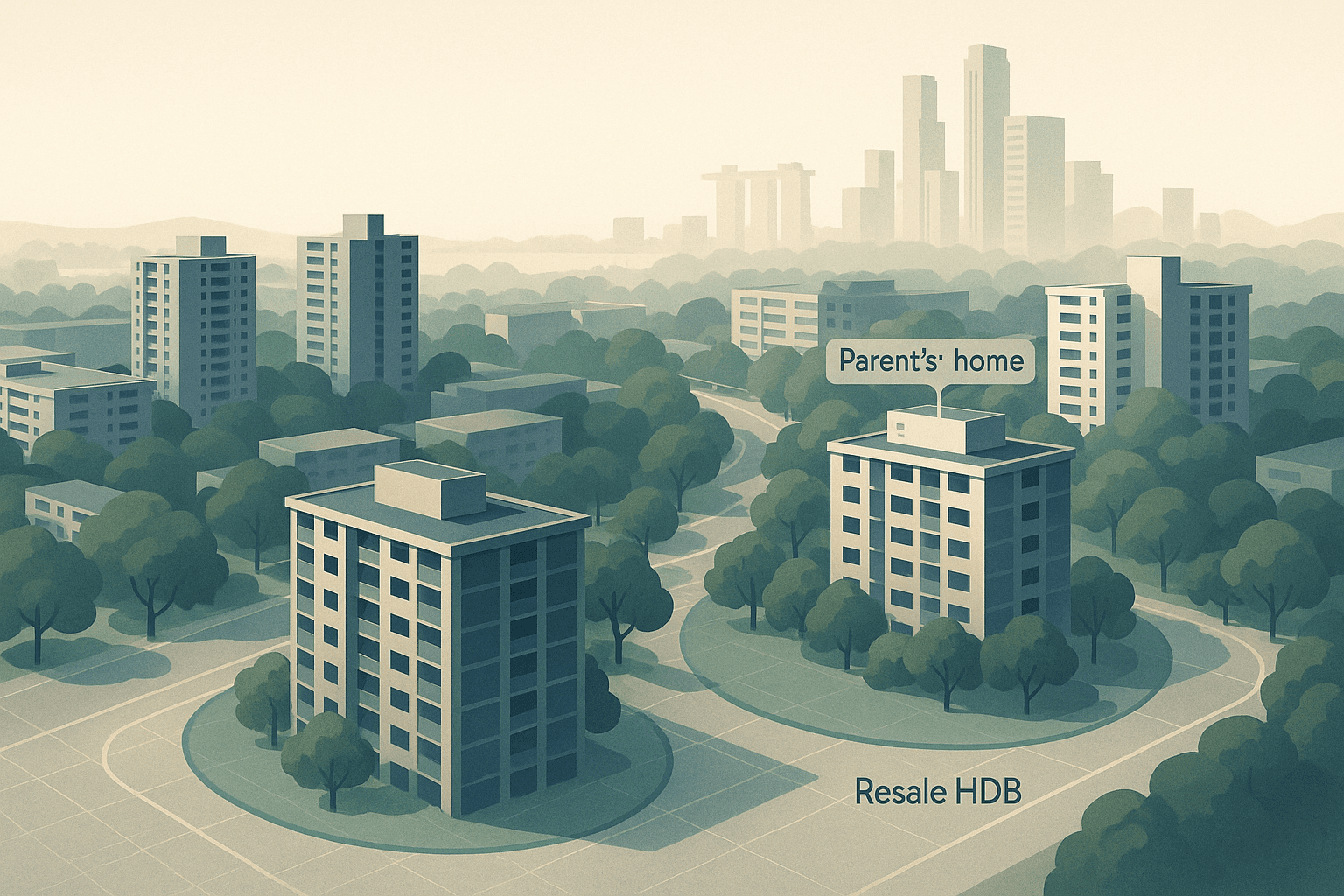
If you want PHG because you plan to live near parents or children, do not rely on a rough Google Maps estimate. Use HDB’s official Distance Enquiry for Proximity Housing Grant with the exact resale flat address and the relevant family member’s actual residential home address. That gives you a cleaner pre-offer answer and reduces the risk of committing to the wrong unit.
What does the PHG 4km rule actually mean for resale buyers?
For PHG, the resale flat must be within a 4km radius (as HDB's e-service measures it, not a driving route) of the relevant parents’ or children’s home address. Clearing it unlocks the “near” tier — $20,000 for families and $10,000 for singles as of 2026. This is a proximity screen, not a full grant approval by itself.
In practical terms, the PHG 4km rule is a flat-to-home check. The question is not whether the unit is in the same town, near the same MRT station, or generally “close by.” The question is whether that specific resale flat falls within 4km of the relevant family member’s home address for PHG purposes.
The rule works like this: the parent's or child's home — an HDB flat, HDB rental flat or private home that meets HDB's ownership conditions (see the verification steps below) — must be within 4km of the resale flat, as HDB's e-service measures it between the two addresses, not the driving route a map app shows. Clearing that check is what unlocks the “live near” tier of the grant. As of 2026, that “near” tier is worth $20,000 for an eligible family and $10,000 for an eligible single; living with a parent or child in the same flat (no distance test) is worth $30,000 for a family and $15,000 for a single. Confirm the current amounts on HDB before you budget with them.
That matters because it is easy to shortlist by area first. A unit in the same estate can still fail the proximity check, while a unit in a neighbouring estate may still pass. So avoid assuming “this whole neighbourhood should qualify” unless each shortlisted unit has been checked.
Put simply: PHG proximity is checked flat by flat — HDB's e-service works block by block, by postal code. You still need to verify this exact flat against your parents’ home address. For the broader PHG framework, see HDB’s Proximity Housing Grant page and PropKaki’s PHG eligibility guide.
The insight: proximity is not a neighbourhood claim; it is an address-level check. For a broader overview, see HDB Housing Grants in Singapore: EHG, Family Grant, PHG and Singles Support.
What address should you use when checking the parents’ home?
Use the parents’ actual residential home address. Do not use a mailing address, an old address, or the address that happens to make the flat look eligible.
The most common PHG mistake is not the map tool. It is the wrong address.
What matters is where the parents or children actually live. Do not assume this from an old NRIC address, a correspondence address, or a vague statement like “they stay around Bishan.” Get the full residential address before screening the flat. HDB's rule is specific: your parents' or child's NRIC must reflect the address they actually live in, and they must keep to the proximity rule through the MOP (HDB).
Be more careful when the family setup is not straightforward, for example:
- the parents moved recently
- they are temporarily staying with relatives
- they own one property but live in another place
- you are thinking of a former home address
In these cases, pause before forming a view on PHG. A fast but wrong answer is worse than a slower accurate one. If needed, use the official SupportGoWhere PHG page and verify the live case with HDB before you commit.
Practical takeaway: confirm the residential address first, then check distance. Do not reverse that order. For a broader overview, see Proximity Housing Grant (PHG): Eligibility, 4km Rule and Who Can Apply.
How can you verify if a flat is within 4km of the parents’ home?
Use HDB’s Check Distance for Proximity Housing Grant e-service (formerly the Distance Enquiry) with the exact flat address and the exact residential home address. Save the result and use it as your working reference for the deal.
The cleanest workflow is straightforward:
- Get the exact resale flat address you are considering.
- Confirm the parents’ or child’s actual residential home address.
- Run HDB’s Check Distance for Proximity Housing Grant e-service (formerly the Distance Enquiry for Proximity Housing Grant). It checks block to block, by postal code.
- Save a screenshot or printout of the result for your records and follow-up.
- Reconfirm the same addresses before you make an offer, pay the option fee, or exercise the OTP.
This matters because PHG screening is most useful before money and expectations are locked in. A saved result is not a legal substitute for HDB’s eventual assessment, but it is a practical record of why you shortlisted or ruled out a unit.
The home you check against has to qualify, not just be where your parents or child live (HDB):
- An HDB flat they live in as owners or registered occupiers. If they are occupiers rather than owners, the flat must be owned and lived in by their immediate family (a child, parent, parent-in-law or sibling).
- An HDB rental flat they live in as the registered tenant or occupier.
- A private home they own and live in, or one owned and lived in by their immediate family. A private home they only rent does not count.
If they have booked an HDB flat under construction or applied to buy a resale flat, HDB says that flat may be used as the reference instead.
Example: if you are deciding between two nearby resale flats, run the HDB check on both exact addresses before deciding which one better fits the grant plan. That is much safer than assuming both “should be within range” based on the same neighbourhood. For a broader overview, see PHG Near vs With Parents or Children.
Which tools or sources are best for a quick PHG proximity check?
Use HDB’s official e-service for the answer that matters, and use map apps only to help you visualise the location.
If you are making a real purchase decision, HDB should be your first check, not your final confirmation after a map app.
A good way to think about the tools is:
| Tool | Best use | What not to use it for |
|---|---|---|
| HDB Distance Enquiry | Official PHG proximity check for a specific unit | Getting a feel for the neighbourhood |
| Google Maps or similar apps | Showing landmarks, travel routes, nearby amenities | Deciding whether PHG proximity has been met |
This distinction helps. Map apps are good for seeing that the flat is near the parents’ estate, the MRT, or a familiar shopping mall. But PHG is not based on how intuitive the location feels. It is based on the official distance check.
If you need a broad overview of PHG before the address-level check, use HDB’s PHG page or PropKaki’s main grants guide. For a broader overview, see How Much Is the Proximity Housing Grant (PHG)? Grant Amounts and What Affects It.
Why can two people get different answers from the same map search?
Because different tools may measure route distance, straight-line distance, or use different map data. That is why app screenshots are not a PHG determination.
One person may be looking at a driving route. Another may be using a point-to-point measure. Someone else may be eyeballing the map without measuring at all. Google Maps itself explains different ways of measuring routes and distances in its help guide.
The practical point is simple: when PHG affects whether you will pursue the unit, rely on HDB’s distance enquiry, not a screenshot from a general map app.
The insight: if the number changes when the app changes, it is not your PHG answer yet.
What should you confirm before assuming you likely qualify for PHG?
Confirm the HDB distance result first, then review the broader PHG basics. A passing distance check is helpful, but it is not the same as saying the grant is confirmed.
Once the distance screen looks positive, the next step is to make sure the rest of the PHG story still fits. At minimum, confirm that:
- the purchase is for a resale HDB flat
- the relevant parent or child household is the correct one to check against
- the family’s living arrangement matches the PHG basis you are relying on
This is where it pays to slow down if the setup is unusual. For example, if you want PHG for living near parents but the parents may move again soon, that is not a detail to brush aside. HDB requires them to keep to the 4km rule throughout your minimum occupation period (MOP), so a planned move is a real problem, not a detail.
Put simply: the unit appears to pass the distance screen. Next, make sure the rest of the PHG criteria line up before treating it as likely.
For a fuller explanation, see PropKaki’s PHG eligibility guide and, where relevant, the article on PHG near vs with parents or children. If you are single, the way PHG sits alongside other grants is covered in our guide on HDB grants for singles: BTO vs resale.
When should you do the PHG check in the buying process?
Do it before you make an offer, pay the option fee, or exercise the OTP. PHG proximity should help shortlist units, not create a problem after commitment.
The best time to run the check is as soon as you have a serious shortlist of actual units.
A practical workflow is:
- Use your target area only for broad searching.
- Once a specific flat is shortlisted, confirm the parents’ exact residential address.
- Run the HDB distance check before you commit.
- Save the result and refer to it in follow-up.
This is not just admin discipline. It changes decision quality. If you check too late, you may already be emotionally anchored to the flat and start treating PHG as part of the affordability plan. That makes a negative result much harder to manage.
PHG should filter the shortlist early, not rescue the decision later.
How many times can you take the proximity grant?
Once. HDB gives the Proximity Housing Grant only to buyers who have not taken the PHG before — families and singles alike — so if you received it on an earlier resale flat, you can't claim it again on the next one (per HDB, as of 2026).
HDB's eligibility conditions for the PHG start with a simple test: the grant is for couples or families "who have not taken the PHG previously" (HDB), and HDB's PHG page for singles carries the same rule.
A family can take either $30,000 to live with parents or a child, or $20,000 to live within 4km; a single, $15,000 or $10,000. Whichever tier you get, it is one grant for good: you can't take the PHG again on a later resale flat. For who qualifies in the first place, see PHG eligibility.
How do I check my HDB grant status?
Check it in two places. Before you buy, your HDB Flat Eligibility (HFE) letter shows the CPF housing grants your household can get — including the PHG, if the flat you buy meets the proximity rule. After the purchase, the PHG is credited into the CPF Ordinary Accounts of the Singapore Citizen and PR members of the core family, so it shows up there.
There are two checkpoints:
- Before you buy: apply for an HDB Flat Eligibility (HFE) letter on the HDB Flat Portal. HDB says it informs you upfront of your eligibility to buy, the CPF housing grants you are eligible for, and the HDB loan you can take (HDB).
- After you buy: the PHG is credited into the CPF Ordinary Accounts of the Singapore Citizen and Singapore Permanent Resident members of the core family nucleus, by their share. Core applicants — the flat's buyers — can use it to offset the price or reduce the loan.
Order matters: get the HFE letter first (HDB says to apply before you start house-hunting), then run the distance check on each flat you shortlist. The HFE shows the grants your household can get; whether a particular flat earns the "live near" tier depends on that flat passing the 4km check, and HDB confirms it when it approves your resale application.
Does the 4km proximity check work the same way for a BTO flat?
No. The PHG is for resale flats only and measures from the flat to the parents' or child's home. For a new flat, HDB's Family Care Scheme (Proximity) gives ballot priority when the project's nearest block is within 4km of your parents' or child's home (per HDB, from the July 2025 exercise).
The two 4km tests look alike but do different jobs:
| Resale flat: Proximity Housing Grant | New flat: Family Care Scheme (Proximity) | |
|---|---|---|
| What you get | A grant of $20,000 (near) or $30,000 (with), for families | Priority in the BTO or Sale of Balance Flats ballot |
| What is measured | The resale flat to your parents' or child's home, within 4km | The project's nearest block to your parents' or child's home, within 4km |
From the July 2025 sales exercise, the Family Care Scheme (Proximity) replaced the Married Child Priority Scheme and the Senior Priority Scheme (living with or near). Its quota goes first to applicants who will live with their parents or child; whatever is left goes to those living near. Priority improves your ballot chances, but HDB says it doesn't guarantee a good queue number — see HDB's priority schemes page for the quotas. The grant side is covered in PHG eligibility.
What should you verify before committing to a resale flat for PHG?
Use this pre-offer checklist so you are not relying on an unverified proximity assumption.
- ✓Confirm the exact resale flat address, not just the block area or estate.
- ✓Confirm the parents’ or child’s actual residential home address.
- ✓Do not use a mailing address, outdated address, or assumed family address.
- ✓Run HDB’s Distance Enquiry for Proximity Housing Grant.
- ✓Save a screenshot or printout of the HDB result for your records.
- ✓Remember that the result is a proximity screen, not full grant approval.
- ✓Recheck the addresses if the family mentions a recent move or unusual living arrangement.
- ✓Complete this check before the offer, option fee, or OTP exercise.
If the flat is within 4km, does that mean you will definitely get PHG?
No. A flat being within 4km only addresses the proximity part of PHG. You still need to satisfy the rest of the grant framework.
Being within the distance requirement is encouraging, but it does not make the grant guaranteed.
“Within 4km” is a useful green light for shortlisting and affordability planning, but it is not the same as final grant approval. Other eligibility points still need to make sense for your case and that transaction.
Put simply: the unit appears to pass the PHG distance check, but review the rest of the PHG requirements before treating the grant as likely. If you are also asking how PHG may affect your grant planning overall, see PropKaki’s guide on how much PHG is.
What if the flat looks close to 4km but you have not verified it yet?
Treat it as promising, but PHG should only be treated as likely after the official HDB distance check for that exact unit.
Treat the flat as a maybe until HDB's check says yes. Until then, leave the $20,000 “near” grant out of your budget, and don't let a close-looking map make the decision for you.
If you want to move fast, run the HDB check straight away and save the result — that settles it faster than comparing screenshots from different apps.
Methodology and sources
Where the figures come from — and what this page does not claim.
Sources. PHG amounts and rules on this page are from HDB and the CPF Board, current as of 2026 — the PHG has no income ceiling of its own, and HDB's eligibility conditions for it list none (with effective dates noted where amounts changed recently — e.g. EHG maximums were raised in August 2024). Grants are revised from time to time, so confirm the current figures and your own eligibility on the official HDB/CPF pages before relying on them.
Updated September 2026. The family PHG amounts, the one-time rule, the address, NRIC and ownership conditions and the CPF crediting are from HDB's PHG page for families, and the singles amounts from HDB's PHG page for singles (both last updated 20 August 2026); the BTO proximity rule from HDB's priority schemes page (last updated 23 August 2026). All read on 18 September 2026.
Scope. This is a practical explainer, not financial advice, and does not guarantee any grant for a specific household — eligibility depends on the full HDB assessment.
Got a question this raised? Ask PropKaki.
Take any point from this analysis and apply it to your own project, budget or decision.
 PropKaki
For most buyers this year, staying well within budget beats trying to time the market.