
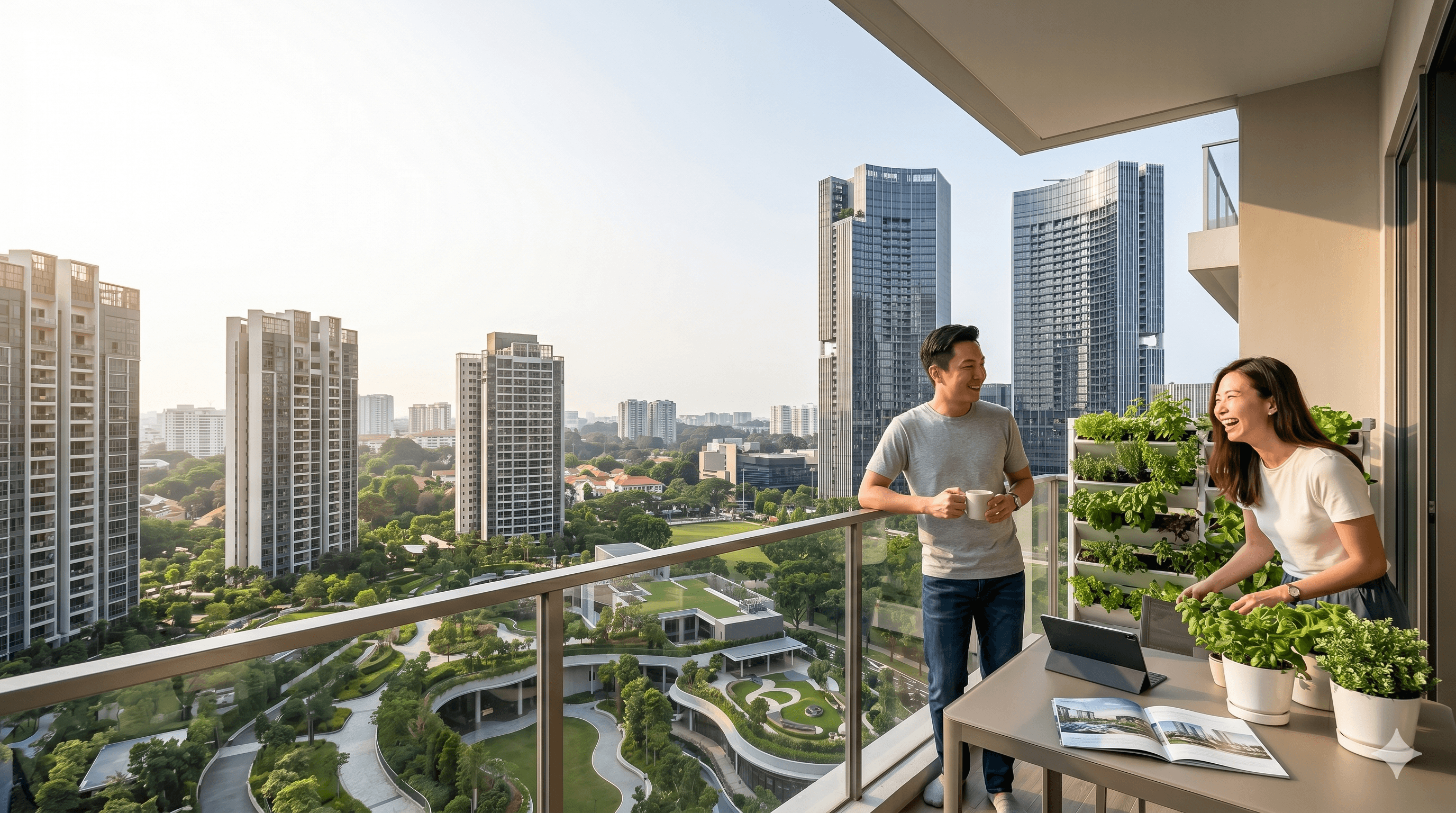
Five Times Oversubscribed in Eleven Days — and It Only Ever Had a Hundred Rooms
More than 500 young Singaporeans applied for around 100 discounted co-living rooms at $1,800 a month. The response is being read as proof the scheme works. It is better read as a measurement of how much demand there is and how little supply.
More than 500 young Singaporeans applied for around 100 discounted co-living rooms between the scheme's launch on 25 July 2026 and 4 August, leaving it five times oversubscribed. The rooms sit at 1925 Quarters in Jalan Besar, Coliwoo Boon Lay and Coliwoo Lutheran in Bukit Timah, are offered at a 30% discount starting from $1,800 a month, and are allocated first-come, first-served; the majority of applicants are single. For scale, the number of Singapore citizens and PRs under 35 living alone rose from 10,500 in 2016 to 22,600 in 2025. Our own rental data prices whole homes, not rooms: across 89,307 private non-landed leases in the trailing 12 months, the median rent is $4,300, a one-bedroom unit runs a median $3,300, and by region the medians are $3,900 in the OCR, $4,300 in the RCR and $5,672 in the CCR.

The Straits Times reported this month that more than 500 young Singaporeans signed up for discounted co-living rooms in the 11 days after the scheme launched, leaving it five times oversubscribed.
The initiative, part of the SG Youth Plan, offers over 100 rooms across three co-living properties at a 30% discount, for Singaporeans aged 21 to 35 who want to live independently — including singles and couples waiting for a BTO flat. Discounted rates start at $1,800 a month, with the operators absorbing the subsidy.
We wrote about the policy behind this two weeks ago, when it was a minister saying the government was studying more rental options. Now there are application numbers, and they say something quite specific — just not the thing the headline implies.
The applicant who was on the waitlist by day ten
An engineer applied on the first day, was waitlisted within a fortnight, and is now looking elsewhere.
The Straits Times found someone who applied on the very first day. An engineer, 29, who asked to be known only as Alicia. She wanted a twin room at the Bukit Timah property because it is closer to work, and she liked the idea of meeting other young people in a co-living space.
On 3 August she got an email telling her she was on the waitlist. Should units become available, waitlisted applicants would be referred to operators in sequence, based on the timestamp of their application.
She was not especially bothered — she will look at other options. But her reason for wanting to move is worth sitting with, because it is not a housing-policy reason. She told the paper she wants to change her way of life at this stage, because her family "see me as a child forever".
That is the demand this scheme found. Not people who lack shelter. People who have a bedroom in their parents' flat and want a life that starts before they turn 35.
What five times oversubscribed actually tells you
That a hundred rooms is a small number — and that $1,800 clears the market instantly.
Oversubscription statistics feel like verdicts. They are usually just ratios, and a ratio has a denominator.
The denominator here is about 100 rooms, across three buildings. The numerator is more than 500 applications in 11 days. Both numbers are real; only one of them is surprising.
Against the population being served, the supply is very small. As the report notes, citing Department of Statistics data, the number of Singapore citizens and PRs under 35 living alone more than doubled from 10,500 in 2016 to 22,600 in 2025. A hundred rooms is not a policy response to a group that size. It is a pilot.
So the honest reading of "five times oversubscribed" is not that the scheme succeeded. It is that the scheme was small, and that at $1,800 a month, rooms in Jalan Besar, Boon Lay and Bukit Timah clear in under two weeks.
That second finding is the genuinely useful one — and it is a fact about the rental market, not about the programme.
Is $1,800 a month for a room actually a discount?
We cannot price a room from our data. We can tell you a whole one-bedroom unit rents at a median $3,300.
This is the question everyone asked when the rates were announced, and we want to be straight about the limits of what we can say.
Our rental data does not price rooms. It covers transacted leases on whole private non-landed homes — 89,307 of them in the trailing 12 months. Room rentals, and HDB room sublets in particular, are a separate market that these figures do not cover.
What we can give you is the whole-home benchmark those rooms sit inside:
| Home type | Median rent | Rent psf | Leases (n) |
|---|---|---|---|
| 1-bed | $3,300 | $6.36 | 22,604 |
| 2-bed | $4,100 | $5.16 | 32,263 |
| 3-bed | $5,300 | $4.29 | 27,879 |
And by region:
| Region | Median rent | Leases (n) |
|---|---|---|
| CCR (Core Central) | $5,672 | 26,004 |
| RCR (Rest of Central) | $4,300 | 29,105 |
| OCR (Outside Central) | $3,900 | 34,198 |
The islandwide median across everything is $4,300, with the cheaper quartile at $3,500 and the pricier at $5,600.
So the comparison a 29-year-old is actually making: $1,800 for a room, against $3,300 for the entire smallest private home on the market. Just over half the price for a fraction of the space, with utilities, furnishing and shared facilities folded in, and — the part that matters most to this cohort — a minimum lease of one month rather than the usual two years.
PropNex chief executive Kelvin Fong made the same comparison from the industry side, telling the paper that $1,800 is broadly in line with the market rate for a master bedroom in a private condominium. That is a reasonable read, and it points at the awkward part: if the discounted rate is around market, the discount is doing less work than the framing suggests.
First-come, first-served is a real design choice
Places go by application timestamp — not by need, and explicitly not by income.
One line in the reporting deserves more attention than it got.
Places are allocated first-come, first-served. The National Youth Council said information collected — applicants' race, religion and income level — will not be used as selection criteria. Waitlisted applicants are referred to operators in sequence by the timestamp of their application.
There is a defensible case for that. It is transparent, it cannot be gamed by misrepresenting circumstances, and it avoids the state adjudicating whose desire to move out is more legitimate.
But it does mean the rooms went to whoever was watching on launch day, and that a subsidised place is not directed toward the applicants who most need the subsidy. MCCY declined to answer the paper's questions about applicants' occupations and income range, noting only that they came from diverse backgrounds — so we do not know who got them.
For a pilot testing whether demand exists, timestamp allocation is a fine choice. If this scales, it is the first thing that will have to change, because at scale it stops being a test and starts being an allocation of public benefit.
What the operators are saying, and what it implies
Coliwoo says it is open to adding rooms — which is the part that would actually change anything.
Coliwoo's executive chairman and chief executive Kelvin Lim told the paper the company is open to making more rooms available under the programme, and would work with MCCY to assess demand before deciding on timing, location and numbers. He also said the strong demand was no surprise: it reinforces what they already see on their own platform, that today's youth are actively looking for housing that offers independence and community.
He made a further point that is easy to skip past. Their rates and furnishing compare favourably to bare-room rentals, and the minimum lease is one month against the typical two years. Co-living, he argued, also offers a community that HDB room rentals do not naturally provide.
The lease-length point is, we think, the strongest thing anyone said in the whole story. A two-year commitment is the actual barrier for someone waiting on a BTO with an uncertain completion date. A person who can leave in a month is in a fundamentally different position from one signing a two-year lease.
If this initiative ends up mattering, it will be less because of the 30% discount and more because it normalised short-tenure rental for a cohort whose housing timeline is set by a ballot they have not won yet.
The honest reality-check: we are pricing next to this market, not inside it
Our rental figures are whole-home private leases. They contextualise a room price; they do not benchmark one.
We cannot tell you whether $1,800 is a good price for one of these rooms. Our data covers transacted leases on whole private non-landed homes. Room rentals and HDB sublets are a different market, and nobody publishes a comprehensive room-level rental benchmark for Singapore. Every comparison in this piece is a whole-home figure placed alongside a room price so you can see the scale — not a like-for-like valuation.
Transacted, not asking. These are URA rental contracts over a trailing 12-month window, so they lag the current market. Rent is gross — before any agency fee, maintenance or tax — and medians move with the mix of units let.
Non-landed private only. HDB sublet rent, which is where a large share of this cohort actually rents, is excluded entirely, as is landed.
And a specific unit varies enormously by floor, condition, furnishing and lease terms. A median is a midpoint of a wide distribution: islandwide the cheaper quartile sits at $3,500 and the pricier at $5,600.
One more caveat that is not about data. Five hundred applications is a real signal, but it is a signal from people who saw the announcement, were eligible, and were ready to move within days. That is not a random sample of young Singaporeans, and it should not be read as one.
Is co-living cheaper than renting a whole flat in Singapore?
Per person, usually yes. Per square foot, usually not.
Both halves of that matter.
Per person, it is cheaper. A room at $1,800 against a median $3,300 for a whole one-bedroom private unit is a real saving for someone living alone, and the co-living rate bundles in furnishing, utilities and shared facilities that a bare rental does not.
Per square foot, it is not. You are paying roughly half the price of an entire small home for one room in a shared one. That is how the co-living model works everywhere it exists: the operator monetises a shared unit at a higher rate per square foot than a single tenancy would achieve. Nobody is being deceived by this, but it is worth naming, because "cheaper than a condo" and "good value" are different claims.
The honest comparison set for someone in this position is not a one-bedroom condo. It is a room in an HDB flat, a room in a private condo, or staying at home — and we cannot price the first two from our data.
What the co-living option genuinely adds over those alternatives is the short lease, the furnishing and the community. Whether that is worth the premium over a bare room is a personal question, and 500 people answered it in the affirmative within eleven days.
Will there be more of these rooms?
The operator says it is open to it. Nothing has been committed.
Coliwoo has said it is open to making more rooms available and will work with MCCY to assess demand before deciding on timing, location and numbers. That is a genuine signal from the supply side, and a five-times-oversubscribed pilot is about the strongest evidence base an expansion decision could ask for.
But nothing has been committed, and it is worth being clear about what expansion would have to overcome. The discount is absorbed by the operators, which means every additional subsidised room comes out of somebody's margin. That is a workable arrangement for a hundred rooms attached to a national youth plan. It is a different proposition at a thousand.
The wider policy question — whether Singapore builds a genuine rental tier for people who are not yet eligible to buy, through co-living, long-stay serviced apartments or Build-To-Rent — is still at the study stage. This pilot is a data point feeding into that, and a fairly emphatic one.
For anyone currently waiting: allocation is by application timestamp, and the waitlist is worked in sequence, so applying early matters more than applying well.
How we sourced this
The scheme, the numbers and the quotes come from The Straits Times; the rental medians are ours.
Everything about the initiative — the 500-plus applications between 25 July and 4 August, the five-times oversubscription, the 100-plus rooms across 1925 Quarters, Coliwoo Boon Lay and Coliwoo Lutheran, the 30% discount and $1,800 starting rate absorbed by operators, the 21-to-35 eligibility, first-come-first-served allocation, the National Youth Council's statement on selection criteria, MCCY's response, the Department of Statistics figures on under-35s living alone, and the quotes from the applicant, from PropNex's Kelvin Fong and from Coliwoo's Kelvin Lim — comes from The Straits Times, linked below. Those are the reporter's facts, attributed rather than claimed as ours.
The rental figures are ours: transacted rents from URA rental contracts on private non-landed homes, over a trailing 12-month window — 89,307 leases — with medians by bedroom count and by URA market segment.
The caveat that matters most is in the reality-check section and we will repeat it here: our data prices whole homes, not rooms. Every figure we have put next to the $1,800 rate is context for scale, not a like-for-like benchmark, and we have not attempted to derive a room-level valuation from whole-home data.
Sources
The report, and our own private rental transaction data.
The news:
- The Straits Times — Over 500 young S'poreans apply for co-living rooms; scheme five times oversubscribed, 7 August 2026.
The data:
- PropKaki — transacted private non-landed rents from URA rental contracts, trailing 12 months: 89,307 leases, with medians by bedroom count and by URA market segment.
Related:
- She Rented a Room to Grieve, and Borrowed Money to Stay in It — our commentary on the policy behind this scheme.
About this commentary
Opinion and analysis from the PropKaki Editorial Desk — not financial or property advice.
This is commentary by the PropKaki Editorial Desk on reporting by The Straits Times. The account of the scheme, its numbers and every quoted person belong to that newsroom; the rental analysis, the framing and the opinions are ours.
To be fair to the initiative: nothing here is an argument that a hundred subsidised rooms is a bad idea. A pilot is supposed to be small, and this one has produced an unusually clear answer about demand. Our point is narrower — that a five-times-oversubscription headline describes the size of the pilot at least as much as the strength of the response, and that the more useful finding underneath it is about what young Singaporeans will pay to live alone.
It is opinion and general information, not financial, legal or property advice.
Published 12 August 2026.
Got a question this raised? Ask PropKaki.
Take any point from this analysis and apply it to your own project, budget or decision.
 PropKaki
For most buyers this year, staying well within budget beats trying to time the market.