
Springleaf Residence Review: Is a Nature-Fringe Address Worth ~$2,169 PSF?
It sells calm, forest views and a low-rise village mood, one MRT stop from the busy Lentor cluster. We price that tranquility against the resale market and every Lentor rival to see whether the quiet is worth paying for.
Springleaf Residence is a 941-unit, 99-year leasehold condo on Upper Thomson Road (District 26) by GuocoLand and Hong Leong Holdings, bordering Springleaf Forest and the Central Catchment Nature Reserve, a sub-two-minute covered walk from Springleaf MRT on the Thomson-East Coast Line, with vacant possession expected 31 December 2031. Across 934 developer-sale caveats its indicative pricing is about $2,169 psf (median ~$1.77M), roughly 34% above District 26's median resale. Against the launches you would actually cross-shop it is the value pick of the area: it undercuts every nearby Lentor project — Lentor Mansion (~$2,262), Lentoria (~$2,217), Lentor Central Residences (~$2,214), Hillock Green (~$2,212) — by roughly $45–95 psf, while offering the greenest, lowest-density setting of the lot. It suits the buyer who wants nature, quiet and a straight TEL commute; it is less compelling for a pure investor chasing the busiest growth corridor.
Springleaf Residence at a glance
| Developer | Springleaf Parcel B Pte Ltd |
|---|---|
| Tenure | 99-year leasehold |
| Units | 941 |
| Launched | August 2025 (first developer sale) |
| Sales progress | 917 of Springleaf Residence's 941 units (97%) had been sold as of Oct 2026, leaving 24 unsold (URA developer sales). |
| Launch price paid | S$2,170 psf median (S$1.78M), 929 developer caveats to Oct 2026 |
| District 26 resale | S$1,480 psf median across 80 resales in the last 12 months, so the launch price is 47% higher |
From URA caveats and URA's developer-sales figures (sales checked Oct 2026), refreshed daily. The review below was written earlier and quotes the figures of its day.
Every transaction and listing at Springleaf Residence →Resale profit odds →Floor plans ↓
Where is the Springleaf Residence showflat?
Springleaf Residence's showflat is at 825A Upper Thomson Road, Singapore 787135, according to its EdgeProp new-launch listing (checked 18 September 2026). 24 units were still unsold as of Oct 2026 (URA), so book a viewing with the developer's sales team before you go.
Source: EdgeProp new-launch listing, checked 18 September 2026. PropKaki has not visited this showflat; this review is a desk analysis.
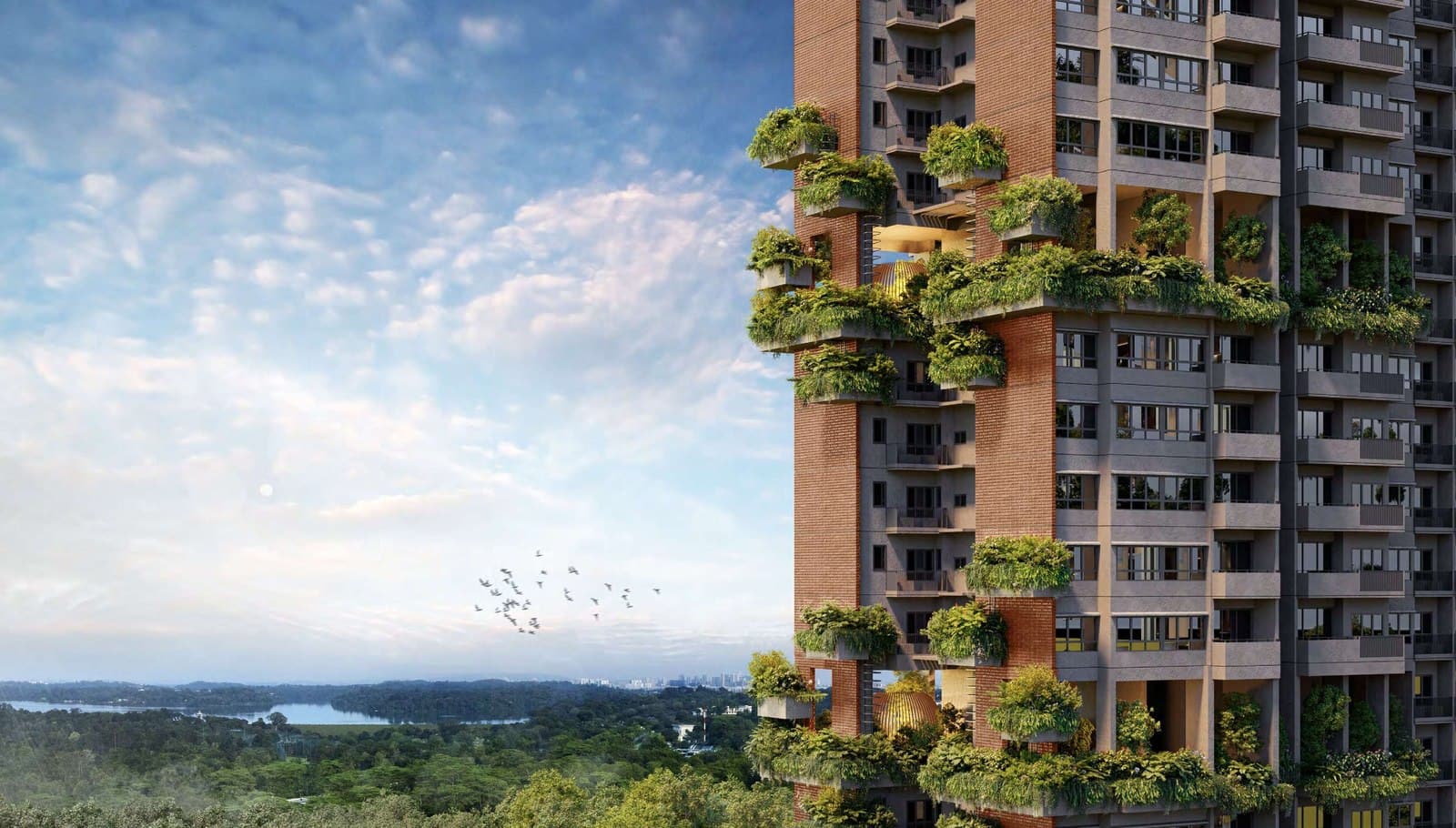
Springleaf Residence is not trying to be the biggest number in its district. Its pitch is the opposite of the Lentor arms race one stop down the line: a forest on your doorstep, a low-rise village behind you, and a five-tower, 941-home development that hides most of itself in greenery. The question this review answers is whether that calm is worth roughly $2,169 psf — and whether you are buying a genuinely different address, or simply the quieter, greener edge of the same Lentor story. We price it against the resale market and its direct rivals so you can see exactly what the tranquility costs.
Is Springleaf Residence worth buying? Our verdict
Springleaf Residence sells calm, forest and a low-rise village mood — and prices it below every nearby Lentor launch, not above. At ~$2,169 psf it undercuts Lentor Mansion, Lentoria and the rest by $45–95 psf. It suits the nature-and-quiet buyer and the TEL commuter; less so a pure growth-chasing investor.
Springleaf Residence is a buy for the buyer who is actually shopping for calm and greenery — and it happens to be the cheapest way into the wider Lentor–Thomson growth story, not the most expensive. That is the twist here. Most launches ask you to pay a premium for their headline feature. Springleaf asks you to pay less than every nearby Lentor project while giving you the one thing they can't: a forest on the boundary and a low-rise village at your back.
The numbers frame it cleanly. Across 934 developer-sale caveats, Springleaf is pricing at about $2,169 psf (a median unit near $1.77M) — roughly 34% above District 26's median resale. That gap looks large until you set it beside the launches a buyer would genuinely cross-shop. Springleaf undercuts every Lentor rival: Lentor Mansion (~$2,262 psf), Lentoria (~$2,217), Lentor Central Residences (~$2,214) and Hillock Green (~$2,212) all sit $45–95 psf above it. You are not paying a nature premium — you are paying a nature discount, relative to the denser new-town blocks one MRT stop away.
So the verdict turns on a single question: do you want the quiet, or do you want the crowd? If you value forest views, a two-minute covered walk to the MRT, weekend trails and Upper Thomson's cafe belt over being at the centre of the busiest cluster, Springleaf is a genuinely differentiated home at a friendly entry price. If your whole thesis is riding the most intense growth corridor with the deepest future resale pool, the Lentor core is where the volume — and the crowd — will be. Buy Springleaf for the setting, not to be at the centre of everything.
The market clearly agreed the price was right: GuocoLand sold about 92% of the 941 units over the two-day launch weekend in August 2025. This review shows the full workings behind that number. For the market-wide picture, see our roundup of every 2026 new launch benchmarked against resale. You can also browse every 2026 launch in the Singapore new launches directory.
Springleaf Residence at a glance: the key facts
Springleaf Residence is a 941-unit, 99-year leasehold condo on Upper Thomson Road (District 26) by GuocoLand and Hong Leong Holdings — five 25-storey towers plus a conserved block — with vacant possession expected 31 December 2031 and indicative pricing around $2,169 psf.
| Detail | Springleaf Residence |
|---|---|
| Developer | GuocoLand + Hong Leong Holdings (JV) |
| Tenure | 99-year leasehold (from 15 July 2024) |
| Location | Upper Thomson Road, Springleaf, District 26 |
| Site area | ~3.2 hectares (~344,000 sq ft), 77% landscaping and facilities |
| Total units | 941 — five 25-storey towers (909 homes) + a conserved building (32 homes) |
| Unit types | 1- to 5-bedroom, ~388–1,475 sq ft |
| Expected TOP | Vacant possession 31 December 2031 (legal completion 31 December 2034) |
| Launched | 15 August 2025 |
| Indicative pricing | ~$2,169 psf · median ~$1.77M |
Two notes on these figures. First, the developer, tenure, completion, site area and unit sizes are taken from the project's own launch materials and legal disclosure, not our directory — our automated records list an earlier expected-completion year (around 2029) for this site, but the sales-brochure legal page states vacant possession on 31 December 2031, so we use the brochure. Second, the pricing is our own, computed from URA developer-sale caveats. Independent coverage corroborates the launch: EdgeProp reported GuocoLand previewed the project from $1,995 psf and sold about 92% of units at an average $2,175 psf over its launch weekend.
What makes Springleaf different: nature, low density and a village mood
Springleaf borders the Central Catchment Nature Reserve, gives 77% of its site to greenery and facilities, and sits in a quiet, low-rise village of landed estates near the Upper Thomson food belt. The setting — forest, calm and trails — is the whole case for choosing it.
This is the section that matters most, because the setting is the entire reason to choose Springleaf over its rivals. The development borders Springleaf Forest and the Central Catchment Nature Reserve — Singapore's largest — and dedicates 77% of its 3.2-hectare site to landscaping and facilities, with a 730m native-forest corridor and unobstructed views over the reserve from the upper floors. It is, in EdgeProp's words, the first high-rise condo in a new enclave by the forest. GuocoLand's own launch was pitched on exactly this: its press release credited demand to the project's nature-integrated design and heritage appeal.
The surroundings back the brochure. Springleaf is a low-rise, low-density pocket — landed estates (Springleaf, Springside, Thong Bee) and a quiet village feel, not a dense new town. The Upper Thomson cafe-and-food belt and the Springleaf eateries are minutes away; Thomson Nature Park, Springleaf Nature Park and the Upper/Lower Seletar Reservoir parks ring the area; and the Rail Corridor and future North-South Corridor ecological loop add green connectors for cyclists and walkers. The heritage layer is real too: the development keeps and revitalises the conserved former Upper Thomson Secondary School as 32 homes and communal spaces, and a conserved raintree anchors the arrival court.
The honest way to read all of this: Springleaf is a lifestyle-and-nature address first, and a pure investment address second. You are buying the forest, the quiet and the trails — features a denser, more central site simply cannot replicate at this price.
How much does Springleaf Residence cost? Prices and PSF by unit size
Across 934 developer-sale caveats, Springleaf's median is ~$2,169 psf and ~$1.77M, with most units between $2,114 and $2,243 psf. PSF is unusually flat across sizes, and the sub-$1.2M entry quantum on the smallest units is one of its real draws.
Across the 934 developer-sale caveats lodged so far, Springleaf's median is about $2,169 psf, with most units transacting between $2,114 and $2,243 psf. The median price works out to roughly $1.77M — a notably accessible quantum for a launch, helped by an efficient unit mix. That read matches the market: GuocoLand sold at an average $2,175 psf at launch, within a whisker of our caveat median.
| Unit size (from our caveats) | Caveats (n) | Median PSF | Median price |
|---|---|---|---|
| ≤550 sqft (studio/1BR) | 127 | $2,158 | $1.12M |
| 550–750 sqft (1–2BR) | 224 | $2,180 | $1.40M |
| 750–1,100 sqft (2–3BR) | 372 | $2,168 | $1.92M |
| 1,100–1,500 sqft (3–4BR) | 211 | $2,168 | $2.71M |
The pattern worth noting is how flat the PSF is across sizes — the big 3-4 bedroom homes (~$2,168 psf) price almost identically to the smaller stock (~$2,180 psf). The developer is not discounting the larger units on a per-square-foot basis; the bigger quantum is simply the cost of more space. The practical takeaway: buying smaller here lowers your total outlay (the sub-550 sqft band starts around $1.12M) but not your entry PSF. If you want the most home per dollar of tenure, the mid-size 2-3 bedroom band around $1.9M is the sweet spot. To think through the quantum-versus-PSF trade, read quantum vs PSF when buying a condo.
Springleaf vs the Lentor cluster: the calmer, cheaper alternative?
Springleaf and the Lentor projects are one MRT stop apart but pursue opposite characters: Lentor is the denser mall-anchored new town, Springleaf the quieter forest-edge village. And Springleaf (~$2,169 psf) undercuts the Lentor headliners by ~$45–95 psf — so you get the calmer, greener setting without paying more.
This is the comparison every serious buyer here should make, because Springleaf and the Lentor projects are one MRT stop apart on the same line — and they are pursuing opposite characters. Lentor is a denser, faster new-town build-out: GuocoLand's own four-development Lentor precinct (Lentor Modern, Lentor Hills, Lentor Mansion, Lentor Central) is anchored by a mall and stacks thousands of units around the interchange. Springleaf is the quieter, greener, more established village at the edge of the forest. Same catchment, very different day-to-day life.
The pricing makes the trade explicit:
| Project | New-Sale caveats (n) | Median launch PSF |
|---|---|---|
| Lentor Mansion | 533 | $2,262 |
| Lentor Modern | 15 | $2,260 |
| Lentoria | 246 | $2,217 |
| Lentor Central Residences | 477 | $2,214 |
| Hillock Green | 327 | $2,212 |
| Lentor Hills Residences | 153 | $2,139 |
Read against these peers, Springleaf (~$2,169 psf) is the value end of the district, undercutting the Lentor headline projects by roughly $45–95 psf while sitting close to the older Lentor Hills Residences. So the choice is unusually clean: for a comparable — often lower — price, Springleaf trades the buzz, the integrated mall and the deepest resale liquidity of the Lentor core for more greenery, lower density and more quiet. If proximity to the mall-and-interchange energy is your priority, Lentor wins. If the forest and the calm are, Springleaf is not a compromise on price to get them — which is what makes its case genuinely strong. To run a structured head-to-head, use our two-project comparison scorecard, and for the segment lens see OCR condo investment.
Is the ~34% premium over District 26 resale a red flag?
The ~34% premium over District 26 resale compares a new, fresh-lease project to older leasehold resale, so some gap is just the price of new — and Springleaf's gap is narrower than many launches carry. Against its true peers, the Lentor launches, it's cheaper, so overpricing is not the real worry.
On the face of it, Springleaf's ~34% premium over District 26's median resale (~$1,617 psf) looks steep. But that comparison is unfair to any new launch: you are pitting a brand-new project on a fresh 99-year lease against a district-wide pool of older, mostly leasehold, lived-in resale stock on shorter remaining leases. Some premium is simply the price of new — a fresh lease, current finishes, and full facilities. It is not, by itself, evidence of overpricing.
Notably, Springleaf's ~34% new-launch gap is narrower than many launches carry — a reflection of its comparatively accessible pricing rather than a soft market. The fairer benchmark is the one we ran above: against the Lentor launches a buyer would actually cross-shop, Springleaf is the cheaper option, not the dearer one. When a launch prices below its direct new-launch peers and only moderately above district resale, the overpricing worry is weak. What you should weigh instead is location and character — a less central address on the northern arc of the TEL — which we cover next, and the tenure trade in freehold vs leasehold condo and how much a new-launch premium should be.
Where is Springleaf Residence, and how good is the connectivity?
Springleaf is on Upper Thomson Road (District 26) on the edge of the Central Catchment forest, a sub-two-minute covered walk to Springleaf MRT on the TEL — one stop to Lentor, two to Woodlands, about ten to Orchard. The trade-off is a northern, less central address with retail leaning on nearby, not on-site, options.
Springleaf Residence sits on Upper Thomson Road in the Springleaf pocket of District 26, wedged between the Seletar Expressway and Springleaf Forest, on the northern arc of the Thomson-East Coast Line. This is a location you choose for its setting, and it comes with a clear connectivity story and one honest trade-off.
The rail is the strength. Springleaf MRT (TE4) is a sub-two-minute sheltered walk from the development — the kind of dry, door-to-platform access that genuinely changes daily life. From there the TEL runs a single direct line: Lentor is one stop, Woodlands two stops, Orchard about ten, and the line will eventually reach Changi Airport Terminal 5. Drivers get the SLE and CTE at hand, and the future North-South Corridor is set to cut bus commute times to the city by up to 30 minutes when it completes around 2029, with a 7km recreational ecological loop threading past Springleaf Nature Park.
The honest trade-off is centrality. This is the north of the island, not the city fringe — a straight, comfortable TEL commute, but a longer one than a central address, and the immediate surroundings are residential-and-nature rather than a dense town centre with a mall at your feet. Day-to-day retail leans on the Springleaf and Upper Thomson eateries, the future Springleaf retail space and Lentor Modern's mall one stop away, rather than a large mall on-site. For a buyer who wants forest, quiet and a clean rail link, that is exactly the deal on offer; for one who wants to be in the thick of things, it is the compromise to weigh.
Is Springleaf Residence a good investment? What the data says about rental and resale
Springleaf has never been resold, so there's no track record. The honest proxy — OCR resales — shows 86.3% sold above cost with a +27.6% median gain (gross). Rental demand drivers (direct TEL, forest-edge lifestyle) are real but tenant-specific; we don't quote a yield. A fresh 99-year lease and a low quantum help; heavy area supply is the counterweight.
Springleaf has never been resold — it is a brand-new launch — so there is no project track record to quote, and anyone promising you a return is guessing. The honest proxy is how comparable homes in its market segment have actually performed. Across matched resale pairs, 86.3% of OCR (Outside Central Region) private resales sold above their purchase price, with a median gross gain of 27.6%. Treat that as a base rate, not a forecast, and remember it is gross — before commission, stamp duties, any Seller's Stamp Duty and loan interest.
On rental, we won't quote a yield figure — this is a pre-completion launch with no rental history, so any number would be invented. What we can say qualitatively is that the rental demand drivers are real but specific: a direct TEL line, the sub-two-minute MRT walk, and the nature-and-quiet appeal that draws a particular tenant (families, wellness-minded professionals, those who want green space over nightlife). It is not a dense CBD-adjacent rental machine like a city-fringe project; it is a lifestyle-tenant location. To pressure-test a specific unit against your own holding period, financing and costs — including a realistic rent assumption you supply — run it through the PropKaki profitability model, and read how to tell if a property will be profitable.
One structural point in Springleaf's favour: the lease is fresh (99 years from July 2024), so lease decay is a distant concern, and the accessible sub-$1.8M median quantum keeps the buyer pool wide on any future exit. The counterweight is scale — at 941 units, and with the broader Lentor–Springleaf area adding thousands more homes, your eventual resale competes in a well-supplied market.
What unit types and sizes does Springleaf Residence have?
Springleaf has 941 units from 1- to 5-bedroom, roughly 388 to 1,475 sq ft: five towers of 909 mostly family-sized homes (2BR up) plus 32 character units in a conserved school building that hold the only true 1-bedders. At launch the 2-4 bedders sold out fastest; the 5-bedders moved slowest.
Springleaf offers 941 units spanning 1- to 5-bedroom layouts, roughly 388 to 1,475 sq ft, split across two very different products. The five 25-storey towers hold 909 homes — 2-bedroom from about 527 sq ft, 3-bedroom around 786–1,076 sq ft, 4-bedroom about 1,227 sq ft and 5-bedroom about 1,453–1,475 sq ft. The conserved former Upper Thomson Secondary School holds 32 homes — including the only true 1-bedroom units (from about 388 sq ft) and a handful of larger heritage 3-bedders up to ~1,259 sq ft. So the shoebox-sized stock is confined to the character-rich conserved block; the main towers are a family and own-stay mix from two bedrooms up.
The launch demand told its own story about which units suit which buyer. Per the developer's launch results, the two-, three- and four-bedroom homes were almost entirely taken up, while the largest five-bedders moved more slowly — a reminder that the big-quantum units are a narrower market even in a hot launch. If you want the lowest cash outlay, the smaller bands are the entry point; if you want the forest-facing family home, the mid-size 3-bedders are the heart of the project. (Unit sizes are from the developer's floor plans; the per-size pricing in the table above is reconstructed from our own URA caveats, so the bedroom labels there are size proxies, not the official unit mix.)
The one thing to weigh before buying Springleaf Residence
Springleaf's case is its calm, forest-edge setting — so weigh whether that survives a 941-unit scale and a fast-growing, well-supplied corridor. The price is right (below every Lentor rival, fresh 99-year lease), but you're buying quiet and green over central. Buy it for the setting, not to be at the centre.
The whole case for Springleaf is the setting — the forest, the quiet, the low-rise village. So the one thing to weigh is whether that setting survives the scale and the surroundings you are buying into. This is a 941-unit development, and the broader Springleaf–Lentor arc is adding thousands more homes over the next few years; the immediate calm of a forest-edge address today shares its MRT and roads with a fast-growing corridor. On the plus side, the price is right — you are paying below every Lentor headliner, on a fresh 99-year lease, at an accessible sub-$1.8M median — so you are not overpaying for the tranquility. But be clear-eyed that you are buying a quiet, green, less central home, not a central one, and that its eventual resale will compete against a well-supplied area. Buy Springleaf because you genuinely want the forest and the calm over the crowd — if being at the centre of the action matters more, the denser Lentor core is the better fit and the deeper market.
Where is Springleaf Residence and which MRT is it near?
On Upper Thomson Road in Springleaf (District 26), a sub-two-minute covered walk to Springleaf MRT on the Thomson-East Coast Line.
Springleaf Residence is on Upper Thomson Road in the Springleaf area (District 26), on the edge of Springleaf Forest and the Central Catchment Nature Reserve. It is a sub-two-minute sheltered walk to Springleaf MRT (TE4) on the Thomson-East Coast Line — one stop from Lentor, two from Woodlands and about ten from Orchard, on a line that will eventually reach Changi Airport Terminal 5.
How much does Springleaf Residence cost?
About $2,169 psf median (~$1.77M), with most units $2,114–$2,243 psf, from our URA caveat data — in line with the ~$2,175 psf launch average.
Based on 934 URA developer-sale caveats, Springleaf's indicative pricing is about $2,169 psf (median unit ~$1.77M), with most units between $2,114 and $2,243 psf. That aligns with the average $2,175 psf reported at its August 2025 launch. Pricing is a live snapshot and moves as more units are released.
Is Springleaf Residence freehold or leasehold, and when will it be completed?
It's 99-year leasehold (from July 2024), with expected vacant possession on 31 December 2031 per the developer's materials.
Springleaf Residence is 99-year leasehold, on a fresh lease commencing 15 July 2024, developed by GuocoLand and Hong Leong Holdings. Per the developer's legal disclosure, its expected vacant possession is 31 December 2031 (legal completion 31 December 2034), so a TOP around 2031. Note that automated property directories may show an earlier completion year for this site; we use the brochure's stated date.
Springleaf Residence vs the Lentor condos — which is cheaper?
Springleaf (~$2,169 psf) is cheaper than the Lentor headliners (Lentor Mansion, Lentoria, Lentor Central, Hillock Green), and offers a greener, quieter setting for the money.
By indicative launch PSF, Springleaf (~$2,169 psf) is cheaper than the Lentor headline projects — Lentor Mansion (~$2,262), Lentoria (~$2,217), Lentor Central Residences (~$2,214) and Hillock Green (~$2,212) — and close to the older Lentor Hills Residences (~$2,139). Springleaf trades the Lentor core's mall-and-interchange density for a quieter, greener, forest-edge setting, at a comparable or lower price.
Who should buy Springleaf Residence?
Best for nature-and-quiet buyers, families and TEL commuters who want greenery and calm at a friendly price; less ideal for those wanting a dense central hub or a pure growth-first investment.
Springleaf best suits nature-and-quiet buyers, families and Thomson-line commuters who value forest views, low density and a two-minute MRT walk over being in the busiest, most central cluster — and who like that it prices below the Lentor rivals on a fresh 99-year lease with an accessible sub-$1.8M median quantum. Think twice if you want to be at the centre of a dense, mall-anchored town, need the deepest possible future resale pool, or are a pure investor chasing the single hottest growth corridor rather than a lifestyle-led hold.
Methodology and sources
Pricing from our URA New-Sale caveats; the premium from District 26 resale caveats; comparables from each project's caveats; segment odds from matched OCR pairs. Developer, tenure, TOP and concept are brochure-sourced (we use the brochure's 2031 completion, not the directory's ~2029). A desktop analysis, not a showflat visit; no yield quoted.
Where the figures come from. Springleaf Residence's indicative pricing is the median of 934 URA private-sale caveats flagged New Sale for the project (window 15 August 2025 to 18 June 2026), from PropKaki's own transaction data. The ~34% premium compares that to the median PSF of Resale caveats in District 26 over the last ~18 months (235 caveats). The comparable-launch PSFs are the medians of each rival project's own New-Sale caveats in the same district over the last ~30 months, deduped per project. The 86.3% segment resale odds and +27.6% median gain come from matched private buy→sell pairs in the OCR segment via PropKaki's profitability model. Developer, tenure, expected completion, site area, unit sizes and the nature/heritage concept are from the project's official launch materials and legal disclosure — not our directory, whose completion field is unreliable for this site (it indicated ~2029; the brochure states vacant possession 31 December 2031, which we use). External context is cited inline from EdgeProp and GuocoLand's press release for the launch, pricing and take-up.
What we did not do, and did not claim. This is a data and desktop analysis, not a showflat visit — we have not toured the units, verified finishes, or stood on a balcony to check the forest view in person. Indicative PSF is a dated snapshot that moves as more units sell; PSF is price ÷ area, so a median shifts with which units transact. The resale benchmark is a district median, not a unit-matched valuation. The comparable-launch table is a broad district reference, not a like-for-like specification match. Segment profit odds are gross (before commission, stamp duties, any SSD and interest) and are a base rate, not a forecast — Springleaf has never been resold. We quote no rental yield, because the project has no rental history and any figure would be invented. Nothing here is financial advice; verify current rules and figures with URA, IRAS and HDB.
What are the floor plans and unit sizes at Springleaf Residence?
PropKaki has 33 layouts on record for Springleaf Residence, from 1 to 5 bedrooms (388 sqft to 1,475 sqft).
| Bedrooms | Layouts | Sizes |
|---|---|---|
| 1 Bedroom | 1 | 388 sq ft |
| 2 Bedroom | 5 | 527 to 646 sq ft |
| 3 Bedroom | 19 | 786 to 1,259 sq ft |
| 4 Bedroom | 4 | 1,227 sq ft |
| 5 Bedroom | 4 | 1,453 to 1,475 sq ft |
PropKaki holds 25 floor plans for Springleaf Residence.
See Springleaf Residence's floor plans — ask PropKaki. Ask PropKakisqm ↔ sq ft converter
Layouts digitised from developer brochures.
Springleaf Residence: quick answers
Answered from URA data, refreshed daily.
Is Springleaf Residence fully sold?⌄
Not yet. 917 of Springleaf Residence's 941 units (97%) had been sold as of Oct 2026, leaving 24 unsold (URA developer sales).
Who is the developer of Springleaf Residence?⌄
Springleaf Residence is being developed by Springleaf Parcel B Pte Ltd.
When was Springleaf Residence launched?⌄
Springleaf Residence went on sale in August 2025. Its first developer sale on record is dated 15 August 2025 (URA caveats).
Why is Springleaf Residence so expensive?⌄
Springleaf Residence's developer sales have a median of S$2,170 psf, about 47% above the S$1,480 psf median for resale condos in District 26 over the last 12 months (URA caveats). A new launch usually costs more than resale: buyers pay for a full-length new lease and a home no one has lived in. The review explains what else is in Springleaf Residence's price.
Got a question this raised? Ask PropKaki.
Take any point from this analysis and apply it to your own project, budget or decision.
PropKakiFor most buyers this year, staying well within budget beats trying to time the market.