
Parktown Residence Review: Is 'Live Above the Mall and MRT' Worth ~$2,360 PSF?
The year's biggest launch — 1,193 units above a mall, a Cross Island Line station, a bus interchange, a hawker centre and a community club. We price the integrated-hub convenience against a 63% premium and ask whether mega-scale helps or caps your upside.
Parktown Residence is a 1,193-unit, 99-year leasehold integrated development on Tampines Avenue 11 (District 18, OCR) by Topaz Residential and Topaz Commercial — the UOL, Singapore Land and CapitaLand Development joint venture — with vacant possession expected 30 June 2030. Its indicative pricing is about $2,360 psf (median unit ~$1.86M), roughly 63% above District 18's median resale but a clear step above every other recent Tampines launch. The real case is convenience: a mall, a Cross Island Line station, a bus interchange, a hawker centre and a community club all under the same roof, in a district on a genuine growth arc. The catch is scale — 1,193 homes buy huge facilities and easy entry, but they also become the largest future resale pool of any 2026 launch, which caps the scarcity that drives outsized price gains. It suits own-stay families who will use the convenience daily; pure flip-for-scarcity investors should look elsewhere.
Parktown Residence at a glance
| Developer | Topaz Residential Pte Ltd/Topaz Commercial Pte Ltd |
|---|---|
| Tenure | 99-year leasehold |
| Units | 1,193 |
| Launched | February 2025 (first developer sale) |
| Sales progress | 1,164 of Parktown Residence's 1,193 units (98%) had been sold as of Oct 2026, leaving 29 unsold (URA developer sales). |
| Launch price paid | S$2,361 psf median (S$1.85M), 1,170 developer caveats to Oct 2026 |
| District 18 resale | S$1,467 psf median across 1,004 resales in the last 12 months, so the launch price is 61% higher |
From URA caveats and URA's developer-sales figures (sales checked Oct 2026), refreshed daily. The review below was written earlier and quotes the figures of its day.
Every transaction and listing at Parktown Residence →Resale profit odds →Floor plans ↓
Where is the Parktown Residence showflat?
Parktown Residence's showflat is at 7 Tampines Grande, Singapore 528736, according to its EdgeProp new-launch listing (checked 18 September 2026). 29 units were still unsold as of Oct 2026 (URA), so book a viewing with the developer's sales team before you go.
Source: EdgeProp new-launch listing, checked 18 September 2026. PropKaki has not visited this showflat; this review is a desk analysis.
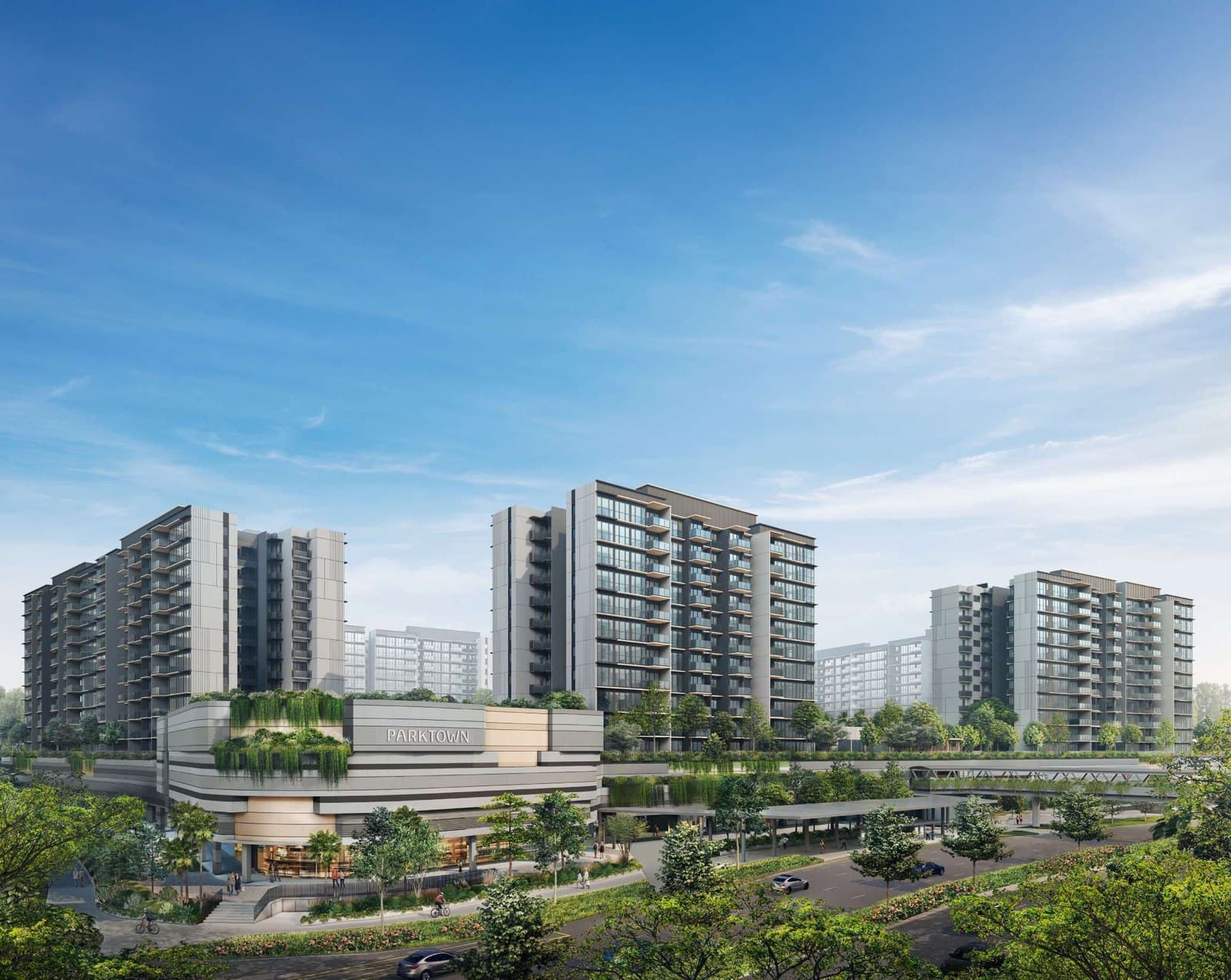
Parktown Residence sells one idea harder than any launch this year: never leave the building. Homes sit directly above a retail mall, a Cross Island Line MRT station, an air-conditioned bus interchange, a hawker centre and a community club — Tampines North's first fully integrated development, and at 1,193 units, the single largest new launch of 2026. This review prices that convenience against a real premium, and works through the part the marketing skips: what the biggest unit count of the year does to your resale odds when it is your turn to sell.
Is Parktown Residence worth buying? Our verdict
Parktown Residence is a buy for own-stay families who will use the integrated mall-MRT-hawker convenience daily. At ~$2,360 psf it prices above every recent Tampines launch, and its 1,193-unit scale is a double edge: huge facilities and liquidity, but the largest future resale pool of any 2026 launch — which caps scarcity-driven gains.
Parktown Residence is a buy if you will actually live the convenience — and a much weaker case if you are buying purely to flip for scarcity. Its entire pitch is that everything you need sits under one roof: a retail mall, a Cross Island Line MRT station, an air-conditioned bus interchange, a hawker centre and a community club, all wrapped into Tampines North's first fully integrated development. For a family that commutes by rail, does the weekly grocery run downstairs and eats at the hawker centre, that is a real, daily, priced-in benefit — not a brochure line.
The numbers frame the trade cleanly. Across our developer-sale caveats, Parktown is pricing at about $2,360 psf (a median unit near $1.86M) — roughly 63% above District 18's median resale. That premium sounds steep until you see it clears every recent Tampines launch by a wide margin: the next-nearest, Rivelle, sits at about $1,935 psf, and older neighbours like Aurelle and Parc Central are lower still. You are not paying the district average; you are paying to be the newest, most connected, most convenient address in the precinct.
So the verdict turns on one honest tension. The 1,193-unit scale is both the reason to buy and the reason your upside is capped. That scale buys resort-grade facilities, easy financing and a deep, liquid market — but when you sell, you are competing against the largest single future resale pool of any 2026 launch, which is exactly the condition that flattens the scarcity premium sellers hope for. If your horizon is own-stay and long, the convenience earns its keep. If it is a quick, scarcity-driven exit, a smaller project gives you rarer stock to sell.
This review shows the full workings. For the market-wide picture, see our roundup of every 2026 new launch benchmarked against resale. You can also browse every 2026 launch in the Singapore new launches directory.
What does 'live above the mall and MRT' actually get you at Parktown Residence?
Integration means the mall, a Cross Island Line MRT station, an air-conditioned bus interchange, a hawker centre and a community club are inside the same address — not nearby. The value is friction removed from everyday routines (commute, groceries, dining, school run). The trade-off is footfall and some stacks facing the hub.
This is the part worth understanding before anything else, because it is what you are paying the premium for. Parktown Residence is Tampines North's first fully integrated development — the homes are stacked directly above a mixed-use podium, so the amenities are not 'nearby', they are inside the same address:
- A retail mall (the development includes roughly 14,000 sqm of commercial space) — groceries, F&B and daily errands without stepping outside.
- A Cross Island Line MRT station (the future Tampines North station) with direct sheltered access — no walk to the train in the rain or heat.
- An air-conditioned bus interchange at the doorstep — the connectivity most integrated projects don't have.
- A hawker centre and a community club — everyday dining and neighbourhood life built into the block.
- A landscaped green boulevard threading through the ground plane.
The practical value of integration is not glamour; it is friction removed from ordinary days. School run, commute, groceries, dinner, a package pickup — the things you do 300 times a year happen within a covered, weather-protected footprint. That is genuinely hard to replicate, and it is why integrated developments (think Bedok Residences, North Park Residences, Pasir Ris 8) have historically held their appeal with families and tenants. Parktown is the newest and, at 1,193 units, the largest of this breed in the east.
Be clear-eyed about the flip side of living above a hub, too: retail-and-transit footfall means more people through the ground floor, and the units facing the interchange or mall service areas will trade some quiet for the convenience. That is a stack-selection question you resolve at the showflat, not a dealbreaker — but it is the honest cost of the 'never leave the building' promise.
Parktown Residence at a glance: the key facts
Parktown Residence is a 1,193-unit, 99-year leasehold integrated development on Tampines Avenue 11 (District 18) by the UOL–SingLand–CapitaLand joint venture, with vacant possession expected 30 June 2030 and indicative pricing around $2,360 psf (~$1.86M median).
| Detail | Parktown Residence |
|---|---|
| Developer | Topaz Residential & Topaz Commercial — a UOL Group, Singapore Land (SingLand) & CapitaLand Development joint venture |
| Tenure | 99-year leasehold (from 9 October 2023) |
| Location | Tampines Avenue 11 / Tampines Street 62, District 18 (Tampines, OCR) |
| Site area | ~50,700 sqm |
| Total units | 1,193 (the largest 2026 launch) |
| Unit types | 1-bedroom + study to 5-bedroom |
| Concept | Tampines North's first fully integrated development (mall, MRT, bus interchange, hawker centre, community club) |
| Expected TOP | ~2030 (vacant possession expected 30 June 2030; legal completion 30 June 2033) |
| Indicative pricing | ~$2,360 psf · median ~$1.86M |
Two notes on these figures. The developer, tenure, site area, concept and completion date are taken from the project's own launch brochure — 'Topaz Residential/Topaz Commercial' is the project company for the UOL–SingLand–CapitaLand tie-up, not three unrelated names. We flag this because automated property directories can carry an unreliable completion year for new sites, so we anchor TOP to the brochure's stated 30 June 2030 vacant possession. The pricing is our own, computed from URA developer-sale caveats. The launch itself was a landmark event: EdgeProp reported the UOL–CapitaLand team moved 1,041 units on launch weekend — about 87% of the project — at an average price of $2,360 psf, which matches our caveat read almost exactly.
How much does Parktown Residence cost? Prices and PSF by unit size
Parktown's median is ~$2,360 psf (~$1.86M), with most units between $2,304 and $2,417 psf. Demand skews to the smallest, lowest-quantum units — nearly 45% of caveats are under 750 sqft — which fits its mass-market, convenience-led buyer base.
Across the developer-sale caveats lodged so far, Parktown's median is about $2,360 psf, with the middle of the market between roughly $2,304 and $2,417 psf. The median price works out to about $1.86M — a quantum that keeps a mass-market, family-sized product within reach in a way the district's prime-fringe rivals cannot. Because this is one of the best-selling launches of the year, our sample is unusually deep (well over a thousand caveats), so this read is more stable than the thin early-caveat picture you get at boutique launches.
| Unit size (from our caveats) | Caveats (n) | Median PSF | Median price |
|---|---|---|---|
| ≤550 sqft (studio/1BR) | 73 | $2,382 | $1.19M |
| 550–750 sqft (1–2BR) | 452 | $2,390 | $1.63M |
| 750–1,100 sqft (2–3BR) | 427 | $2,354 | $2.19M |
| 1,100–1,500 sqft (3–4BR) | 199 | $2,307 | $2.80M |
| 1,500+ sqft (4BR+/penthouse) | 14 | $2,343 | $3.93M |
The useful signal here is the shape of demand: the two smallest bands hold nearly 45% of transactions, and the 550–750 sqft band alone is the single biggest slice. That is a broad, entry-led buyer base — first-timers, young families and investors buying the convenience-plus-connectivity story at the lowest quantum the location allows. PSF is fairly even across sizes (a mild taper as units get larger and quantum climbs), so going smaller mainly lowers your total outlay rather than your per-square-foot rate. If you are weighing entry price against long-run flexibility, read quantum vs PSF when buying a condo.
Pricing is a live snapshot — a median moves with which stacks and sizes have been released, and it is not the developer's full final price list.
Is Parktown Residence overpriced? Its PSF vs District 18 resale and rival launches
At ~$2,360 psf, Parktown is ~63% above District 18's median resale — but the fair read is against launches: it leads Rivelle (~$1,935) by about $425 psf and sits well above Aurelle and older projects. That gap is the price of integration and the Cross Island Line, not proof of overpricing.
On paper, Parktown's ~63% premium over District 18's median resale (~$1,452 psf) looks aggressive. But that comparison is unfair to any new launch — you are pitting a brand-new, integrated, connected development against a district-wide pool of older, mostly non-integrated, lived-in resale stock on shorter remaining leases. Some premium is simply the price of new, and a lot of it is the price of integrated and on the Cross Island Line. The honest benchmark is how Parktown prices against the launches a Tampines buyer would actually cross-shop:
| Project | New-Sale caveats (n) | Median launch PSF |
|---|---|---|
| Parktown Residence | 1,165 | $2,361 |
| Rivelle Tampines | 623 | $1,935 |
| Aurelle Of Tampines | 760 | $1,769 |
| Tenet | 16 | $1,560 |
| Parc Central Residences | 11 | $1,560 |
Read against its true peers, Parktown is the clear price leader of the precinct — about $425 psf (roughly 22%) above the next-nearest launch, Rivelle, and further still above the executive-condo and older options. That gap is not evidence of overpricing; it is the market's price for the one thing none of the others offer: a home wired directly into a mall, an MRT station and a bus interchange. Whether that convenience is worth the step-up is the judgement you make on your own routine — a rail commuter and a car-first household will value it very differently. For how to size a fair new-launch premium, see how much a new-launch premium should be, and for the wider tenure-and-timing context, new launch vs resale. Note too that Business Times has flagged emerging price ceilings as more supply comes to market — a reason not to assume today's premium keeps compounding.
Where is Parktown Residence, and is Tampines North a location on the up?
Parktown sits in the emerging Tampines North sub-zone of District 18, pairing mature Tampines amenities with growth-area upside. Its future Tampines North MRT is a Cross Island Line stop giving direct rail to Punggol Digital District and Jurong Lake District — the connectivity that underpins the location thesis, alongside Tampines North's build-out and the long-term Paya Lebar Air Base redevelopment.
Parktown sits on Tampines Avenue 11 (Tampines Street 62), in the emerging Tampines North sub-zone of District 18 — the eastern, less built-up edge of one of Singapore's most established and self-sufficient regional centres. The pitch is a rare combination: the maturity of Tampines town (Tampines Regional Centre, Tampines Mall/Century Square/Tampines 1, IKEA, Our Tampines Hub) plus the ground-floor upside of a precinct still being built out.
The connectivity story is the anchor, and it is a genuine step-change rather than a maybe:
- The future Tampines North MRT station is a Cross Island Line (CRL Phase 1) stop, and it plugs directly into Parktown. When it opens (targeted around 2030), the CRL gives you direct rail to Hougang and Ang Mo Kio and to two of the country's biggest future job engines — the Punggol Digital District and the Jurong Lake District — without a change.
- The air-conditioned bus interchange on-site handles the rest of the east.
- The Pan-Island and Tampines expressways are close for drivers, and Changi Airport and the airport logistics/aviation job cluster are a short hop east.
The growth thesis rests on two catalysts beyond the CRL: Tampines North itself is a designated growth area adding thousands of new homes and residents, and the long-horizon Paya Lebar Air Base redevelopment to the west is expected to unlock a large new housing and jobs district over the coming decades. Both are tailwinds, not guarantees — timelines on projects this size move — but the direction of travel for this pocket is unambiguously up. For how the region tier shapes an investment case, read our CCR, RCR and OCR buying guide and investing in OCR condos.
What does 1,193 units mean for you — as a buyer and as a future seller?
1,193 units buy resort-grade facilities, easy financing, deep liquidity and strong rental demand — real advantages while you own. But at exit you face the largest future resale pool of any 2026 launch, and that abundance is the opposite of the scarcity that drives outsized gains. Great for long own-stay holds; a headwind for a quick scarcity-led flip.
Scale is Parktown's defining trait, and it cuts both ways. It is worth holding both edges in view because most marketing only shows you one.
Where the mega-scale works for you (mostly as a buyer and owner):
- Facilities you couldn't get otherwise. A 1,193-unit site supports a resort-grade clubhouse, multiple pools, function rooms and landscaped decks that a 100-to-300-unit project simply cannot fund — and those are shared over a larger base.
- Easy to buy and finance. A deep unit mix from 1-bed-plus-study to 5-bed means more entry points and quanta, and a large, well-backed launch is straightforward to value and lend against.
- Liquidity and a busy, lived-in address. Something is always transacting, and the integrated retail keeps the ground plane alive.
- Rental depth. A big, brand-new, MRT-integrated block near job nodes is attractive to tenants — we won't quote a yield figure (this review is deliberately price-and-value, not a yield projection), but the demand case for leasing is strong. To model rent against a specific unit and your costs, use the PropKaki profitability model.
Where the mega-scale works against you (mostly as a future seller):
- The largest future resale pool of any 2026 launch. When you sell, potentially dozens of near-identical units in the same development may be listed at once. That internal competition is the single biggest structural headwind to price growth here.
- Scarcity is the opposite of your story. The gains that make headlines usually come from rare stock — a boutique block, an odd freehold, a stack with a unique view. Parktown is the antithesis: abundant, standardised and easy to comp, which tends to keep resale pricing efficient rather than exuberant.
- You differentiate on the unit, not the address. With a thousand-plus neighbours, your exit price will lean on your specific stack, floor, facing and layout far more than on the project name.
None of this makes Parktown a poor buy — it makes it a particular buy. The scale is superb if you value living well now and holding long; it is a headwind if your plan is to sell into scarcity in a few years. Weigh it deliberately.
Is Parktown Residence a good investment? What the resale data says
Parktown has never been resold, so there's no track record. The honest proxy — OCR resales — shows 86.3% sold above cost with a +27.6% median gain (gross, a base rate not a forecast). Integration and the CRL support demand, but the huge resale pool and a running 99-year lease argue against banking on outsized gains.
Parktown has never been resold — it is a brand-new launch — so there is no project track record to quote, and anyone promising you a return is guessing. The honest proxy is how comparable homes in its market segment have actually performed. Across matched resale pairs, 86.3% of OCR (Outside Central Region) private resales sold above their purchase price, with a median gross gain of 27.6%.
Treat that as a base rate, not a forecast, and remember it is gross — before commission, buyer's and seller's stamp duties, any Seller's Stamp Duty and loan interest. Two things pull in opposite directions for Parktown specifically. In its favour: the integration and Cross Island Line connectivity are exactly the durable-demand features that support long-run values, and Tampines North's build-out adds a growth tailwind. Against it: the 1,193-unit resale pool (see the section above) works to keep pricing efficient, so a repeat of the segment's fatter historical gains is not something to bank on for a project this large and standardised. And on tenure — this is 99-year leasehold from 2023, so the lease clock is running; over a long hold, lease decay will eventually matter to resale in a way it never does for freehold. To pressure-test a specific unit against your own holding period and costs, run it through the PropKaki profitability model, and read how to tell if a property will be profitable.
Parktown Residence pros and cons: who should buy it?
Pros: genuine integration, a growth-arc location with CRL connectivity, mega-scale facilities and liquidity, accessible quantum and blue-chip developers. Cons: a clear premium, the biggest future resale pool of 2026, a running 99-year lease, hub-side footfall and a 2030 completion. Best for own-stay families; less ideal for a scarcity-led flip.
Where Parktown earns its premium:
- True integration — a mall, a Cross Island Line MRT station, an air-conditioned bus interchange, a hawker centre and a community club under one roof. Few projects anywhere offer this.
- A location on a genuine growth arc — mature Tampines amenities plus Tampines North's build-out, CRL connectivity to major job districts, and the long-term Paya Lebar Air Base upside.
- Mega-scale facilities and liquidity — resort-grade communal offerings and an always-active resale and rental market.
- Accessible quantum — a ~$1.86M median and a deep, entry-led unit mix keep it within reach for families and first-timers.
- Heavyweight developers — UOL, SingLand and CapitaLand, with the track record and holding power a landmark integrated project needs.
The catches to weigh:
- A clear price premium — ~63% over district resale and ~22% above the next Tampines launch; you are paying up for the convenience.
- The largest future resale pool of any 2026 launch — internal competition at exit is the main structural cap on price growth.
- 99-year leasehold — the lease clock is running from 2023, unlike a freehold hold.
- Hub-side trade-offs — footfall and some stacks facing the mall/interchange; quiet is a stack-selection exercise.
- A 2030 completion — you fund interim housing while you wait.
It fits: own-stay families and rail commuters who will use the integrated convenience daily, long-hold buyers who value living well now, and investors focused on rental demand rather than a scarcity flip. Skip it if: your plan is a short, scarcity-driven exit, you want freehold or a boutique address, or you need absolute quiet. For a structured head-to-head against another shortlisted project, use our two-project comparison scorecard.
The one thing to weigh before buying Parktown Residence
The 1,193-unit scale is the whole decision: it makes Parktown superb to own (facilities, liquidity, convenience) but a weak scarcity flip, because you'll sell against many identical units at once, on a lease already ticking. Buy it to live the convenience long-term, not to flip into scarcity.
Before anything else, decide honestly whether you are buying to use this or to flip it — because the 1,193-unit scale rewards the first and punishes the second. That unit count is the largest of any 2026 launch, which means the facilities and liquidity are superb while you own, but when you sell you will very likely be listing alongside many near-identical neighbours at the same time. That internal competition, plus a lease that is already ticking from 2023, is the structural reason not to expect the rare, scarcity-driven price jumps that boutique or freehold projects can throw off. Buy Parktown for the years of everyday convenience — the mall, the train, the hawker centre downstairs — and for a Tampines North location that is genuinely on the up. If your real plan is to sell into scarcity in a few years, this is the wrong shape of project for that bet, and a smaller or rarer development will serve it better.
Who is the developer of Parktown Residence?
A UOL Group, Singapore Land (SingLand) and CapitaLand Development joint venture, using the project companies Topaz Residential and Topaz Commercial.
Parktown Residence is developed by Topaz Residential Pte Ltd and Topaz Commercial Pte Ltd, the project companies for a joint venture between UOL Group, Singapore Land Group (SingLand) and CapitaLand Development (CLD) — with UOL and SingLand holding half the venture and CapitaLand the remainder. All three are heavyweight, long-track-record Singapore developers, which is the kind of backing a 1,193-unit integrated project needs.
How much does Parktown Residence cost?
About $2,360 psf median (~$1.86M), with most units $2,304–$2,417 psf, from our URA caveat data — matching the launch-day average.
Based on our URA developer-sale caveats, Parktown Residence's indicative pricing is about $2,360 psf (median unit ~$1.86M), with most units between $2,304 and $2,417 psf. That matches the average price the developers reported achieving at launch. Entry quanta start around the low-$1M range for the smallest units. Pricing is a live snapshot and moves as more stacks are released — it is not the full final price list.
Is Parktown Residence an integrated development, and what is it connected to?
Yes — it's Tampines North's first integrated development, with a mall, a Cross Island Line MRT station, an air-conditioned bus interchange, a hawker centre and a community club built in.
Yes — Parktown Residence is Tampines North's first fully integrated development. The homes sit directly above a mixed-use podium that includes a retail mall, the future Tampines North MRT station (a Cross Island Line stop), an air-conditioned bus interchange, a hawker centre and a community club, plus a landscaped green boulevard. The point of integration is sheltered, weather-protected access to daily amenities and transport without leaving the address.
When is Parktown Residence expected to be completed (TOP)?
Around 2030 — expected vacant possession is 30 June 2030, per the developer's brochure.
Per the developer's launch brochure, Parktown Residence's expected vacant possession is 30 June 2030 (legal completion 30 June 2033), so a TOP around 2030. Note that automated property directories can show a wrong completion year for new sites, so we anchor this to the brochure's stated date.
Is Parktown Residence a good buy for investment or own-stay?
Better for own-stay and long holds. Great to live in with strong rental demand, but the huge resale pool and running lease cap scarcity-driven gains — so it's a weaker short-term flip.
It leans own-stay and long-hold more than short-term investment. The integration, Cross Island Line connectivity and Tampines North growth make it excellent to live in and support strong rental demand. But its 1,193-unit scale creates the largest future resale pool of any 2026 launch, which tends to keep resale pricing efficient rather than delivering the scarcity-driven jumps investors chase — and the 99-year lease is already ticking. Buy it to use the convenience for years; be more cautious if your plan is a quick scarcity flip. We don't quote a rental yield here — model your own with the PropKaki profitability model.
Methodology and sources
Corrected 15 September 2026: caveat counts were overstated and are corrected as at 7 July 2026. Pricing from our URA New-Sale caveats; the premium from District 18 resale caveats; comparables from each project's caveats; segment odds from matched OCR pairs. Developer, tenure, concept and TOP are brochure-sourced. A desktop analysis, not a showflat visit; no yield figure quoted.
⚠️ Corrected 15 September 2026. The caveat counts in the version of this review published in July were overstated. URA amends some caveat details after first publishing them, and our records had been keeping the original and the amended caveat as two separate sales — almost all of them new-launch sales. Corrected as at 7 July 2026, when this analysis was run: Parktown Residence had 1,165 New-Sale caveats, not 1,191; among the rival launches, Rivelle Tampines 623 (not 835), Tenet 16 (not 18). Counts are corrected throughout; the size and comparison tables show the de-duplicated medians, and price figures in the text that moved by less than 1% sit within its approximations and are unchanged.
Where the figures come from. Parktown Residence's indicative pricing is the median of URA private-sale caveats flagged New Sale for the project (window to 11 June 2026), from PropKaki's own transaction data (1,165 caveats). The ~63% premium compares that to the median PSF of Resale caveats in District 18 over the last ~18 months (1,656 caveats). The comparable-launch PSFs are the medians of each rival project's own New-Sale caveats over the last ~30 months, deduped per project. The 86.3% segment resale odds and +27.6% median gain come from matched private buy→sell pairs in the OCR segment via PropKaki's profitability model. Developer, tenure, site area, concept and expected completion are from the project's official launch brochure — not our directory, whose completion field is unreliable for new sites. External context is cited inline: EdgeProp for launch performance and pricing, and The Business Times on supply and emerging price ceilings.
What we did not do, and did not claim. This is a data and desktop analysis, not a showflat visit — we have not toured the units or verified finishes in person. Indicative PSF is a dated snapshot that moves as more units sell; PSF is price ÷ area, so a median shifts with which units transact. The resale benchmark is a district median, not a unit-matched valuation, and resale stock is older and on shorter leases, so some launch premium is expected and is not itself proof of overpricing. Segment profit odds are gross (before commission, stamp duties, any SSD and interest) and are a base rate, not a forecast — Parktown has never been resold. We deliberately quote no rental-yield figure; assess rental economics for a specific unit with the profitability model. Nothing here is financial advice; verify current rules and figures with URA, IRAS and HDB.
What are the floor plans and unit sizes at Parktown Residence?
PropKaki has 52 layouts on record for Parktown Residence, from 1 to 5 bedrooms (463 sqft to 1,679 sqft).
| Bedrooms | Layouts | Sizes |
|---|---|---|
| 1 Bedroom | 4 | 463 to 506 sq ft |
| 2 Bedroom | 12 | 592 to 764 sq ft |
| 3 Bedroom | 23 | 926 to 1,184 sq ft |
| 4 Bedroom | 12 | 1,335 to 1,496 sq ft |
| 5 Bedroom | 1 | 1,679 sq ft |
PropKaki holds 33 floor plans for Parktown Residence.
See Parktown Residence's floor plans — ask PropKaki. Ask PropKakisqm ↔ sq ft converter
Layouts digitised from developer brochures.
Parktown Residence: quick answers
Answered from URA data, refreshed daily.
Is Parktown Residence fully sold?⌄
Not yet. 1,164 of Parktown Residence's 1,193 units (98%) had been sold as of Oct 2026, leaving 29 unsold (URA developer sales).
Is Parktown Residence freehold?⌄
No. Parktown Residence is 99-year leasehold.
When was Parktown Residence launched?⌄
Parktown Residence went on sale in February 2025. Its first developer sale on record is dated 21 February 2025 (URA caveats).
Why is Parktown Residence so expensive?⌄
Parktown Residence's developer sales have a median of S$2,361 psf, about 61% above the S$1,467 psf median for resale condos in District 18 over the last 12 months (URA caveats). A new launch usually costs more than resale: buyers pay for a full-length new lease and a home no one has lived in. The review explains what else is in Parktown Residence's price.
Got a question this raised? Ask PropKaki.
Take any point from this analysis and apply it to your own project, budget or decision.
PropKakiFor most buyers this year, staying well within budget beats trying to time the market.