
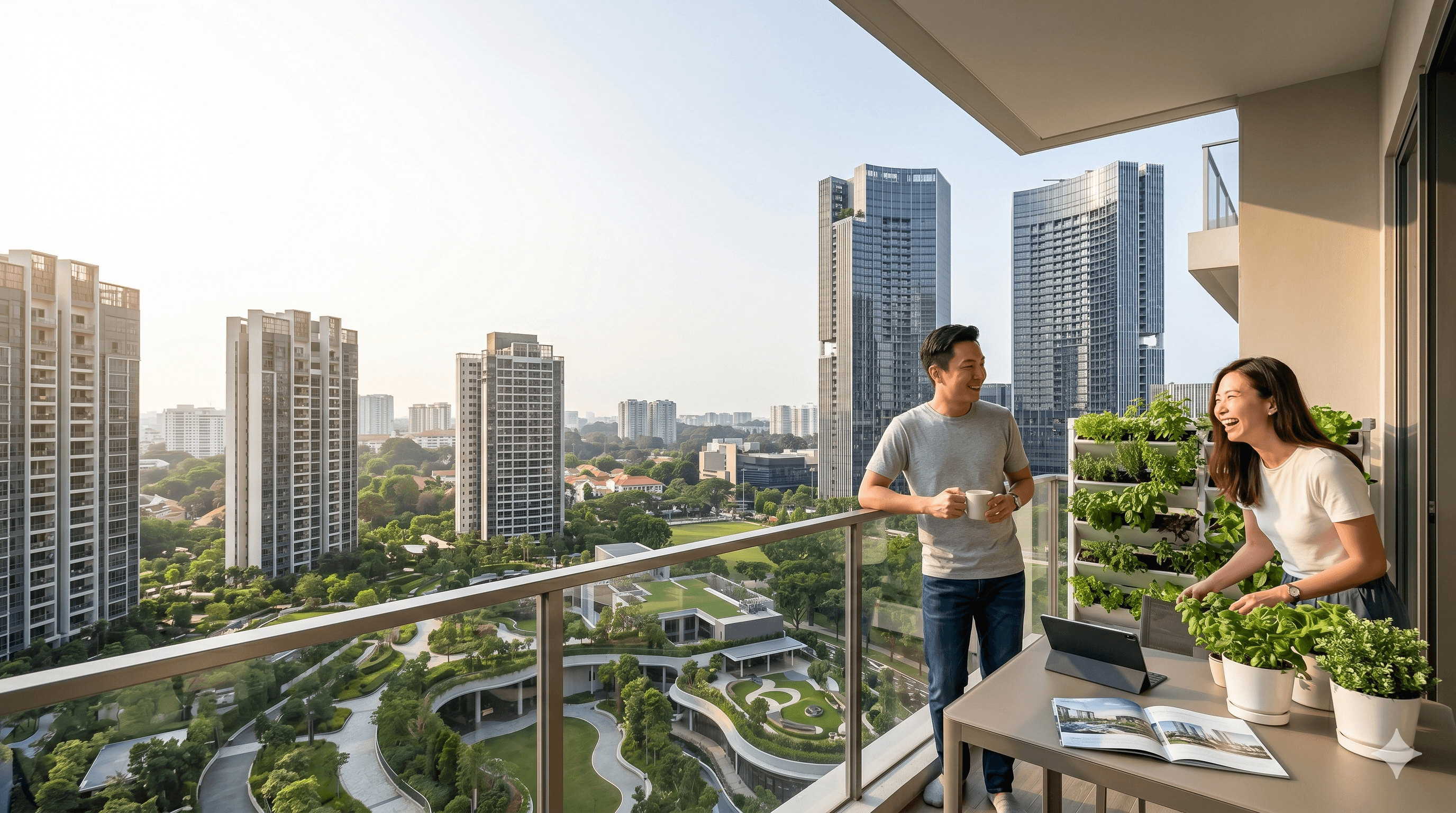
Grand Dunman Review: Is the Cheapest Way Into Prime District 15 Worth It at ~$2,524 PSF?
The lowest-priced of the big Katong-belt launches sits in a prestige postcode next to Dakota MRT. We price that value against what you trade for it — freehold cachet and a boutique scale — to see who the bargain is really for.
Grand Dunman is a 1,008-unit, 99-year leasehold condo at 2 Dunman Road (District 15, RCR) by SingHaiyi Group, with an expected TOP around 2028. Across 916 developer-sale caveats its indicative pricing is about $2,524 psf (median unit ~$2.31M), roughly 33% above District 15's median resale. The sharper read is against rival launches, where it is the cheapest of the big Katong-belt projects: it undercuts freehold Meyer Blue (~$3,206) and Amber House (~$3,060) by roughly $500–680 psf, and even sits below leasehold Emerald of Katong (~$2,628). That gap is what you save by taking a 99-year lease and a mega-scale project instead of freehold cachet and a boutique block. It suits a buyer who values the prime-fringe location and the lower entry price over tenure prestige; freehold-first and scarcity-flip buyers will look next door.
Grand Dunman at a glance
| Developer | Sing-Haiyi Jade Pte Ltd |
|---|---|
| Tenure | 99-year leasehold |
| Units | 1,008 |
| Launched | July 2023 (first developer sale) |
| Sales progress | 912 of Grand Dunman's 1,008 units (90%) had been sold as of Oct 2026, leaving 96 unsold (URA developer sales). |
| Launch price paid | S$2,523 psf median (S$2.32M), 940 developer caveats to Sep 2026 |
| District 15 resale | S$1,831 psf median across 968 resales in the last 12 months, so the launch price is 38% higher |
From URA caveats and URA's developer-sales figures (sales checked Oct 2026), refreshed daily. The review below was written earlier and quotes the figures of its day.
Every transaction and listing at Grand Dunman →Resale profit odds →Floor plans ↓
Where is the Grand Dunman showflat?
We couldn't confirm where Grand Dunman's showflat is from the developer, the news or its EdgeProp listing. 96 units were still unsold as of Oct 2026 (URA), so book a viewing with the developer's sales team before you go.
PropKaki has not visited this showflat; this review is a desk analysis.
Grand Dunman sells the opposite of scarcity. In a District 15 launch market where the headline projects flaunt freehold tenure and boutique exclusivity at $3,000-plus psf, Grand Dunman is the value play: a prime-fringe address on the Dunman–Dakota stretch at the lowest launch PSF of the Katong belt. But a lower price always buys you something and costs you something. This review prices exactly what the discount gets you — and what you give up to get it — so you can decide whether the cheapest ticket into D15 is the smart one.
Is Grand Dunman worth buying? Our verdict
Grand Dunman is a buy for the buyer who wants the prime District 15 location and the lowest entry price, not freehold prestige. At ~$2,524 psf it is the cheapest big Katong-belt launch — roughly $500–680 psf under freehold Meyer Blue and Amber House, and below leasehold Emerald of Katong. The trade you accept is a 99-year lease and 1,008-unit scale instead of freehold and boutique rarity.
Grand Dunman is a buy if you are chasing the address more than the tenure — and it is the smart-money value entry into prime District 15 for exactly that buyer. Its whole case is that it puts you in one of Singapore's most desirable prime-fringe postcodes, next to Dakota MRT and the Old Airport Road food belt, for the lowest launch price of the entire Katong belt. You are not paying up for scarcity here; you are paying down for it.
The numbers make the case plainly. Across 916 developer-sale caveats, Grand Dunman is pricing at about $2,524 psf (a median unit near $2.31M) — roughly 33% above District 15's median resale, which is a modest new-launch premium by 2026 standards. The comparison that matters is against the launches you would actually cross-shop, and here Grand Dunman is the cheapest of the big ones: it undercuts freehold Meyer Blue (~$3,206 psf) and Amber House (~$3,060 psf) by roughly $500–680 psf, and it even edges below leasehold Emerald of Katong (~$2,628 psf). In a district where prime addresses routinely start with a '3', a launch that starts with a '2' is the headline.
So the verdict turns on one honest trade. What you save on price, you give back in tenure and scale. Grand Dunman is 99-year leasehold, not freehold, and it is a 1,008-unit mega-project, not a boutique block — so you swap perpetual ownership and rarity for a lower entry cost and a deep, liquid market. If the Dunman–Katong location and the price are what you are buying, that is a trade well worth making. If freehold cachet or a scarcity-driven flip is your goal, the pricier projects next door are built for that, and Grand Dunman is not.
This review shows the full workings. For the market-wide picture, see our roundup of every 2026 new launch benchmarked against resale. You can also browse every 2026 launch in the Singapore new launches directory.
Why is ~$2,524 psf the whole story at Grand Dunman?
Grand Dunman's defining feature is its price: at ~$2,524 psf it is the cheapest brand-new entry into prime District 15, roughly $300–680 psf below its Katong-belt rivals and clearly under the district's '3-handle' launches. The market validated it — 550 units sold on launch weekend at about $2,500 psf.
Most new-launch reviews open with the location or the developer. Grand Dunman earns a different opening, because its defining feature is the price tag itself: it is the cheapest way a buyer can get a brand-new home into prime-fringe District 15 right now, and everything else about the project flows from that.
Consider what a '2' in front of the PSF means in this postcode. District 15 — the Katong, Amber, Meyer and Dunman belt — is one of the most established prestige addresses outside the core central region, and its 2026 launches have been priced to match: Meyer Blue at about $3,206 psf, Amber House at about $3,060 psf, The Continuum at about $2,851 psf. Against that backdrop, Grand Dunman's ~$2,524 psf is not a small discount — it is roughly $300–680 psf less than the projects it shares a district with, and it clears the psychological line that separates a '3-handle' prime launch from a '2-handle' one.
That pricing is also market-tested, not theoretical. Grand Dunman was one of the best-selling launches of its cycle: EdgeProp reported SingHaiyi sold 550 units on its July 2023 launch weekend — the best-selling project in two and a half years at the time — at an average of about $2,500 psf, and the project has since climbed to a new price peak of about $2,994 psf on its most sought-after stacks. That reception tells you the value case landed: buyers recognised a prime-district address at a sub-prime-district price. The rest of this review is about what that price buys — and, just as importantly, what it quietly asks you to give up.
Grand Dunman at a glance: the key facts
Grand Dunman is a 1,008-unit, 99-year leasehold condo at 2 Dunman Road (District 15, RCR) by SingHaiyi Group with CSC Land Group, expected to TOP around 2028, launched in July 2023, with indicative pricing around $2,524 psf (~$2.31M median).
| Detail | Grand Dunman |
|---|---|
| Developer | SingHaiyi Group (with CSC Land Group; project company Sing-Haiyi Jade Pte Ltd) |
| Tenure | 99-year leasehold |
| Location | 2 Dunman Road, District 15 (Marine Parade, RCR) |
| Total units | 1,008 across multiple towers |
| Unit types | 1- to 5-bedroom (studios/1BR from ~452 sq ft) |
| Nearest MRT | Dakota (Circle Line), a short walk away |
| Expected TOP | ~2028 |
| Launched | July 2023 (550 units sold on launch weekend) |
| Indicative pricing | ~$2,524 psf · median ~$2.31M |
A note on two of these figures. The developer and tenure are taken from the project's own launch materials and directory records; SingHaiyi Group is the lead developer, with CSC Land Group as its joint-venture partner, and 'Sing-Haiyi Jade Pte Ltd' is simply the project-holding company — not a separate developer. We anchor the expected TOP to around 2028, in line with the project timeline; automated directories can carry an unreliable completion year for new sites, so treat any figure that looks off (for example, a year in the past) as a directory artefact rather than the real date. The pricing is our own, computed from URA developer-sale caveats, and it lines up almost exactly with the ~$2,521 psf average independent coverage has reported as the project sold through to nearly 90% of its units.
How much does Grand Dunman cost? Prices and PSF by unit size
Across 916 developer-sale caveats, Grand Dunman's median is ~$2,524 psf (~$2.31M), with most units between $2,450 and $2,618 psf. PSF tapers the normal way — the smallest units are dearest per square foot (~$2,610) and the largest cheapest (~$2,458) — and a ~$1.24M studio/1BR entry is unusually accessible for prime District 15.
Across the 916 developer-sale caveats lodged so far, Grand Dunman's median is about $2,524 psf, with the cheaper and pricier quartiles running from roughly $2,450 to $2,618 psf. The median price works out to about $2.31M — a genuinely broad quantum spread for a prime-district launch, because the unit mix runs all the way from compact one-bedders to large family homes. With 916 caveats, this is a deep, well-populated sample rather than the thin early read you get at boutique launches, so the picture below is stable.
| Unit size (from our caveats) | Caveats (n) | Median PSF | Median price |
|---|---|---|---|
| ≤550 sqft (studio/1BR) | 139 | $2,610 | $1.24M |
| 550–750 sqft (1–2BR) | 134 | $2,556 | $1.72M |
| 750–1,100 sqft (2–3BR) | 327 | $2,502 | $2.26M |
| 1,100–1,500 sqft (3–4BR) | 225 | $2,523 | $3.08M |
| 1,500+ sqft (4BR+/penthouse) | 91 | $2,460 | $4.43M |
Two things stand out. First, the PSF tapers the right way: the smallest units carry the highest per-square-foot rate (~$2,610) and the largest carry the lowest (~$2,458), which is the normal, healthy pattern — the developer is discounting the big quantums to move them, so a larger unit here genuinely buys a cheaper per-square-foot rate as well as more space. Second, the entry point is unusually accessible for the district: a studio/1BR median of about $1.24M puts a foothold in prime-fringe D15 within reach of a single buyer or a first investor, which is a big part of why the project sold so deep so fast. If you are weighing the small-quantum entry against the per-square-foot maths, read quantum vs PSF when buying a condo. Pricing is a live snapshot — a median moves with which stacks and sizes have been released, and it is not the developer's full final price list.
Is Grand Dunman overpriced? Its PSF vs nearby resale and rival launches
At ~$2,524 psf, Grand Dunman is ~33% above District 15's median resale — a modest premium for a new launch, and smaller than the freehold rivals'. Against its true peers it is the value anchor: about $680 psf below Meyer Blue, $540 below Amber House, and even ~$100 below leasehold Emerald of Katong. That gap is the price of leasehold and scale, not proof of a weak project.
On the face of it, Grand Dunman's ~33% premium over District 15's median resale (~$1,894 psf) is the gap to explain. But that comparison flatters no new launch and unfairly penalises this one: you are pitting a brand-new, full-facility project against a district-wide pool of older, lived-in resale stock on shorter remaining leases. Some premium is simply the price of new. And notably, at ~33% Grand Dunman's premium is one of the smaller new-launch mark-ups in the district — the freehold launches nearby carry a far steeper gap over the same resale base. The honest benchmark is how Grand Dunman prices against the launches a District 15 buyer would actually cross-shop:
| Project | New-Sale caveats (n) | Median launch PSF |
|---|---|---|
| Meyer Blue | 178 | $3,206 |
| Amber House | 82 | $3,054 |
| The Continuum | 470 | $2,853 |
| Arina East Residences | 85 | $2,821 |
| Emerald Of Katong | 844 | $2,628 |
| Ardor Residence | 31 | $2,503 |
Read against its true peers, Grand Dunman is not just competitive — it is the value anchor of the group. It sits about $680 psf below freehold Meyer Blue, roughly $540 below Amber House, and even $100-odd below leasehold Emerald of Katong, its closest tenure-and-scale twin. Only the boutique Ardor Residence (~$2,506, on a much smaller sample) prices in the same neighbourhood. That is not evidence of a project being marked down for weakness — Grand Dunman sold through faster than almost anything in its cycle — it is the market pricing a 99-year, mega-scale product below the freehold and boutique options in the same postcode. Whether that discount is worth taking is the tenure-and-scale question, worked through in freehold vs leasehold condo and, for the price-gap discipline itself, how much a new-launch premium should be. Note too that The Business Times has flagged emerging price ceilings as more supply arrives — a reason a value-priced project can be a safer place to sit than one already stretched to the top of its market.
Where is Grand Dunman, and what does the Dunman–Dakota location get you?
Grand Dunman is at 2 Dunman Road on the city-facing Dunman–Dakota edge of District 15. Dakota MRT (Circle Line) is a short walk, the ECP and PIE are close, and the Old Airport Road Food Centre, Geylang River and Katong food belt are on the doorstep. It trades beach-frontage for rail-on-your-doorstep connectivity and everyday convenience.
Grand Dunman sits at 2 Dunman Road, on the Dunman–Dakota stretch of District 15 — the western, city-facing edge of the Katong belt, closer to town than the seafront Amber and Meyer addresses. This is a location that trades beach-frontage for connectivity and everyday convenience, and for a lot of buyers that is the better trade.
The connectivity is the anchor, and unlike the historically MRT-poor Amber enclave, it is already here:
- Dakota MRT (Circle Line) is a short walk away, putting you a handful of stops from Paya Lebar (a Circle/East–West interchange and a growing commercial hub), Marina Bay and the CBD without a transfer. The Circle Line also loops you to the rest of the island's rail network.
- The East Coast Parkway and Pan-Island Expressway are both close, so a car reaches the CBD or Changi in 10–15 minutes.
- Day to day, you are on the doorstep of the Old Airport Road Food Centre — one of Singapore's most famous hawker destinations — with the Geylang River promenade, the Dakota/Old Kallang estate and the Katong/Joo Chiat heritage food belt all within easy reach.
The practical read: this is a prime-fringe location that behaves like a well-connected city-fringe one. You get the District 15 postcode and its food-and-lifestyle depth, plus rail on your doorstep and a genuinely central position — a combination that supports both owner-occupier appeal and steady tenant demand. It is less a beach-lifestyle address than Amber or Meyer, and more an everyday-liveability one; which of those you value more is a large part of the Grand Dunman decision. For how the market tier shapes an investment case, read our CCR, RCR and OCR buying guide.
What do the 99-year lease and 1,008-unit scale actually cost you?
The price you save buys two trade-offs. First, a 99-year lease instead of freehold — academic over a short hold, but real over a long one as lease decay eventually bites, which is what the freehold neighbours' premium avoids. Second, 1,008-unit scale — great facilities and liquidity while you own, but a larger resale pool at exit. Both are the terms of the discount, not hidden flaws.
This is the other side of the value ledger, and it deserves an honest accounting, because the price you save at Grand Dunman is not free money — it is the market's discount for two specific things you accept.
You accept a 99-year lease instead of freehold. Grand Dunman's two priciest neighbours, Meyer Blue and Amber House, are freehold; Grand Dunman is 99-year leasehold. Over a short-to-medium hold the difference is largely academic — the lease clock barely moves in the first decade. Over a long hold it becomes real: a leasehold owner eventually watches lease decay erode value in a way a freehold owner never does, and the freehold buyers next door are paying their ~$500–680 psf premium precisely to avoid that. If you intend to hold for 25 years or pass the home to the next generation, that premium is buying something you are choosing to forgo. For the framing itself, see freehold vs leasehold condo.
You accept a 1,008-unit mega-project instead of a boutique block. This is the usual big-launch double-edge, and it is worth stating plainly rather than pretending it only cuts one way:
- In your favour while you own: a project this size funds resort-grade facilities — multiple pools, function spaces, landscaped decks — that a 100-unit block cannot, plus a deep, liquid resale and rental market where something is always transacting.
- Against you at exit: with 1,008 homes, your eventual sale competes against a larger pool of near-identical units, which tends to keep resale pricing efficient rather than letting a scarcity premium build. This is a real consideration — but note it is not Grand Dunman's headline story the way it is for a pure mega-convenience play, because here the draw is the value-in-a-prime-postcode, not the scale itself. The scale is the thing you tolerate for the price, not the thing you buy.
Put together, the leasehold and the scale are exactly why Grand Dunman can sit ~$500–680 psf below the freehold-boutique launches. Neither is a flaw so much as a term of the deal — and for the buyer whose priority is the location and the entry price, they are terms well worth accepting.
Is Grand Dunman a good investment? What the resale data says
Grand Dunman has never been resold, so there's no track record. The honest proxy — RCR resales — shows 86.4% sold above cost with a +24.8% median gain (gross, a base rate not a forecast). A low entry price for the district gives a wider margin of safety; the running lease and 1,008-unit resale pool argue against banking on outsized gains. Rental demand is strong, but we quote no yield.
Grand Dunman has never been resold — it is a brand-new launch — so there is no project track record to quote, and anyone promising you a return is guessing. The honest proxy is how comparable homes in its market segment have actually performed. Across matched resale pairs, 86.4% of city-fringe (RCR) private resales sold above their purchase price, with a median gross gain of 24.8%.
Treat that as a base rate, not a forecast, and remember it is gross — before commission, buyer's and seller's stamp duties, any Seller's Stamp Duty and loan interest. Two things shape how Grand Dunman's own odds sit against that base rate. Working for it: the entry price is low for the district, and buying below the prevailing prime-D15 launch level gives you a wider margin of safety than paying top-of-market — you are not relying on the district re-rating just to break even. Working against it: the 99-year lease is already running, so a very long hold eventually meets lease decay, and the 1,008-unit resale pool keeps pricing efficient rather than exuberant. On the rental side, a brand-new, MRT-adjacent block in a prime-fringe food-and-lifestyle district has a genuinely strong demand case for leasing — we won't quote a yield figure here, because this review is deliberately price-and-value rather than a yield projection, but the tenant appeal of the Dunman–Dakota location is real. To pressure-test a specific unit against your own holding period, costs and rent, run it through the PropKaki profitability model, and read how to tell if a property will be profitable.
Grand Dunman pros and cons: who should buy it?
Pros: the cheapest prime-D15 entry, a central Dakota-MRT location with the food belt nearby, a modest resale premium, an accessible ~$1.24M entry quantum, and mega-scale facilities with deep liquidity. Cons: 99-year leasehold not freehold, 1,008-unit scale, a city-fringe rather than seafront feel, and a ~2028 completion. Best for value-minded location buyers; not for freehold-first or scarcity-flip buyers.
Where Grand Dunman earns its keep:
- The cheapest entry into prime District 15 — ~$2,524 psf, roughly $500–680 psf below the freehold Katong launches and even below leasehold Emerald of Katong.
- A genuinely central prime-fringe location — Dakota MRT (Circle Line) on the doorstep, the ECP and PIE close, and the Old Airport Road food belt and Geylang River nearby.
- A modest premium over resale — ~33%, smaller than the district's freehold launches, so less stretched at the top of the market.
- An accessible entry quantum — a ~$1.24M studio/1BR foothold is rare for this postcode, and PSF tapers the normal way so larger units genuinely cost less per square foot.
- Mega-scale facilities and deep liquidity — resort-grade communal offerings and an always-active resale and rental market, backed by a proven best-selling launch.
The trade-offs you accept:
- 99-year leasehold, not freehold — you forgo the perpetual tenure the pricier neighbours are built on, and a very long hold eventually meets lease decay.
- 1,008-unit scale — a larger future resale pool that keeps pricing efficient rather than scarce.
- A city-fringe feel, not a beach one — this is the Dunman–Dakota stretch, not the seafront Amber/Meyer address, so it is a connectivity-and-food location more than a lifestyle-by-the-sea one.
- A ~2028 completion — you fund interim housing while you wait.
It fits: value-minded buyers who want the District 15 postcode and location at the lowest price, own-stay buyers who prize central connectivity and the food scene, and investors who want a low entry cost and strong rental demand in a prime-fringe address. Skip it if: freehold tenure is non-negotiable, you want a boutique or scarcity-driven asset to flip, or a seafront lifestyle address is the point. For a structured head-to-head against another shortlisted project, use our two-project comparison scorecard.
The one thing to weigh before buying Grand Dunman
Grand Dunman only makes sense if you want the prime-D15 location and the ~$500–680 psf saving, not tenure prestige. That discount is real, but it is the price of a 99-year lease and 1,008-unit scale — exactly what the freehold neighbours charge to avoid. Buy it for the location and value; look next door if you want freehold or a scarcity flip.
Before anything else, be honest about why you want a District 15 address — because Grand Dunman only makes sense if the answer is the location and the price, not the prestige of tenure. You are being offered a prime-fringe postcode next to Dakota MRT and the Old Airport Road food belt at roughly $500–680 psf less than the freehold launches sharing that postcode. That saving is real, and it is the reason to buy. But it is also a decision, not a free lunch: you are choosing a 99-year lease over freehold and a 1,008-unit project over a boutique one, and those are precisely what the pricier neighbours charge their premium to avoid. If the Dunman–Katong location and a lower entry cost are what you actually value, this is the smart-money way into the district and the trade is well worth making. If, deep down, what you want is freehold permanence or a rare asset to flip into scarcity, no amount of PSF saving will make Grand Dunman the right project — and a pricier freehold or boutique launch next door will serve that goal better.
Who is the developer of Grand Dunman?
SingHaiyi Group, with joint-venture partner CSC Land Group (project company Sing-Haiyi Jade Pte Ltd).
Grand Dunman is developed by SingHaiyi Group, together with joint-venture partner CSC Land Group; the project-holding company is Sing-Haiyi Jade Pte Ltd. SingHaiyi is an established Singapore-listed developer, and Grand Dunman was one of its landmark launches — EdgeProp reported it sold 550 units on its July 2023 launch weekend, making it the best-selling project of its cycle at the time.
How much does Grand Dunman cost?
About $2,524 psf median (~$2.31M), with most units $2,450–$2,618 psf and studio/1BR entry from ~$1.24M, from our URA caveat data.
Based on 916 URA developer-sale caveats, Grand Dunman's indicative pricing is about $2,524 psf (median unit ~$2.31M), with most units between $2,450 and $2,618 psf. The smallest studio/1BR units start from around $1.24M, and the per-square-foot rate is highest on the smallest units and lowest on the largest. That read aligns closely with the ~$2,521 psf average reported as the project sold through to nearly 90% of its units. Pricing is a live snapshot and moves as more stacks are released — it is not the full final price list.
Is Grand Dunman the cheapest new launch in District 15?
It is the cheapest of the big D15 launches — below freehold Meyer Blue, Amber House and even leasehold Emerald of Katong; only the tiny-sample Ardor Residence edges it.
By median launch PSF, Grand Dunman (~$2,524) is the cheapest of the big District 15 launches — it undercuts freehold Meyer Blue (~$3,206) and Amber House (~$3,060), The Continuum (~$2,851), Arina East (~$2,812) and even leasehold Emerald of Katong (~$2,628). Only the small-sample boutique Ardor Residence (~$2,506) sits marginally lower. That makes Grand Dunman the value entry point into the district — a prime-fringe address at a below-district-average launch price.
Grand Dunman vs Emerald of Katong — which should you choose?
Both are 99-year D15 mega-launches; Grand Dunman is cheaper (~$2,524 vs ~$2,628 psf) and sits by Dakota MRT and the Old Airport Road food belt. Choose on precinct and price — tenure is the same.
Both are 99-year leasehold District 15 mega-launches, so this is a like-for-like tenure comparison, and Grand Dunman is the cheaper of the two by median PSF (~$2,524 vs ~$2,628). The choice comes down to precinct and product: Grand Dunman sits on the city-facing Dunman–Dakota stretch, a short walk from Dakota MRT (Circle Line) and the Old Airport Road food belt, while Emerald of Katong is deeper in the Katong/Tanjong Katong pocket. If a lower price and Circle Line connectivity matter most, Grand Dunman leads; if you prefer the specific Tanjong Katong location, weigh that against the small PSF premium. Neither is freehold, so tenure is not the deciding factor here.
When is Grand Dunman expected to be completed (TOP)?
Around 2028, in line with the project timeline; confirm the latest date in the developer's current sales documents.
Grand Dunman's expected TOP is around 2028, in line with the project timeline for a 2023 launch. Note that automated property directories can show an unreliable completion year for new sites, so we anchor this to the project's own timeline rather than a directory field. As with any under-construction launch, you should confirm the latest expected vacant-possession date in the developer's current sales documents before committing.
Methodology and sources
Corrected 15 September 2026: caveat counts were overstated and are corrected as at 8 July 2026. Pricing from our URA New-Sale caveats; the premium from District 15 resale caveats; comparables from each project's caveats; segment odds from matched RCR pairs. Developer, tenure and TOP are anchored to the project's own materials. A desktop analysis, not a showflat visit; no yield figure quoted.
⚠️ Corrected 15 September 2026. The caveat counts in the version of this review published in July were overstated. URA amends some caveat details after first publishing them, and our records had been keeping the original and the amended caveat as two separate sales — almost all of them new-launch sales. Corrected as at 8 July 2026, when this analysis was run: Grand Dunman had 916 New-Sale caveats, not 922; among the rival launches, Amber House 82 (not 87), The Continuum 470 (not 510), Arina East Residences 85 (not 114), Ardor Residence 31 (not 33). Counts are corrected throughout; the size and comparison tables show the de-duplicated medians, and price figures in the text that moved by less than 1% sit within its approximations and are unchanged.
Where the figures come from. Grand Dunman's indicative pricing is the median of 916 URA private-sale caveats flagged New Sale for the project (window 14 July 2023 to 8 June 2026), from PropKaki's own transaction data. The ~33% premium compares that to the median PSF of Resale caveats in District 15 over the last ~18 months (1,830 caveats). The comparable-launch PSFs are the medians of each rival project's own New-Sale caveats over the last ~30 months, deduped per project. The 86.4% segment resale odds and +24.8% median gain come from matched private buy→sell pairs in the RCR (city-fringe) segment via PropKaki's profitability model. Developer, tenure and the expected completion are anchored to the project's own materials and timeline — not a directory completion field, which can be unreliable for new sites. External context is cited inline: EdgeProp for the launch-weekend sell-through and its later price peak, 99.co for the sold-through average, and The Business Times on emerging price ceilings.
What we did not do, and did not claim. This is a data and desktop analysis, not a showflat visit — we have not toured the units or verified finishes in person. Indicative PSF is a dated snapshot that moves as more units sell; PSF is price ÷ area, so a median shifts with which units transact — the by-size table controls for this. The resale benchmark is a district median, not a unit-matched valuation, and resale stock is older and on shorter leases, so some launch premium is expected and is not itself proof of overpricing. Segment profit odds are gross (before commission, stamp duties, any SSD and interest) and are a base rate, not a forecast — Grand Dunman has never been resold. We deliberately quote no rental-yield figure; assess rental economics for a specific unit with the profitability model. Nothing here is financial advice; verify current rules and figures with URA, IRAS and HDB.
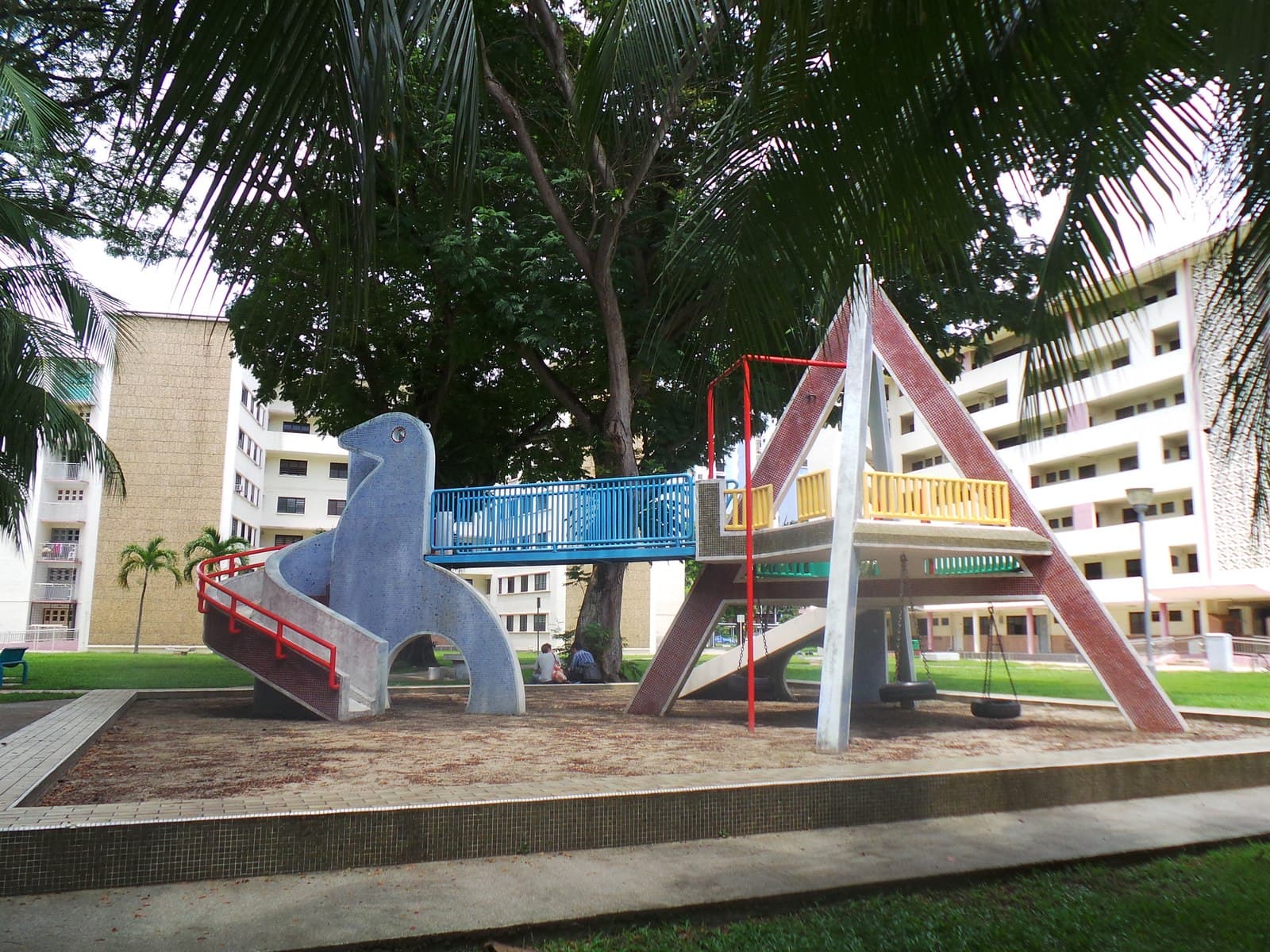
Hero image: Dove Playground, Dakota Crescent — photo by Leexueli95, CC BY-SA 4.0, via Wikimedia Commons.
What are the floor plans and unit sizes at Grand Dunman?
PropKaki has 83 layouts on record for Grand Dunman, from 1 to 5 bedrooms (452 sqft to 3,068 sqft).
| Bedrooms | Layouts | Sizes |
|---|---|---|
| 1 Bedroom | 16 | 452 to 710 sq ft |
| 2 Bedroom | 18 | 667 to 1,012 sq ft |
| 3 Bedroom | 23 | 926 to 1,819 sq ft |
| 4 Bedroom | 11 | 1,292 to 2,314 sq ft |
| 5 Bedroom | 7 | 1,679 to 2,615 sq ft |
| Other layouts | 8 | 2,336 to 3,068 sq ft |
PropKaki holds 68 floor plans for Grand Dunman.
See Grand Dunman's floor plans — ask PropKaki. Ask PropKakisqm ↔ sq ft converter
Layouts digitised from developer brochures.
Grand Dunman: quick answers
Answered from URA data, refreshed daily.
Is Grand Dunman fully sold?⌄
Not yet. 912 of Grand Dunman's 1,008 units (90%) had been sold as of Oct 2026, leaving 96 unsold (URA developer sales).
Is Grand Dunman freehold?⌄
No. Grand Dunman is 99-year leasehold.
When was Grand Dunman launched?⌄
Grand Dunman went on sale in July 2023. Its first developer sale on record is dated 14 July 2023 (URA caveats).
Why is Grand Dunman so expensive?⌄
Grand Dunman's developer sales have a median of S$2,523 psf, about 38% above the S$1,831 psf median for resale condos in District 15 over the last 12 months (URA caveats). A new launch usually costs more than resale: buyers pay for a full-length new lease and a home no one has lived in. The review explains what else is in Grand Dunman's price.
Got a question this raised? Ask PropKaki.
Take any point from this analysis and apply it to your own project, budget or decision.
PropKakiFor most buyers this year, staying well within budget beats trying to time the market.