
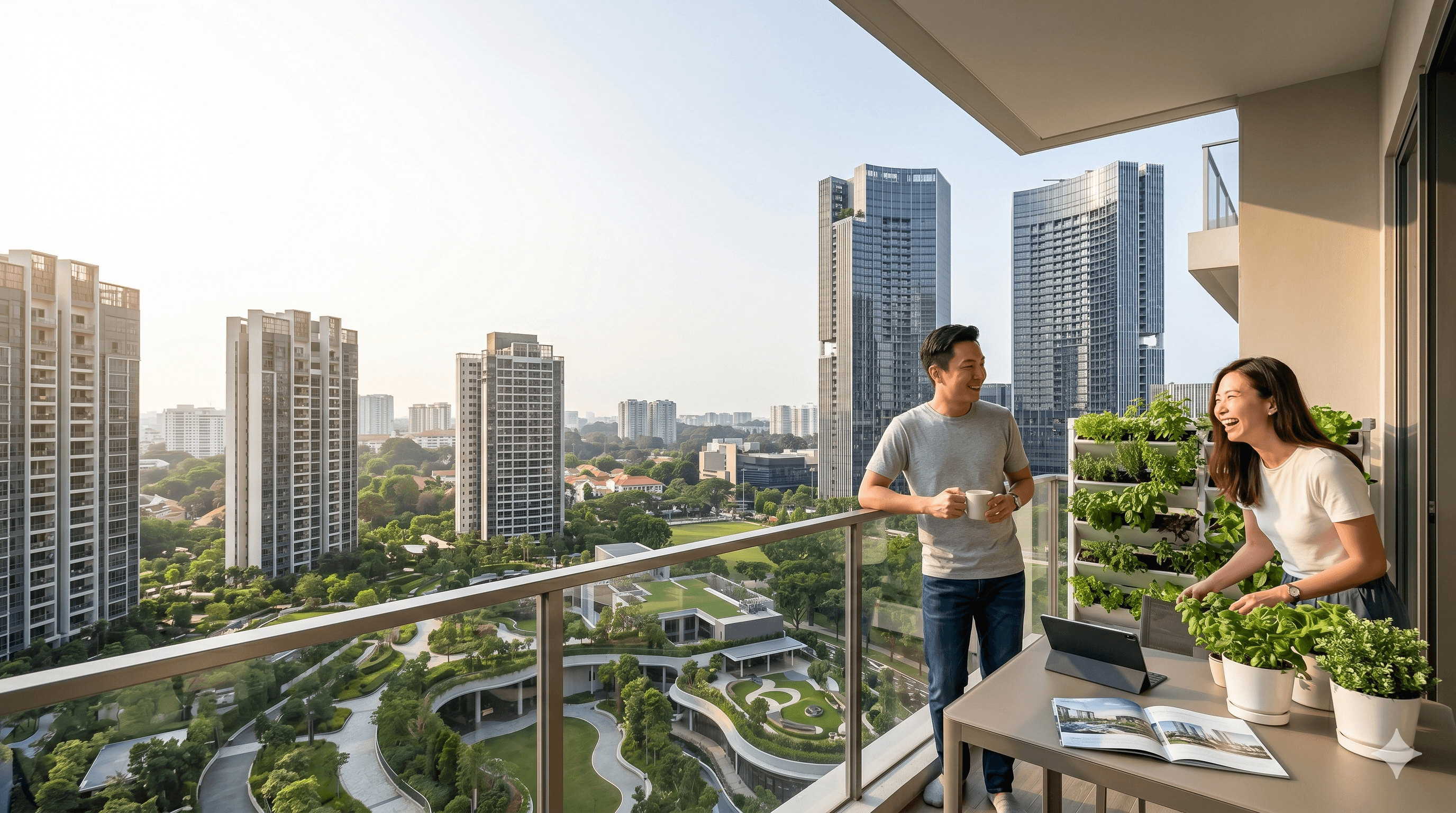
Bloomsbury Residences Review: A Smart Rental Play Near One-North?
The first homes inside Singapore's one-north research corridor, priced at one of the tightest premiums of the 2026 batch. We read it as a landlord would — through the tenant pipeline next door, not the showflat.
Bloomsbury Residences is a 358-unit 99-year leasehold condo on Media Circle in one-north (District 5, RCR) by Qingjian Realty and Forsea Holdings, with vacant possession expected 7 February 2029. Across 320 developer-sale caveats its indicative pricing is about $2,522 psf (median ~$1.81M), roughly 38% above District 5's median resale — one of the tightest launch premiums in the 2026 batch. That restraint is the story: it sits within a few percent of a cluster of recent one-north launches (Elta, The Hill @ One-North, Hudson Place, Lyndenwoods), so it is fairly, not aggressively, priced. Its real edge is the tenant engine on its doorstep — Biopolis, Fusionopolis, the universities and the media precinct put a deep pool of well-paid renters next door. It is the most investment-oriented launch of the batch: buy it for the one-north rental pipeline and the fair entry, not for prestige.
Bloomsbury Residences at a glance
| Developer | Media Circle Development Pte Ltd |
|---|---|
| Tenure | 99-year leasehold |
| Units | 358 |
| Launched | April 2025 (first developer sale) |
| Sales progress | 311 of Bloomsbury Residences's 358 units (87%) had been sold as of Oct 2026, leaving 47 unsold (URA developer sales). |
| Launch price paid | S$2,529 psf median (S$1.83M), 334 developer caveats to Sep 2026 |
| District 5 resale | S$1,858 psf median across 672 resales in the last 12 months, so the launch price is 36% higher |
From URA caveats and URA's developer-sales figures (sales checked Oct 2026), refreshed daily. The review below was written earlier and quotes the figures of its day.
Every transaction and listing at Bloomsbury Residences →Resale profit odds →Floor plans ↓
Where is the Bloomsbury Residences showflat?
Bloomsbury Residences's showflat is along Media Walk, one-north, according to its EdgeProp new-launch listing (checked 18 September 2026). 47 units were still unsold as of Oct 2026 (URA), so book a viewing with the developer's sales team before you go.
Source: EdgeProp new-launch listing, checked 18 September 2026. PropKaki has not visited this showflat; this review is a desk analysis.
Most new-launch reviews ask whether a home is nice to live in. Bloomsbury Residences deserves a different first question, because of where it sits: right inside one-north, Singapore's biomedical, tech, media and R&D corridor. So the honest lens here is a landlord's. Who rents next door, is the entry price fair against the launches around it, and does the investment case hold up on the data — before you ever see a showflat? That is what this review works through.
Is Bloomsbury Residences a smart rental play near one-north? Our verdict
Bloomsbury Residences is the batch's most investment-led launch: a tight ~38% premium (fair against the cluster of one-north launches around it) plus a deep, well-paid tenant pool at Biopolis, Fusionopolis, the universities and the media precinct next door. Buy it for the one-north rental pipeline and fair entry, not for tenure or prestige.
Bloomsbury Residences is the most investment-oriented launch of this 2026 batch, and it earns that label for two concrete reasons: a fair entry price and the deepest tenant pool of any project on this list sitting right next door. If you are buying to let, this is the one to look at hardest — not because of freehold or prestige, which it does not have, but because of who works within walking distance.
Start with the price, because the number that matters is the premium, not the headline PSF. Across 320 developer-sale caveats, Bloomsbury is pricing at about $2,522 psf (a median unit near $1.81M) — roughly 38% above District 5's median resale of ~$1,824 psf. In new-launch terms that 38% is tight: several launches this year carry premiums well north of 60%. Bloomsbury reads as fairly priced because it is surrounded by recent comparable stock — a cluster of one-north launches (Elta, The Hill @ One-North, Hudson Place Residences, Lyndenwoods) all sit within a few percent of its PSF, so there is nowhere for an inflated premium to hide.
Then there is the reason a landlord cares about this exact address: one-north. Biopolis and Fusionopolis, the universities, and the media and R&D precinct on its doorstep are a standing supply of well-paid tenants — the biomedical scientists, engineers, academics and MNC staff who want to live minutes from work. That is a demand engine most new launches simply do not have next door.
So the verdict is narrow and clear: buy Bloomsbury for the one-north tenant pipeline and the fair entry, not for the tenure. It is 99-year leasehold in a leasehold-heavy year, so it will not carry the scarcity story that a freehold launch does. If your plan is to let it to the workforce next door and hold through the lease, the case is strong. If you want perpetual tenure or a trophy address, look elsewhere. For the market-wide picture, see our roundup of every 2026 new launch benchmarked against resale. You can also browse every 2026 launch in the Singapore new launches directory.
Bloomsbury Residences at a glance: the key facts
Bloomsbury Residences is a 358-unit 99-year leasehold condo on Media Circle in one-north (District 5, RCR) by Qingjian Realty and Forsea Holdings, with vacant possession expected 7 February 2029 and indicative pricing around $2,522 psf.
| Detail | Bloomsbury Residences |
|---|---|
| Developer | Qingjian Realty & Forsea Holdings (JV vehicle: Media Circle Developments Pte Ltd) |
| Tenure | 99-year leasehold (from 7 May 2024) |
| Location | Blocks 61 / 63 / 65 Media Circle, District 5 (Queenstown, RCR) |
| Site area | ~10,632 sqm (~114,443 sq ft) |
| Total units | 358, across three towers (23, 21 and 14 storeys) with shops on level 1 |
| Unit types | 2- to 6-bedroom (size proxies from our caveats: ~550–1,500+ sqft) |
| Expected TOP | ~2029 (expected vacant possession 7 February 2029) |
| Indicative pricing | ~$2,522 psf · median ~$1.81M |
Two notes on these figures. The developer, tenure, site area, unit count and vacant-possession date are from the project's own launch materials — the brochure names the developer as the joint-venture vehicle Media Circle Developments Pte Ltd, formed by Qingjian Realty and Forsea Holdings. Our automated directory lists the completion year as 2028, but the brochure's expected vacant possession is 7 February 2029, so we use ~2029. The pricing is our own, computed from URA developer-sale caveats. Independent coverage from EdgeProp corroborates the launch: Qingjian and Forsea sold 90 units (25.1% of the project) on the opening weekend at an average of $2,474 psf.
Who rents in one-north? The tenant-demand engine next door
one-north is a purpose-built research and innovation corridor: Biopolis (biomedical), Fusionopolis (tech and media), the universities and the wider business park sit on Bloomsbury's doorstep, with one-north and Buona Vista MRT alongside. That is a deep pool of well-paid tenants who want to live next to work — the demand engine a landlord buys this location for.
This is the section that decides whether Bloomsbury Residences works as a rental asset, so it comes first among the specifics. A landlord's return depends on a reliable, well-paid stream of tenants — and one-north is one of the few places in Singapore built expressly to generate exactly that.
one-north is a purpose-built research and innovation corridor, not an ordinary suburban precinct. On Bloomsbury's doorstep are:
- Biopolis — the biomedical-sciences hub: research institutes, pharma and biotech firms, and the scientists and engineers they employ.
- Fusionopolis — the infocomm, media and engineering cluster, home to tech companies and government research bodies.
- Universities and schools next to the precinct — including INSEAD, ESSEC and the nearby National University of Singapore and one-north's education tenants, which bring in academics, researchers and postgraduate students.
- The media precinct (Mediapolis / Media Circle itself) and a spread of MNC and R&D offices across the business park.
What this means for a landlord is straightforward: a deep, renewing pool of tenants who are well-paid, mobile, and want to live minutes from work rather than commute across the island. EdgeProp described Bloomsbury as the first residential development in Mediapolis — meaning the workforce that fills these buildings has had little new-build housing right on top of the jobs until now. Connectivity reinforces it: one-north MRT and Buona Vista MRT (an interchange linking the Circle and East–West lines) put the CBD and the rest of the island within easy reach.
One honest limit: a tenant pool being deep is not the same as a guaranteed yield, and this pack carries no rental-yield figure, so we will not quote one. What we can say plainly is that the demand-side ingredients a landlord looks for — a large, high-income employment base within walking distance, plus rail — are unusually well stacked here. To turn that into an actual net-yield number for a specific unit and your own costs, run it through the PropKaki profitability model.
How much does Bloomsbury Residences cost? Prices and PSF by unit size
Across 320 developer-sale caveats, Bloomsbury's median is ~$2,522 psf and ~$1.81M, with most units $2,456–$2,574 psf. Smaller units dominate the caveats (187 of 320) at a ~$1.68M median entry, and PSF barely rises with size — so the compact, more-rentable units carry the project.
Across the 320 developer-sale caveats lodged so far, Bloomsbury's median is about $2,522 psf, with most units transacting between roughly $2,456 and $2,574 psf — a tight band. The median price works out to about $1.81M. That indicative median sits a touch above the opening-weekend average of $2,474 psf that EdgeProp reported, which is what you would expect: the median has crept up as more of the pricier, higher-floor stacks were released after launch. Read the PSF as a live snapshot, not a fixed price list.
| Unit size (from our caveats) | Caveats (n) | Median PSF | Median price |
|---|---|---|---|
| 550–750 sqft (1–2BR) | 187 | $2,510 | $1.68M |
| 750–1,100 sqft (2–3BR) | 91 | $2,512 | $2.42M |
| 1,100–1,500 sqft (3–4BR) | 41 | $2,573 | $3.17M |
Two things stand out for a landlord. First, the smaller units dominate the caveats — 187 of 320 sold so far are in the 550–750 sqft band, and their ~$1.68M median is the most rentable, most liquid entry point in the project. That matches the launch pattern: EdgeProp noted two-bedders made up more than 70% of the units sold on opening weekend. Second, PSF barely rises with size (roughly $2,510 for the smallest band versus $2,578 for the largest), so going bigger buys you more space but not a meaningfully cheaper per-square-foot deal — and the bigger quantum is harder to rent out efficiently. For a rental play, the smaller bands do more of the work. If the quantum-versus-PSF trade-off matters to you, read quantum vs PSF when buying a condo. (Size bands are reconstructed from our own caveats, so the bedroom labels are size proxies, not the developer's official unit mix.)
Is the 39% premium fair? Bloomsbury's PSF vs nearby resale and rival launches
Bloomsbury's ~38% premium over District 5 resale is modest for 2026, and its ~$2,522 psf sits mid-pack among one-north launches (Elta ~$2,552, The Hill @ One-North ~$2,498, Lyndenwoods ~$2,465, Terra Hill ~$2,690). Being priced next to plentiful comparable stock is what makes the premium read as fair value, not a stretch.
At first glance, Bloomsbury's ~38% premium over District 5's median resale (~$1,824 psf) looks like the usual new-launch mark-up — and it partly is, because you are comparing a brand-new leasehold project against a district-wide pool of older, lived-in, shorter-lease resale stock. Some premium always comes with new. But 38% is genuinely modest by 2026 standards, and the reason becomes obvious the moment you line Bloomsbury up against the launches a buyer would actually cross-shop:
| Project | New-Sale caveats (n) | Median launch PSF |
|---|---|---|
| Terra Hill | 96 | $2,684 |
| Elta | 410 | $2,547 |
| The Hill @ One-North | 141 | $2,498 |
| Hudson Place Residences | 218 | $2,468 |
| Lyndenwoods | 342 | $2,465 |
| The Hillshore | 9 | $2,409 |
Read against its true peers, Bloomsbury (~$2,522) sits squarely in the middle of the pack — a shade under Elta (~$2,552), a shade over The Hill @ One-North (~$2,498), and well below the pricier Terra Hill (~$2,690). This is the point that makes the premium read as fair value rather than a stretch: Bloomsbury is priced next to plentiful, recent, directly comparable one-north supply. Unlike a frontier-precinct launch that sets the first-ever benchmark in an area with no nearby stock to check it against, Bloomsbury has a whole neighbourhood of freshly transacted launches boxing in its price. When five comparable projects all cluster within roughly $2,409–$2,552 psf, a sixth at $2,522 is being disciplined by the market, not testing a ceiling.
That matters for an investor for a simple reason: you make more of your return on the buy than on the sell. A fair, well-anchored entry price leaves more room for the rental income and any capital growth to actually accrue to you, rather than being pre-spent on an inflated premium. It is not evidence the price will rise — no launch price is — but it is the opposite of overpaying. The Business Times has flagged that price ceilings are emerging as more supply arrives, which is exactly the dynamic keeping premiums like Bloomsbury's honest. For how to think about the mark-up itself, see how much a new-launch premium should be and new launch vs resale.
Is Bloomsbury Residences a good investment? What the data says
Bloomsbury has never been resold, so there is no track record. The RCR segment base rate is favourable — 86.4% of resales sold above cost with a +24.8% median gain (gross) — but that is a segment odds, not a forecast, and it is 99-year leasehold. Rental *demand* is qualitatively strong thanks to one-north, but the pack has no yield figure, so we quote none; model your own unit.
An honest investment read on a brand-new launch has two halves — capital growth and rental demand — and it is important to be clear about which half the data actually supports.
Capital growth: a base rate, not a forecast. Bloomsbury has never been resold, so there is no project track record, and anyone quoting you a return is guessing. The honest proxy is how comparable homes in its market segment have performed. Across matched resale pairs, 86.4% of city-fringe (RCR) private resales sold above their purchase price, with a median gross gain of 24.8%. Treat that as a base rate for the segment, not a prediction for this project — and remember it is gross, before commission, stamp duties, any Seller's Stamp Duty and loan interest. Tenure is the caveat that cuts the other way: Bloomsbury is 99-year leasehold, so the lease clock does eventually weigh on value in a way freehold avoids. Over a normal hold that is manageable, but it is a reason this is a hold-and-let asset rather than a decades-long legacy hold. See how lease decay affects condo prices.
Rental demand: qualitatively strong, but we will not put a yield number on it. This is where Bloomsbury separates from the pack, and where honesty about the data matters most. Our pack contains no rental-yield figure, so we will not state one — quoting a made-up yield would be exactly the showflat spin this review exists to avoid. What the demand side clearly offers is the one-north tenant engine from earlier: a large, high-income employment base (Biopolis, Fusionopolis, the universities, the media precinct) within walking distance, plus one-north and Buona Vista MRT. Those are the ingredients that support occupancy and rent — but the actual yield depends on the rent you achieve and your all-in costs, which are unit- and timing-specific.
So the investment case is: a fair, well-anchored entry price; a favourable RCR base rate for capital growth (as a segment, not a promise); and an unusually strong qualitative demand story for rental. To turn all of that into a real number for a specific unit, your financing and your holding period, run it through the PropKaki profitability model and read how to tell if a property will be profitable.
What should you actually buy here as a landlord?
For a rental strategy, lead with the compact 1- and 2-bedroom units: they make up the bulk of sales (187 of 320 caveats, and 70%+ of opening-weekend sales), match the one-north tenant profile, and offer the best mix of lower quantum, deeper demand and resale liquidity. The large 4- to 6-bedders suit own-stay families more than landlords.
Bloomsbury spans 2- to 6-bedroom layouts across 358 units in three towers, but not every unit is an equal rental proposition, and the caveat data points clearly at where the demand is.
The compact units are the rental workhorses. Our caveats show the 550–750 sqft band (proxying 1- and 2-bedders) accounts for 187 of the 320 sales so far, at a ~$1.68M median — and EdgeProp reported two-bedders made up over 70% of opening-weekend sales. That concentration is not an accident: it maps directly onto the one-north tenant profile. A biomedical researcher, a young engineer or a visiting academic is far likelier to rent a well-located 1- or 2-bedder near work than a family-sized 4-bedder. For a letting strategy, the compact units offer the best combination of lower quantum, deeper tenant demand and easier resale liquidity later.
The larger units are a different, thinner bet. The 1,100–1,500 sqft band (and the headline 5- and 6-bedroom layouts, including a penthouse that transacted around $2,700 psf per EdgeProp) carry bigger quantums without a PSF discount, and the pool of tenants who will pay for that much space near one-north is smaller than the pool for compact units. They can suit an owner-occupier family who wants to live in the precinct, but as a pure rental instrument they are less efficient.
The practical takeaway for a landlord: lead with the 1- and 2-bedroom bands. They are where the tenant demand, the liquidity and the sensible quantum all line up. If you are weighing two specific stacks or unit types, our two-project / unit comparison scorecard helps structure the call.
Bloomsbury Residences pros and cons for an investor
Pros: a rare on-top-of-the-jobs one-north location with deep tenant demand, a fair mid-pack entry price, strong MRT connectivity, and a rentable compact unit mix. Cons: 99-year leasehold with no scarcity story, no stated yield to lean on, a 2029 completion, and a crowded field of rival one-north launches. Best for landlords letting to the one-north workforce.
The strengths are specific and investor-relevant:
- A rare on-top-of-the-jobs location — the first residential build inside the Mediapolis / one-north precinct, with Biopolis, Fusionopolis, the universities and the media cluster generating tenant demand next door.
- A fair, well-anchored entry price — a ~38% premium that is modest for 2026, priced mid-pack among a cluster of comparable one-north launches, so you are not overpaying at the buy.
- Strong connectivity — one-north and Buona Vista MRT (a Circle / East–West interchange) put the CBD and the island within easy reach.
- A rentable, liquid unit mix — a large supply of compact 1- and 2-bedders that match the tenant profile and sell on easily.
The risks you're underwriting:
- 99-year leasehold — no scarcity story, and the lease clock eventually weighs on value; this is a hold-and-let asset, not a perpetual legacy hold.
- No stated yield, and a demand story is not a guarantee — a deep tenant pool supports occupancy, but your actual return depends on achieved rent and your costs, which you must model.
- A 2029 completion — you fund interim housing (or forgo rent) while you wait for vacant possession.
- A crowded competitive set — the same cluster of one-north launches that keeps the price fair also means you will compete with them for tenants and, later, buyers.
The ideal buyer: investors and landlords who want to let to the one-north workforce, buyers who value a disciplined entry price over prestige, and anyone comfortable with leasehold as a medium-term hold. This isn't your play if: you want freehold or a trophy address, you need certainty on yield before you buy, or you cannot carry a 2029 completion. To pressure-test the numbers before you decide, use the PropKaki profitability model.
The one thing to weigh before buying Bloomsbury Residences
Bloomsbury's case is a tenant-demand story, not a guaranteed yield. one-north demand is real and the ~38% premium is fair, but achieved rent, rival one-north launches and a 2029 completion sit between demand and return. The pack has no yield figure — model your own unit before you commit.
Bloomsbury's whole case rests on a demand story, not a yield promise — and those are not the same thing. one-north genuinely is a deep, well-paid tenant pool on your doorstep, and the ~38% premium is fair, priced next to a cluster of comparable launches. But a strong demand story does not by itself guarantee a strong net yield: the rent you actually achieve, competition from the very one-north launches sitting beside you, your financing, and a 2029 completion all sit between the demand and your return. Our pack carries no yield figure, so we quote none — and neither should any showflat. Before you commit, put your specific unit, rent assumption and costs through the profitability model and make the demand story prove itself as a number. Buy Bloomsbury for the tenant pipeline and the fair entry — then verify the yield yourself, rather than taking it on faith.
Is Bloomsbury Residences freehold or leasehold?
It is 99-year leasehold (from 7 May 2024), by Qingjian Realty and Forsea Holdings on Media Circle in one-north, District 5.
Bloomsbury Residences is 99-year leasehold, with the lease running from 7 May 2024. It is developed by Qingjian Realty and Forsea Holdings on Media Circle in one-north (District 5, RCR). Unlike a freehold launch, it does not carry a scarcity premium — its case rests on location and rental demand, not perpetual tenure.
How much does Bloomsbury Residences cost?
About $2,522 psf median (~$1.81M), with most units $2,456–$2,574 psf, from our URA caveat data.
Based on 320 URA developer-sale caveats, Bloomsbury Residences' indicative pricing is about $2,522 psf (median unit ~$1.81M), with most units between $2,456 and $2,574 psf. That is a touch above the $2,474 psf opening-weekend average reported by EdgeProp, as the median has risen with the release of higher-floor stacks. Pricing is a live snapshot and moves as more units are released.
Why is Bloomsbury Residences good for rental investment?
Because it sits inside one-north — Biopolis, Fusionopolis, the universities and the media precinct provide a deep pool of well-paid tenants next door. That is strong rental demand, but model your own unit for the actual yield.
Its location. Bloomsbury sits inside one-north, Singapore's biomedical, tech, media and R&D corridor — Biopolis, Fusionopolis, the universities and the media precinct put a large pool of well-paid tenants within walking distance, with one-north and Buona Vista MRT alongside. That is a strong demand story for a landlord. Note, though, that a deep tenant pool is not a guaranteed yield: your actual return depends on the rent you achieve and your costs, so model a specific unit in the profitability tool rather than assuming a figure.
When is Bloomsbury Residences expected to be completed (TOP)?
Around 2029 — expected vacant possession is 7 February 2029, per the developer's materials (our directory's 2028 is superseded by the brochure).
Per the developer's launch materials, Bloomsbury Residences' expected vacant possession is 7 February 2029, so a TOP around 2029. Our automated directory shows a 2028 completion year, but we defer to the brochure's stated date. As with any new launch, you should budget for interim housing or forgone rent until vacant possession.
Methodology and sources
Corrected 15 September 2026: caveat counts were overstated and are corrected as at 7 July 2026. Pricing from our URA New-Sale caveats; the premium from District 5 resale caveats; comparables from each project's caveats; segment odds from matched RCR pairs. Developer, tenure and TOP are brochure-sourced (2029, overriding the directory's 2028). A desktop analysis, not a showflat visit — and no yield is stated because the pack has none.
⚠️ Corrected 15 September 2026. The caveat counts in the version of this review published in July were overstated. URA amends some caveat details after first publishing them, and our records had been keeping the original and the amended caveat as two separate sales — almost all of them new-launch sales. Corrected as at 7 July 2026, when this analysis was run: Bloomsbury Residences had 320 New-Sale caveats, not 338; among the rival launches, Harbour Residences 6 (not 8), Terra Hill 96 (not 109), Hudson Place Residences 218 (not 263). Because the double-counted caveats changed the mix, its median moves from $2,528 to $2,522 psf and the premium over district resale from 39% to 38%. Counts are corrected throughout; the size and comparison tables show the de-duplicated medians, and price figures in the text that moved by less than 1% sit within its approximations and are unchanged.
Where the figures come from. Bloomsbury Residences' indicative pricing is the median of 320 URA private-sale caveats flagged New Sale for the project (window 11 April 2025 to 19 June 2026), from PropKaki's own transaction data. The ~38% premium compares that to the median PSF of Resale caveats in District 5 over the last ~18 months (1,090 caveats). The comparable-launch PSFs are the medians of each rival project's own New-Sale caveats in the district over the last ~30 months, deduped per project. The 86.4% segment resale odds and +24.8% median gross gain come from matched private buy→sell pairs in the RCR segment via PropKaki's profitability model. Developer, tenure, site area, unit count and expected vacant possession are from the project's official launch materials — not our directory, whose completion field (2028) we override with the brochure's 7 February 2029. External context is cited inline: EdgeProp for the launch result and buyer mix, EdgeProp on Bloomsbury as the first residential build in Mediapolis, and The Business Times on emerging price ceilings as H2 supply arrives.
What we did not do, and did not claim. This is a data and desktop analysis, not a showflat visit — we have not toured the units or verified finishes in person. Indicative PSF is a dated snapshot that moves as more units sell; PSF is price ÷ area, so a median shifts with which units transact. The resale benchmark is a District 5 median, not a unit-matched valuation — resale stock is older and on a shorter lease, so some launch premium is expected and is not proof of overpricing. Segment profit odds are gross (before commission, stamp duties, any SSD and interest) and are a base rate, not a forecast — Bloomsbury has never been resold. We deliberately state no rental-yield figure, because our pack contains none; the one-north tenant story is a qualitative demand argument, and any actual yield must be modelled per unit. Nothing here is financial advice; verify current rules and figures with URA, IRAS and HDB.
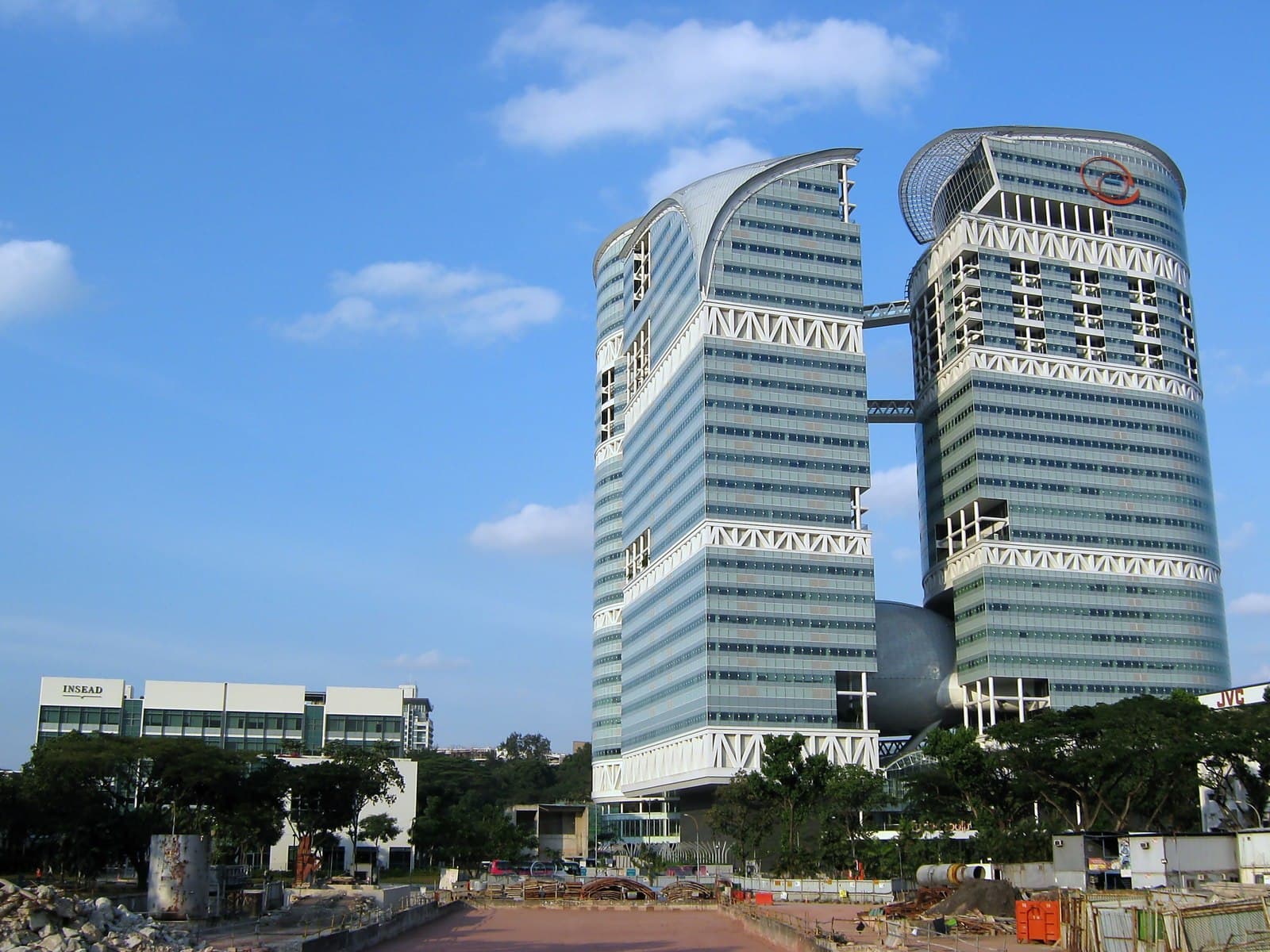
Hero image: Fusionopolis, one-north — photo by Kok Leng Yeo, CC BY 2.0, via Wikimedia Commons.
What are the floor plans and unit sizes at Bloomsbury Residences?
PropKaki has 17 layouts on record for Bloomsbury Residences, from 2 to 6 bedrooms (570 sqft to 2,131 sqft).
| Bedrooms | Layouts | Sizes |
|---|---|---|
| 2 Bedroom | 4 | 570 to 689 sq ft |
| 3 Bedroom | 5 | 904 to 1,098 sq ft |
| 4 Bedroom | 4 | 1,173 to 1,421 sq ft |
| 5 Bedroom | 3 | 1,668 to 1,916 sq ft |
| 6 Bedroom | 1 | 2,131 sq ft |
PropKaki holds 17 floor plans for Bloomsbury Residences.
See Bloomsbury Residences's floor plans — ask PropKaki. Ask PropKakisqm ↔ sq ft converter
Layouts digitised from developer brochures.
Bloomsbury Residences: quick answers
Answered from URA data, refreshed daily.
Is Bloomsbury Residences fully sold?⌄
Not yet. 311 of Bloomsbury Residences's 358 units (87%) had been sold as of Oct 2026, leaving 47 unsold (URA developer sales).
Who is the developer of Bloomsbury Residences?⌄
Bloomsbury Residences is being developed by Media Circle Development Pte Ltd.
When was Bloomsbury Residences launched?⌄
Bloomsbury Residences went on sale in April 2025. Its first developer sale on record is dated 11 April 2025 (URA caveats).
Why is Bloomsbury Residences so expensive?⌄
Bloomsbury Residences's developer sales have a median of S$2,529 psf, about 36% above the S$1,858 psf median for resale condos in District 5 over the last 12 months (URA caveats). A new launch usually costs more than resale: buyers pay for a full-length new lease and a home no one has lived in. The review explains what else is in Bloomsbury Residences's price.
Got a question this raised? Ask PropKaki.
Take any point from this analysis and apply it to your own project, budget or decision.
PropKakiFor most buyers this year, staying well within budget beats trying to time the market.