
Aurea Review: Is Living Inside a Conserved Icon Worth ~$2,852 PSF?
Aurea is the residential tower rising beside the gazetted Golden Mile Complex — Singapore's first large-scale conservation of a strata building. We price that one-of-one address against District 7 resale and its launch peers to see whether the heritage story holds up.
Aurea is a 188-unit, 99-year leasehold tower at Beach Road (District 7, Downtown Core) by GMC Property, the Perennial Holdings and Far East Organization or Sino Group venture behind the Golden Mile Complex redevelopment, with vacant possession expected 31 March 2030. Across 71 developer-sale caveats its indicative pricing is about $2,852 psf (median ~$2.05M), roughly 35% above District 7's median resale. Yet against District 7 launches it is the cheaper option, undercutting Midtown Modern (~$3,567) and Midtown Bay (~$3,396). You are paying up versus resale for a novel conserved-icon product and a 2030 completion. It suits design-led own-stayers and collectors of a landmark address more than a buyer chasing the lowest entry price.
Aurea at a glance
| Developer | Pre 17 Pte Ltd |
|---|---|
| Tenure | 99-year leasehold |
| Units | 188 |
| Launched | March 2025 (first developer sale) |
| Sales progress | 68 of the 78 units launched so far (87%) had been sold as of Oct 2026; Aurea has 188 units in total (URA developer sales). |
| Launch price paid | S$2,858 psf median (S$2.00M), 71 developer caveats to Jul 2026 |
| District 7 resale | S$2,110 psf median across 111 resales in the last 12 months, so the launch price is 35% higher |
From URA caveats and URA's developer-sales figures (sales checked Oct 2026), refreshed daily. The review below was written earlier and quotes the figures of its day.
Every transaction and listing at Aurea →Resale profit odds →Floor plans ↓
Where is the Aurea showflat?
Aurea's showflat is at 10A Central Lane 1, Singapore 019927, according to its EdgeProp new-launch listing (checked 18 September 2026). 10 units were still unsold as of Oct 2026 (URA), so book a viewing with the developer's sales team before you go.
Source: EdgeProp new-launch listing, checked 18 September 2026. PropKaki has not visited this showflat; this review is a desk analysis.
Aurea sells something no other 2026 launch can: an apartment folded into a national monument. It is the new residential tower rising beside the conserved Golden Mile Complex, the 1970s Brutalist 'vertical city' on Beach Road that became the first large-scale strata building Singapore ever gazetted for conservation. That heritage is genuinely one-of-one and cannot be replicated. But a landmark address and a fair price are not the same thing, so this review prices Aurea against District 7 resale and its launch peers to show exactly what the story costs you — and who it actually suits.
Is Aurea worth buying? Our verdict
Aurea is one-of-one — the only new home built into the conserved Golden Mile Complex. At ~$2,852 psf it runs ~35% above District 7 resale but undercuts launch peers Midtown Modern and Midtown Bay. It suits a design-led own-stayer who wants the landmark, not a buyer chasing the lowest price.
Aurea is a buy if you want to own a piece of a national monument and will hold it as a home — and a harder sell if you are buying purely on the numbers. Its case is not cheapness or yield. It is that Aurea is the only new home in Singapore wrapped into a gazetted architectural icon: the residential tower rising beside the conserved Golden Mile Complex, the Brutalist 'vertical city' that in 2021 became the first large-scale strata-titled building the country ever gazetted for conservation. You cannot buy this address anywhere else, and no future developer can build another one next to it.
The pricing frames the trade cleanly. Across 71 developer-sale caveats, Aurea is transacting at about $2,852 psf (median unit near $2.05M), roughly 35% above District 7's median resale of ~$2,108 psf. That premium is the price of new, of the conserved-icon concept, and of a Downtown Core address on the cusp of the Kallang and Beach Road transformation. But here is the twist that matters: measured against the District's other launches, Aurea is not the expensive one. It undercuts Midtown Modern (~$3,567 psf) and Midtown Bay (~$3,396 psf) by a wide margin. So the honest read is a split decision — a clear premium over lived-in resale, but a relative discount to the newest towers you would actually cross-shop.
So the verdict turns on what you are buying it for. If you want a design-led home in a landmark you will hold for years, Aurea offers something scarce that its launch peers cannot — and it does so at a lower PSF than they ask. If you are buying strictly to maximise a return, you are paying up over resale for a novel, unproven product on a 99-year lease that completes in 2030, and the heritage premium is a bet on a story the resale market has never priced. Buy Aurea for the landmark, not for the spreadsheet.
This review shows the full workings. For the market-wide picture, see our roundup of every 2026 new launch benchmarked against resale. You can also browse every 2026 launch in the Singapore new launches directory.
What exactly is Aurea, and why does the Golden Mile Complex matter?
Aurea is the residential tower beside the conserved Golden Mile Complex — the 1970s Brutalist 'vertical city' that in 2021 became Singapore's first large-scale strata building gazetted for conservation. It reinterprets the icon's oculus windows and terraces, offering scarcity you cannot manufacture.
Aurea is not a standalone condo dropped onto a bare plot. It is the residential half of a rare piece of urban surgery: the redevelopment of the Golden Mile Complex, the 1970s Brutalist landmark on Beach Road. The old complex — a stepped, terraced 'linear city' where all 64 original apartments sold within a month of launch — is being sensitively restored as The Golden Mile, a mixed-use block of retail, offices and medical suites. A new slender residential tower, Aurea, rises next to it.
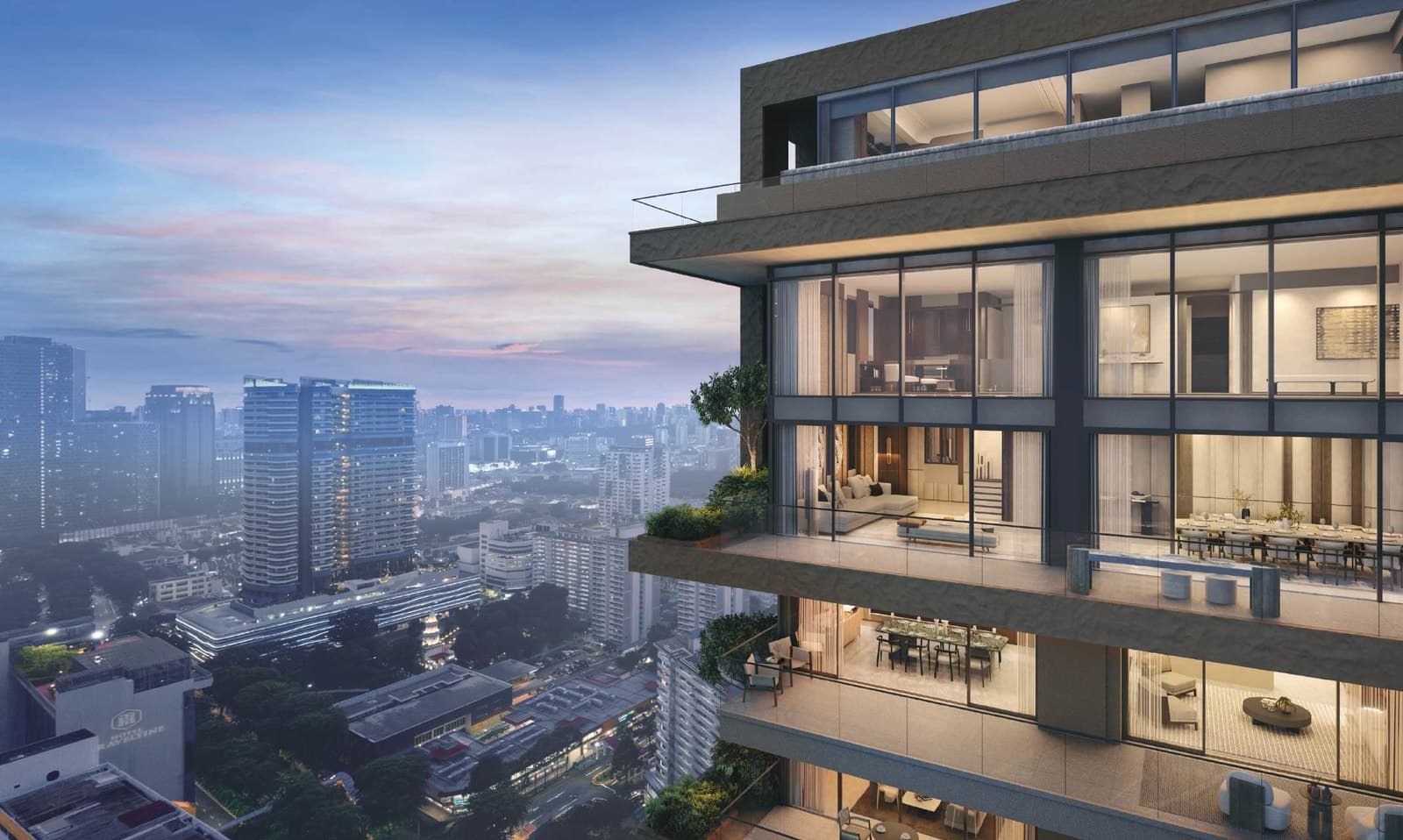
What makes this genuinely unusual is the conservation status. In 2021, the Golden Mile Complex was gazetted as a conserved building — the first large-scale strata-titled building in Singapore to receive that recognition. Strata conservation is hard precisely because hundreds of owners must agree; pulling it off here set a national precedent. The brochure carries the design DNA across deliberately: Aurea reinterprets the complex's signature oculus windows, stacks vertical terraces and sea-front balconies, and threads sky gardens up the tower, with an elevated arrival lobby and views over Marina Bay and the Kallang River.
The investment point is simple: scarcity you cannot manufacture. Freehold scarcity is a supply story; conserved-icon scarcity is a one-of-one story. There is exactly one Golden Mile Complex, it is now legally protected, and Aurea is the only home attached to it. Whether that uniqueness converts into resale strength is untested — but the uniqueness itself is real, documented, and permanent.
Aurea at a glance: the key facts
Aurea is a 188-unit, 99-year leasehold tower on Beach Road (District 7) by GMC Property — a Perennial Holdings and Far East Organization / Sino Group venture — beside the conserved Golden Mile Complex, with vacant possession expected 31 March 2030 and indicative pricing around $2,852 psf.
| Detail | Aurea |
|---|---|
| Developer | GMC Property Pte. Ltd. (Perennial Holdings and Far East Organization / Sino Group) |
| Development architect | DP Architects |
| Tenure | 99 years (from 18 November 2024) |
| Location | Beach Road, District 7 (Downtown Core) |
| Total units | 188 |
| Setting | The residential tower beside the conserved Golden Mile Complex |
| Expected vacant possession | 31 March 2030 (legal completion 31 March 2033) |
| Indicative pricing | ~$2,852 psf · median ~$2.05M |
A note on where these come from: the developer, tenure, expected completion and land details are taken from the project's own launch brochure, not our automated directory, which can carry a wrong completion year for a redeveloped site like this. GMC Property is the entity behind the redevelopment; the developer pages name Perennial Holdings and Far East Organization (with its Hong Kong sister company Sino Group) as the partners, and DP Architects as development architect. The pricing is our own, computed from URA developer-sale caveats. Note the lease clock: at 99 years from November 2024, Aurea is a leasehold home — the conservation status protects the building next door, not your tenure, a distinction worth holding onto.
How much does Aurea cost? Prices and PSF by unit size
Across 71 developer-sale caveats, Aurea's median is ~$2,852 psf and ~$2.05M, with most deals between $2,769 and $2,942 psf. The best-sellers are small 1–2BR units (~$2,850 psf, ~$1.91M); PSF rises for the large view units, which top ~$3,265 psf.
Across the 71 developer-sale caveats lodged so far (a window running 4 March 2025 to 29 May 2026), Aurea's median is about $2,852 psf, with the middle half of deals falling between roughly $2,769 and $2,942 psf. The median price works out to about $2.05M — a Downtown Core entry point that is more accessible than the headline PSF suggests, because the best-selling units are the smaller ones.
| Unit size (from our caveats) | Caveats (n) | Median PSF | Median price |
|---|---|---|---|
| 550–750 sqft (1–2BR) | 43 | $2,850 | $1.91M |
| 750–1,100 sqft (2–3BR) | 18 | $2,725 | $2.73M |
| 1,100–1,500 sqft (3–4BR) | 3 | $2,959 | $4.27M |
| 1,500+ sqft (4BR+/penthouse) | 7 | $3,265 | $5.87M |
The shape here is the opposite of a flat price list, and it tells you how the tower is selling. The bulk of transactions — 43 of 71 — are small 1–2 bedroom units around $2,850 psf and $1.91M, the compact city homes and investor-sized stock. PSF then rises with size at the top: the 1,500+ sqft units and penthouses command about $3,265 psf, a premium for the sky-terrace and view stock rather than a discount. In other words, going bigger at Aurea costs you more per square foot, not less — the scarce large units carry the icon premium most heavily. If you want the lowest entry, the 1–2 bedroom band is the door; if you want the view and the volume, you pay for it twice, in quantum and in PSF. Weigh that trade in quantum vs PSF when buying a condo.
Is Aurea overpriced? Its PSF vs District 7 resale and rival launches
At ~$2,852 psf, Aurea is ~35% above District 7's median resale — but against launch peers it is the cheaper option, undercutting Midtown Modern (~$3,567) and Midtown Bay (~$3,396) by $550–$700 psf. It is a premium over resale, a relative discount to the newest towers.
On the surface, Aurea's ~35% premium over District 7's median resale (~$2,108 psf, from 158 resale caveats) looks like the whole story. It is not, and that comparison is unfair to any launch: you are pitting a brand-new, never-lived-in tower against a district-wide pool of older, mostly resale stock on shorter leases. Some premium is simply the price of new, and some is the price of this address. The benchmark that actually tests overpricing is how Aurea prices against the launches a buyer would genuinely cross-shop:
| Project | New-Sale caveats (n) | Median launch PSF |
|---|---|---|
| Midtown Modern | 16 | $3,567 |
| Midtown Bay | 17 | $3,396 |
Read against its true peers, Aurea is the cheaper ticket, not the dearer one. At ~$2,852 psf it sits well below Midtown Modern (~$3,567) and Midtown Bay (~$3,396) — a gap of roughly $550–$700 psf. That reframes the verdict: Aurea is not a premium play priced above the market; it is a conserved-icon product priced under the District's newest towers, while still commanding a clear step over lived-in resale. Whether the 35% over resale is 'worth it' comes down to how much you value the landmark and the Downtown Core location, worked through in how much a new-launch premium should be and new launch vs resale. One honest caveat: with only 33 caveats between the two comparables, this is a thin peer set — Aurea's relative-discount case rests on a small sample, so treat it as directional, not definitive.
Where is Aurea? Beach Road, Kallang Basin and the Ophir-Rochor corridor
Aurea sits on Beach Road in District 7's Downtown Core, at the Kallang Basin / Nicoll Highway edge. It is minutes from the CBD, Marina Bay and Orchard by the ECP, MCE and KPE — and at the front edge of the Beach Road, Ophir-Rochor and Kallang transformation, a precinct still years from finished.
Aurea sits on Beach Road in District 7, Singapore's Downtown Core — the financial and civic heart — at the point where the city edge meets the Kallang Basin and Nicoll Highway. This is not a quiet suburban enclave; it is a location whose entire case is being rewritten by planned transformation on three fronts.
First, Beach Road and the Ophir-Rochor Corridor are slated to rise into a new spine of offices, residences, hotels and next-generation retail — gleaming towers replacing low-rise stock, pulling the Downtown Core's centre of gravity eastward. Second, the Kallang Basin and Kampong Bugis are being redeveloped into a car-lite, community-centric waterfront district, with Kallang Alive reshaping the Sports Hub precinct into a world-class sporting and entertainment hub. Third, connectivity is already deep: you are minutes from the CBD, Marina Bay and Orchard by the ECP, MCE and KPE, with the upcoming North-South Corridor adding another artery, and Suntec, Bugis, Raffles City and Marina Bay Sands all within easy reach.
The honest read on location is that Aurea is a bet on a precinct in transition, not a finished postcard. The upside is you are buying at the front edge of a masterplan-scale rejuvenation of a central district. The risk is timing: much of what makes this address compelling — the transformed waterfront, the new Beach Road towers — is years of construction away, and you live alongside that build-out. If a walk-to-everything, already-mature neighbourhood is what you want, this is not yet that; if you want to own the central-fringe story before it finishes, this is exactly it.
Is Aurea a good investment? What the segment data says
Aurea has never been resold, so there's no track record. The honest proxy — CCR resales — shows 80.7% sold above cost with a +21.2% median gain (gross). But Aurea is a novel conserved-icon product on a 99-year lease, inheriting the segment's odds without its history.
Aurea has never been resold — it is a brand-new launch beside a redevelopment — so there is no project track record to quote, and anyone promising you a specific return is guessing. The honest proxy is how comparable homes in its market segment have actually performed. Aurea sits in the Core Central Region (CCR), and across matched CCR resale pairs, 80.7% sold above their purchase price, with a median gross gain of 21.2%.
Read that as a base rate, not a forecast, and remember it is gross — before commission, stamp duties, any Seller's Stamp Duty and loan interest. Two things temper it for Aurea specifically. First, the CCR base rate is drawn from established prime stock with real resale histories; Aurea is a novel conserved-icon product on a 99-year lease, so it inherits the segment's odds without inheriting a track record. Second, its investment case leans on demand for a landmark Downtown Core address rather than on yield — the rental market here is deep, driven by CBD professionals, but the pack carries no yield figure and neither will we. To pressure-test a specific Aurea unit against your own holding period, financing and costs, run it through the PropKaki profitability model, and read how to tell if a property will be profitable.
Aurea pros and cons: who should buy it?
Pros: a one-of-one conserved-icon address, DP Architects design, Downtown Core location, and a lower PSF than its launch peers. Cons: a clear premium over resale, an unproven product, a 99-year lease, and a precinct still years from finished. Best for design-led own-stayers, not liquidity-first buyers.
What a conserved landmark gives that new-build cannot:
- A one-of-one address — the only new home attached to the conserved Golden Mile Complex, a gazetted national landmark that cannot be replicated.
- Design pedigree — oculus windows, vertical terraces, sky gardens and sea-front balconies, by DP Architects, carrying the icon's DNA.
- Downtown Core location — minutes to the CBD, Marina Bay and Orchard, at the front edge of the Beach Road, Ophir-Rochor and Kallang transformation.
- Cheaper than its launch peers — at ~$2,852 psf it undercuts Midtown Modern and Midtown Bay by $550–$700 psf.
The untested-product risks:
- A clear premium over resale — ~35% above District 7's lived-in stock, and a bet on a story the resale market has never priced.
- A novel, unproven product — conserved-icon living has no resale track record; the premium rests on demand that has not been tested through a full cycle.
- 99-year leasehold — the conservation status protects the neighbouring building, not your tenure; the lease clock runs from November 2024.
- A precinct still under construction — much of the location's appeal is years away, and a 2030 completion means you fund interim housing while you wait.
It's the buy for: design-led own-stayers, collectors who want a landmark address, and central-fringe investors who believe in the Beach Road and Kallang transformation. Look past it if: you want proven resale liquidity, you need a mature finished neighbourhood today, or your case depends on the lowest possible entry over the address itself. For a structured head-to-head, use our two-project comparison scorecard.
The one thing to weigh before buying Aurea
You're paying ~35% over District 7 resale for a conserved-icon product the resale market has never priced. Buy it to live in the landmark; if your case rests on that premium holding at resale, know that you are testing the thesis, not following it.
You are paying a ~35% premium over District 7 resale for a product the resale market has never priced. Conserved-icon living sounds compelling, and it is genuinely scarce — but scarcity only becomes value if buyers keep paying for it, and no one has yet resold an Aurea unit to prove they will. Everything else about the home — the 99-year lease running from 2024, the 2030 completion, the years of construction still ahead in Beach Road and Kallang — is knowable and ordinary. The single unknowable is whether the Golden Mile story commands a durable premium on exit, or whether it settles back toward the price of a well-located Downtown Core leasehold once the novelty fades. Buy Aurea because you want to live in the landmark; if your case depends on the icon premium holding at resale, understand that you are the market testing that thesis, not following it.
Who is the developer of Aurea?
GMC Property Pte. Ltd. — a Perennial Holdings and Far East Organization / Sino Group venture, with DP Architects as development architect.
Per the project's launch brochure, Aurea is developed by GMC Property Pte. Ltd., the entity behind the Golden Mile Complex redevelopment. The brochure's developer pages name Perennial Holdings and Far East Organization — together with its Hong Kong sister company Sino Group — as the partners, with DP Architects as development architect. It is a 99-year leasehold project on Beach Road in District 7.
How much does Aurea cost?
About $2,852 psf median (~$2.05M), with most deals $2,769–$2,942 psf, from our URA caveat data. Small 1–2BR units start near $1.91M.
Based on 71 URA developer-sale caveats, Aurea's indicative pricing is about $2,852 psf (median unit ~$2.05M), with the middle half of deals between $2,769 and $2,942 psf. Small 1–2 bedroom units — the best-sellers — sit around $2,850 psf and $1.91M, while the large view units and penthouses run higher, to about $3,265 psf. Pricing is a live snapshot and moves as more units are released.
Is Aurea freehold or leasehold?
99-year leasehold, from 18 November 2024. The conservation status protects the neighbouring Golden Mile Complex, not your tenure.
Aurea is 99-year leasehold, with the lease commencing 18 November 2024 per the developer's brochure. An important nuance: the neighbouring Golden Mile Complex is a conserved building, but conservation protects that structure's architecture — it does not extend your tenure. Your Aurea home is a standard 99-year lease, and lease decay applies as it would to any leasehold condo.
When is Aurea expected to be completed (TOP)?
Around 2030 — expected vacant possession is 31 March 2030, per the developer's brochure.
Per the developer's brochure, Aurea's expected vacant possession is 31 March 2030 (expected legal completion 31 March 2033), so a TOP around 2030. Note that automated property directories may show a different or wrong completion year for this site because it is a redevelopment of the Golden Mile Complex; we take the date from the brochure.
Methodology and sources
Pricing from our 71 URA New-Sale caveats; the premium from 158 District 7 resale caveats; comparables from each project's caveats; CCR odds from matched pairs. Developer, tenure and TOP are from the brochure. A desktop analysis, not a showflat visit.
Where the figures come from. Aurea's indicative pricing is the median of 71 URA private-sale caveats flagged New Sale for the project (window 4 March 2025 to 29 May 2026), from PropKaki's own transaction data. The ~35% premium compares that to the median PSF of 158 Resale caveats in District 7 over the last ~18 months. The comparable-launch PSFs are the medians of each rival project's own New-Sale caveats over the last ~30 months (16 for Midtown Modern, 17 for Midtown Bay). The 80.7% CCR segment odds and 21.2% median gross gain come from matched private buy→sell pairs in the Core Central Region via PropKaki's profitability base-rate model. Developer, tenure, expected completion, land description and design concept are from the project's official launch brochure — not our directory, whose completion field is unreliable for redeveloped sites; on the brochure, the developer is GMC Property Pte. Ltd., tenure is 99 years from 18 November 2024, and expected vacant possession is 31 March 2030.
What we did not do, and did not claim. This is a data and desktop analysis, not a showflat visit — we have not toured the units or verified finishes in person. Indicative PSF is a dated snapshot that moves as more units sell; PSF is price ÷ area, so the median shifts with which units transact — the by-size table controls for that. The resale benchmark is a district median, not a unit-matched valuation, and resale stock is older and on shorter leases, so some launch premium is expected and is not proof of overpricing. The comparable set is small (33 caveats across two projects), so the relative-discount finding is directional. Segment profit odds are gross (before commission, stamp duties, any SSD and interest) and are a base rate, not a forecast — Aurea has never been resold. Nothing here is financial advice; verify current rules and figures with URA, IRAS and HDB.
What are the floor plans and unit sizes at Aurea?
PropKaki has 19 layouts on record for Aurea, from 2 to 5 bedrooms (635 sqft to 5,597 sqft).
| Bedrooms | Layouts | Sizes |
|---|---|---|
| 2 Bedroom | 5 | 635 to 710 sq ft |
| 3 Bedroom | 2 | 1,001 sq ft |
| 4 Bedroom | 8 | 1,442 to 1,798 sq ft |
| 5 Bedroom | 3 | 2,852 to 3,251 sq ft |
| Other layouts | 1 | 5,597 sq ft |
PropKaki holds 18 floor plans for Aurea.
See Aurea's floor plans — ask PropKaki. Ask PropKakisqm ↔ sq ft converter
Layouts digitised from developer brochures.
Aurea: quick answers
Answered from URA data, refreshed daily.
Is Aurea fully sold?⌄
Not yet. 68 of the 78 units launched so far (87%) had been sold as of Oct 2026; Aurea has 188 units in total (URA developer sales).
When was Aurea launched?⌄
Aurea went on sale in March 2025. Its first developer sale on record is dated 4 March 2025 (URA caveats).
Why is Aurea so expensive?⌄
Aurea's developer sales have a median of S$2,858 psf, about 35% above the S$2,110 psf median for resale condos in District 7 over the last 12 months (URA caveats). A new launch usually costs more than resale: buyers pay for a full-length new lease and a home no one has lived in. The review explains what else is in Aurea's price.
Got a question this raised? Ask PropKaki.
Take any point from this analysis and apply it to your own project, budget or decision.
PropKakiFor most buyers this year, staying well within budget beats trying to time the market.