

Difference Between TOP and CSC in Singapore: What New Condo Buyers Should Know
A practical guide to Temporary Occupation Permit and Certificate of Statutory Completion, and what each stage really means for move-in, handover and completion timing.
TOP, the Temporary Occupation Permit, is BCA's permit that lets a newly built development be occupied; CSC, the Certificate of Statutory Completion, is usually issued later, once every statutory requirement is met. For a condo buyer, TOP is the milestone that matters day to day: you pay the 25% instalment due at TOP, the developer must hand over the unit within 21 days of that payment, and the 12-month defects liability period runs from handover or 15 days after the TOP notice, whichever is earlier (URA). Plan key collection and move-in around TOP, but don't assume the whole project is finished, defect-free, or fully opened for renovation until the handover details are confirmed.
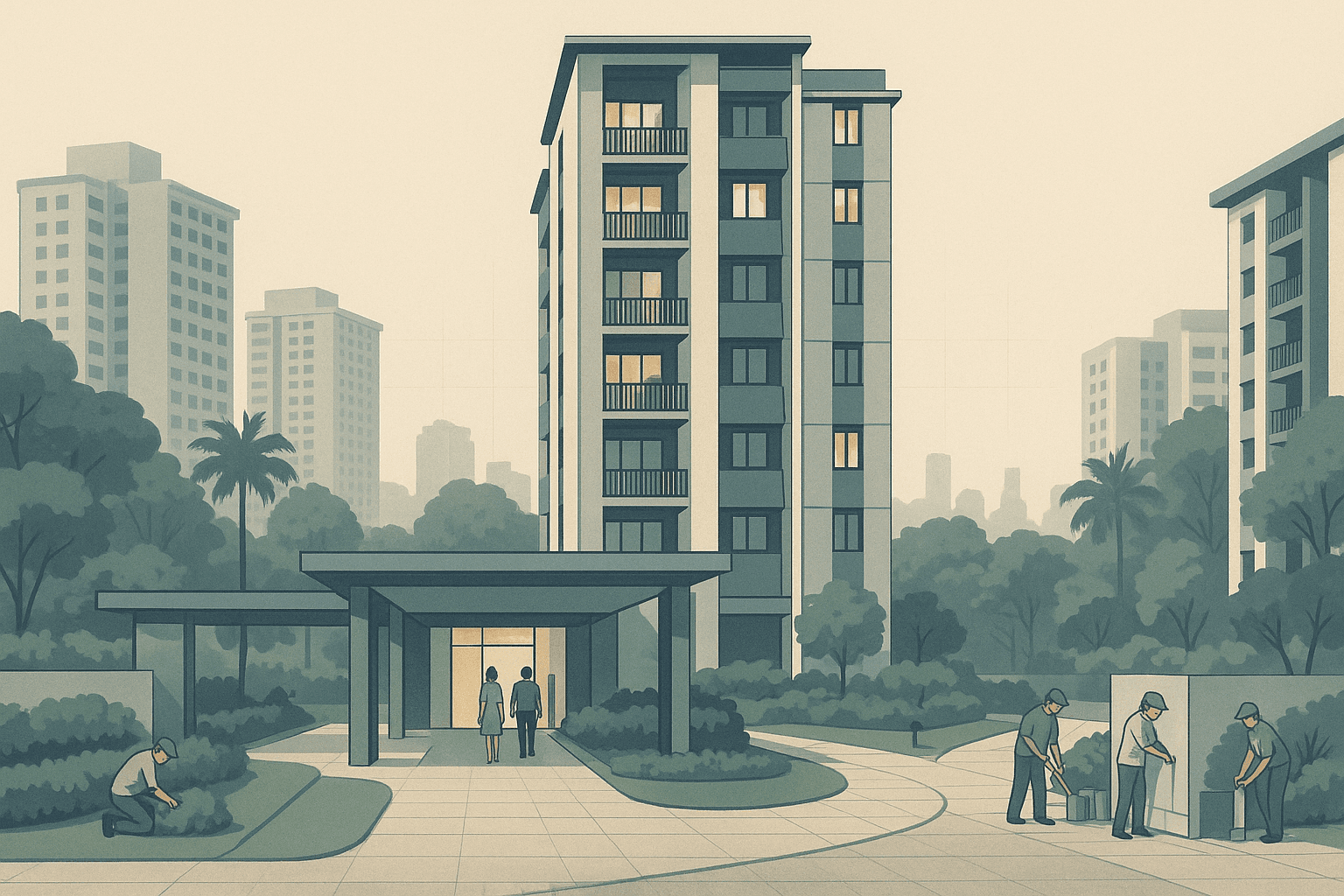
TOP and CSC answer two different buyer questions. TOP is the milestone that usually tells you a new condo can be occupied; CSC is the milestone that tells you the development has reached final statutory completion. If you want to know whether you can collect keys, move in, or line up renovation works, start with TOP — then verify the developer's actual handover arrangements before treating the project as fully ready.
What does TOP mean for a new condo in Singapore?
TOP stands for Temporary Occupation Permit: the permit that lets a newly built development be occupied before every requirement for the Certificate of Statutory Completion (CSC) is met. For most buyers, it is the first milestone that makes key collection, move-in planning and unit inspection feel real.
TOP stands for Temporary Occupation Permit. In plain buyer language, it usually means the condo has reached the stage where occupation is allowed, so the conversation shifts from "when will it be built?" to "when is my handover and what can I do next?"
That practical meaning is the one to focus on first. If you ask, "Can I move in once the project gets TOP?", the starting answer is usually yes in principle, but the real next step is to confirm the developer's handover notice, key collection process and any access conditions for the specific unit.
The important expectation-setting point is this: TOP is about occupiability, not total completion. A unit can be fit for occupation even though some common works, defect rectification items or admin steps are still being wrapped up.
A simple way to put it: TOP tells you the condo is generally liveable; it does not tell you every last item is done. If you want a very short explainer, PropertyGuru's brief note on what TOP of a condo means is easy to read, but project readiness still has to be confirmed directly with the developer. For a broader overview, see New Launch Condo Buying Process in Singapore: A Step-by-Step Guide.
What does CSC mean, and what is the difference between TOP and CSC?
CSC, the Certificate of Statutory Completion, is the certificate BCA issues once a development has met every statutory requirement; TOP, the Temporary Occupation Permit, lets it be occupied before then. They describe different stages, and CSC usually comes later.
CSC stands for Certificate of Statutory Completion. The practical difference is simple: TOP is the point when the development is generally occupiable, while CSC is the point when the development reaches final statutory completion. As of 2026, both are administered by BCA (the Building and Construction Authority): a TOP permits occupation before all requirements for the CSC are met, and the CSC is issued once the development is fully completed and compliant. Because these rules are updated from time to time, confirm the current position on BCA.
The easiest way to see the difference is to tie each milestone to the buyer question it answers:
| Milestone | What it means in plain English | What buyers usually focus on | What not to assume |
|---|---|---|---|
| TOP | The condo can generally be occupied | Key collection, unit inspection, move-in planning, initial access | That every facility is open or every defect is settled |
| CSC | The development has reached final statutory completion | Overall completion status of the project | That CSC is the first point when residents can move in |
So if a buyer asks, "Can I live there?", TOP is the more relevant milestone. If the buyer asks, "Is the whole development finally completed in statutory terms?", CSC is the better answer.
TOP is for occupancy, CSC is for completion. For official condo ownership background, BCA's What to Know as a Condo Owner is a useful reference. If you want a short consumer-level comparison, Carousell's TOP and CSC explainer is readable, but project-specific advice should still be verified with the developer or project team. For a broader overview, see When Can You Collect Keys After TOP for a New Launch Condo?.
What can buyers usually do after TOP?
After TOP, buyers usually move into the handover stage: key collection, unit inspection, move-in planning and, in some cases, renovation preparation.
Once TOP is granted, most buyer conversations become operational rather than theoretical. The usual next steps are:
- collect keys based on the developer's handover schedule
- inspect the unit and note defects or outstanding items
- coordinate movers and practical move-in timing
- start planning renovation, subject to access rules
What the rules fix, as of 2026, when you buy an uncompleted private home from a licensed developer under the standard Sale and Purchase Agreement (URA's Home Buyers' Guide):
- The TOP instalment: 25% of the price falls due once TOP is issued and the roads, drainage and sewerage serving the project are complete. You collect keys after paying it.
- Handover deadline: the developer must deliver vacant possession by the date in your Sale and Purchase Agreement, and within 21 days of receiving that 25% payment, or pay you liquidated damages.
- Defects liability period: 12 months, from handover or the 15th day after the TOP notice, whichever is earlier; the developer must fix reported defects within one month.
- Maintenance fees: start from handover or the 15th day after you receive the TOP notice, whichever is earlier; the first 6 months are paid upfront, then quarterly.
The trap is assuming those next steps happen immediately and uniformly. In real projects, handover can be staggered. A development may have TOP, but owners could still receive different key collection dates, different access windows or different facility opening timelines.
A realistic example: you hear "project got TOP" and book movers for the same week. That may be premature if the developer is still assigning inspection slots or if the relevant block's handover sequence is still being rolled out.
Treat TOP as the signal to start planning, then confirm your actual handover date and access conditions. If you want the next-step workflow, see When Can You Collect Keys After TOP for a New Launch Condo?. For the broader purchase timeline, our new launch condo process guide is the better map, and this step-by-step new launch overview from Ohmyhome is a useful secondary consumer reference. For a broader overview, see Progressive Payment Scheme for New Launch Condos in Singapore: How It Works and When You Pay.
What cannot be assumed at TOP?
TOP does not mean the project is fully complete, defect-free or immediately ready in every respect. It mainly means occupation is generally allowed.
There are three things buyers should not read into TOP.
First, do not assume the entire development is fully finished. Some common areas, landscaping or non-critical works may still be ongoing even though the unit is occupiable.
Second, do not assume the unit is defect-free. TOP is not a workmanship guarantee. Buyers still need a proper inspection, a clear defects list and a realistic follow-up plan for rectification.
Third, do not assume every practical step has already opened up. Renovation access, loading arrangements, contractor registration or move-in coordination may still be controlled through project-specific rules.
This is where many misunderstandings start. Buyers hear "ready for occupation" and picture a fully polished, fully opened project. In reality, a more accurate expectation is often: the unit is usable, but some finishing, coordination or rectification work may still be in progress.
The best shorthand is: TOP means usable, not perfect. That line helps you avoid committing too early to movers, contractors or temporary housing plans without checking what is actually ready on site.
Why does CSC matter if the unit is already occupiable at TOP?
CSC still matters because it marks the development's final statutory completion. It tells buyers the project has moved beyond occupiability into formal completion.
CSC matters because it is the formal completion end-point for the development, not just a technical label. Even if residents have already moved in after TOP, the project has not reached final statutory completion until CSC is issued.
This is useful when you wonder, "If people are already staying there, why is the project not considered fully complete yet?" The answer is that occupation readiness and final statutory completion are different checkpoints.
The value of CSC is mainly explanatory. It explains why some final close-out items may still exist after TOP and why TOP should not be treated as equivalent to full completion.
Another practical angle: some buyers confuse CSC with a second move-in trigger. It is not. TOP is usually the milestone for occupancy planning; CSC is the milestone for the project's final completion status. If you also want to know how completion stages fit into the wider purchase journey, the new launch condo process guide and our explainer on the Progressive Payment Scheme for new launch condos are the more useful next reads.
What should you check with the developer before treating a condo as ready at TOP?
Confirm the actual handover status, not just the milestone name. Buyers need operational details, not just a TOP announcement.
- ✓Confirm whether TOP applies to the whole project or only to certain blocks, stacks or phases.
- ✓Ask for the handover sequence and key collection schedule for the specific unit or block.
- ✓Verify whether the buyer's unit is actually ready for inspection and handover.
- ✓Check which common areas and facilities are already usable, and which are still under works or pending opening.
- ✓Ask whether there are outstanding site conditions that may affect access, loading, moving or daily use.
- ✓Confirm the current rules for renovation access, contractor registration, delivery timing and move-in coordination.
- ✓Identify who is managing ground questions: the developer's handover team, project representatives or estate management side.
- ✓If you are fixing movers or contractors, re-check the latest status directly instead of relying on old sales updates or generic marketing language.
How long is it from TOP to CSC?
There is no fixed gap: BCA issues the CSC (Certificate of Statutory Completion) only once every outstanding requirement is met, so the timing varies by project. What is fixed is your completion date: the developer must give you the Notice to Complete by the date in your Sale and Purchase Agreement or 3 years after handing over the unit, whichever is earlier (URA).
For a buyer, the practical end point isn't the CSC itself but legal completion — the transfer of the title into your name (URA's Home Buyers' Guide):
- The developer sends you a Notice to Complete, by the date in your Sale and Purchase Agreement or 3 years after handing over vacant possession, whichever is earlier.
- Completion must take place within 14 days of that notice.
- You then receive the conveyance and the duplicate certificate of title.
If the developer misses the notice deadline, URA says you can claim liquidated damages under the formula in the agreement. The CSC also matters for your payments: the last instalments of the price are tied to the CSC and completion under the standard agreement — see the progressive payment scheme for the schedule.
What does TOP mean for an HDB flat?
TOP stands for Temporary Occupation Permit, as it does for a condo, and people use an HDB 'TOP date' to mean when a BTO project is completed and ready for occupation. For your own flat, the dates that matter more are key collection and legal completion: the HDB minimum occupation period counts from legal completion, not TOP (HDB).
ECs are the exception worth knowing. HDB publishes each EC project's TOP date, and an EC's minimum occupation period is counted from its TOP, not from when you collect the keys (HDB): 5 years, or 10 years for EC projects whose land tender closed on or after 8 May 2026. So for an EC, the TOP date sets when you can first sell on the open market.
What is the most common misunderstanding about TOP versus CSC?
The usual mistake is treating TOP as proof that the whole project is fully complete. It is not.
Many buyers hear "TOP" and think "finished." That is the wrong mental model.
Use this instead:
- TOP = can usually occupy
- CSC = final statutory completion
That distinction helps you avoid overestimating what is ready — defects, facilities, renovation access or overall project readiness. It also keeps moving plans realistic when you are lining up temporary accommodation, movers or contractors.
How can you sum up TOP and CSC in one simple sentence?
Use this: TOP means the condo can usually be occupied; CSC means the project has reached final statutory completion.
A short one-liner is often all you need, because it answers the question without sounding legalistic.
If you want a slightly more conversational version, try: "TOP is when you can usually start handover and move-in planning; CSC is when the project reaches final completion."
The reason this wording works is that it separates your practical concern from the project's formal completion status. It also stops you from using TOP and CSC as interchangeable labels when you are planning key collection, renovation quotes or temporary housing arrangements.
The project got TOP. Can you start renovation immediately?
Not automatically. TOP may make renovation possible in principle, but the real start date still depends on handover, access rules and contractor procedures for that project.
The practical answer is: do not book a firm renovation date based on the TOP announcement alone.
Before works start, confirm at least four things: whether keys have actually been collected, whether contractor access is already open, whether there are project or house rules to comply with, and whether any move-in or loading restrictions affect the planned works.
A common mistake is this: you hear the project has TOP, the contractor is booked, but the handover slot has not happened yet or contractor registration is not complete. That turns a "confirmed start date" into a rescheduling problem.
A safer way to think about it: "TOP is a good sign, but confirm your actual handover and renovation access before committing the contractor." That keeps expectations realistic if the project team is phasing access by block, stack or appointment.
Methodology and sources
Where the rules come from — and what this page does not claim.
Sources. The TOP and CSC definitions on this page follow BCA (the Building and Construction Authority), which administers both, and HDB where the milestone affects HDB flats, current as of 2026. BCA and HDB rules are updated from time to time, and each developer's handover process differs, so confirm the current rules and your project's specific completion and handover terms on the official BCA/HDB pages and with your developer and conveyancing lawyer before relying on them.
Updated September 2026. The TOP instalment, handover deadline, defects period, maintenance fees and completion steps are from URA's buying-property guidance (last updated 29 June 2026) and its Home Buyers' Guide; the MOP rules from HDB. All read on 18 September 2026. BCA's own site could not be re-checked that day; its role is as described in URA's guide.
Scope. This is a practical explainer, not legal advice; a specific case depends on the full official assessment.
Got a question this raised? Ask PropKaki.
Take any point from this analysis and apply it to your own project, budget or decision.
 PropKaki
For most buyers this year, staying well within budget beats trying to time the market.