
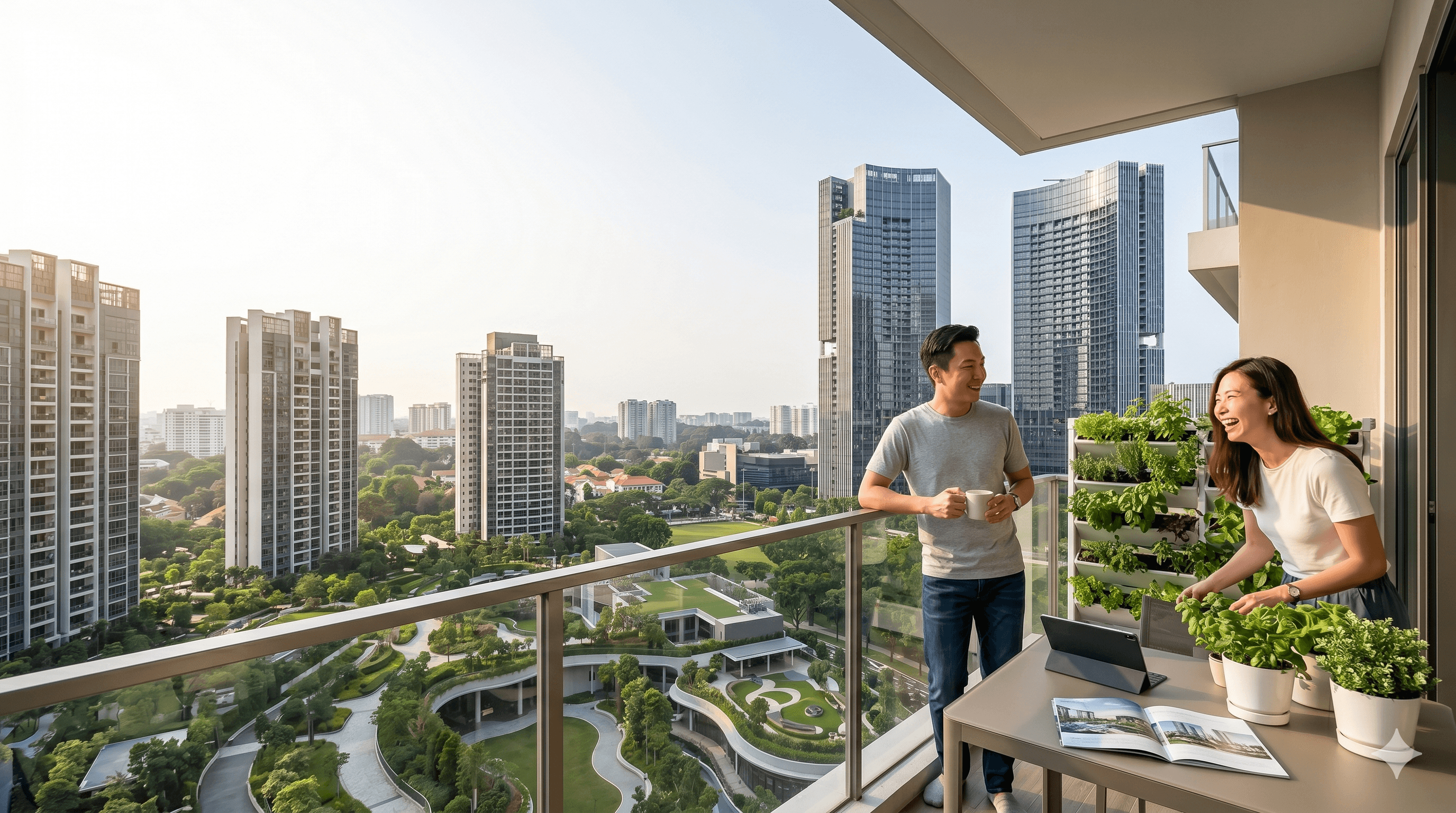
Singles Eligibility to Buy HDB in Singapore: BTO vs Resale Rules Explained
A practical guide to whether you can buy HDB as a single, and which route to assess first.
Yes — a single Singapore Citizen aged 35 or above can buy an HDB flat, alone under the Single Singapore Citizen (SSC) scheme or with up to three other singles under the Joint Singles Scheme (JSS): a new 2-room Flexi flat from HDB, or any resale flat except 3Gen (buying alone, up to 5-room with CPF grants), per HDB. Widowed or orphaned singles can buy resale from 21. For HFE letter applications from 24 August 2026, the income ceiling is $8,000 for a 2-room Flexi (99-year lease) and, for the Singles Grant or an HDB loan, $8,000 alone or $16,000 joint (up from $7,000 and $14,000). A resale Standard or unclassified flat bought without the Singles Grant or EHG has no ceiling.
Yes, a single person can buy HDB in Singapore, but not every single buyer qualifies for every route. The first thing to sort out is not project shortlisting. It is confirming whether you can buy at all, whether you can buy alone, and whether BTO or resale is the realistic path under the current singles framework.
Can a single person buy an HDB flat in Singapore?
Yes. A single Singapore Citizen aged 35 or above can buy an HDB flat — a new 2-room Flexi flat, or a resale flat — and widowed or orphaned singles can buy resale from 21 (per HDB). The route depends on citizenship, age, ownership history, and whether you are targeting BTO or resale.
Yes. A single person can buy an HDB flat in Singapore, but eligibility depends on citizenship, age, ownership history, and whether you are going for BTO or resale. The common mistake is treating this like a flat search before it is an eligibility check.
The practical split is simple:
- Only Singapore Citizens can buy under HDB's singles rules; a single SPR can't buy an HDB flat alone.
- BTO access for singles is tighter than resale.
- You may qualify for one route but not the other.
As a guide, singles buy under their own name from age 35 (as of 2026), either as a single Singapore Citizen or with one to three other eligible singles under the Joint Singles Scheme (2 to 4 singles in total) — verify your exact case on HDB. Widowed singles, and orphans with at least one deceased parent who was a Singapore Citizen or PR, can buy a resale flat from age 21 (HDB). That is why the first question to settle is: "Can you buy, under which scheme, and on your own or with other eligible singles?" Only after that does location, budget, or project choice come into play.
If you need the broader framework beyond singles cases, see the main HDB eligibility rules guide. A useful way to put it: you may be able to buy HDB as a single buyer, but the route depends on whether you fit the singles framework and whether you are looking at a new flat or a resale flat.
What is the difference between singles eligibility for BTO and resale HDB flats?
BTO is usually much more restricted for singles, while resale offers broader flat-type and location choice and is often the more realistic route.
The short answer is: BTO is narrower, while resale is broader and usually more practical for singles.
| Route | What singles usually face | Practical takeaway |
|---|---|---|
| BTO | Access through singles schemes, with much tighter flat-type access. Singles can buy only a new 2-room Flexi flat from HDB (as of 2026). | Best only if you fit the scheme and can wait. |
| Resale | Wider flat-type and location choice, subject to HDB eligibility and unit-level checks. On resale, singles are not limited to 2-room Flexi — almost any flat type is allowed (as of 2026): every flat type except 3Gen, and, buying alone, up to 5-room if you take CPF housing grants (HDB). | Often the more realistic route if you want speed, estate choice, or larger-unit options. |
This is where many single buyers get confused. They hear "singles can buy HDB" and assume that means every BTO launch is open to them. It does not. BTO eligibility for singles is usually scheme-specific and much narrower than the resale market — verify your exact case on HDB.
A practical example: if you are a 36-year-old single who wants to live near parents in a mature estate, resale is often the first route to assess. If instead you are flexible on timing and comfortable with a smaller new flat, then BTO may be worth checking. The route follows the rule set, not your first preference.
Useful external explainers include HDB's official Singles page and MyNiceHome's guide for singles. For a broader overview, see Joint Singles Scheme HDB Eligibility: Can Two Singles Buy HDB Together?.
What basic eligibility checks should you run first as a single HDB buyer?
Check citizenship, age, marital status, private property ownership, buying structure, and HFE readiness first. That order removes most unsuitable paths early.
Run the first check in this order: citizenship, age and marital status, property ownership, buying structure, and HFE readiness. That sequence rules out most dead ends before you waste time on the wrong route.
- Confirm whether you are a Singapore Citizen or SPR.
- Check age and marital status. Unmarried or divorced singles must be at least 35, for new and resale flats (per HDB).
- Note whether you currently own, or have recently owned, any private residential property or interest in one.
- Decide whether you are applying alone or with other singles under a valid scheme.
- Start the HFE process early so eligibility and financing are checked together, not separately.
Income matters too: for HFE letter applications from 24 August 2026, singles face an average gross monthly household income ceiling of $8,000 (up from $7,000) for a new 2-room Flexi flat on a 99-year lease, alone or joint; for the Singles Grant or an HDB loan, $8,000 buying alone (up to a 5-room resale flat) or $16,000 as joint singles (up from $14,000); and $16,000 for a resale Plus flat bought without the Singles Grant. A resale Standard or unclassified flat bought without the Singles Grant or EHG has no income ceiling, and neither does the Proximity Housing Grant, per HDB — verify your exact case on HDB.
A fast way to frame it: before you look at flats, confirm your citizenship, age, whether you own any property, and whether you are buying alone or with another eligible single. Then check HFE so you know which route is real.
For verification, use HDB's Singles page and CPF's guide on what singles should consider before buying. The key point: first ask "Can I buy?" then ask "Can I afford the route safely?" Eligibility and affordability are different checks. For a broader overview, see Singles Grant for HDB Resale Flats in Singapore.
How do singles qualify for BTO under HDB rules?
Singles can access BTO only through the relevant singles schemes, and the route is generally much narrower than resale, including tighter flat-type access.
Singles can qualify for BTO only through the relevant HDB singles framework, and the access is much narrower than resale. The most important practical point is that as a single buyer you should not assume you can apply for any new launch.
The main structures to know are:
- Single Singapore Citizen (SSC) scheme: buying on your own
- Joint Singles Scheme (JSS): buying with up to three other singles, at least two of you Singapore Citizens
Singles can buy only a new 2-room Flexi flat from HDB — the only BTO flat type open to singles across all categories (as of 2026). That is the key restriction many buyers miss. If you want a larger flat or a wider spread of locations, resale may be the more realistic route from day one — verify your exact case on HDB.
Another practical check is the co-buy structure. Under the Joint Singles Scheme, 2 to 4 singles aged 35 or older may buy together: you must be a Singapore Citizen and include at least one other co-applicant who is a Singapore Citizen (per HDB, as of 2026); confirm the current official wording on HDB before you commit to a live application. If you need that route in detail, see our Joint Singles Scheme HDB eligibility guide.
For unmarried or divorced singles, age is the first gate. For a new flat, HDB's singles minimum is 35 even if you are widowed or orphaned; the age-21 route applies to resale flats only. A useful way to think about it: for BTO, the question is not just whether you can apply. It is what you are actually allowed to apply for. For a broader overview, see How to Apply for HDB Loan Eligibility.
What common BTO mistakes do single buyers make?
Most BTO missteps happen when buyers assume all launches are open to singles, miss the age gate, or skip HFE and ownership screening.
The usual mistakes are assuming every BTO launch is open to singles, forgetting the standard age gate, treating a single SPR as if they can buy alone, and browsing projects before checking HFE or ownership history.
A useful way to think about it: for singles, the wrong flat search is usually an eligibility problem first, not a market problem.
A common trap is fixating on one launch or estate. If that launch is not realistically open to you under the singles framework, switch focus early to resale instead of chasing a ballot you cannot use. For a broader overview, see How to Check HDB EIP and SPR Quota Before Buying a Resale Flat.
How do singles qualify to buy a resale HDB flat?
Resale is usually the more practical route for singles, but you still need to clear HDB citizenship, age, ownership, and flat-level checks before proceeding.
Resale is usually the more accessible route for singles, but it is not automatic. As a single buyer you still need to clear HDB's eligibility checks on citizenship, age, and ownership history before moving ahead.
In practical terms:
- A single Singapore Citizen buying alone usually has the clearest resale path.
- You must be a Singapore Citizen: a single SPR can't buy alone.
- Unmarried or divorced: at least 35. Widowed, or an orphan with at least one deceased parent who was a Singapore Citizen or PR: at least 21 for a resale flat (per HDB).
The resale advantage is choice. Compared with BTO, singles generally have access to a much wider range of flat types and locations in the resale market — almost any flat type is allowed on resale (as of 2026) — every type except 3Gen, and, buying alone, up to 5-room if you take CPF housing grants — unlike the 2-room Flexi limit on BTO. That is why many singles who want faster occupation, a mature estate, or a larger flat end up on the resale route — verify your exact case on HDB.
Screen the flat as well as yourself. Once you look broadly eligible, check unit-level restrictions such as EIP and SPR quota, then confirm financing and any private property ownership issues. If you need the flat-level screening workflow, see How to Check HDB EIP and SPR Quota Before Buying a Resale Flat. If you are comparing affordability after eligibility, Singles Grant for HDB Resale Flats is the next useful step.
A useful way to put it: resale gives you more choice, but you still need to pass both buyer-level eligibility and flat-level checks.
Can singles buy a 3-room BTO flat?
No — singles can't buy a 3-room BTO flat: alone or under the Joint Singles Scheme, HDB lets singles buy only a 2-room Flexi as a new flat (as of 2026). A 3-room or bigger flat means buying resale, where singles can buy any flat type except 3Gen, up to 5-room if they buy alone with CPF housing grants.
For new flats, HDB's singles rules name one flat type: the 2-room Flexi, whether you buy alone or with up to three other singles (HDB). So a single can't book a 3-room or 4-room BTO flat, even with other singles under the Joint Singles Scheme. Applying with your parents is a family application with its own rules; see the HDB eligibility rules guide.
Two other rules apply:
- The income ceiling is the 2-room Flexi ceiling: $8,000 a month on a 99-year lease, for HFE letter applications from 24 August 2026 (up from $7,000), per HDB.
- Buying alone, the price includes a singles add-on: a single buying a new flat from HDB on their own pays an additional $15,000, built into the price of the flat.
If you want a bigger flat, the resale market is open: every flat type except 3Gen, and, buying alone, up to 5-room if you're taking CPF housing grants.
How much is the HDB grant for singles?
Up to $115,000 for a first-timer single buying resale; on a new 2-room Flexi, only the Enhanced CPF Housing Grant (Singles), up to $60,000 (as of 2026 — verify on HDB/CPF).
Which grants you can stack depends on whether you buy new or resale (HDB; amounts per CPF and MyNiceHome, verified July 2026):
| Grant | New 2-room Flexi | Resale flat |
|---|---|---|
| Enhanced CPF Housing Grant (Singles) | Up to $60,000 | Up to $60,000 |
| CPF Housing Grant (Singles), the "Singles Grant" | — | $40,000 (2- to 4-room) · $25,000 (5-room, or bigger if buying with parents or other singles) |
| Proximity Housing Grant (Singles) | — | $15,000 living with parents · $10,000 living near |
| Top-up Grant | — | Later, if eligible |
The EHG is income-tiered, with its own lower ceiling, and you must be working when you apply for the HFE letter. If you have already taken a housing subsidy, you can't get CPF housing grants again, though the PHG may still apply. For the full breakdown, see HDB grants for singles: BTO vs resale.
What salary is too high to buy an HDB flat as a single?
Buying alone, above $8,000 a month you can't buy a 2-room Flexi on a 99-year lease from HDB, get the Singles Grant or take an HDB loan ($16,000 for joint singles' grant and loan), for HFE letter applications from 24 August 2026. A resale Standard or unclassified flat bought without the Singles Grant or EHG has no income ceiling, and a resale Plus flat without the grant allows up to $16,000.
HDB raised the singles income ceiling for HFE letter applications made from 24 August 2026 (HDB), and it now works like this:
| If you are single and want to... | Ceiling (HFE applications from 24 Aug 2026) |
|---|---|
| Buy a new 2-room Flexi flat (99-year lease) | $8,000 alone or joint |
| Buy a 2-room resale Prime flat (with or without the Singles Grant) | $8,000 alone or joint |
| Take the Singles Grant on a resale flat | $8,000 alone (up to 5-room) · $16,000 joint |
| Take an HDB housing loan | $8,000 alone (up to a 5-room resale flat) · $16,000 joint |
| Buy a resale Plus flat without the Singles Grant | $16,000 |
| Buy a resale Standard or unclassified flat without the Singles Grant or EHG | No ceiling |
HDB counts the total income of everyone listed in your HFE letter application. "Too high" closes the subsidised routes, and above $16,000 resale Plus flats as well: a higher-earning single can still buy a resale Standard or unclassified flat (unclassified means sold before HDB's October 2024 flat classification), at market price and with a bank loan. The Proximity Housing Grant has no income ceiling, so you can still claim it on that route.
If you applied for an HFE letter before 24 August 2026 and were over the old $7,000 ceiling, or your application is still being processed, you can cancel it and submit a new one to be assessed at $8,000, as long as you haven't yet submitted a flat application (HDB, Annex B). HDB has asked buyers for the November 2026 BTO exercise to apply for an HFE letter and submit their documents by 25 September 2026.
Singles aged 55 and above buying a short-lease 2-room Flexi or a Community Care Apartment follow HDB's rules for seniors, where the ceiling is $16,000. For how the ceilings compare with families', see the HDB income ceiling for BTO.
Who is not eligible for an HDB loan as a single?
As a single you can't take an HDB loan if your income is above $8,000 buying alone (for up to a 5-room resale flat) or $16,000 with joint singles — the ceilings for HFE letter applications from 24 August 2026 — if you own private residential property or sold one less than 30 months before your HFE application, or if you are not working when you apply for the HFE letter (per HDB).
HDB's main conditions for its housing loan, as they apply to singles (HDB; income ceilings per HDB's 23 August 2026 revision, Annex A; the work rule per HDB's income guidelines):
- Income: average gross monthly income of up to $8,000 buying alone (for up to a 5-room resale flat), or $16,000 as joint singles, for HFE letter applications from 24 August 2026 (families: $16,000).
- Private property: you must not own or have an interest in any private residential property, in Singapore or overseas, and must not have disposed of one in the 30 months before your HFE letter application.
- Work: you must be working at the point of the HFE letter application to be considered for an HDB loan.
If any of these rules you out, a bank loan is the alternative — the HFE letter will tell you which loan you qualify for. For the full financing checklist, see HDB loan eligibility.
What should you check before choosing BTO or resale as a single buyer?
Choose between BTO and resale only after checking eligibility, timeline, location needs, and HFE-backed affordability. Route choice should follow facts, not preference.
Start with eligibility, then compare urgency, budget, and location goals. Do not settle on a route just because you prefer it.
A practical decision flow is:
- Confirm that you are eligible as a single applicant, and under which route.
- Check how soon you need housing.
- Decide whether you are flexible on location and flat size.
- Review financing and cash-flow readiness through the HFE process.
- Only then compare whether BTO or resale is the better fit.
In practice, BTO usually suits you if you can wait, accept narrower singles access, and are comfortable with the likely flat-type limits. Resale usually suits you if you want faster occupation, more estate choice, or a larger unit range.
A realistic example: if you need to move within a year and want to stay near your parents, that is usually a resale-first situation. If instead you are flexible on timing and mainly want an entry route into HDB ownership, then BTO may be worth assessing if you fit the singles framework.
If you want a better pre-application workflow, our HDB loan eligibility precheck guide helps you line up the financing side before unit search. A useful summary: BTO is about waiting for an eligible launch. Resale is about finding a suitable unit now.
What documents and details should a single buyer prepare before applying?
Prepare identity, marital-status, income, CPF, ownership, co-applicant, and route-planning details early so eligibility and financing can be screened before flat selection.
- ✓NRIC details and citizenship status
- ✓Marital-status details relevant to your route
- ✓Age and basic personal profile information for singles-scheme screening
- ✓Income documents and employment details for HFE and financing checks
- ✓CPF information relevant to the home purchase plan
- ✓Declarations on current or past private residential property ownership or interest
- ✓Details of any co-applicants if you are applying with other singles
- ✓Preferred route: BTO, resale, or both
- ✓Preferred flat type, location, move-in timing, and budget range
- ✓Supporting records for special-case situations such as widowed or orphaned status, if applicable
What do single buyers usually need to clarify about buying HDB?
You usually need to clarify age, citizenship, whether you can apply alone, whether resale is more realistic than BTO, and why HFE should be done early.
Can a single buy HDB before 35? For unmarried or divorced singles, 35 is the minimum age for both new and resale flats. Widowed singles and orphans (with at least one deceased parent who was a Singapore Citizen or PR) can buy a resale flat from 21, per HDB — confirm your exact personal situation before treating the answer as a firm yes or no.
Can a single SPR buy HDB alone? No. HDB's singles routes require you to be a Singapore Citizen, so a sole SPR is not eligible to buy HDB as a single applicant.
Is resale easier than BTO for singles? Usually yes. Resale generally gives singles broader flat-type and location choice, while BTO access is tighter and usually tied to singles schemes and limited flat-type options.
Should HFE be done first? Yes. Treat HFE as an early filter, not a closing step. It helps test eligibility and financing before you get emotionally attached to the wrong route or unit.
What do single buyers most often misunderstand? Many hear that singles can buy HDB and assume that means any HDB route is open to them. The better way to think about it: eligibility to buy HDB does not mean eligibility for every HDB route.
Methodology and sources
Where every figure comes from — and what we deliberately did not claim.
Verified figures. HDB eligibility figures here come from HDB (and CPF where noted) — as of 2026; these rules change and some HDB pages render dynamically, so confirm your specific case on HDB before you rely on it.
Updated September 2026. The flat types, ages, income ceilings, private-property rules, singles add-on and grant list are from HDB's Singles page (last updated 23 August 2026) and its 23 August 2026 income-ceiling revision with Annexes A and B (the ceilings apply to HFE letter applications from 24 August 2026); the rule that you must be working from HDB's income guidelines (last updated 24 July 2026); the grant amounts from CPF and MyNiceHome, verified July 2026. HDB pages read on 18 September 2026.
What we have not claimed: eligibility for any specific household (check HDB); approval of any application; or a legal ruling — a practical explainer, not advice.
Got a question this raised? Ask PropKaki.
Take any point from this analysis and apply it to your own project, budget or decision.
 PropKaki
For most buyers this year, staying well within budget beats trying to time the market.