

Do You Need to Sell Your HDB or Private Property Before Buying a New EC?
A practical Singapore guide to EC ownership restrictions, disposal timing, and what to verify before you commit to a launch.
For a new EC launch, an HDB owner who has met the flat's MOP may be able to buy first and dispose of the flat later within the required HDB timeline — as of 2026, within 6 months of EC key collection (verify on HDB). A private residential property owner must sell first and then wait 30 months from the legal completion of that sale before applying (HDB). Before any booking or option commitment, confirm ownership, household structure, and financing.
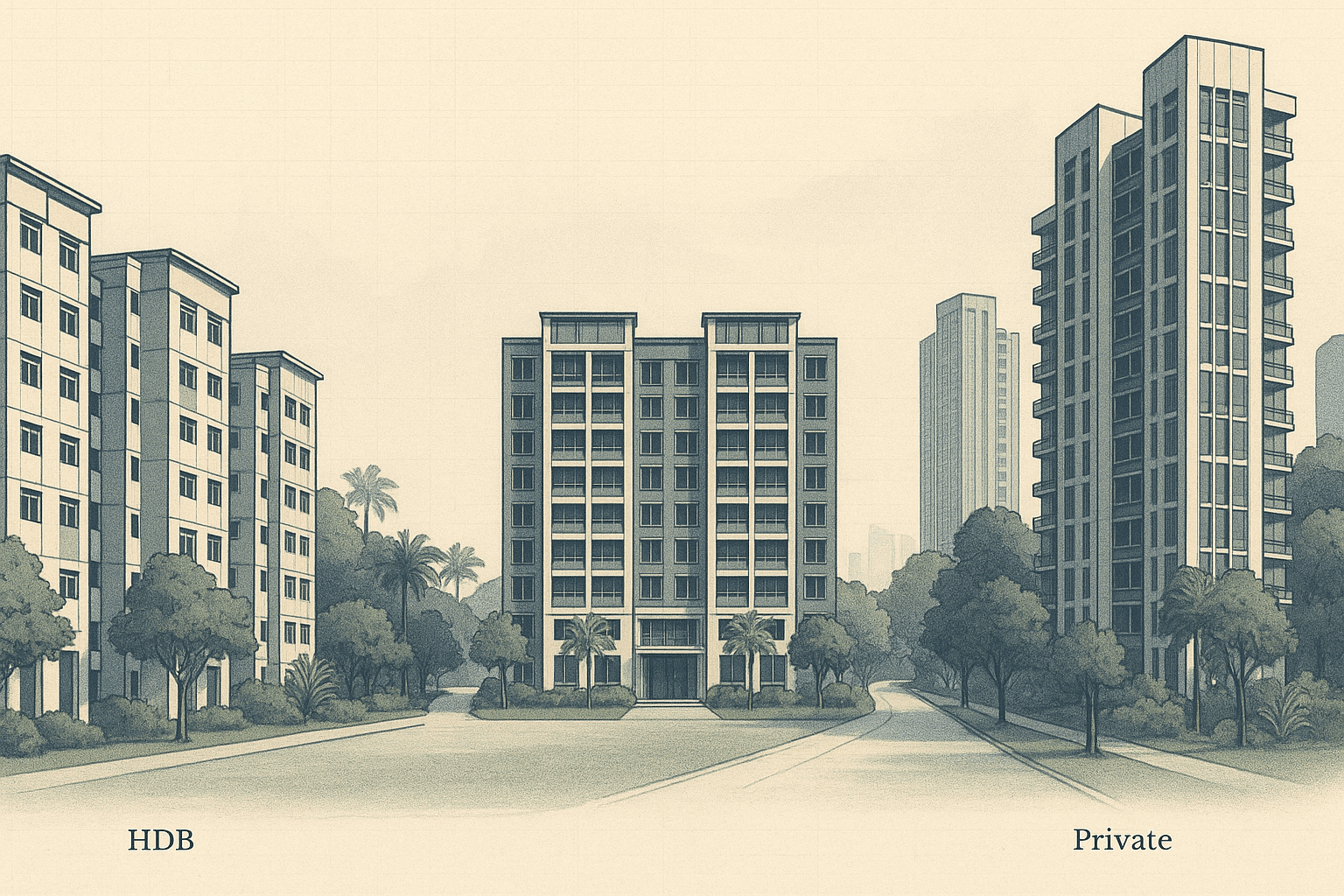
Short answer: an HDB owner who has met the flat's minimum occupation period (MOP) may be able to buy a new EC first and sell the flat later within HDB's required disposal timeline, while a private residential property owner must dispose of the property first and then wait 30 months from the legal completion of that sale before applying. As of 2026, an HDB flat owner buying a new EC must dispose of the existing flat within 6 months of collecting the keys to the EC — verify on HDB. The real work is not memorising a one-line rule. It is confirming ownership, spouse or co-buyer interests, household eligibility, and financing before launch day.
Short answer: Do you need to sell your HDB or private property before buying a new EC?
For a new EC launch, an HDB owner who has met the flat's MOP may be able to buy first and sell later, within 6 months of collecting the EC keys. A private residential property owner must sell first and then wait 30 months from the legal completion of that sale before applying (HDB).
That is the main split to remember.
A new EC is sold by a private developer, but entry is still controlled by HDB-style eligibility rules. So the right question is not just "do you own a property?" It is "are you allowed to still hold that property at the point you apply and through the relevant EC milestone?"
This distinction matters because a new EC is often treated like a private condo launch. It is not. Ownership restrictions, household eligibility and disposal timing all still matter. As of 2026, an HDB flat owner who buys a new EC must dispose of the flat within 6 months of collecting the EC keys — verify on HDB. An owner still within the flat's minimum occupation period (MOP) can't apply at all: HDB bars a flat's core members from applying to buy an EC unit from a developer during the MOP (HDB).
This page is about new EC launches, not resale ECs. If you are comparing both routes, use this as the first filter, then move to EC Eligibility Singapore for the broader rule set.
Who can buy a new EC in Singapore?
Only eligible households can buy a new EC. Property ownership matters, but so do citizenship, family nucleus, age, household income and housing history.
In practice, a new EC sits between public housing and a private condo. It is built and sold by a developer, but the buyer pool is still restricted.
Assess EC cases at the household level, not just the property level. The common checks include citizenship, age, family nucleus, household income, and prior housing or subsidy history. Ownership is only one gate. As of 2026, buying a new EC requires an applicant who is a Singapore Citizen plus at least one other SC or SPR, and the total household income must not exceed $16,000 a month for EC sites whose tender was awarded before 24 August 2026, or $18,000 for new units in ECs whose land tender closed on or after that date (HDB).
Start with HDB's official Executive Condominiums eligibility page. For a plain-English overview before diving into documents, a secondary explainer like EdgeProp's guide to buying an EC can help frame the basics. Then cross-check those points against the launch brochure and developer booking conditions.
For ECs, ownership is only one gate; household structure is the other. For a broader overview, see How a New EC Launch Works: From Application to Booking.
What if you currently own an HDB flat?
An HDB upgrader who has met the flat's MOP may not need to sell before applying for a new EC, but the flat cannot simply be kept indefinitely. As of 2026, the flat must be disposed of within 6 months of EC key collection (verify on HDB), so a workable sale plan is essential. Most second-timers pay a resale levy set by their first subsidised home's type, and a household in which anyone has already taken two housing subsidies can't apply.
This is the classic upgrader case, and it is where the rule often gets oversimplified.
The useful framing is not "you must sell first." It is: "you may be able to buy first, but you still need to sell your HDB within the required timeline later." As of 2026, that timeline is within 6 months of collecting the EC keys — verify on HDB.
One condition comes first: the flat's MOP. HDB doesn't let a flat's core members apply to buy an EC unit from a developer while the flat is still within its MOP (HDB), so the buy-first route opens only once the MOP is met.
That turns the case into an execution problem, not just an eligibility problem. Before booking a unit, check:
- whether HDB sale proceeds are needed to fund the EC
- whether any overlap in monthly commitments can be managed
- whether temporary housing may be needed if the HDB sale and EC key collection do not line up neatly
Example: a family of four may be technically comfortable with the EC price, but if the HDB has to be sold quickly to free up cash or reduce liabilities, the real risk is not eligibility. It is being forced into a rushed sale later.
Practical takeaway: for an HDB upgrader, do not stop at "allowed." Also test whether the timeline is actually workable. For launch sequencing, see How a New EC Launch Works. For a broader overview, see EC Application Requirements: Documents and Checks to Prepare Early.
What if you currently own a private residential property?
If you still own private residential property, you can't yet apply for a new EC. That property must be disposed of first, and then 30 months must pass from the legal completion of the sale before you apply (HDB).
This is where many buyers get caught out.
The safe position is simple: do not assume a private-property owner can secure a queue number first and sell later. Treat the case as ineligible until the ownership position is fully cleared and the current HDB rule is checked.
Do not check only the obvious condo title. Look at:
- local and overseas residential property
- sole and joint ownership
- spouse or co-applicant interests
- recent property disposals and their completion dates
Example: "The condo is under my spouse's name only, so I should still be fine" is exactly the kind of assumption that should be tested before any EC booking discussion continues.
Use HDB's official EC eligibility guidance as the primary reference. For a broad explainer first, PropertyGuru's EC buying guide is a useful secondary read, but official wording should drive the decision. For a broader overview, see EC Income Ceiling Singapore: How Household Income Is Assessed.
When does the existing property have to be sold or disposed of?
The timing is different for HDB owners and private-property owners. HDB owners past the flat's MOP sell after buying, within 6 months of EC key collection; private-property owners must complete the sale 30 months before applying.
Think about the EC journey in stages: application, booking, completion, key collection or possession, and then any required disposal milestone. That is the timeline to work with.
| Current owner type | Usual sequence for a new EC | What to verify before launch |
|---|---|---|
| HDB owner | Once the flat's MOP is met, may be able to apply and book first, then dispose of the HDB within HDB's required timeline — as of 2026, within 6 months of EC key collection (verify on HDB) | Whether the HDB sale plan is realistic, whether sale proceeds are needed for the EC, and whether interim housing may be required |
| Private-property owner | Must fully dispose of the private residential property first, then wait 30 months before applying: no one in the application may have disposed of private residential property in the 30 months before the EC application, counted from the legal completion of the sale | Disposal completion date, proof that ownership has been fully removed, and whether any spouse or co-applicant still has another residential interest |
Two common scenarios:
- An HDB upgrader gets a queue number quickly and assumes the rest can be sorted out later. That may still work, but only if the sale and financing plan are already thought through.
- A private condo owner wants to "lock in" the EC first and sell only if selected. That doesn't work: HDB requires the sale, and the 30-month wait, before the application.
Practical takeaway: verify eligibility before committing to the launch, not after the booking fee is paid. For a broader overview, see New EC Citizenship Rules: Can PRs or Foreign Spouses Buy?.
Can you buy first and sell later?
Yes for HDB upgraders past their flat's MOP, within HDB's 6-month disposal deadline; no for private-property owners, who must sell first. Even where allowed, the bigger question is whether the household can carry the overlap.
The right way to frame this is as an overlap test, not a shortcut.
For an HDB upgrader past the flat's MOP, buying first and selling later can be sensible if the household has enough cash flow, does not need immediate sale proceeds, and has a realistic disposal plan. For private-property owners, this sequence isn't available: HDB requires the private property to be sold, and 30 months to pass from the sale's legal completion, before the EC application.
The main risks are practical:
- cash flow strain if the current home has not sold when the EC payment timeline starts
- weaker loan positioning if the household is trying to carry two homes at once
- pressure to cut price later because the existing property must be sold quickly
Example: "sort out financing later" only works if the current home is sold at a strong price within a short period. That is not a comfortable overlap plan. It is a dependency.
If the move only works after a perfect sale, the risk sits in the sale, not in the EC.
What should you verify before committing to an EC launch?
Use a pre-commitment checklist so eligibility, ownership and financing are tested before any booking or option decision is made.
- ✓Confirm whether it is a new EC launch or a resale EC, because the rules are not the same
- ✓Map the full ownership picture: HDB, private residential property, local and overseas holdings
- ✓Check whose names are involved: sole owner, joint owner, spouse, co-applicant, occupier or intended occupier
- ✓Check whether any residential property was recently sold and note the completion date, not just the sale agreement date
- ✓Confirm whether any private residential interest still exists, even one that seems minor or indirect
- ✓Check household eligibility items early: family nucleus, citizenship, age, household income and relevant housing history
- ✓Review the launch brochure, e-application declarations and developer booking conditions before collecting any booking fee
- ✓Test the financing plan for overlap risk, especially if the current home must be sold to support the EC purchase
- ✓If any ownership fact is unclear, pause the booking until the position is properly documented
Why EC eligibility is more than just an ownership question
It is easy to reduce the issue to "sell first or later," but EC eligibility can still fail even when the disposal timing looks fine.
Common blind spots include family nucleus, citizenship, household income, prior subsidised housing history and spouse or co-applicant ownership issues.
If the ownership piece is right but the household structure is wrong, the application can still fail.
That is why ownership should be treated as the first screen, not the only screen. For the broader framework, see EC Eligibility Singapore, EC Income Ceiling Singapore and New EC Citizenship Rules.
How can the rule be explained in plain language?
Give the split first, then explain the next check. Do not start with policy jargon.
A ready-to-use version is:
"If you own an HDB flat and have met its MOP, you may still be able to buy a new EC and sell your flat within 6 months of getting the EC keys. If you own private residential property, you need to sell it and wait 30 months from the sale's completion before you can apply for a new EC. After that, the rest of your household eligibility and financing still need checking."
Why this works:
- it separates the HDB upgrader case from the private-property case immediately
- it avoids overpromising approval
- it points to the next practical step, which is verification
A useful follow-up line is: HDB upgrader logic is mostly about timing; private-property-owner logic is about clearance first.
If the real goal is to keep a current private home while buying another property, that is usually a sign the new EC route may not fit. In that case, it may help to compare EC vs Private Condo.
Not sure you qualify for a new EC? What to do before paying any booking fee
Do not pay first and verify later. Confirm the ownership facts, then match them against current HDB rules and the developer's launch requirements before any money is committed.
Start with HDB's official EC eligibility page, then check HDB's conditions after buying an EC so what happens after purchase is clear too.
Next, compare those rules against the developer's launch brochure, e-application declarations and booking conditions. If the case involves a spouse with property ownership, overseas residential property, or a recent property disposal, get the documents and note the actual dates before proceeding.
Watch for the resale levy where a household member is a second-timer who has taken a prior housing subsidy. A new EC from a developer counts as a second subsidised home, so the levy applies, fixed by the type of the first subsidised home where it was sold on or after 3 March 2006: for a family, $15,000 for a 2-room flat, $30,000 for a 3-room, $40,000 for a 4-room, $45,000 for a 5-room, $50,000 for an Executive flat and $55,000 for an EC; singles pay half, so $27,500 after an EC (HDB). The EC figure applies where that earlier EC was bought with a CPF Housing Grant, or came from a project whose tender closed on or after 9 December 2013 (HDB); a first flat sold before 3 March 2006 attracts a percentage-based levy instead. The levy is fixed when you book the EC and paid in cash or from your flat's sale proceeds, not with a housing loan.
Finally, separate eligibility from affordability. A household may be eligible on paper but still unable to manage the overlap or pass financing comfortably. Use EC Application Requirements as a prep checklist, and for a secondary explainer, PropertyGuru's EC buying guide or EdgeProp's EC guide can help fill in the process context.
Safest workflow: verify ownership first, financing second, launch commitment last.
Methodology and sources
Where every figure comes from — and what we deliberately did not claim.
Verified figures. EC figures here come from HDB (and CPF where noted) — as of 2026; EC rules and the MOP change with policy, so confirm your specific case on HDB before you rely on it.
Updated September 2026. The EC income ceilings, the 30-month private-property rule, the 6-month HDB disposal rule and the two-subsidy bar are from HDB's EC eligibility page (updated 25 Aug 2026) and Conditions After Buying an EC page, read on 18 September 2026. The MOP bar on applying for an EC and the resale levy amounts are from HDB's Conditions After Buying a New Flat (updated 18 Aug 2026) and Conditions After Buying a Resale Flat (28 Jul 2026) pages, read on 19 September 2026.
What we have not claimed: eligibility, price, or outcome for any specific EC or household (check HDB / the developer); or a legal ruling — a practical explainer, not advice.
Got a question this raised? Ask PropKaki.
Take any point from this analysis and apply it to your own project, budget or decision.
 PropKaki
For most buyers this year, staying well within budget beats trying to time the market.