
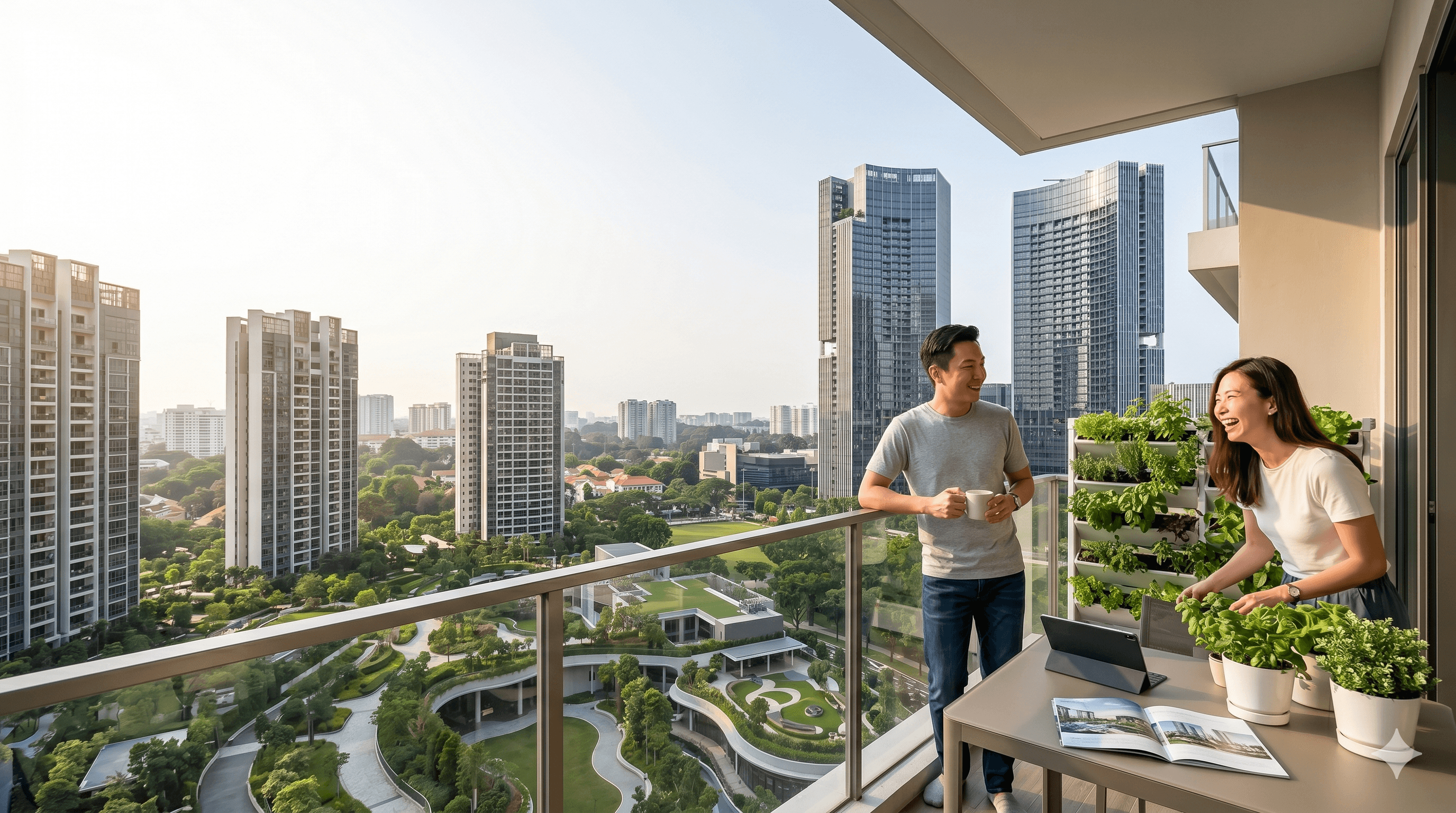
How Much Are Condo Maintenance Fees in Singapore Per Month? What Buyers Should Budget For
There is no official national average. Use the actual MCST fee, estate features, and reserve clues to budget more realistically.
There is no official Singapore-wide average for condo maintenance fees. As a practical rule of thumb, industry guides commonly place many mainstream private condos around S$300 to S$700 per month, but the actual MCST fee can sit outside that range depending on the project’s size, facilities, staffing, age, and reserve needs.
There is no official Singapore-wide condo maintenance fee average. For budgeting, industry guides commonly place many mainstream private condos around S$300 to S$700 a month, but that is only a rough guide, not a market rule. The safer approach is to check the actual project’s MCST fee, what it covers, and whether the development’s facilities, age, staffing, or reserve needs could make ownership cost heavier over time.
What are condo maintenance fees in Singapore?
Condo maintenance fees are monthly MCST contributions for shared upkeep, estate management, and reserve needs. They are a recurring ownership cost, separate from the mortgage and property tax.
Condo maintenance fees are MCST contributions used to run and maintain the shared parts of a condominium. In plain terms, this is the estate’s recurring operating cost, not an optional facilities pass.
These payments typically support cleaning, security, landscaping, lift servicing, common-area utilities, estate management, and longer-term reserve needs for future repairs and replacement works. For budgeting, the important point is that this sits on top of the mortgage, property tax, and other ownership costs.
A common misunderstanding is to think the fee is mainly for pool and gym access. Even a condo with modest facilities still has common property to manage, maintain, insure, and repair over time. For a deeper breakdown, see What Are MCST Fees in Singapore and What Do They Cover?. For a broader overview, see Singapore Property Tax and Ownership Costs: A Practical Guide.
How much are condo maintenance fees per month on average?
There is no official national average. For budgeting, industry guides commonly place many mainstream private condos around S$300 to S$700 a month, but the actual MCST fee must be checked project by project.
There is no official Singapore-wide average published by the main government property agencies, so it is best to avoid treating any single number as a formal benchmark. For practical budgeting, industry guides commonly place many mainstream private condos around S$300 to S$700 per month, with some projects and larger units going above that range.
| Budgeting view | What it usually means |
|---|---|
| Mainstream private condo | Industry guides commonly cite about S$300 to S$700 per month as a rough budgeting range |
| Boutique, larger-unit, older, or facility-heavy condo | Fees can run above that range because the estate is simply more expensive to operate |
Use that range only as a starting point. The real number should be verified from the project’s current MCST information, seller documents, or latest available management records before you commit.
For plain-English references, see Ohmyhome’s guide to condo maintenance fees and StackedHomes’ condo maintenance fee overview. For a broader overview, see What Are MCST Fees in Singapore and What Do They Cover?.
What drives condo maintenance fees up or down?
Fees are driven mainly by operating cost: facilities, staffing, building complexity, age, utilities, and reserve needs usually matter more than the condo’s marketing label.
Maintenance fees move with the estate’s operating burden, not just with its branding. More facilities, more staff, and more complex systems usually mean a higher monthly bill.
| Cost driver | Why it affects fees | What to check |
|---|---|---|
| Facilities | Pools, gyms, clubhouses, function rooms, and other amenities cost money to clean, service, and repair | Count the facilities and ask whether the estate is facility-heavy for its size |
| Staffing and security | 24/7 guards, concierge-style service, cleaners, and estate staff increase recurring payroll and contract cost | Check whether the condo runs lean staffing or a premium service model |
| Building complexity | Multiple towers, basements, long driveways, lifts, pumps, and mechanical systems add maintenance load | Look at how much common infrastructure the estate actually has |
| Age and condition | Older lifts, waterproofing, façade elements, and common systems often need more attention | Ask about recent repairs and any major components nearing replacement |
| Common-area utilities | Lighting, water features, pumps, and shared services add ongoing utility cost | Watch for designs that are attractive but expensive to run |
| Reserve needs | A development with bigger future repair needs may need stronger ongoing funding | Review budget notes, reserve mentions, and AGM or EGM discussions where available |
Example: a condo with a pool, gym, several lifts, 24/7 security, and heavy landscaping will usually cost more to run than a simple low-facility project, even if both are in the same district.
Maintenance fees follow operating load, not brochure status. For a public-facing explanation of service charges and sinking fund mechanics, see PropertyGuru’s guide. For a broader overview, see Sinking Fund vs Maintenance Fund in a Condo: What’s the Difference?.
Why do smaller condos often have higher fees per unit?
Smaller developments often cost more per unit because many shared costs do not shrink in proportion to unit count.
Smaller condos often have higher fees per unit because many estate costs are fixed or semi-fixed. A boutique development still needs baseline management, cleaning, security arrangements, lift servicing, landscaping, and routine repairs even if it has far fewer owners sharing the bill.
A simple way to see it: a 40-unit project and a 400-unit project may both need a managing agent, common-area cleaning, security coverage, and maintenance contracts. The smaller project spreads those costs across a much smaller owner base, so the per-unit contribution can look surprisingly high.
This is why "small condo" should not be treated as shorthand for "cheap to maintain". If you are price-sensitive, the better question is whether a lower purchase price is being offset by a heavier monthly MCST bill. For a broader overview, see Property Tax for HDB Flats, Condos and Landed Homes in Singapore.
Do luxury condos always have higher maintenance fees?
No. Luxury condos often cost more to maintain, but the real driver is the estate’s actual cost structure, not the label.
No. Luxury projects often do have higher fees because they tend to offer more facilities, more staff, and higher service standards, but branding alone is not the real test.
A large luxury development with many owners sharing the bill may sometimes look more reasonable per unit than a smaller non-luxury project with complex systems or limited unit count. The useful question is not "Is it luxury?" but "What does this estate cost to run, and how many owners are paying for it?"
| Common assumption | Better way to explain it |
|---|---|
| "Luxury means expensive fees" | Often true, but usually because premium features and service levels cost more to operate |
| "Non-luxury means cheap fees" | Not necessarily; boutique projects and complex buildings can still be costly to maintain |
| "The brochure tells me enough" | Check actual facilities, staffing, unit count, and reserve signals instead |
Luxury branding is a clue, not a conclusion.
How do older condos compare with newer condos on maintenance costs?
Older condos may face more repair pressure, while newer condos can look cheaper early on but still see fees rise as the estate ages.
Older condos often carry more upkeep risk because aging systems and bigger repair cycles can add cost pressure over time. Newer condos may start with lower visible maintenance pressure, but that does not mean the fees will stay low indefinitely.
For older projects, the practical watchpoints are lifts, façade-related works, waterproofing, pumps, landscaping wear, and whether major common systems are approaching replacement. For newer projects, ask whether the current fee looks sustainable once the development matures and more long-term maintenance needs start to build.
A useful way to see it: the current fee tells you what owners are paying now, but the building’s age helps you judge where future pressure may come from. If you plan to hold the property for years, the likely fee trajectory matters as much as the starting number.
What should buyers check before buying a condo to estimate future fees?
Check the current fee, what it covers, recent changes, reserve signals, planned works, and any special levy history before you describe a condo as affordable to maintain.
- ✓Confirm the current monthly MCST fee for the exact unit, not just a generic project estimate
- ✓Ask what the fee covers and whether any items are billed separately
- ✓Check whether the fee has changed recently and why
- ✓Review any MCST budget summary, management note, or sale document that shows current cost pressures
- ✓Ask for AGM or EGM minutes that mention fee revisions, large contracts, repairs, or planned works
- ✓Look for signs of reserve or sinking fund pressure where documents are available
- ✓Check for planned major works such as lift replacement, waterproofing, façade repairs, pump upgrades, or landscaping overhauls
- ✓Ask whether there is any history of special levies or unusual one-off owner contributions
- ✓Compare the seller’s marketing description with the latest available management information
- ✓Treat missing documents as a due-diligence gap rather than assuming the condo is cheap to maintain
How do condo maintenance fees affect monthly affordability?
Maintenance fees are part of the real monthly cost of owning a condo. A cheaper unit upfront can still be costlier to carry each month if the MCST fee is high.
Maintenance fees should be treated as part of the buyer’s true monthly carrying cost. A unit with a slightly lower purchase price can still feel more expensive month to month if its MCST fee is meaningfully higher.
A practical comparison method is:
- Estimate the monthly mortgage repayment.
- Add the condo maintenance fee.
- Add property tax and other recurring ownership costs.
- Compare the full monthly cost, not just the asking price or psf.
This framing is especially useful when choosing between a cheaper boutique condo with a heavier fee and a more standard project with lower recurring cost. The better question is not "Which one is cheaper to buy?" but "Which one is easier to carry every month?"
For the broader ownership-cost view, see the Singapore Property Tax and Ownership Costs guide.
Can condo maintenance fees go up after you buy?
Yes. Condo maintenance fees can increase after purchase if the estate’s costs rise or more funding is needed for future works.
Yes. MCST fees can rise after purchase if operating costs increase, reserve funding needs change, or the development faces major repair and replacement works. Do not assume the current quoted fee will stay unchanged for as long as you own the unit.
The practical move is to check recent budgets, AGM or EGM minutes, and any signs of upcoming major works before treating a condo as "cheap to maintain". A project with a reasonable current fee but weak reserves or visible repair pressure can become a budgeting issue later.
For more context, pair PropKaki’s guide on sinking fund vs maintenance fund with this broader Redbrick explanation of condominium maintenance fees.
Official sources
Go straight to the authorities for the current rules and figures.
Methodology and sources
Where every figure comes from — and what we deliberately did not claim.
Verified figures. Property-tax figures on this page come from IRAS — as of 2026; confirm the current bands/rules on IRAS before you rely on them. There is no official government-set rate for condo maintenance or sinking-fund contributions, so the S$300–S$700 monthly range cited here is drawn from published industry guides as a rough budgeting reference, not an official figure — verify the actual MCST fee for the specific development.
What we have not claimed: the exact tax or fee for any specific property (check IRAS / your MCST); a market rate for maintenance/sinking-fund contributions (these vary by development); or a legal ruling — a practical explainer, not legal advice.
Got a question this raised? Ask PropKaki.
Take any point from this analysis and apply it to your own project, budget or decision.
 PropKaki
For most buyers this year, staying well within budget beats trying to time the market.